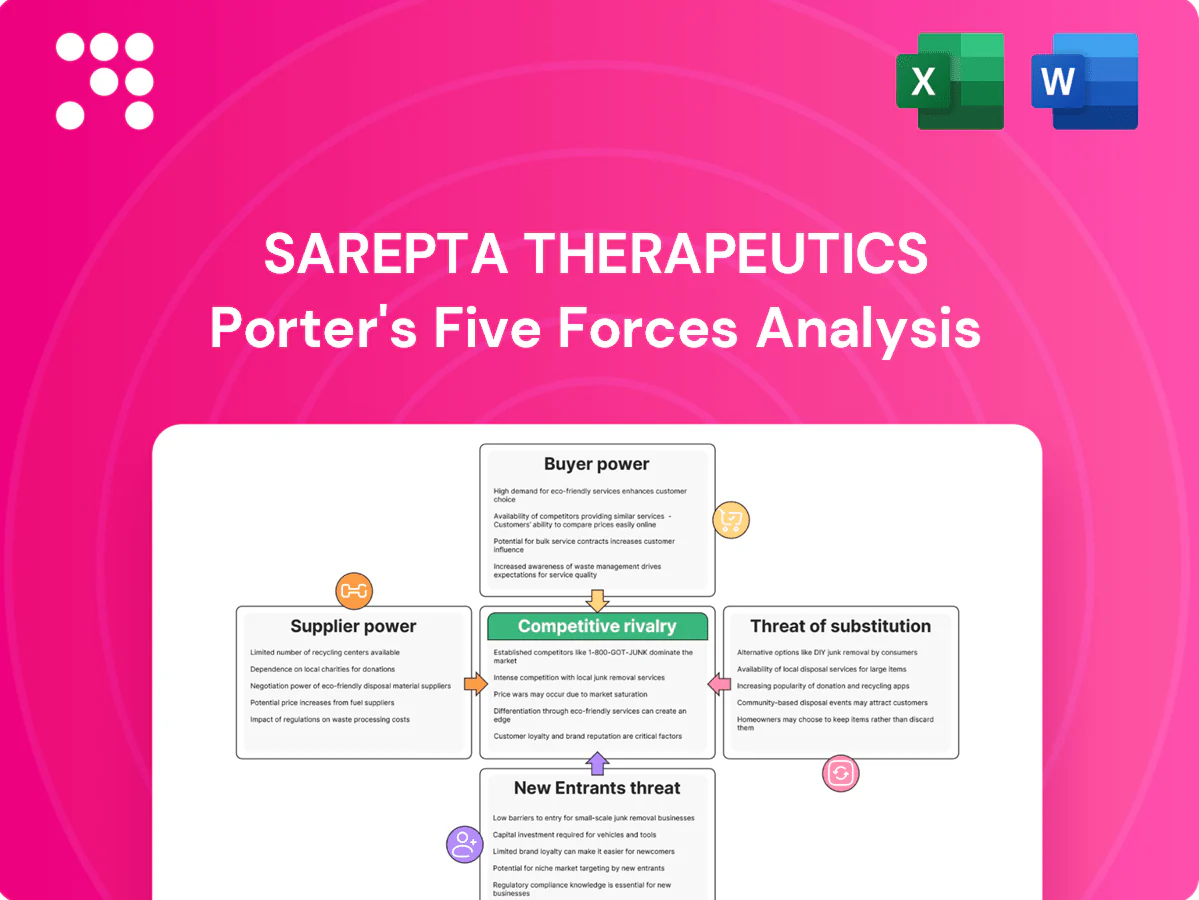
Sarepta Therapeutics Porter's Five Forces Analysis

Don't Miss the Bigger Picture
Sarepta Therapeutics faces intense supplier and buyer dynamics due to specialized raw materials and concentrated payer negotiations, while high R&D barriers and regulatory hurdles limit new entrants but raise substitute and rivalry pressures as competitors pursue gene therapies. This snapshot highlights strategic risks around pricing, IP protection, and pipeline dependency. This brief snapshot only scratches the surface. Unlock the full Porter's Five Forces Analysis to explore Sarepta Therapeutics’s competitive dynamics, market pressures, and strategic advantages in detail.
Suppliers Bargaining Power

Concentrated AAV and plasmid suppliers
Few qualified vendors produce GMP‑grade AAV vectors, plasmids and critical reagents; 2024 industry reports cite under a dozen global CMOs for AAV with multi‑month to >12‑month lead times, giving suppliers leverage on price, lead times and allocation. Quality failures or capacity shortfalls can disrupt Sarepta’s production schedules, and dual‑sourcing is constrained by comparability and heavy regulatory burdens.
Dependence on specialized CDMOs/CMOs
Sarepta depends on niche bioprocess and fill-finish CDMOs/CMOs with constrained capacity, leaving scheduling and pricing sensitive to provider priorities. CMOs often favor larger or longer-term clients, affecting slot availability and commercial terms for Sarepta. Complex tech transfer and proprietary process know-how create high switching frictions, and multi-year contract cycles further entrench supplier leverage across Sarepta programs.

High switching costs and validation
Any change of supplier for Sarepta’s gene-therapy and peptide manufacturing typically triggers extensive requalification, stability work and FDA/EMA comparability or clinical-bridging requirements, which industry guidance indicates can add 6–24 months and multi-million-dollar studies. These time and cost hurdles elevate switching costs, invite regulatory scrutiny that magnifies deviation risk, and enable suppliers to negotiate more favorable commercial and quality terms.

IP, tools, and academic licensors
Access to proprietary capsids, promoters, delivery systems, and research tools for Sarepta often depends on academic and commercial licensors, increasing negotiation complexity for DMD and neuromuscular freedom-to-operate; royalty stacks and field-of-use limits can compress margins, with licensors frequently securing double-digit royalty or milestone structures.
Cold chain and single-use consumables
Specialized resins, filters and single-use assemblies for Sarepta's gene therapies carry long lead times (commonly months), creating dependency on a small supplier base; ultra-cold chain and specialized shippers are capacity-constrained during demand spikes (e.g., vaccine-era stresses), so logistics failures risk product loss and batch write-offs. Suppliers can therefore exert pricing and allocation power, raising COGS volatility and supply risk.
Supplier power: 8–12 GMP AAV CMOs; lead times >12m, royalties double-digit
Supplier power is high: 2024 industry reports list ~8–12 global GMP AAV CMOs with multi‑month to >12‑month lead times, creating pricing and allocation leverage; switching triggers 6–24 months of requalification and multi‑million‑dollar comparability work, while licensors commonly demand double‑digit royalties.
| Metric | 2024 Value |
|---|---|
| Global GMP AAV CMOs | 8–12 |
| Lead times | Months to >12 months |
| Supplier switching time | 6–24 months |
| Licensor royalties | Double‑digit % |
What is included in the product
 Detailed Word Document
Tailored Porter's Five Forces analysis for Sarepta Therapeutics uncovering competitive intensity, buyer/supplier power, threat of new entrants and substitutes, and disruptive forces shaping pricing, profitability and market entry risks—delivered in fully editable Word format for investor reports, strategy decks, or academic use.

 Customizable Excel Spreadsheet
Clear, one-sheet Porter's Five Forces for Sarepta—instantly spot competitive pressures and relief points, customize force levels with new data, and drop a ready-to-use spider chart into decks for fast strategic decisions.
Customers Bargaining Power

Payer dominance in rare disease pricing
Insurers and national payers strongly gate access to high-cost genetic medicines, demanding durability, functional benefit and cost-effectiveness evidence; outcomes-based rebates and prior authorizations are common. Landmark gene therapies like Zolgensma carry list prices of $2.125m, pressuring payers to negotiate. DMD prevalence (~1 in 3,500–5,000 male births) means few patients but concentrated buyer power.
High price sensitivity per patient
Each treated DMD patient can cost payers millions—Sarepta’s one‑time gene therapy list price is about $3.2M—so even tens of patients create large budget impact given an estimated US DMD population of ~15,000. Low volumes already prompt intensive utilization management and prior authorization. Budget holders negotiate steep discounts or staged/outcomes‑based payments tied to real‑world effectiveness and label scope.

Physician and center-of-excellence gatekeepers
Specialist neuromuscular clinics and centers of excellence act as gatekeepers for Sarepta therapies, driving selection and adherence to clinical guidelines; with Duchenne prevalence about 1 in 5,000 male births, concentrated clinic networks shape where patients seek treatment. Their preferences, capacity, and risk tolerance materially affect demand elasticity and uptake. Education, real-world data and outcomes support are critical to win formulary pull-through.

International HTA and reference pricing
Ex‑US HTA bodies apply cost‑effectiveness thresholds (NICE ~£20,000–30,000/QALY in 2024) and managed‑entry agreements, while cross‑border reference pricing across ~20 EU markets can cascade price pressure. HTA delays often extend time‑to‑reimbursement to 12–24 months, slowing adoption of Sarepta therapies. Robust health‑economic dossiers materially affect net prices via rebates often reported at 20–60% for high‑cost orphan drugs in 2024.
- HTA thresholds: NICE ~£20k–30k/QALY (2024)
- Reference pricing: ~20 EU countries influence prices
- Reimbursement delays: 12–24 months median (2024)
- Net price impact: rebates/discounts 20%–60% for costly orphan drugs (2024)
Patient advocacy and caregiver influence
Rare disease communities mobilize for access but rigorously scrutinize benefit-risk; Sarepta had three FDA approvals for DMD therapies by 2024, increasing advocacy visibility and payer focus. Advocacy groups can accelerate coverage decisions or highlight unmet needs, while pressing for transparent data on durability and safety. Their coordinated voice has swayed payer policies and prescriber behavior in recent DMD coverage debates.
- Advocacy reach: amplifies access pressure
- Data demand: pushes for durability/safety transparency
- Payer influence: can accelerate or block coverage
Insurers demand deep discounts on $3.2M gene therapy
Payers and insurers exert strong bargaining power via prior authorization, outcomes‑based contracts and formulary gates. High list prices (~$3.2M one‑time for gene therapy) vs ~15,000 US DMD patients create large budget impact. HTA pressure (NICE £20–30k/QALY) and 20–60% rebates (2024) force steep discounts; advocacy groups influence coverage.
| Metric | Value |
|---|---|
| List price | $3.2M |
| US DMD pop | ~15,000 |
| NICE (2024) | £20–30k/QALY |
| Rebates (2024) | 20–60% |
Full Version Awaits
Sarepta Therapeutics Porter's Five Forces Analysis
This preview shows the exact Sarepta Therapeutics Porter’s Five Forces analysis you’ll receive upon purchase—no surprises, no placeholders. The document is the full, professionally formatted analysis ready for immediate download and use. It covers industry rivalry, supplier and buyer power, and threats of entry and substitutes with actionable insights. You’re getting this exact file instantly after payment.

Original: $10.00
-65%$10.00
$3.50Product Information
Product Information
Shipping & Returns
Shipping & Returns
Description
Don't Miss the Bigger Picture
Sarepta Therapeutics faces intense supplier and buyer dynamics due to specialized raw materials and concentrated payer negotiations, while high R&D barriers and regulatory hurdles limit new entrants but raise substitute and rivalry pressures as competitors pursue gene therapies. This snapshot highlights strategic risks around pricing, IP protection, and pipeline dependency. This brief snapshot only scratches the surface. Unlock the full Porter's Five Forces Analysis to explore Sarepta Therapeutics’s competitive dynamics, market pressures, and strategic advantages in detail.
Suppliers Bargaining Power
Concentrated AAV and plasmid suppliers
Few qualified vendors produce GMP‑grade AAV vectors, plasmids and critical reagents; 2024 industry reports cite under a dozen global CMOs for AAV with multi‑month to >12‑month lead times, giving suppliers leverage on price, lead times and allocation. Quality failures or capacity shortfalls can disrupt Sarepta’s production schedules, and dual‑sourcing is constrained by comparability and heavy regulatory burdens.
Dependence on specialized CDMOs/CMOs
Sarepta depends on niche bioprocess and fill-finish CDMOs/CMOs with constrained capacity, leaving scheduling and pricing sensitive to provider priorities. CMOs often favor larger or longer-term clients, affecting slot availability and commercial terms for Sarepta. Complex tech transfer and proprietary process know-how create high switching frictions, and multi-year contract cycles further entrench supplier leverage across Sarepta programs.
High switching costs and validation
Any change of supplier for Sarepta’s gene-therapy and peptide manufacturing typically triggers extensive requalification, stability work and FDA/EMA comparability or clinical-bridging requirements, which industry guidance indicates can add 6–24 months and multi-million-dollar studies. These time and cost hurdles elevate switching costs, invite regulatory scrutiny that magnifies deviation risk, and enable suppliers to negotiate more favorable commercial and quality terms.
IP, tools, and academic licensors
Access to proprietary capsids, promoters, delivery systems, and research tools for Sarepta often depends on academic and commercial licensors, increasing negotiation complexity for DMD and neuromuscular freedom-to-operate; royalty stacks and field-of-use limits can compress margins, with licensors frequently securing double-digit royalty or milestone structures.
Cold chain and single-use consumables
Specialized resins, filters and single-use assemblies for Sarepta's gene therapies carry long lead times (commonly months), creating dependency on a small supplier base; ultra-cold chain and specialized shippers are capacity-constrained during demand spikes (e.g., vaccine-era stresses), so logistics failures risk product loss and batch write-offs. Suppliers can therefore exert pricing and allocation power, raising COGS volatility and supply risk.
Supplier power: 8–12 GMP AAV CMOs; lead times >12m, royalties double-digit
Supplier power is high: 2024 industry reports list ~8–12 global GMP AAV CMOs with multi‑month to >12‑month lead times, creating pricing and allocation leverage; switching triggers 6–24 months of requalification and multi‑million‑dollar comparability work, while licensors commonly demand double‑digit royalties.
| Metric | 2024 Value |
|---|---|
| Global GMP AAV CMOs | 8–12 |
| Lead times | Months to >12 months |
| Supplier switching time | 6–24 months |
| Licensor royalties | Double‑digit % |
What is included in the product
Detailed Word Document
Tailored Porter's Five Forces analysis for Sarepta Therapeutics uncovering competitive intensity, buyer/supplier power, threat of new entrants and substitutes, and disruptive forces shaping pricing, profitability and market entry risks—delivered in fully editable Word format for investor reports, strategy decks, or academic use.
Customizable Excel Spreadsheet
Clear, one-sheet Porter's Five Forces for Sarepta—instantly spot competitive pressures and relief points, customize force levels with new data, and drop a ready-to-use spider chart into decks for fast strategic decisions.
Customers Bargaining Power
Payer dominance in rare disease pricing
Insurers and national payers strongly gate access to high-cost genetic medicines, demanding durability, functional benefit and cost-effectiveness evidence; outcomes-based rebates and prior authorizations are common. Landmark gene therapies like Zolgensma carry list prices of $2.125m, pressuring payers to negotiate. DMD prevalence (~1 in 3,500–5,000 male births) means few patients but concentrated buyer power.
High price sensitivity per patient
Each treated DMD patient can cost payers millions—Sarepta’s one‑time gene therapy list price is about $3.2M—so even tens of patients create large budget impact given an estimated US DMD population of ~15,000. Low volumes already prompt intensive utilization management and prior authorization. Budget holders negotiate steep discounts or staged/outcomes‑based payments tied to real‑world effectiveness and label scope.
Physician and center-of-excellence gatekeepers
Specialist neuromuscular clinics and centers of excellence act as gatekeepers for Sarepta therapies, driving selection and adherence to clinical guidelines; with Duchenne prevalence about 1 in 5,000 male births, concentrated clinic networks shape where patients seek treatment. Their preferences, capacity, and risk tolerance materially affect demand elasticity and uptake. Education, real-world data and outcomes support are critical to win formulary pull-through.
International HTA and reference pricing
Ex‑US HTA bodies apply cost‑effectiveness thresholds (NICE ~£20,000–30,000/QALY in 2024) and managed‑entry agreements, while cross‑border reference pricing across ~20 EU markets can cascade price pressure. HTA delays often extend time‑to‑reimbursement to 12–24 months, slowing adoption of Sarepta therapies. Robust health‑economic dossiers materially affect net prices via rebates often reported at 20–60% for high‑cost orphan drugs in 2024.
- HTA thresholds: NICE ~£20k–30k/QALY (2024)
- Reference pricing: ~20 EU countries influence prices
- Reimbursement delays: 12–24 months median (2024)
- Net price impact: rebates/discounts 20%–60% for costly orphan drugs (2024)
Patient advocacy and caregiver influence
Rare disease communities mobilize for access but rigorously scrutinize benefit-risk; Sarepta had three FDA approvals for DMD therapies by 2024, increasing advocacy visibility and payer focus. Advocacy groups can accelerate coverage decisions or highlight unmet needs, while pressing for transparent data on durability and safety. Their coordinated voice has swayed payer policies and prescriber behavior in recent DMD coverage debates.
- Advocacy reach: amplifies access pressure
- Data demand: pushes for durability/safety transparency
- Payer influence: can accelerate or block coverage
Insurers demand deep discounts on $3.2M gene therapy
Payers and insurers exert strong bargaining power via prior authorization, outcomes‑based contracts and formulary gates. High list prices (~$3.2M one‑time for gene therapy) vs ~15,000 US DMD patients create large budget impact. HTA pressure (NICE £20–30k/QALY) and 20–60% rebates (2024) force steep discounts; advocacy groups influence coverage.
| Metric | Value |
|---|---|
| List price | $3.2M |
| US DMD pop | ~15,000 |
| NICE (2024) | £20–30k/QALY |
| Rebates (2024) | 20–60% |
Full Version Awaits
Sarepta Therapeutics Porter's Five Forces Analysis
This preview shows the exact Sarepta Therapeutics Porter’s Five Forces analysis you’ll receive upon purchase—no surprises, no placeholders. The document is the full, professionally formatted analysis ready for immediate download and use. It covers industry rivalry, supplier and buyer power, and threats of entry and substitutes with actionable insights. You’re getting this exact file instantly after payment.