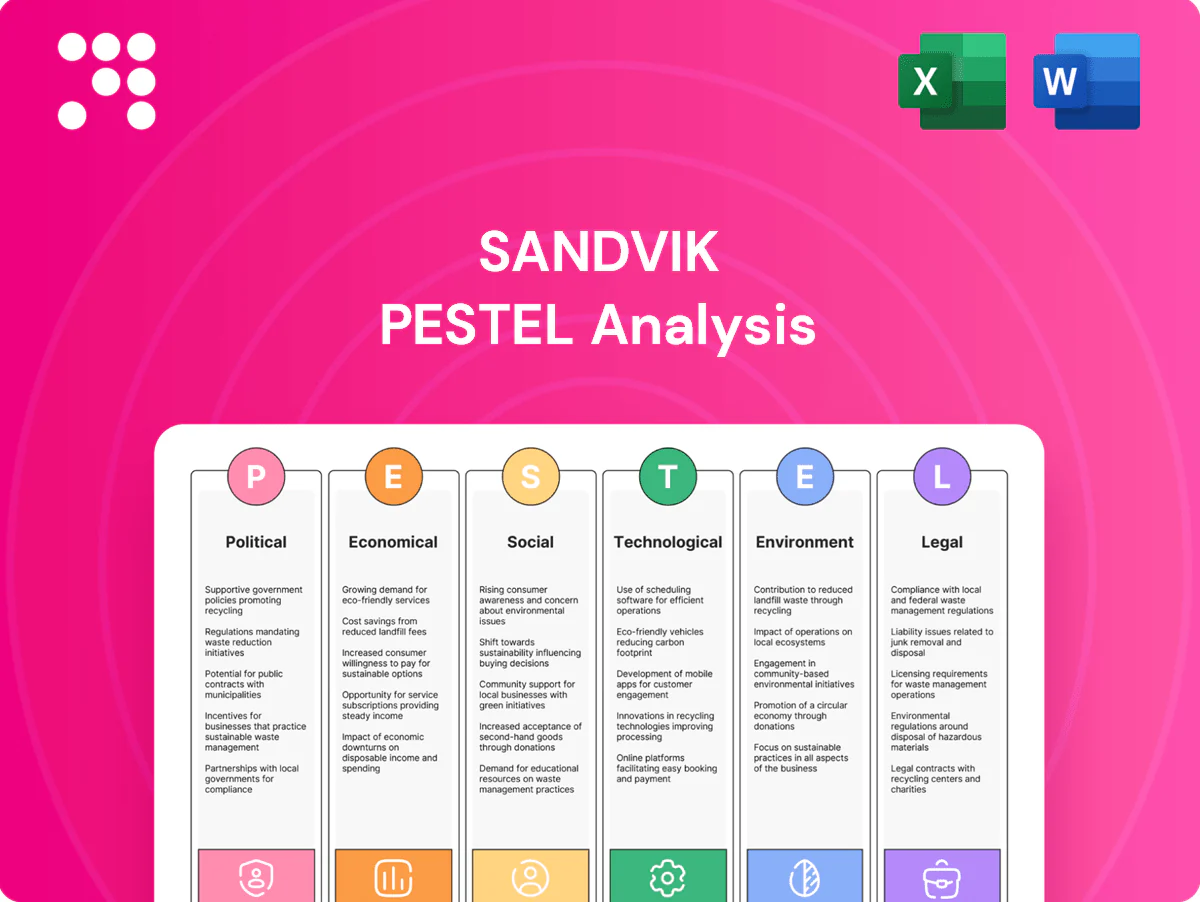
Sandvik PESTLE Analysis

Skip the Research. Get the Strategy.
Navigate the complex global landscape impacting Sandvik with our comprehensive PESTLE analysis. Understand how political shifts, economic volatility, and technological advancements are redefining the mining and manufacturing sectors. Equip yourself with actionable intelligence to anticipate challenges and capitalize on emerging opportunities. Download the full PESTLE analysis now and gain a decisive strategic advantage.
Political factors

Geopolitical Stability and Trade Policies
Sandvik's extensive global operations mean geopolitical stability is a critical factor. For instance, the ongoing tensions in Eastern Europe and their impact on energy prices and supply chains directly affect manufacturing costs and logistics for a company heavily reliant on global trade. Changes in trade policies, such as the European Union's evolving stance on carbon border adjustments, could also influence the cost of imported materials and the competitiveness of Sandvik's products in key markets throughout 2024 and 2025.
Government Regulations on Mining and Manufacturing
Governments globally are increasingly tightening regulations on mining and manufacturing, focusing on worker safety and environmental impact. For instance, the European Union's Green Deal, which aims for climate neutrality by 2050, is driving stricter emissions standards and resource management policies that directly affect manufacturing processes and supply chains.
Sandvik must navigate a complex web of these regulations, which vary significantly by region. Compliance with environmental standards, such as those governing water usage and waste disposal in mining operations, can add substantial costs. In 2023, the mining industry globally saw increased investment in environmental, social, and governance (ESG) compliance, with companies allocating billions to meet new regulatory demands.
These diverse regulatory landscapes directly influence Sandvik's operational costs, product innovation, and market access. For example, new safety equipment mandates in manufacturing can necessitate redesigns and increased production expenses. Failure to comply can result in hefty fines and, more critically, the loss of a social license to operate, impacting brand reputation and future business opportunities.

Industrial Policies and R&D Incentives
Governments worldwide are increasingly implementing industrial policies to foster economic growth and technological advancement. For instance, in 2024, the European Union continued its push for digital and green transitions, with significant funding allocated to research and development initiatives. These policies often include subsidies for manufacturing upgrades and substantial R&D tax credits, which directly benefit companies like Sandvik that invest heavily in innovation.
These government incentives are crucial for companies like Sandvik, which are at the forefront of developing advanced technologies, digitalization, and sustainable solutions. For example, in 2024, many nations offered enhanced R&D tax credits, with some countries raising them by up to 10% to spur private sector investment. Such support can accelerate the development and market introduction of Sandvik's cutting-edge products, particularly in areas like automation and sustainable mining equipment.

Sanctions and Export Controls
International sanctions and export controls pose a significant challenge for Sandvik, a global leader in mining and rock excavation technology. These regulations can directly impede the company's ability to conduct business in specific markets or with designated entities. For instance, in 2023, various countries continued to enforce sanctions against Russia, impacting global supply chains and requiring companies like Sandvik to meticulously vet their customer base and transaction flows to ensure compliance.
Sandvik's high-tech product portfolio, which includes advanced machinery and digital solutions, often falls under stringent export control regimes. Navigating these complex, evolving legal frameworks is paramount. Failure to comply can result in substantial financial penalties; for example, violations of US export control laws can lead to fines in the millions of dollars, alongside potential denial of export privileges.
The reputational damage from a sanctions or export control breach can be equally devastating. Sandvik must maintain robust internal compliance programs, including thorough due diligence, training, and monitoring systems. These measures are essential to mitigate risks and safeguard the company's global operations and market access. The ongoing geopolitical landscape in 2024 and projected into 2025 suggests these regulatory complexities will persist, demanding continuous adaptation.
- Global Reach Impact: Sanctions can block Sandvik from selling advanced equipment and solutions in sanctioned countries, limiting market penetration and revenue streams.
- Compliance Burden: Adhering to a patchwork of international trade regulations requires significant investment in legal expertise and compliance infrastructure.
- Risk of Penalties: Non-compliance can lead to severe financial penalties, potentially running into tens of millions of dollars, and can also result in restrictions on future international trade.
- Reputational Damage: A breach of sanctions or export controls can severely damage Sandvik's brand reputation, affecting customer trust and investor confidence.
Political Stability in Resource-Rich Regions
Many of Sandvik's key mining clients operate in regions where political stability can be a significant concern. For instance, in 2024, countries like the Democratic Republic of Congo, a major copper and cobalt producer, continued to face challenges related to governance and security, impacting mining investment. These shifts can directly affect the demand for Sandvik's advanced mining machinery and aftermarket services.
Resource nationalism, where governments seek greater control over natural resources, also presents a political risk. In 2024, several African nations explored or implemented changes to mining codes, aiming for increased state ownership or royalties, which can alter the investment landscape for mining companies and, by extension, their purchasing decisions for new equipment.
Sandvik must continuously monitor and adapt its strategies to mitigate these political uncertainties. The company's ability to navigate these complex environments is crucial for maintaining a steady revenue stream from its mining sector customers, particularly as global demand for commodities like copper and lithium remains strong, driving activity in these often volatile markets.
- Political Instability Impact: Regions like parts of Sub-Saharan Africa, crucial for mining, experienced ongoing political volatility in 2024, affecting capital expenditure in the sector.
- Resource Nationalism Trends: As of mid-2024, several resource-rich countries were reviewing or amending mining legislation to increase state benefits, potentially influencing equipment procurement.
- Demand Sensitivity: Sandvik's sales are directly tied to the health of mining projects, making it vulnerable to disruptions caused by political unrest or policy changes in key operating regions.
Global Policies Shape Industrial Innovation and Operations
Government industrial policies, including incentives for green technology and digitalization, are crucial for Sandvik's innovation. For example, in 2024, the EU continued to allocate significant funding to R&D for green transitions, potentially boosting Sandvik's investment in sustainable solutions. Many nations also enhanced R&D tax credits, with some raising them by up to 10% in 2024 to encourage private sector investment in advanced technologies.
Sandvik's global footprint means it must navigate evolving trade policies and geopolitical tensions. For instance, changes in trade policies, such as the EU's carbon border adjustment mechanism, could impact material costs and competitiveness throughout 2024 and 2025. Geopolitical instability in regions like Eastern Europe also directly affects energy prices and supply chains, influencing manufacturing costs.
Increased regulatory focus on environmental impact and worker safety, driven by initiatives like the EU's Green Deal, directly affects Sandvik's operations. Stricter emissions standards and resource management policies necessitate compliance, which can add costs. Globally, the mining industry saw increased ESG compliance investment in 2023, with billions allocated to meet new demands.
International sanctions and export controls present significant challenges for Sandvik's high-tech product portfolio. Navigating these complex legal frameworks is vital, as violations of US export control laws, for example, can result in millions of dollars in fines and denial of export privileges.
What is included in the product
 Detailed Word Document
This Sandvik PESTLE analysis examines the impact of Political, Economic, Social, Technological, Environmental, and Legal factors on the company's strategic landscape, offering a comprehensive overview of external influences.

 Customizable Excel Spreadsheet
Provides a concise version that can be dropped into PowerPoints or used in group planning sessions, simplifying complex external factors for actionable strategy.
Economic factors

Global Economic Growth and Industrial Activity
Sandvik's fortunes are intrinsically linked to the pulse of the global economy, particularly within the manufacturing, mining, and infrastructure sectors. When these industries thrive, so does Sandvik, as increased investment fuels demand for its specialized tools, equipment, and advanced digital offerings. For instance, the International Monetary Fund (IMF) projected global growth to be around 3.2% in 2024, a figure that directly influences capital expenditure in these key areas for Sandvik.
However, the economic landscape can shift, impacting Sandvik's performance. A slowdown in industrial activity, such as the moderating growth observed in some manufacturing hubs during parts of 2024, can translate into lower order intake and consequently, reduced revenue for the company. Geopolitical tensions and supply chain disruptions also play a significant role, creating volatility that businesses like Sandvik must navigate.
Commodity Prices and Mining Investment
Fluctuations in global commodity prices are a critical economic factor for Sandvik, directly influencing investment in the mining sector. When prices for metals like iron ore, copper, and gold rise, mining companies tend to increase their capital expenditures. This often translates into greater demand for Sandvik's advanced mining equipment and rock solutions.
For instance, Sandvik's Mining and Rock Solutions segment saw strong performance in the first quarter of 2025, with orders increasing by 10% year-on-year. This growth was notably supported by favorable commodity price environments, encouraging mining operations to upgrade and expand their fleets, thereby boosting sales for Sandvik.

Inflation and Interest Rates
Rising inflation presents a significant challenge for Sandvik, potentially increasing operational expenses for crucial inputs like raw materials, energy, and labor. For instance, the producer price index for manufactured goods in the Eurozone, a key market for Sandvik, saw a notable increase in late 2023 and early 2024, impacting input costs.
Higher interest rates, as seen with central bank policy shifts in 2023 and projections for 2024, can also create headwinds. This directly affects Sandvik's cost of borrowing for investments and can reduce customer appetite for capital expenditure on new machinery due to increased financing costs.
To navigate these economic pressures, Sandvik's strategy likely emphasizes robust cost management initiatives and agile pricing strategies. This approach is vital to protect profit margins amidst fluctuating input costs and potentially softer demand driven by higher borrowing expenses.

Currency Fluctuations
Currency fluctuations present a significant economic factor for Sandvik, a global entity. Changes in exchange rates directly impact the reported value of its international revenues and the cost of its global operations. A stronger Swedish Krona, for instance, would make Sandvik's products more expensive for overseas buyers, potentially reducing sales volume.
Conversely, a weaker Krona can enhance the translated value of earnings generated in foreign currencies. Sandvik's financial reports have indicated the impact of these movements; for example, currency headwinds were cited as a factor that dampened Q2 2025 results, even as the company achieved organic growth.
- Impact on Exports: A stronger currency increases the price of Sandvik's goods in international markets, potentially hindering sales.
- Translation of Earnings: A weaker local currency (e.g., SEK) can boost the reported value of profits earned in stronger foreign currencies.
- Q2 2025 Performance: Currency headwinds negatively affected Sandvik's financial results in the second quarter of 2025, despite underlying organic growth.
Investment Cycles in Infrastructure and Manufacturing
Sandvik's core business areas, especially those focused on infrastructure and manufacturing, are significantly influenced by investment cycles. These cycles dictate the pace of large-scale projects and the willingness of companies to invest in new equipment or upgrades, directly impacting demand for Sandvik's specialized products like advanced materials and metal-cutting tools.
For instance, the global infrastructure spending outlook for 2024-2025 remains robust, with projections indicating continued growth. The U.S. is expected to see substantial investment driven by the Infrastructure Investment and Jobs Act, while many European nations are also prioritizing infrastructure development to boost economic activity and sustainability. This trend directly translates into increased demand for the drilling and rock excavation equipment Sandvik provides.
- Global infrastructure spending is projected to grow steadily through 2025, creating a favorable environment for Sandvik's infrastructure-related segments.
- Manufacturing sector investment is also showing signs of recovery, with businesses looking to modernize operations and enhance productivity, benefiting Sandvik's metal-cutting and automation solutions.
- The cyclical nature of these investments means Sandvik must carefully manage its production capacity and inventory to align with anticipated demand fluctuations.
- Anticipating these investment cycles is crucial for accurate sales forecasting and efficient resource allocation within Sandvik's operations.
Economic Shifts Drive Sandvik's Performance
Sandvik's performance is closely tied to global economic growth, with the IMF projecting 3.2% global growth for 2024, influencing investment in manufacturing and mining. However, economic slowdowns, like moderating manufacturing growth in parts of 2024, can reduce order intake.
Commodity prices significantly impact Sandvik; for example, favorable prices in early 2025 boosted orders for its Mining and Rock Solutions segment by 10% year-on-year. Inflation, as seen in the Eurozone's producer price index in late 2023/early 2024, increases operational costs for Sandvik.
Rising interest rates, a trend continuing into 2024, increase borrowing costs for Sandvik and its customers, potentially dampening capital expenditure. Currency fluctuations also play a role; for instance, currency headwinds negatively impacted Sandvik's Q2 2025 results despite organic growth.
| Economic Factor | Impact on Sandvik | 2024/2025 Data/Trend |
| Global Economic Growth | Influences demand for tools, equipment, and digital offerings in mining, manufacturing, and infrastructure. | IMF projected 3.2% global growth for 2024. |
| Commodity Prices | Higher prices stimulate investment in the mining sector, boosting demand for Sandvik's mining equipment. | 10% year-on-year order increase for Mining and Rock Solutions in Q1 2025, supported by favorable commodity prices. |
| Inflation | Increases operational expenses for raw materials, energy, and labor. | Eurozone producer price index for manufactured goods saw notable increases in late 2023/early 2024. |
| Interest Rates | Raises borrowing costs and can reduce customer appetite for capital expenditure. | Central banks continued policy shifts in 2023, with rates remaining elevated into 2024. |
| Currency Fluctuations | Affects reported value of international revenues and operational costs. | Currency headwinds negatively impacted Sandvik's Q2 2025 results. |
Same Document Delivered
Sandvik PESTLE Analysis
The preview shown here is the exact document you’ll receive after purchase—fully formatted and ready to use, offering a comprehensive Sandvik PESTLE analysis. This detailed report covers Political, Economic, Social, Technological, Legal, and Environmental factors impacting Sandvik's operations and strategy. You can trust that the insights and structure you see are precisely what you'll gain access to immediately after your purchase.

Original: $10.00
-65%$10.00
$3.50Product Information
Product Information
Shipping & Returns
Shipping & Returns
Description
Skip the Research. Get the Strategy.
Navigate the complex global landscape impacting Sandvik with our comprehensive PESTLE analysis. Understand how political shifts, economic volatility, and technological advancements are redefining the mining and manufacturing sectors. Equip yourself with actionable intelligence to anticipate challenges and capitalize on emerging opportunities. Download the full PESTLE analysis now and gain a decisive strategic advantage.
Political factors
Geopolitical Stability and Trade Policies
Sandvik's extensive global operations mean geopolitical stability is a critical factor. For instance, the ongoing tensions in Eastern Europe and their impact on energy prices and supply chains directly affect manufacturing costs and logistics for a company heavily reliant on global trade. Changes in trade policies, such as the European Union's evolving stance on carbon border adjustments, could also influence the cost of imported materials and the competitiveness of Sandvik's products in key markets throughout 2024 and 2025.
Government Regulations on Mining and Manufacturing
Governments globally are increasingly tightening regulations on mining and manufacturing, focusing on worker safety and environmental impact. For instance, the European Union's Green Deal, which aims for climate neutrality by 2050, is driving stricter emissions standards and resource management policies that directly affect manufacturing processes and supply chains.
Sandvik must navigate a complex web of these regulations, which vary significantly by region. Compliance with environmental standards, such as those governing water usage and waste disposal in mining operations, can add substantial costs. In 2023, the mining industry globally saw increased investment in environmental, social, and governance (ESG) compliance, with companies allocating billions to meet new regulatory demands.
These diverse regulatory landscapes directly influence Sandvik's operational costs, product innovation, and market access. For example, new safety equipment mandates in manufacturing can necessitate redesigns and increased production expenses. Failure to comply can result in hefty fines and, more critically, the loss of a social license to operate, impacting brand reputation and future business opportunities.
Industrial Policies and R&D Incentives
Governments worldwide are increasingly implementing industrial policies to foster economic growth and technological advancement. For instance, in 2024, the European Union continued its push for digital and green transitions, with significant funding allocated to research and development initiatives. These policies often include subsidies for manufacturing upgrades and substantial R&D tax credits, which directly benefit companies like Sandvik that invest heavily in innovation.
These government incentives are crucial for companies like Sandvik, which are at the forefront of developing advanced technologies, digitalization, and sustainable solutions. For example, in 2024, many nations offered enhanced R&D tax credits, with some countries raising them by up to 10% to spur private sector investment. Such support can accelerate the development and market introduction of Sandvik's cutting-edge products, particularly in areas like automation and sustainable mining equipment.
Sanctions and Export Controls
International sanctions and export controls pose a significant challenge for Sandvik, a global leader in mining and rock excavation technology. These regulations can directly impede the company's ability to conduct business in specific markets or with designated entities. For instance, in 2023, various countries continued to enforce sanctions against Russia, impacting global supply chains and requiring companies like Sandvik to meticulously vet their customer base and transaction flows to ensure compliance.
Sandvik's high-tech product portfolio, which includes advanced machinery and digital solutions, often falls under stringent export control regimes. Navigating these complex, evolving legal frameworks is paramount. Failure to comply can result in substantial financial penalties; for example, violations of US export control laws can lead to fines in the millions of dollars, alongside potential denial of export privileges.
The reputational damage from a sanctions or export control breach can be equally devastating. Sandvik must maintain robust internal compliance programs, including thorough due diligence, training, and monitoring systems. These measures are essential to mitigate risks and safeguard the company's global operations and market access. The ongoing geopolitical landscape in 2024 and projected into 2025 suggests these regulatory complexities will persist, demanding continuous adaptation.
- Global Reach Impact: Sanctions can block Sandvik from selling advanced equipment and solutions in sanctioned countries, limiting market penetration and revenue streams.
- Compliance Burden: Adhering to a patchwork of international trade regulations requires significant investment in legal expertise and compliance infrastructure.
- Risk of Penalties: Non-compliance can lead to severe financial penalties, potentially running into tens of millions of dollars, and can also result in restrictions on future international trade.
- Reputational Damage: A breach of sanctions or export controls can severely damage Sandvik's brand reputation, affecting customer trust and investor confidence.
Political Stability in Resource-Rich Regions
Many of Sandvik's key mining clients operate in regions where political stability can be a significant concern. For instance, in 2024, countries like the Democratic Republic of Congo, a major copper and cobalt producer, continued to face challenges related to governance and security, impacting mining investment. These shifts can directly affect the demand for Sandvik's advanced mining machinery and aftermarket services.
Resource nationalism, where governments seek greater control over natural resources, also presents a political risk. In 2024, several African nations explored or implemented changes to mining codes, aiming for increased state ownership or royalties, which can alter the investment landscape for mining companies and, by extension, their purchasing decisions for new equipment.
Sandvik must continuously monitor and adapt its strategies to mitigate these political uncertainties. The company's ability to navigate these complex environments is crucial for maintaining a steady revenue stream from its mining sector customers, particularly as global demand for commodities like copper and lithium remains strong, driving activity in these often volatile markets.
- Political Instability Impact: Regions like parts of Sub-Saharan Africa, crucial for mining, experienced ongoing political volatility in 2024, affecting capital expenditure in the sector.
- Resource Nationalism Trends: As of mid-2024, several resource-rich countries were reviewing or amending mining legislation to increase state benefits, potentially influencing equipment procurement.
- Demand Sensitivity: Sandvik's sales are directly tied to the health of mining projects, making it vulnerable to disruptions caused by political unrest or policy changes in key operating regions.
Global Policies Shape Industrial Innovation and Operations
Government industrial policies, including incentives for green technology and digitalization, are crucial for Sandvik's innovation. For example, in 2024, the EU continued to allocate significant funding to R&D for green transitions, potentially boosting Sandvik's investment in sustainable solutions. Many nations also enhanced R&D tax credits, with some raising them by up to 10% in 2024 to encourage private sector investment in advanced technologies.
Sandvik's global footprint means it must navigate evolving trade policies and geopolitical tensions. For instance, changes in trade policies, such as the EU's carbon border adjustment mechanism, could impact material costs and competitiveness throughout 2024 and 2025. Geopolitical instability in regions like Eastern Europe also directly affects energy prices and supply chains, influencing manufacturing costs.
Increased regulatory focus on environmental impact and worker safety, driven by initiatives like the EU's Green Deal, directly affects Sandvik's operations. Stricter emissions standards and resource management policies necessitate compliance, which can add costs. Globally, the mining industry saw increased ESG compliance investment in 2023, with billions allocated to meet new demands.
International sanctions and export controls present significant challenges for Sandvik's high-tech product portfolio. Navigating these complex legal frameworks is vital, as violations of US export control laws, for example, can result in millions of dollars in fines and denial of export privileges.
What is included in the product
Detailed Word Document
This Sandvik PESTLE analysis examines the impact of Political, Economic, Social, Technological, Environmental, and Legal factors on the company's strategic landscape, offering a comprehensive overview of external influences.
Customizable Excel Spreadsheet
Provides a concise version that can be dropped into PowerPoints or used in group planning sessions, simplifying complex external factors for actionable strategy.
Economic factors
Global Economic Growth and Industrial Activity
Sandvik's fortunes are intrinsically linked to the pulse of the global economy, particularly within the manufacturing, mining, and infrastructure sectors. When these industries thrive, so does Sandvik, as increased investment fuels demand for its specialized tools, equipment, and advanced digital offerings. For instance, the International Monetary Fund (IMF) projected global growth to be around 3.2% in 2024, a figure that directly influences capital expenditure in these key areas for Sandvik.
However, the economic landscape can shift, impacting Sandvik's performance. A slowdown in industrial activity, such as the moderating growth observed in some manufacturing hubs during parts of 2024, can translate into lower order intake and consequently, reduced revenue for the company. Geopolitical tensions and supply chain disruptions also play a significant role, creating volatility that businesses like Sandvik must navigate.
Commodity Prices and Mining Investment
Fluctuations in global commodity prices are a critical economic factor for Sandvik, directly influencing investment in the mining sector. When prices for metals like iron ore, copper, and gold rise, mining companies tend to increase their capital expenditures. This often translates into greater demand for Sandvik's advanced mining equipment and rock solutions.
For instance, Sandvik's Mining and Rock Solutions segment saw strong performance in the first quarter of 2025, with orders increasing by 10% year-on-year. This growth was notably supported by favorable commodity price environments, encouraging mining operations to upgrade and expand their fleets, thereby boosting sales for Sandvik.
Inflation and Interest Rates
Rising inflation presents a significant challenge for Sandvik, potentially increasing operational expenses for crucial inputs like raw materials, energy, and labor. For instance, the producer price index for manufactured goods in the Eurozone, a key market for Sandvik, saw a notable increase in late 2023 and early 2024, impacting input costs.
Higher interest rates, as seen with central bank policy shifts in 2023 and projections for 2024, can also create headwinds. This directly affects Sandvik's cost of borrowing for investments and can reduce customer appetite for capital expenditure on new machinery due to increased financing costs.
To navigate these economic pressures, Sandvik's strategy likely emphasizes robust cost management initiatives and agile pricing strategies. This approach is vital to protect profit margins amidst fluctuating input costs and potentially softer demand driven by higher borrowing expenses.
Currency Fluctuations
Currency fluctuations present a significant economic factor for Sandvik, a global entity. Changes in exchange rates directly impact the reported value of its international revenues and the cost of its global operations. A stronger Swedish Krona, for instance, would make Sandvik's products more expensive for overseas buyers, potentially reducing sales volume.
Conversely, a weaker Krona can enhance the translated value of earnings generated in foreign currencies. Sandvik's financial reports have indicated the impact of these movements; for example, currency headwinds were cited as a factor that dampened Q2 2025 results, even as the company achieved organic growth.
- Impact on Exports: A stronger currency increases the price of Sandvik's goods in international markets, potentially hindering sales.
- Translation of Earnings: A weaker local currency (e.g., SEK) can boost the reported value of profits earned in stronger foreign currencies.
- Q2 2025 Performance: Currency headwinds negatively affected Sandvik's financial results in the second quarter of 2025, despite underlying organic growth.
Investment Cycles in Infrastructure and Manufacturing
Sandvik's core business areas, especially those focused on infrastructure and manufacturing, are significantly influenced by investment cycles. These cycles dictate the pace of large-scale projects and the willingness of companies to invest in new equipment or upgrades, directly impacting demand for Sandvik's specialized products like advanced materials and metal-cutting tools.
For instance, the global infrastructure spending outlook for 2024-2025 remains robust, with projections indicating continued growth. The U.S. is expected to see substantial investment driven by the Infrastructure Investment and Jobs Act, while many European nations are also prioritizing infrastructure development to boost economic activity and sustainability. This trend directly translates into increased demand for the drilling and rock excavation equipment Sandvik provides.
- Global infrastructure spending is projected to grow steadily through 2025, creating a favorable environment for Sandvik's infrastructure-related segments.
- Manufacturing sector investment is also showing signs of recovery, with businesses looking to modernize operations and enhance productivity, benefiting Sandvik's metal-cutting and automation solutions.
- The cyclical nature of these investments means Sandvik must carefully manage its production capacity and inventory to align with anticipated demand fluctuations.
- Anticipating these investment cycles is crucial for accurate sales forecasting and efficient resource allocation within Sandvik's operations.
Economic Shifts Drive Sandvik's Performance
Sandvik's performance is closely tied to global economic growth, with the IMF projecting 3.2% global growth for 2024, influencing investment in manufacturing and mining. However, economic slowdowns, like moderating manufacturing growth in parts of 2024, can reduce order intake.
Commodity prices significantly impact Sandvik; for example, favorable prices in early 2025 boosted orders for its Mining and Rock Solutions segment by 10% year-on-year. Inflation, as seen in the Eurozone's producer price index in late 2023/early 2024, increases operational costs for Sandvik.
Rising interest rates, a trend continuing into 2024, increase borrowing costs for Sandvik and its customers, potentially dampening capital expenditure. Currency fluctuations also play a role; for instance, currency headwinds negatively impacted Sandvik's Q2 2025 results despite organic growth.
| Economic Factor | Impact on Sandvik | 2024/2025 Data/Trend |
| Global Economic Growth | Influences demand for tools, equipment, and digital offerings in mining, manufacturing, and infrastructure. | IMF projected 3.2% global growth for 2024. |
| Commodity Prices | Higher prices stimulate investment in the mining sector, boosting demand for Sandvik's mining equipment. | 10% year-on-year order increase for Mining and Rock Solutions in Q1 2025, supported by favorable commodity prices. |
| Inflation | Increases operational expenses for raw materials, energy, and labor. | Eurozone producer price index for manufactured goods saw notable increases in late 2023/early 2024. |
| Interest Rates | Raises borrowing costs and can reduce customer appetite for capital expenditure. | Central banks continued policy shifts in 2023, with rates remaining elevated into 2024. |
| Currency Fluctuations | Affects reported value of international revenues and operational costs. | Currency headwinds negatively impacted Sandvik's Q2 2025 results. |
Same Document Delivered
Sandvik PESTLE Analysis
The preview shown here is the exact document you’ll receive after purchase—fully formatted and ready to use, offering a comprehensive Sandvik PESTLE analysis. This detailed report covers Political, Economic, Social, Technological, Legal, and Environmental factors impacting Sandvik's operations and strategy. You can trust that the insights and structure you see are precisely what you'll gain access to immediately after your purchase.