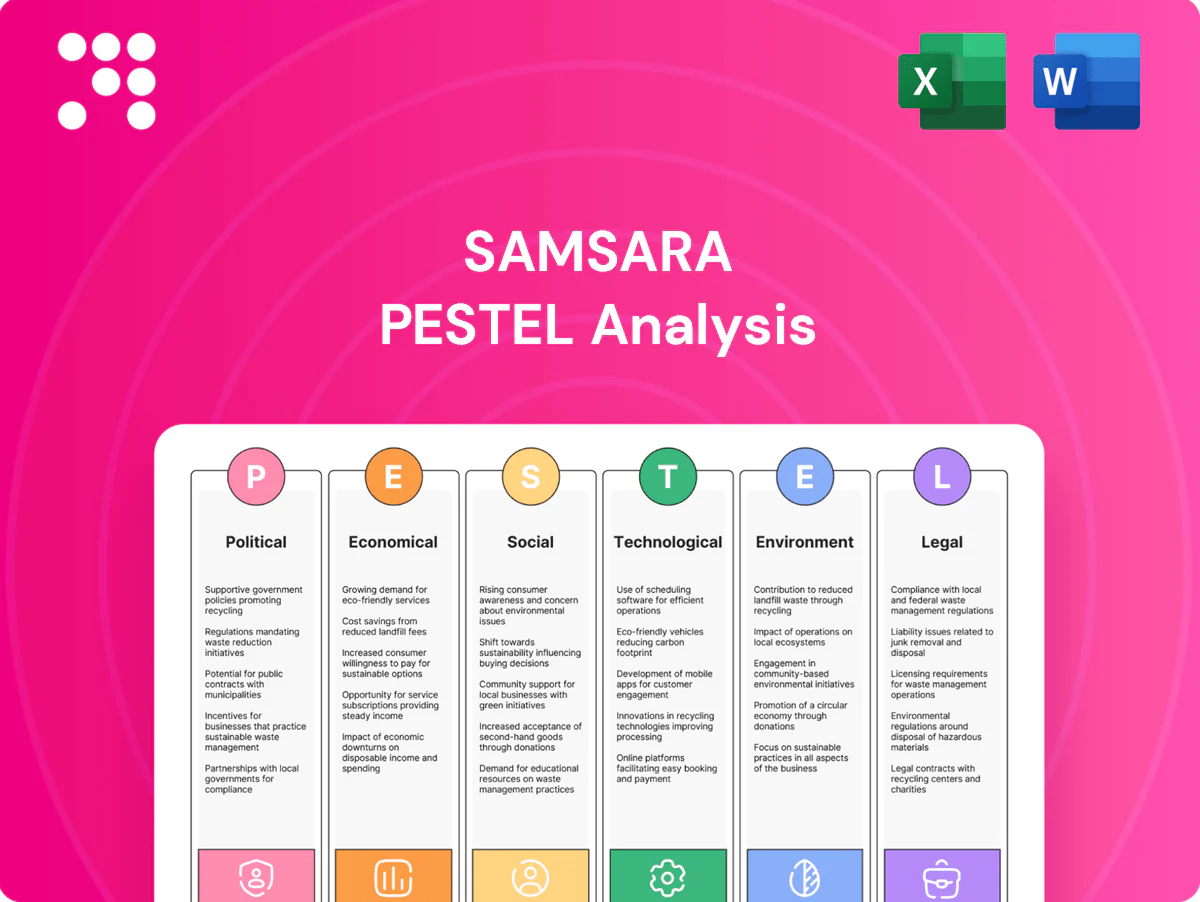
Samsara PESTLE Analysis

Plan Smarter. Present Sharper. Compete Stronger.
Gain a competitive edge with our PESTLE Analysis of Samsara. Explore how political, economic, social, technological, legal and environmental forces will shape growth and risk, with concise, actionable insights tailored for investors and strategists. Download the full analysis now for the complete, ready-to-use report.
Political factors

Transport safety mandates
Governments in the US, EU and UK are tightening fleet safety and driver-monitoring rules, with mandates like US ELDs affecting over 3.5 million commercial drivers, driving demand for AI dashcams, telematics and compliance tooling. Samsara can market its integrated platform as a turnkey path to meet evolving rules and obtain required certifications. Rapid policy shifts will force frequent feature updates and certification cycles.
Infrastructure investment
Public spending such as the US Infrastructure Investment and Jobs Act (about 1.2 trillion USD total, ~550 billion USD in new spending) accelerates IoT adoption in roads, logistics, and smart cities. More connected infrastructure multiplies data touchpoints for fleets and equipment, expanding telemetry volumes and integration needs. Samsara gains integration opportunities with public systems but faces lengthy, politically influenced procurement cycles that can delay deployments.

Data sovereignty policies
National data localization rules dictate where Samsara can store operational data, forcing regional clouds and custom routing to meet local laws; DLA Piper notes 150+ jurisdictions have data protection laws (2024). Compliance choices drive latency, add infrastructure and compliance costs (regional cloud deployments can cost millions), and fragmented regimes raise operational complexity and time-to-market.

Trade and export controls
Tariffs and export controls, notably tightened US restrictions on advanced semiconductors to China since 2022, can disrupt IoT hardware supply and raise component costs and lead times; Samsara, with FY2024 revenue about 1.02 billion USD, faces margin and deployment risks from such shocks. Shifts in US–China or EU trade policy can materially affect procurement and customer rollouts, while alternative suppliers and modular design reduce exposure.
- Tariffs: higher COGS, longer lead times
- Export controls: semiconductor access constraints
- Mitigation: multi-sourcing, modular hardware design
- Risk: geopolitics can halt cross-border deployments
Public sector adoption
City, state, and federal agencies are accelerating fleet and worksite digitization, with government procurement in 2024 prioritizing compliance, transparency, and auditability. Samsara’s safety and sustainability analytics map directly to policy goals such as emissions tracking and OSHA-style reporting, supporting its public-sector growth. Winning large contracts requires certifications (FedRAMP/state equivalents) and lobbying or government-relations capability.
- 2024: public-sector focus on compliance and auditability
- Certs: FedRAMP/state procurement clearances
- Samsara: analytics aligned to emissions and safety targets
Fleet ELDs hit 3.5M; IIJA $1.2T fuels telematics amid data laws, chip risks
US/EU/UK tightening fleet safety rules (US ELDs impact 3.5M drivers) boosts demand for Samsara telematics; frequent regs demand rapid feature/cert cycles. IIJA (~1.2T total, ~550B new) and smart-city spend enlarge IoT integrations; public procurement is slow. 150+ jurisdictions have data laws, forcing regional clouds; export controls since 2022 raise hardware costs; Samsara FY2024 rev ~1.02B USD.
| Factor | 2024/25 Stat | Impact |
|---|---|---|
| Regulation | 3.5M drivers | Higher demand, faster updates |
| Infrastructure | $1.2T IIJA | More integration ops |
| Data laws | 150+ jurisdictions | Regional infra cost |
| Trade | Semiconductor controls | Supply/cost risk |
What is included in the product
 Detailed Word Document
Explores how macro-environmental forces uniquely affect Samsara across Political, Economic, Social, Technological, Environmental and Legal dimensions, with data-backed trends and industry-specific subpoints; designed for executives and investors, it offers forward-looking insights and ready-to-use formatting for plans, decks, and scenario planning.

 Customizable Excel Spreadsheet
A concise, visually segmented PESTLE summary of Samsara that eases stakeholder alignment, highlights external risks and market opportunities for strategic planning, and is editable for local context or presentation-ready slides.
Economic factors

Cyclical capex sensitivity
Customers in logistics, construction and field services re-price capex with macro cycles, often deferring hardware refreshes in downturns while prioritizing ROI-driven efficiency tools that justify near-term spend. Samsara reported subscription revenue as the majority of FY2024 revenue, exceeding 70%, which softens volatility versus pure hardware sales. Clear, quantified payback messaging (months to break-even) is critical to close deals amid tighter budgets.
Fuel and labor costs
Rising fuel and driver wages—U.S. diesel averaged about $3.75/gal in 2024 (EIA) and median heavy-truck pay was roughly $48,000 in 2024 (BLS)—drive demand for route optimization and safety automation. Samsara analytics can cut idling by up to 20% and lower incidents/overtime, translating to measurable fuel and labor savings. Those savings boost customer retention and upsell potential. Cost spikes raise elasticity, accelerating tech adoption.

Scale economies
Larger installed base—now over 1.2 million connected devices—lowers per-unit device and connectivity costs through procurement scale and deployment efficiencies. Network effects from billions of sensor-hours of data boost AI accuracy and product differentiation, aiding feature retention. As software mix rises (SaaS contributed ~40%+ of revenue in recent quarters), gross margins improve, though commoditized telematics keeps competitive pricing pressure intense.

Insurance incentives
Insurers increasingly discount premiums for verified safety telematics, with industry reports in 2024 showing median reductions around 10–20% for fleets using validated data. Samsara can ingest risk scores and event data to auditablely demonstrate improvements in crash rates and exposure, enabling joint offerings with carriers to accelerate adoption and share savings. Economic value must be quantifiable and auditable to unlock insurer discounts and partner revenue.
- 2024: median premium reduction 10–20%
- Samsara: integrates risk scores + event data
- Joint carrier offerings accelerate uptake
- Value must be quantifiable & auditable
Currency and global expansion
International expansion exposes Samsara to FX volatility on subscription ARR and one-time hardware revenue; corporate guidance often flags currency as a key variable after the dollar strengthened ~5–10% vs EM currencies in 2023–24, making local pricing and hedging critical to protect margins.
Regional partnerships and local resellers lower go-to-market costs and speed deployment, while economic instability in key markets commonly delays fleet digitization and hardware refresh cycles.
- FX exposure: affects subscription ARR and hardware revenue
- Hedging/local pricing: essential to stabilize margins
- Partnerships: reduce GTM costs and accelerate adoption
- Macro risk: instability delays digitization projects
Fleet ELDs hit 3.5M; IIJA $1.2T fuels telematics amid data laws, chip risks
Macro cycles push customers to defer hardware but favor ROI-driven SaaS; Samsara had >70% subscription revenue in FY2024 and >1.2M connected devices, stabilizing cash flow. Rising diesel (~$3.75/gal in 2024) and median truck pay ~$48k drive demand for fuel/labor savings; insurers cut premiums ~10–20% for telematics. FX swing ~5–10% vs EMs affects ARR and margins.
| Metric | 2024 |
|---|---|
| Subscription mix | >70% |
| Connected devices | >1.2M |
| Diesel (US) | $3.75/gal |
| Truck median pay | $48k |
| Insurer discount | 10–20% |
Preview Before You Purchase
Samsara PESTLE Analysis
The preview shown here is the exact Samsara PESTLE Analysis you’ll receive after purchase—fully formatted and ready to use. It delivers concise Political, Economic, Social, Technological, Legal and Environmental insights tailored to Samsara’s market position. No placeholders, no surprises, instant download.

Product Information
Product Information
Shipping & Returns
Shipping & Returns
Description
Plan Smarter. Present Sharper. Compete Stronger.
Gain a competitive edge with our PESTLE Analysis of Samsara. Explore how political, economic, social, technological, legal and environmental forces will shape growth and risk, with concise, actionable insights tailored for investors and strategists. Download the full analysis now for the complete, ready-to-use report.
Political factors
Transport safety mandates
Governments in the US, EU and UK are tightening fleet safety and driver-monitoring rules, with mandates like US ELDs affecting over 3.5 million commercial drivers, driving demand for AI dashcams, telematics and compliance tooling. Samsara can market its integrated platform as a turnkey path to meet evolving rules and obtain required certifications. Rapid policy shifts will force frequent feature updates and certification cycles.
Infrastructure investment
Public spending such as the US Infrastructure Investment and Jobs Act (about 1.2 trillion USD total, ~550 billion USD in new spending) accelerates IoT adoption in roads, logistics, and smart cities. More connected infrastructure multiplies data touchpoints for fleets and equipment, expanding telemetry volumes and integration needs. Samsara gains integration opportunities with public systems but faces lengthy, politically influenced procurement cycles that can delay deployments.
Data sovereignty policies
National data localization rules dictate where Samsara can store operational data, forcing regional clouds and custom routing to meet local laws; DLA Piper notes 150+ jurisdictions have data protection laws (2024). Compliance choices drive latency, add infrastructure and compliance costs (regional cloud deployments can cost millions), and fragmented regimes raise operational complexity and time-to-market.
Trade and export controls
Tariffs and export controls, notably tightened US restrictions on advanced semiconductors to China since 2022, can disrupt IoT hardware supply and raise component costs and lead times; Samsara, with FY2024 revenue about 1.02 billion USD, faces margin and deployment risks from such shocks. Shifts in US–China or EU trade policy can materially affect procurement and customer rollouts, while alternative suppliers and modular design reduce exposure.
- Tariffs: higher COGS, longer lead times
- Export controls: semiconductor access constraints
- Mitigation: multi-sourcing, modular hardware design
- Risk: geopolitics can halt cross-border deployments
Public sector adoption
City, state, and federal agencies are accelerating fleet and worksite digitization, with government procurement in 2024 prioritizing compliance, transparency, and auditability. Samsara’s safety and sustainability analytics map directly to policy goals such as emissions tracking and OSHA-style reporting, supporting its public-sector growth. Winning large contracts requires certifications (FedRAMP/state equivalents) and lobbying or government-relations capability.
- 2024: public-sector focus on compliance and auditability
- Certs: FedRAMP/state procurement clearances
- Samsara: analytics aligned to emissions and safety targets
Fleet ELDs hit 3.5M; IIJA $1.2T fuels telematics amid data laws, chip risks
US/EU/UK tightening fleet safety rules (US ELDs impact 3.5M drivers) boosts demand for Samsara telematics; frequent regs demand rapid feature/cert cycles. IIJA (~1.2T total, ~550B new) and smart-city spend enlarge IoT integrations; public procurement is slow. 150+ jurisdictions have data laws, forcing regional clouds; export controls since 2022 raise hardware costs; Samsara FY2024 rev ~1.02B USD.
| Factor | 2024/25 Stat | Impact |
|---|---|---|
| Regulation | 3.5M drivers | Higher demand, faster updates |
| Infrastructure | $1.2T IIJA | More integration ops |
| Data laws | 150+ jurisdictions | Regional infra cost |
| Trade | Semiconductor controls | Supply/cost risk |
What is included in the product
Detailed Word Document
Explores how macro-environmental forces uniquely affect Samsara across Political, Economic, Social, Technological, Environmental and Legal dimensions, with data-backed trends and industry-specific subpoints; designed for executives and investors, it offers forward-looking insights and ready-to-use formatting for plans, decks, and scenario planning.
Customizable Excel Spreadsheet
A concise, visually segmented PESTLE summary of Samsara that eases stakeholder alignment, highlights external risks and market opportunities for strategic planning, and is editable for local context or presentation-ready slides.
Economic factors
Cyclical capex sensitivity
Customers in logistics, construction and field services re-price capex with macro cycles, often deferring hardware refreshes in downturns while prioritizing ROI-driven efficiency tools that justify near-term spend. Samsara reported subscription revenue as the majority of FY2024 revenue, exceeding 70%, which softens volatility versus pure hardware sales. Clear, quantified payback messaging (months to break-even) is critical to close deals amid tighter budgets.
Fuel and labor costs
Rising fuel and driver wages—U.S. diesel averaged about $3.75/gal in 2024 (EIA) and median heavy-truck pay was roughly $48,000 in 2024 (BLS)—drive demand for route optimization and safety automation. Samsara analytics can cut idling by up to 20% and lower incidents/overtime, translating to measurable fuel and labor savings. Those savings boost customer retention and upsell potential. Cost spikes raise elasticity, accelerating tech adoption.
Scale economies
Larger installed base—now over 1.2 million connected devices—lowers per-unit device and connectivity costs through procurement scale and deployment efficiencies. Network effects from billions of sensor-hours of data boost AI accuracy and product differentiation, aiding feature retention. As software mix rises (SaaS contributed ~40%+ of revenue in recent quarters), gross margins improve, though commoditized telematics keeps competitive pricing pressure intense.
Insurance incentives
Insurers increasingly discount premiums for verified safety telematics, with industry reports in 2024 showing median reductions around 10–20% for fleets using validated data. Samsara can ingest risk scores and event data to auditablely demonstrate improvements in crash rates and exposure, enabling joint offerings with carriers to accelerate adoption and share savings. Economic value must be quantifiable and auditable to unlock insurer discounts and partner revenue.
- 2024: median premium reduction 10–20%
- Samsara: integrates risk scores + event data
- Joint carrier offerings accelerate uptake
- Value must be quantifiable & auditable
Currency and global expansion
International expansion exposes Samsara to FX volatility on subscription ARR and one-time hardware revenue; corporate guidance often flags currency as a key variable after the dollar strengthened ~5–10% vs EM currencies in 2023–24, making local pricing and hedging critical to protect margins.
Regional partnerships and local resellers lower go-to-market costs and speed deployment, while economic instability in key markets commonly delays fleet digitization and hardware refresh cycles.
- FX exposure: affects subscription ARR and hardware revenue
- Hedging/local pricing: essential to stabilize margins
- Partnerships: reduce GTM costs and accelerate adoption
- Macro risk: instability delays digitization projects
Fleet ELDs hit 3.5M; IIJA $1.2T fuels telematics amid data laws, chip risks
Macro cycles push customers to defer hardware but favor ROI-driven SaaS; Samsara had >70% subscription revenue in FY2024 and >1.2M connected devices, stabilizing cash flow. Rising diesel (~$3.75/gal in 2024) and median truck pay ~$48k drive demand for fuel/labor savings; insurers cut premiums ~10–20% for telematics. FX swing ~5–10% vs EMs affects ARR and margins.
| Metric | 2024 |
|---|---|
| Subscription mix | >70% |
| Connected devices | >1.2M |
| Diesel (US) | $3.75/gal |
| Truck median pay | $48k |
| Insurer discount | 10–20% |
Preview Before You Purchase
Samsara PESTLE Analysis
The preview shown here is the exact Samsara PESTLE Analysis you’ll receive after purchase—fully formatted and ready to use. It delivers concise Political, Economic, Social, Technological, Legal and Environmental insights tailored to Samsara’s market position. No placeholders, no surprises, instant download.











