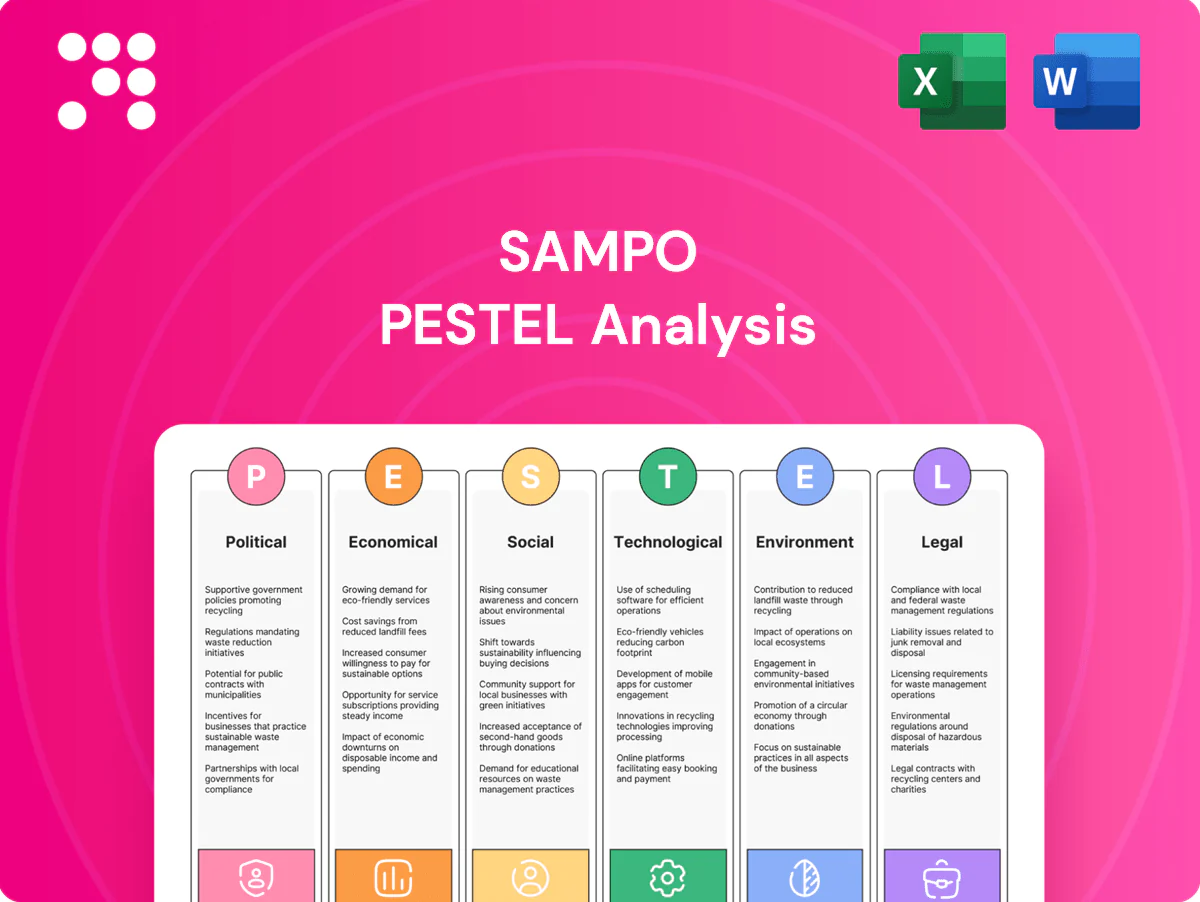
Sampo PESTLE Analysis

Plan Smarter. Present Sharper. Compete Stronger.
Discover how political, economic, social, technological, legal, and environmental forces are shaping Sampo’s strategic outlook in our concise PESTLE summary. Gain actionable insights to forecast risks and spot growth opportunities. Purchase the full PESTLE for the complete, ready-to-use analysis and download instantly.
Political factors

Stable Nordic governance
Stable governance across Finland, Sweden, Norway and Denmark—reflected in high Transparency International CPI scores (approx. Finland 87, Denmark 90, Sweden 83, Norway 86)—supports predictable insurance regulation and public policy, helping Sampo with pricing, capital allocation and long-term underwriting, bolstering consumer confidence and investment returns; however, coalition shifts can still alter sector levies and supervisory priorities.
Brexit and UK policy divergence
Operating in the UK exposes Sampo to post-Brexit regulatory divergence from EU standards as HM Treasury and the PRA pursue Solvency UK reforms that may change capital and reporting regimes.
Revisions to matching adjustments, risk margins and reporting templates could materially alter capital allocation and pricing for UK business.
Shifts in trade and immigration policy affect claims patterns and labor costs, while greater policy unpredictability increases planning complexity versus the EU framework.

Government disaster policy
Government disaster policies such as the UK Flood Re (launched 2016) shape pricing and risk transfer — Flood Re had supported about 360,000 high‑risk properties by 2024 and UK insured flood losses average roughly £1.3bn/year. Political choices on funding thresholds and eligibility directly change insurer loss exposure. Moves toward public‑private partnerships create reinsurance market opportunities, while withdrawal or redesigns would raise primary insurers’ burdens.

Taxation of financial services
Changes in corporate tax and sector levies materially affect Sampo’s profitability: Finland’s statutory rate is 20% while the UK’s rose to 25% from 2023, and UK insurance premium tax stands at 12%, pressuring margins and product pricing. Nordic and UK fiscal shifts after elections can target financial-sector revenue and alter capital allocation; clear double-taxation treaties and withholding rules (commonly 0–15%) support cross-border flows. Tax clarity lowers Sampo’s cost of capital; uncertainty raises it, increasing required returns and reserve buffers.
- Finland corp tax 20%
- UK corp tax 25%, IPT 12%
- Withholding commonly 0–15%
EU regulatory agenda
Despite UK divergence, EU initiatives (Solvency II recalibration finalised 2023 with phased implementation through 2028, Digital Finance Package 2023 and ongoing sustainability rules) continue to shape Nordic markets; political momentum on consumer protection and ESG increases compliance demands. Harmonisation favors scale players like Sampo, but accelerated timelines strain multi-jurisdiction implementation and IT upgrades.
- Solvency II: phased roll‑out through 2028
- Digital finance: EU package 2023
- ESG/consumer rules: higher compliance load
- Benefit: scale advantage for Sampo
Nordic regulatory stability vs UK tax and flood risks amid Solvency II recalibration
Stable Nordic governance (CPI: FI 87, DK 90, SE 83, NO 86) supports predictable regulation; UK post‑Brexit divergence (Solvency UK) and higher taxes (UK corp 25%, IPT 12%) raise capital and pricing risk. Flood Re (≈360,000 properties covered by 2024) and ~£1.3bn/yr UK insured flood losses materially affect underwriting and reinsurance demand. EU Solvency II recalibration (finalised 2023, phased to 2028) increases compliance burdens but benefits scale players like Sampo.
| Item | Value |
|---|---|
| Finland CPI | 87 |
| Denmark CPI | 90 |
| Sweden CPI | 83 |
| Norway CPI | 86 |
| Finland corp tax | 20% |
| UK corp tax | 25% |
| UK IPT | 12% |
| Flood Re properties (2024) | ≈360,000 |
| UK insured flood losses | ≈£1.3bn/yr |
| Solvency II | Finalised 2023; phased to 2028 |
What is included in the product
 Detailed Word Document
Explores how macro-environmental forces shape Sampo across Political, Economic, Social, Technological, Environmental and Legal dimensions, with data-backed trends and region-specific examples to reveal risks and opportunities; formatted for easy insertion into plans and to support strategic, investor-facing decisions.

 Customizable Excel Spreadsheet
A concise, visually segmented PESTLE summary for Sampo that streamlines external risk assessment and market-position discussions. Easily dropped into presentations or shared across teams to align strategy and speed decision-making.
Economic factors

Interest rate environment
Higher interest rates (ECB deposit rate rose to about 4.00% in 2023–24) boost investment income on Sampo’s float and reserves and reduce the present value of long-term claims, supporting capital ratios. However, rising yields have pressured bond and equity valuations and can slow economic activity, weighing on premium growth. As a result, active balance-sheet duration management has become a key profit lever for Sampo amid 10-year Nordic yields near 3% levels.
Inflation and claims severity
Auto and property repair cost inflation pushed loss severity higher, with motor repair parts and labour contributing to roughly a 10% year-on-year increase in repair bills in 2024, straining Sampo's claims payouts.
Wage inflation—about 4–6% in Nordic markets in 2024—lifted bodily injury and liability claim costs, increasing average claim severities and reserving pressure.
Pricing cycles must catch up through rate increases and tighter underwriting; insurers across the region implemented mid-single to high-single digit rate rises in 2024 to restore margins.
Claims supply-chain constraints continue to elongate repair cycle times and add IBNR uncertainty, as extended parts lead times and contractor shortages persisted through 2024.

Macro cycles and exposure
GDP growth drives exposure units in commercial lines and new policy issuance, while recessions historically compress premium volumes and raise fraud — for example global P&C premium growth fell after 2008. Small business failures heighten credit-related and liability exposures, visible in tightened commercial claims trends. Sampo operates across the Nordics and the UK via If and Hastings, which mitigates single-market shocks.

FX fluctuations
FX fluctuations from SEK, NOK, DKK and GBP create material translation risk into Sampo plc EUR reporting, moving reported revenue and claims and thereby affecting solvency and capital ratios; large currency swings have in past cycles shifted dividend capacity materially. Hedging programs blunt headline volatility but incur cost and basis risk. The geographic mix of If, Topdanmark and UK operations can amplify or offset currency impacts depending on claim patterns.
- Translation risk: SEK/NOK/DKK/GBP → EUR
- Capital ratios/dividends sensitive to FX
- Hedging reduces volatility but adds cost
- Geographic mix can magnify or hedge currency shock
Equity market sensitivity
Equity market swings materially move Sampo’s investment income and fair-value of equity holdings, notably its c.21% Nordea stake, driving earnings volatility and OCI swings; 2022–23 market drawdowns (~20% peak-to-trough for Nordic equities) pressured solvency metrics and capital ratios. Strong markets boost dividend inflows and capital flexibility, so prudent allocation and strict equity risk limits are essential to smooth cycles.
- Nordea stake: c.21%
- Nordic equity drawdown: ≈-20% (2022–23)
- Impact: OCI/solvency sensitivity
- Mitigation: allocation & risk limits
Nordic regulatory stability vs UK tax and flood risks amid Solvency II recalibration
Higher ECB rates (~4% in 2023–24) and 10y Nordic yields (~3% in 2024) bolster investment income but compress valuations; motor repair inflation ~+10% and wage inflation 4–6% in 2024 raised claim severities, forcing mid–high single digit rate increases. FX (SEK/NOK/DKK/GBP→EUR) and equity swings (Nordic equities ≈-20% 2022–23; Nordea stake c.21%) drive solvency volatility.
| Metric | 2024/25 |
|---|---|
| ECB deposit rate | ~4.0% |
| 10y Nordic yield | ~3.0% |
| Motor repair inflation | ~+10% |
| Wage inflation | 4–6% |
| Nordea stake | c.21% |
Full Version Awaits
Sampo PESTLE Analysis
The preview shown here is the exact Sampo PESTLE Analysis you’ll receive after purchase—fully formatted and ready to use. The layout, content, and structure visible are identical to the downloadable file. No placeholders or teasers—this is the final, professional document.

Original: $10.00
-65%$10.00
$3.50Product Information
Product Information
Shipping & Returns
Shipping & Returns
Description
Plan Smarter. Present Sharper. Compete Stronger.
Discover how political, economic, social, technological, legal, and environmental forces are shaping Sampo’s strategic outlook in our concise PESTLE summary. Gain actionable insights to forecast risks and spot growth opportunities. Purchase the full PESTLE for the complete, ready-to-use analysis and download instantly.
Political factors
Stable Nordic governance
Stable governance across Finland, Sweden, Norway and Denmark—reflected in high Transparency International CPI scores (approx. Finland 87, Denmark 90, Sweden 83, Norway 86)—supports predictable insurance regulation and public policy, helping Sampo with pricing, capital allocation and long-term underwriting, bolstering consumer confidence and investment returns; however, coalition shifts can still alter sector levies and supervisory priorities.
Brexit and UK policy divergence
Operating in the UK exposes Sampo to post-Brexit regulatory divergence from EU standards as HM Treasury and the PRA pursue Solvency UK reforms that may change capital and reporting regimes.
Revisions to matching adjustments, risk margins and reporting templates could materially alter capital allocation and pricing for UK business.
Shifts in trade and immigration policy affect claims patterns and labor costs, while greater policy unpredictability increases planning complexity versus the EU framework.
Government disaster policy
Government disaster policies such as the UK Flood Re (launched 2016) shape pricing and risk transfer — Flood Re had supported about 360,000 high‑risk properties by 2024 and UK insured flood losses average roughly £1.3bn/year. Political choices on funding thresholds and eligibility directly change insurer loss exposure. Moves toward public‑private partnerships create reinsurance market opportunities, while withdrawal or redesigns would raise primary insurers’ burdens.
Taxation of financial services
Changes in corporate tax and sector levies materially affect Sampo’s profitability: Finland’s statutory rate is 20% while the UK’s rose to 25% from 2023, and UK insurance premium tax stands at 12%, pressuring margins and product pricing. Nordic and UK fiscal shifts after elections can target financial-sector revenue and alter capital allocation; clear double-taxation treaties and withholding rules (commonly 0–15%) support cross-border flows. Tax clarity lowers Sampo’s cost of capital; uncertainty raises it, increasing required returns and reserve buffers.
- Finland corp tax 20%
- UK corp tax 25%, IPT 12%
- Withholding commonly 0–15%
EU regulatory agenda
Despite UK divergence, EU initiatives (Solvency II recalibration finalised 2023 with phased implementation through 2028, Digital Finance Package 2023 and ongoing sustainability rules) continue to shape Nordic markets; political momentum on consumer protection and ESG increases compliance demands. Harmonisation favors scale players like Sampo, but accelerated timelines strain multi-jurisdiction implementation and IT upgrades.
- Solvency II: phased roll‑out through 2028
- Digital finance: EU package 2023
- ESG/consumer rules: higher compliance load
- Benefit: scale advantage for Sampo
Nordic regulatory stability vs UK tax and flood risks amid Solvency II recalibration
Stable Nordic governance (CPI: FI 87, DK 90, SE 83, NO 86) supports predictable regulation; UK post‑Brexit divergence (Solvency UK) and higher taxes (UK corp 25%, IPT 12%) raise capital and pricing risk. Flood Re (≈360,000 properties covered by 2024) and ~£1.3bn/yr UK insured flood losses materially affect underwriting and reinsurance demand. EU Solvency II recalibration (finalised 2023, phased to 2028) increases compliance burdens but benefits scale players like Sampo.
| Item | Value |
|---|---|
| Finland CPI | 87 |
| Denmark CPI | 90 |
| Sweden CPI | 83 |
| Norway CPI | 86 |
| Finland corp tax | 20% |
| UK corp tax | 25% |
| UK IPT | 12% |
| Flood Re properties (2024) | ≈360,000 |
| UK insured flood losses | ≈£1.3bn/yr |
| Solvency II | Finalised 2023; phased to 2028 |
What is included in the product
Detailed Word Document
Explores how macro-environmental forces shape Sampo across Political, Economic, Social, Technological, Environmental and Legal dimensions, with data-backed trends and region-specific examples to reveal risks and opportunities; formatted for easy insertion into plans and to support strategic, investor-facing decisions.
Customizable Excel Spreadsheet
A concise, visually segmented PESTLE summary for Sampo that streamlines external risk assessment and market-position discussions. Easily dropped into presentations or shared across teams to align strategy and speed decision-making.
Economic factors
Interest rate environment
Higher interest rates (ECB deposit rate rose to about 4.00% in 2023–24) boost investment income on Sampo’s float and reserves and reduce the present value of long-term claims, supporting capital ratios. However, rising yields have pressured bond and equity valuations and can slow economic activity, weighing on premium growth. As a result, active balance-sheet duration management has become a key profit lever for Sampo amid 10-year Nordic yields near 3% levels.
Inflation and claims severity
Auto and property repair cost inflation pushed loss severity higher, with motor repair parts and labour contributing to roughly a 10% year-on-year increase in repair bills in 2024, straining Sampo's claims payouts.
Wage inflation—about 4–6% in Nordic markets in 2024—lifted bodily injury and liability claim costs, increasing average claim severities and reserving pressure.
Pricing cycles must catch up through rate increases and tighter underwriting; insurers across the region implemented mid-single to high-single digit rate rises in 2024 to restore margins.
Claims supply-chain constraints continue to elongate repair cycle times and add IBNR uncertainty, as extended parts lead times and contractor shortages persisted through 2024.
Macro cycles and exposure
GDP growth drives exposure units in commercial lines and new policy issuance, while recessions historically compress premium volumes and raise fraud — for example global P&C premium growth fell after 2008. Small business failures heighten credit-related and liability exposures, visible in tightened commercial claims trends. Sampo operates across the Nordics and the UK via If and Hastings, which mitigates single-market shocks.
FX fluctuations
FX fluctuations from SEK, NOK, DKK and GBP create material translation risk into Sampo plc EUR reporting, moving reported revenue and claims and thereby affecting solvency and capital ratios; large currency swings have in past cycles shifted dividend capacity materially. Hedging programs blunt headline volatility but incur cost and basis risk. The geographic mix of If, Topdanmark and UK operations can amplify or offset currency impacts depending on claim patterns.
- Translation risk: SEK/NOK/DKK/GBP → EUR
- Capital ratios/dividends sensitive to FX
- Hedging reduces volatility but adds cost
- Geographic mix can magnify or hedge currency shock
Equity market sensitivity
Equity market swings materially move Sampo’s investment income and fair-value of equity holdings, notably its c.21% Nordea stake, driving earnings volatility and OCI swings; 2022–23 market drawdowns (~20% peak-to-trough for Nordic equities) pressured solvency metrics and capital ratios. Strong markets boost dividend inflows and capital flexibility, so prudent allocation and strict equity risk limits are essential to smooth cycles.
- Nordea stake: c.21%
- Nordic equity drawdown: ≈-20% (2022–23)
- Impact: OCI/solvency sensitivity
- Mitigation: allocation & risk limits
Nordic regulatory stability vs UK tax and flood risks amid Solvency II recalibration
Higher ECB rates (~4% in 2023–24) and 10y Nordic yields (~3% in 2024) bolster investment income but compress valuations; motor repair inflation ~+10% and wage inflation 4–6% in 2024 raised claim severities, forcing mid–high single digit rate increases. FX (SEK/NOK/DKK/GBP→EUR) and equity swings (Nordic equities ≈-20% 2022–23; Nordea stake c.21%) drive solvency volatility.
| Metric | 2024/25 |
|---|---|
| ECB deposit rate | ~4.0% |
| 10y Nordic yield | ~3.0% |
| Motor repair inflation | ~+10% |
| Wage inflation | 4–6% |
| Nordea stake | c.21% |
Full Version Awaits
Sampo PESTLE Analysis
The preview shown here is the exact Sampo PESTLE Analysis you’ll receive after purchase—fully formatted and ready to use. The layout, content, and structure visible are identical to the downloadable file. No placeholders or teasers—this is the final, professional document.