Safestore Holdings PESTLE Analysis

Make Smarter Strategic Decisions with a Complete PESTEL View
Discover how political shifts, economic cycles, and sustainability trends are reshaping Safestore Holdings’ growth prospects in our targeted PESTLE analysis. Packed with actionable insights for investors and strategists, it highlights risks and opportunities you can act on today. Purchase the full report to access the complete, downloadable breakdown.
Political factors

Planning and land-use policy
Local and national planning rules determine where and how large new Safestore sites can be built, with implications for urban versus greenfield footprints. Delays or refusals in planning permissions can slow expansion and increase development costs, prompting closer council engagement to protect pipeline visibility. A policy push toward densification—UK housing target of 300,000 homes p.a.—would favor multi-storey urban sites where Safestore already focuses in the UK and Europe.
Business rates and local taxation
UK business rates revaluation effective April 2023 materially affects Safestore operating costs, with national business rates raising roughly £30bn annually for central government. Reliefs or targeted revaluation outcomes can lift margins, while rate increases constrain pricing power. Regional disparities in rateable values drive site selection and portfolio optimisation decisions. Active appeals and a focused rating strategy reduce bill volatility and cashflow risk.

Trade, labor, and immigration stance
Immigration and labour policies directly affect Safestore’s staffing for operations and development, with UK net migration at 606,000 in the year to mid‑2023 indicating continued labour supply shifts. Restrictions can raise wage inflation and recruitment lead times, squeezing margins. Sourcing skilled trades for builds and refits is sensitive to visa regimes, while political stability underpins predictable workforce planning.

Infrastructure and transport investment
Government spending on roads and public transport reshapes catchment accessibility for Safestore; UK population ~67.1 million (ONS mid‑2023) increases urban demand and better connectivity can lift occupancy and achievable rents by expanding customer draw. Conversely, congestion or limited access reduces site attractiveness and turnover. Monitoring local infrastructure plans supports proactive location strategy.
- Track local transport projects
- Prioritise sites near improved links
Security and public safety priorities
Policy emphasis on crime prevention drives Safestore to meet higher standards for surveillance and access control, while grants and official guidance encourage rollout of enhanced security tech and remote monitoring. Local authority compliance expectations shape site procedures and incident reporting, and strong alignment with community policing builds trust and lowers operational risk.
- surveillance standards
- grant-driven upgrades
- local compliance
- community trust
Planning rules, housing target and migration reshape UK site strategy and security spend
Planning permissions, April 2023 business rates revaluation and UK housing target of 300,000 homes p.a. shape Safestore expansion, site type and margins. Net migration 606,000 (year to mid‑2023) and UK population 67.1m affect labour supply and urban demand. Transport spending and crime-prevention policy influence catchment access and security spend.
| Metric | Value |
|---|---|
| UK population (mid‑2023) | 67.1m |
| Net migration (year to mid‑2023) | 606,000 |
| Business rates (annual) | £30bn |
| Housing target | 300,000 p.a. |
What is included in the product
 Detailed Word Document
Explores how external macro-environmental factors uniquely affect Safestore Holdings across Political, Economic, Social, Technological, Environmental and Legal dimensions, with data-driven trends and forward-looking insights tailored to the UK/European self-storage market. Designed for executives and investors to identify threats, opportunities and strategy implications for funding, operations and growth.

 Customizable Excel Spreadsheet
A concise, visually segmented PESTLE summary for Safestore Holdings that can be dropped into presentations, shared across teams, and annotated for local context—streamlining external risk discussions and strategic planning.
Economic factors

Interest rates and financing costs
Higher interest rates (UK Bank Rate peaked at 5.25% in 2023) raise Safestore’s debt servicing costs and increase hurdle rates for new development, compressing valuations for property-backed assets as yields reprice. Rate declines enable accretive refinancing and support pipeline growth by lowering funding costs. Regular sensitivity analysis calibrates optimal leverage and dividend cover to navigate rate volatility.
Housing market and mobility
Moves, renovations and downsizing drive Safestore demand; slow housing transactions can soften short-term move-related bookings, while renovation-driven storage helps offset declines. Urban micro-living and a growing private rented sector (~20% of English households) support longer-stay units. Tracking listings and completions alongside UK population (~68m mid-2024) improves demand forecasting.

SME activity and e-commerce
With roughly 5.6 million SMEs in the UK and global e-commerce sales of about $5.7 trillion in 2024, small businesses increasingly use self‑storage for inventory, seasonal peaks and last‑mile staging near customers.
UK online retail penetration near 30% in 2024 amplifies demand for flexible, city‑proximate space; macro slowdowns may cut absolute demand but increase the value of short, cancellable contracts and tailored business packages that raise yield per square foot.

Inflation and operating costs
Energy, materials and labor inflation have squeezed margins for Safestore, though UK CPI eased to about 2.0% (ONS, June 2024) reducing headline pressure; index-linked price reviews and dynamic pricing have recaptured cost increases and protected yields. Rising build costs compress development IRRs, making new site viability sensitive to capex, while strategic procurement and energy hedging are key mitigants.
- Energy: hedging to cap volatility
- Materials/labour: raises capex, lowers IRR
- Index-linked reviews: preserve revenue
- Dynamic pricing: immediate margin recovery
Consumer confidence and discretionary spend
Storage demand is partly need-driven but sensitive to household budgets; UK GfK consumer confidence moved from about -24 in 2023 to roughly -12 by mid-2024, showing capacity for recovery that can support occupancy without large rate increases. Weak confidence tends to extend customer churn and compress achievable rate growth, making promotions and flexible terms effective tools to stabilise occupancy and revenue. Marketing ROI becomes pivotal in down cycles to acquire higher-value, lower-churn customers.
- Churn risk up when consumer confidence falls
- Promotions/flexible terms help stabilise occupancy
- Rate growth compresses in tougher consumer climates
- Marketing ROI critical to retain/acquire profitable customers
Planning rules, housing target and migration reshape UK site strategy and security spend
Higher rates (Bank Rate peak 5.25% 2023) raise debt and capex hurdles; rate falls ease refinancing. Demand supported by moves, urban micro‑living, ~5.6m UK SMEs and $5.7trn e‑commerce (2024) with ~30% online retail penetration (2024). CPI ~2.0% (Jun 2024) eases cost pressure but consumer confidence ~-12 (mid‑2024) keeps churn risk elevated.
| Metric | Value |
|---|---|
| Bank Rate (peak) | 5.25% (2023) |
| CPI | ~2.0% (Jun 2024) |
| UK pop | ~68m (mid‑2024) |
| SMEs | ~5.6m |
| E‑commerce | $5.7trn (2024) |
| Online retail | ~30% (2024) |
| GfK confidence | ~-12 (mid‑2024) |
Preview the Actual Deliverable
Safestore Holdings PESTLE Analysis
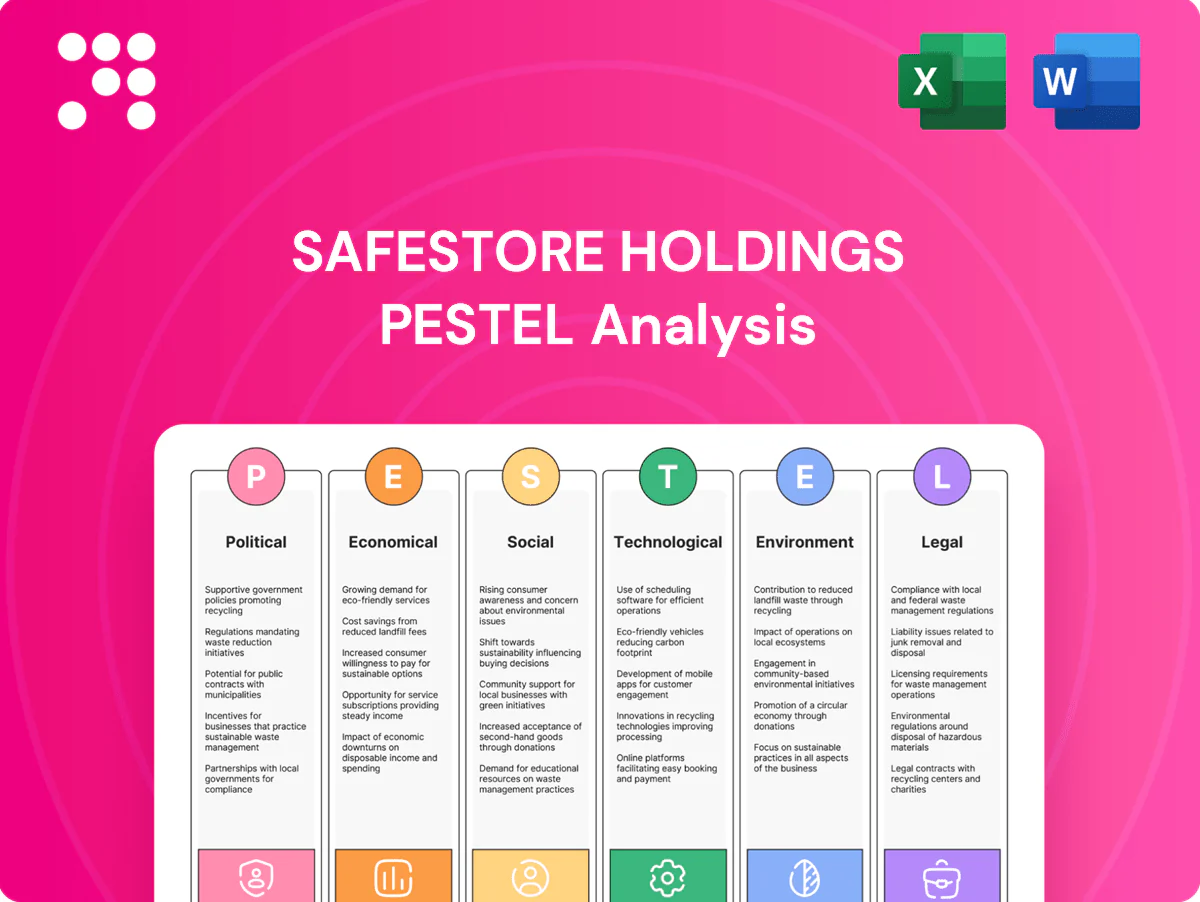
The Safestore Holdings PESTLE Analysis examines political, economic, social, technological, legal and environmental factors affecting the business and strategic risks/opportunities. The content and structure shown in the preview is the same document you’ll download after payment. It is fully formatted and ready to use.

Original: $10.00
-65%$10.00
$3.50Product Information
Product Information
Shipping & Returns
Shipping & Returns
Description
Make Smarter Strategic Decisions with a Complete PESTEL View
Discover how political shifts, economic cycles, and sustainability trends are reshaping Safestore Holdings’ growth prospects in our targeted PESTLE analysis. Packed with actionable insights for investors and strategists, it highlights risks and opportunities you can act on today. Purchase the full report to access the complete, downloadable breakdown.
Political factors
Planning and land-use policy
Local and national planning rules determine where and how large new Safestore sites can be built, with implications for urban versus greenfield footprints. Delays or refusals in planning permissions can slow expansion and increase development costs, prompting closer council engagement to protect pipeline visibility. A policy push toward densification—UK housing target of 300,000 homes p.a.—would favor multi-storey urban sites where Safestore already focuses in the UK and Europe.
Business rates and local taxation
UK business rates revaluation effective April 2023 materially affects Safestore operating costs, with national business rates raising roughly £30bn annually for central government. Reliefs or targeted revaluation outcomes can lift margins, while rate increases constrain pricing power. Regional disparities in rateable values drive site selection and portfolio optimisation decisions. Active appeals and a focused rating strategy reduce bill volatility and cashflow risk.
Trade, labor, and immigration stance
Immigration and labour policies directly affect Safestore’s staffing for operations and development, with UK net migration at 606,000 in the year to mid‑2023 indicating continued labour supply shifts. Restrictions can raise wage inflation and recruitment lead times, squeezing margins. Sourcing skilled trades for builds and refits is sensitive to visa regimes, while political stability underpins predictable workforce planning.
Infrastructure and transport investment
Government spending on roads and public transport reshapes catchment accessibility for Safestore; UK population ~67.1 million (ONS mid‑2023) increases urban demand and better connectivity can lift occupancy and achievable rents by expanding customer draw. Conversely, congestion or limited access reduces site attractiveness and turnover. Monitoring local infrastructure plans supports proactive location strategy.
- Track local transport projects
- Prioritise sites near improved links
Security and public safety priorities
Policy emphasis on crime prevention drives Safestore to meet higher standards for surveillance and access control, while grants and official guidance encourage rollout of enhanced security tech and remote monitoring. Local authority compliance expectations shape site procedures and incident reporting, and strong alignment with community policing builds trust and lowers operational risk.
- surveillance standards
- grant-driven upgrades
- local compliance
- community trust
Planning rules, housing target and migration reshape UK site strategy and security spend
Planning permissions, April 2023 business rates revaluation and UK housing target of 300,000 homes p.a. shape Safestore expansion, site type and margins. Net migration 606,000 (year to mid‑2023) and UK population 67.1m affect labour supply and urban demand. Transport spending and crime-prevention policy influence catchment access and security spend.
| Metric | Value |
|---|---|
| UK population (mid‑2023) | 67.1m |
| Net migration (year to mid‑2023) | 606,000 |
| Business rates (annual) | £30bn |
| Housing target | 300,000 p.a. |
What is included in the product
Detailed Word Document
Explores how external macro-environmental factors uniquely affect Safestore Holdings across Political, Economic, Social, Technological, Environmental and Legal dimensions, with data-driven trends and forward-looking insights tailored to the UK/European self-storage market. Designed for executives and investors to identify threats, opportunities and strategy implications for funding, operations and growth.
Customizable Excel Spreadsheet
A concise, visually segmented PESTLE summary for Safestore Holdings that can be dropped into presentations, shared across teams, and annotated for local context—streamlining external risk discussions and strategic planning.
Economic factors
Interest rates and financing costs
Higher interest rates (UK Bank Rate peaked at 5.25% in 2023) raise Safestore’s debt servicing costs and increase hurdle rates for new development, compressing valuations for property-backed assets as yields reprice. Rate declines enable accretive refinancing and support pipeline growth by lowering funding costs. Regular sensitivity analysis calibrates optimal leverage and dividend cover to navigate rate volatility.
Housing market and mobility
Moves, renovations and downsizing drive Safestore demand; slow housing transactions can soften short-term move-related bookings, while renovation-driven storage helps offset declines. Urban micro-living and a growing private rented sector (~20% of English households) support longer-stay units. Tracking listings and completions alongside UK population (~68m mid-2024) improves demand forecasting.
SME activity and e-commerce
With roughly 5.6 million SMEs in the UK and global e-commerce sales of about $5.7 trillion in 2024, small businesses increasingly use self‑storage for inventory, seasonal peaks and last‑mile staging near customers.
UK online retail penetration near 30% in 2024 amplifies demand for flexible, city‑proximate space; macro slowdowns may cut absolute demand but increase the value of short, cancellable contracts and tailored business packages that raise yield per square foot.
Inflation and operating costs
Energy, materials and labor inflation have squeezed margins for Safestore, though UK CPI eased to about 2.0% (ONS, June 2024) reducing headline pressure; index-linked price reviews and dynamic pricing have recaptured cost increases and protected yields. Rising build costs compress development IRRs, making new site viability sensitive to capex, while strategic procurement and energy hedging are key mitigants.
- Energy: hedging to cap volatility
- Materials/labour: raises capex, lowers IRR
- Index-linked reviews: preserve revenue
- Dynamic pricing: immediate margin recovery
Consumer confidence and discretionary spend
Storage demand is partly need-driven but sensitive to household budgets; UK GfK consumer confidence moved from about -24 in 2023 to roughly -12 by mid-2024, showing capacity for recovery that can support occupancy without large rate increases. Weak confidence tends to extend customer churn and compress achievable rate growth, making promotions and flexible terms effective tools to stabilise occupancy and revenue. Marketing ROI becomes pivotal in down cycles to acquire higher-value, lower-churn customers.
- Churn risk up when consumer confidence falls
- Promotions/flexible terms help stabilise occupancy
- Rate growth compresses in tougher consumer climates
- Marketing ROI critical to retain/acquire profitable customers
Planning rules, housing target and migration reshape UK site strategy and security spend
Higher rates (Bank Rate peak 5.25% 2023) raise debt and capex hurdles; rate falls ease refinancing. Demand supported by moves, urban micro‑living, ~5.6m UK SMEs and $5.7trn e‑commerce (2024) with ~30% online retail penetration (2024). CPI ~2.0% (Jun 2024) eases cost pressure but consumer confidence ~-12 (mid‑2024) keeps churn risk elevated.
| Metric | Value |
|---|---|
| Bank Rate (peak) | 5.25% (2023) |
| CPI | ~2.0% (Jun 2024) |
| UK pop | ~68m (mid‑2024) |
| SMEs | ~5.6m |
| E‑commerce | $5.7trn (2024) |
| Online retail | ~30% (2024) |
| GfK confidence | ~-12 (mid‑2024) |
Preview the Actual Deliverable
Safestore Holdings PESTLE Analysis
The Safestore Holdings PESTLE Analysis examines political, economic, social, technological, legal and environmental factors affecting the business and strategic risks/opportunities. The content and structure shown in the preview is the same document you’ll download after payment. It is fully formatted and ready to use.