Rumo PESTLE Analysis

Your Shortcut to Market Insight Starts Here
Gain a strategic advantage with our tailored PESTLE Analysis of Rumo. Unpack political, economic, social, technological, legal and environmental forces shaping its rail logistics leadership and spot risks and growth levers fast. Purchase the full, editable report for instant, board-ready insights and actionable intelligence.
Political factors

Federal infrastructure policy and concessions
Concession awards, renewals and expansions for Rumo hinge on Brasília’s priorities and four-year budget cycles, with awarded concessions in 2024 reinforcing investment visibility for rail operators. Rumo's network of c.14,000 km (2024) means shifts in the federal agenda can materially accelerate or delay track, terminal and rolling-stock capex. Alignment with national logistics programs and PPP frameworks can unlock fiscal incentives and financing; misalignment raises political risk and cost of capital. A stable concession pipeline reduces long-horizon capex uncertainty and supports multi-year financing plans.
Regulatory oversight by ANTT and transport ministries
Regulatory oversight by ANTT and transport ministries shapes operational tariffs, performance metrics and service obligations for Rumo, Brazil’s largest private rail operator with a network of about 12,500 km; changes in rules on track access, safety or service quality can materially alter costs and capacity utilization and pressure margins or capex schedules, while predictable, data-driven regulation supports planning and financing.

Port governance and federal–state coordination
Rumo’s port interfaces — notably with Santos and Itaqui — hinge on authority decisions on dredging and berth allocation, with last‑mile rail‑port connectivity shaped by federal–state coordination; in 2024 Rumo moved roughly 58 million tonnes by rail, exposing volume to port constraints. Political frictions at state or municipal levels have delayed permitting and right‑of‑way works, while strong intergovernmental alignment can rapidly boost corridor throughput and asset utilization.

Election cycles and policy continuity
Election cycles, notably Brazil’s four-year presidential cycle (last national vote 2022, new administration 2023), can reset priorities on concessions, privatizations and freight modal policy, creating transition risks from contract reviews and subsidy adjustments; continuity supports multi-year projects and financing, while discontinuity prompts renegotiations; scenario planning reduces electoral volatility.
- Risk: contract and subsidy review
- Opportunity: financing for multi-year projects
- Mitigation: scenario planning for electoral shifts
Trade diplomacy impacting agri-exports
Brazil’s trade diplomacy directly affects rail-borne soy, corn, sugar and pulp volumes, with China purchasing roughly two-thirds of Brazilian soy, concentrating flows toward export corridors used by Rumo.
Tariffs, quotas or sanitary disputes with major buyers can quickly reroute cargo between Atlantic and northern ports, altering corridor demand.
Political support for export competitiveness and trade agreements boosts rail tonnage, while geopolitical shocks can sharply reduce or reroute shipments.
- China ~ two-thirds of soy exports
- Tariff/quota disputes shift corridor flows
- Political export support = higher rail demand
- Geopolitical shocks can cut/reroute volumes
Policy drives capex timing; 2024 concessions tighten corridor risk
Political decisions on concessions, budgets and PPPs drive Rumo’s capex timing; awarded concessions in 2024 improved investment visibility. ANTT rules determine tariffs, access and penalties, affecting margins and utilization. Port coordination (Santos, Itaqui) and trade diplomacy (China ~66% of soy purchases) directly shift corridor volumes and financing risk.
| Indicator | 2024 value | Political impact |
|---|---|---|
| Network length | ~14,000 km | Capex exposure |
| Rail volumes | ~58 Mt | Port/policy sensitivity |
| Soy exports to China | ~66% | Corridor concentration |
| Election cycle | 4 years | Policy volatility |
What is included in the product
 Detailed Word Document
Explores how macro-environmental factors uniquely affect Rumo across Political, Economic, Social, Technological, Environmental and Legal dimensions, with data-backed trends and region-specific regulatory context. Designed for executives, consultants and investors, it highlights threats, opportunities and forward-looking scenarios in clean, presentation-ready format to support strategy, funding and scenario planning.

 Customizable Excel Spreadsheet
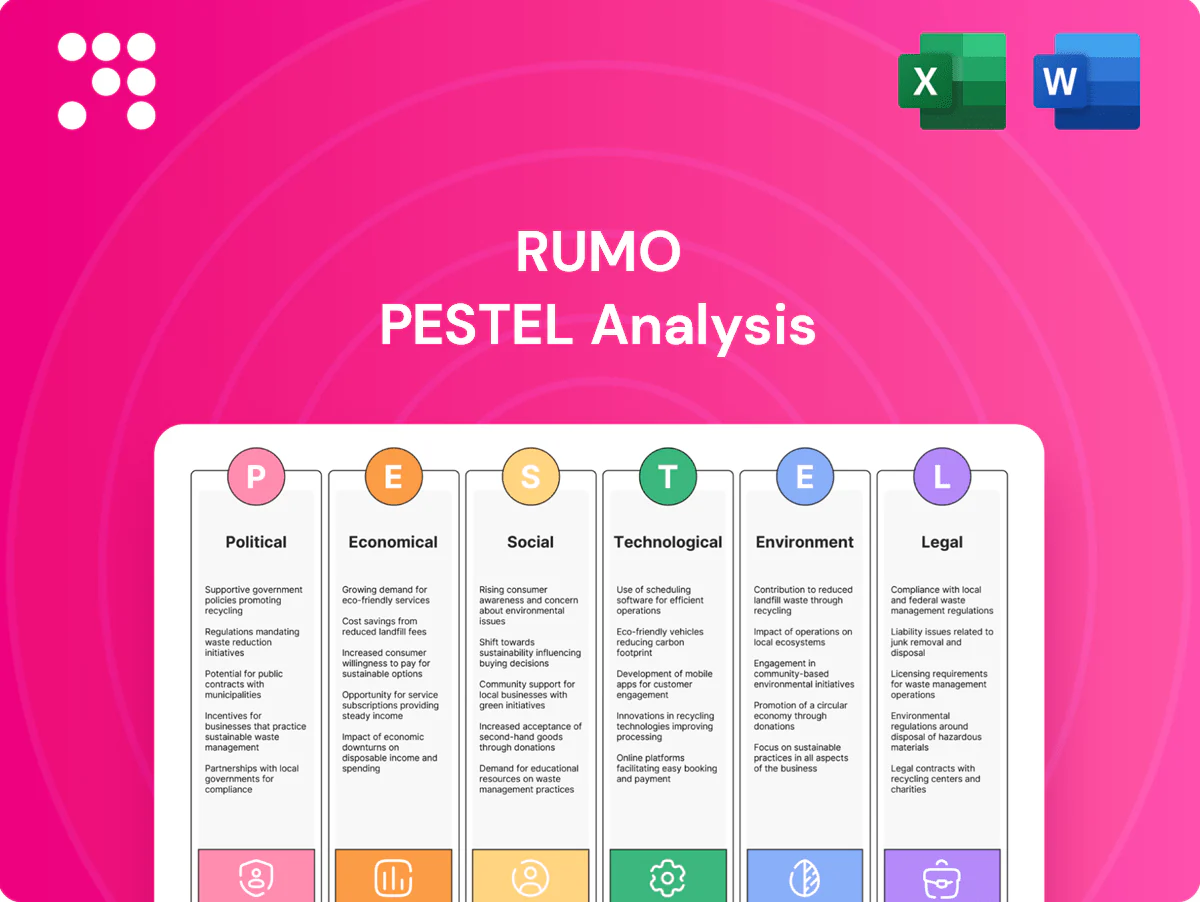
Condensed Rumo PESTLE summary, visually segmented by factor, enables quick risk and opportunity alignment in meetings or presentations and is easily dropped into slides or shared across teams.
Economic factors

Commodity cycle dependence
Freight demand for Rumo closely follows agri and industrial output, driven by global prices for soybeans, sugar, pulp and fuels; USDA forecast Brazil's 2024 soybean crop at about 154 million tonnes, supporting export flows and rail volumes. High harvests and robust commodity prices in 2024 lifted volumes and revenue, while downturns tighten take-or-pay and renegotiation pressure. Diversification across commodities and regions smooths cycle volatility.
FX volatility and interest rates
BRL/USD volatility (average ~5.10 in 2024, trading 4.6–5.5 in 2024–H1 2025) alters Rumo’s export competitiveness and raises imported capex costs for locomotives and steel. Elevated Selic (~12.75% mid-2025) drives financing costs for long-dated yard expansion and rolling stock. Robust FX hedging and staggered debt maturities reduce refinancing risk. Currency swings also change truck-vs-rail price parity, shifting freight modal share.

Fuel and energy costs
Diesel price volatility—with Brent averaging ~$86/barrel in 2024—heightens Rumo’s traction fuel exposure and strengthens modal competition from trucking, as diesel remains a material component of logistics opex. Efficiency gains and strategic fuel procurement and hedging have narrowed margin impact in recent years. Electrification and alternative fuels (biofuels, CNG) could materially reshape unit costs over the next decade. Energy price shocks transmit to tariffs and contract pass-throughs.

Inflation and indexation
Brazilian inflation around 4% YoY in mid‑2025 raises wages, materials and maintenance costs for Rumo; indexation clauses in haulage contracts can pass through increases but typically with 3–6 month lags, squeezing margins. Persistent inflation elevates working capital and capex needs, so procurement discipline and productivity gains are essential to protect cash flow.
- Inflation ~4% YoY (mid‑2025)
- Indexation pass‑through with 3–6m lag
- Higher working capital & capex
- Focus: procurement discipline, productivity
Infrastructure investment and GDP growth
Macro growth in Brazil (GDP ~2.7% in 2024) supports industrial output and inland logistics demand, lifting Rumo volumes across its ~12,000 km network and terminals; public and private capex in key corridors has multiplied rail throughput, with corridor investments driving unit train frequency and terminal utilization. Slowdowns defer customer expansions and volume commitments, while countercyclical investment can capture share during recoveries.
- GDP growth 2024 ~2.7%
- Rumo network ~12,000 km
- Capex in corridors increases train frequency and throughput
- Countercyclical investment gains market share in recoveries
Policy drives capex timing; 2024 concessions tighten corridor risk
Freight demand tied to strong 2024 soybean crop ~154m t and GDP ~2.7% (2024) lifted volumes; BRL/USD avg ~5.10 (2024) and Selic ~12.75% (mid‑2025) raise capex/financing costs; Brent ~$86/bbl (2024) and diesel swings pressure modal competitiveness; inflation ~4% (mid‑2025) increases opex but indexation offers partial pass‑through.
| Metric | Value |
|---|---|
| Soja 2024 | 154m t |
| GDP 2024 | 2.7% |
| BRL/USD 2024 avg | ~5.10 |
| Selic | 12.75% (mid‑2025) |
| Inflation | ~4% (mid‑2025) |
Preview Before You Purchase
Rumo PESTLE Analysis
The preview shown here is the exact Rumo PESTLE Analysis document you’ll receive after purchase—fully formatted and ready to use. It contains the same content, layout, and professional structure visible in the screenshot, with no placeholders or teasers. After payment you’ll instantly download this final, ready-to-use file.

Original: $10.00
-65%$10.00
$3.50Product Information
Product Information
Shipping & Returns
Shipping & Returns
Description
Your Shortcut to Market Insight Starts Here
Gain a strategic advantage with our tailored PESTLE Analysis of Rumo. Unpack political, economic, social, technological, legal and environmental forces shaping its rail logistics leadership and spot risks and growth levers fast. Purchase the full, editable report for instant, board-ready insights and actionable intelligence.
Political factors
Federal infrastructure policy and concessions
Concession awards, renewals and expansions for Rumo hinge on Brasília’s priorities and four-year budget cycles, with awarded concessions in 2024 reinforcing investment visibility for rail operators. Rumo's network of c.14,000 km (2024) means shifts in the federal agenda can materially accelerate or delay track, terminal and rolling-stock capex. Alignment with national logistics programs and PPP frameworks can unlock fiscal incentives and financing; misalignment raises political risk and cost of capital. A stable concession pipeline reduces long-horizon capex uncertainty and supports multi-year financing plans.
Regulatory oversight by ANTT and transport ministries
Regulatory oversight by ANTT and transport ministries shapes operational tariffs, performance metrics and service obligations for Rumo, Brazil’s largest private rail operator with a network of about 12,500 km; changes in rules on track access, safety or service quality can materially alter costs and capacity utilization and pressure margins or capex schedules, while predictable, data-driven regulation supports planning and financing.
Port governance and federal–state coordination
Rumo’s port interfaces — notably with Santos and Itaqui — hinge on authority decisions on dredging and berth allocation, with last‑mile rail‑port connectivity shaped by federal–state coordination; in 2024 Rumo moved roughly 58 million tonnes by rail, exposing volume to port constraints. Political frictions at state or municipal levels have delayed permitting and right‑of‑way works, while strong intergovernmental alignment can rapidly boost corridor throughput and asset utilization.
Election cycles and policy continuity
Election cycles, notably Brazil’s four-year presidential cycle (last national vote 2022, new administration 2023), can reset priorities on concessions, privatizations and freight modal policy, creating transition risks from contract reviews and subsidy adjustments; continuity supports multi-year projects and financing, while discontinuity prompts renegotiations; scenario planning reduces electoral volatility.
- Risk: contract and subsidy review
- Opportunity: financing for multi-year projects
- Mitigation: scenario planning for electoral shifts
Trade diplomacy impacting agri-exports
Brazil’s trade diplomacy directly affects rail-borne soy, corn, sugar and pulp volumes, with China purchasing roughly two-thirds of Brazilian soy, concentrating flows toward export corridors used by Rumo.
Tariffs, quotas or sanitary disputes with major buyers can quickly reroute cargo between Atlantic and northern ports, altering corridor demand.
Political support for export competitiveness and trade agreements boosts rail tonnage, while geopolitical shocks can sharply reduce or reroute shipments.
- China ~ two-thirds of soy exports
- Tariff/quota disputes shift corridor flows
- Political export support = higher rail demand
- Geopolitical shocks can cut/reroute volumes
Policy drives capex timing; 2024 concessions tighten corridor risk
Political decisions on concessions, budgets and PPPs drive Rumo’s capex timing; awarded concessions in 2024 improved investment visibility. ANTT rules determine tariffs, access and penalties, affecting margins and utilization. Port coordination (Santos, Itaqui) and trade diplomacy (China ~66% of soy purchases) directly shift corridor volumes and financing risk.
| Indicator | 2024 value | Political impact |
|---|---|---|
| Network length | ~14,000 km | Capex exposure |
| Rail volumes | ~58 Mt | Port/policy sensitivity |
| Soy exports to China | ~66% | Corridor concentration |
| Election cycle | 4 years | Policy volatility |
What is included in the product
Detailed Word Document
Explores how macro-environmental factors uniquely affect Rumo across Political, Economic, Social, Technological, Environmental and Legal dimensions, with data-backed trends and region-specific regulatory context. Designed for executives, consultants and investors, it highlights threats, opportunities and forward-looking scenarios in clean, presentation-ready format to support strategy, funding and scenario planning.
Customizable Excel Spreadsheet
Condensed Rumo PESTLE summary, visually segmented by factor, enables quick risk and opportunity alignment in meetings or presentations and is easily dropped into slides or shared across teams.
Economic factors
Commodity cycle dependence
Freight demand for Rumo closely follows agri and industrial output, driven by global prices for soybeans, sugar, pulp and fuels; USDA forecast Brazil's 2024 soybean crop at about 154 million tonnes, supporting export flows and rail volumes. High harvests and robust commodity prices in 2024 lifted volumes and revenue, while downturns tighten take-or-pay and renegotiation pressure. Diversification across commodities and regions smooths cycle volatility.
FX volatility and interest rates
BRL/USD volatility (average ~5.10 in 2024, trading 4.6–5.5 in 2024–H1 2025) alters Rumo’s export competitiveness and raises imported capex costs for locomotives and steel. Elevated Selic (~12.75% mid-2025) drives financing costs for long-dated yard expansion and rolling stock. Robust FX hedging and staggered debt maturities reduce refinancing risk. Currency swings also change truck-vs-rail price parity, shifting freight modal share.
Fuel and energy costs
Diesel price volatility—with Brent averaging ~$86/barrel in 2024—heightens Rumo’s traction fuel exposure and strengthens modal competition from trucking, as diesel remains a material component of logistics opex. Efficiency gains and strategic fuel procurement and hedging have narrowed margin impact in recent years. Electrification and alternative fuels (biofuels, CNG) could materially reshape unit costs over the next decade. Energy price shocks transmit to tariffs and contract pass-throughs.
Inflation and indexation
Brazilian inflation around 4% YoY in mid‑2025 raises wages, materials and maintenance costs for Rumo; indexation clauses in haulage contracts can pass through increases but typically with 3–6 month lags, squeezing margins. Persistent inflation elevates working capital and capex needs, so procurement discipline and productivity gains are essential to protect cash flow.
- Inflation ~4% YoY (mid‑2025)
- Indexation pass‑through with 3–6m lag
- Higher working capital & capex
- Focus: procurement discipline, productivity
Infrastructure investment and GDP growth
Macro growth in Brazil (GDP ~2.7% in 2024) supports industrial output and inland logistics demand, lifting Rumo volumes across its ~12,000 km network and terminals; public and private capex in key corridors has multiplied rail throughput, with corridor investments driving unit train frequency and terminal utilization. Slowdowns defer customer expansions and volume commitments, while countercyclical investment can capture share during recoveries.
- GDP growth 2024 ~2.7%
- Rumo network ~12,000 km
- Capex in corridors increases train frequency and throughput
- Countercyclical investment gains market share in recoveries
Policy drives capex timing; 2024 concessions tighten corridor risk
Freight demand tied to strong 2024 soybean crop ~154m t and GDP ~2.7% (2024) lifted volumes; BRL/USD avg ~5.10 (2024) and Selic ~12.75% (mid‑2025) raise capex/financing costs; Brent ~$86/bbl (2024) and diesel swings pressure modal competitiveness; inflation ~4% (mid‑2025) increases opex but indexation offers partial pass‑through.
| Metric | Value |
|---|---|
| Soja 2024 | 154m t |
| GDP 2024 | 2.7% |
| BRL/USD 2024 avg | ~5.10 |
| Selic | 12.75% (mid‑2025) |
| Inflation | ~4% (mid‑2025) |
Preview Before You Purchase
Rumo PESTLE Analysis
The preview shown here is the exact Rumo PESTLE Analysis document you’ll receive after purchase—fully formatted and ready to use. It contains the same content, layout, and professional structure visible in the screenshot, with no placeholders or teasers. After payment you’ll instantly download this final, ready-to-use file.