Ross Stores PESTLE Analysis

Your Shortcut to Market Insight Starts Here
Discover how political, economic, social, technological, legal, and environmental forces are reshaping Ross Stores’ competitive landscape in our concise PESTLE overview. This snapshot highlights key risks and opportunities for investors and strategists. For the complete, actionable analysis with data-driven recommendations, purchase the full PESTLE report and download instantly.
Political factors

U.S.–China trade and tariff policy exposure
Many apparel and home-goods categories are sourced from Asia, leaving landed costs exposed to Section 301 tariffs that target roughly $370 billion of Chinese goods with rates up to 25% (many at 7.5%); shifts or retaliatory measures can quickly compress off-price margins or force merchandise-mix changes, so Ross must sustain diversified sourcing and agile buying to mitigate policy volatility.
State and local policy variability for a national store base
Operating over 2,300 stores nationwide exposes Ross to varying state and local rules on zoning, permitting and store hours, which can delay openings and add costs; political shifts can change incentives or distribution-center costs—impacting CAPEX for expansion tied to FY2024 net sales of about $20.9 billion—so proactive government relations and rigorous site-selection diligence are essential.

Minimum wage and labor policy changes
Local and state minimum wage hikes—federal minimum still $7.25/hr while California reached $16/hr in 2024—directly raise labor and distribution center expenses across Ross Stores' network of over 2,200 stores. Scheduling and benefits mandates (predictive scheduling, paid leave) further increase compliance complexity and administrative cost. Ross must optimize labor productivity and invest in targeted training and scheduling tech to sustain service levels while controlling unit labor costs.

Trade agreements and import compliance
Changes to trade agreements since USMCA took effect (2020) continue to shift duty rates and documentation expectations, affecting sourcing costs; U.S. merchandise imports were about 3.3 trillion in 2023, underscoring exposure. Customs enforcement is tightening on valuation, country-of-origin rules and forced-labor prohibitions, raising seizure and compliance risks. Robust vendor due diligence and automated compliance systems reduce interruption risk and protect Ross Stores reputation.
- Trade rule shifts: duty and paperwork pressure
- Enforcement focus: valuation, origin, forced labor
- Mitigation: vendor due diligence, compliance automation
Public health and emergency policies
Public health and emergency policies can force temporary closures or capacity limits that disrupt Ross Stores operations and supply chains, shifting sales online and altering inventory turnover. Flexible allocation, inventory buffers and tested business continuity plans minimize margin impact and speed store reopenings. Government mandates remain a material operational risk.
- Operational disruptions from closures
- Shift to e‑commerce and altered inventory flows
- Importance of continuity planning and flexible allocation
Tariffs, customs & labor rules squeeze off-price margins; diversify sourcing, bolster continuity
Ross faces tariff risk from Section 301 (up to 25%, many at 7.5%) and customs enforcement, threatening off‑price margins and requiring diversified sourcing; operating 2,300+ stores ties it to varying state/local rules and labor mandates (federal $7.25, CA $16 in 2024) that raise operating costs against FY2024 sales of ~$20.9B. Public‑health closures and trade shifts (US imports ~$3.3T in 2023) make compliance, continuity and agile buying critical.
| Factor | Metric | Impact/Mitigation |
|---|---|---|
| Tariffs/Trade | Section 301 up to 25% | Diversify sourcing, compliance automation |
| Labor/Regulation | 2,300+ stores; CA $16 | Scheduling tech, productivity training |
| Operational risk | US imports $3.3T (2023) | Continuity plans, inventory buffers |
What is included in the product
 Detailed Word Document
Explores how macro-environmental factors specifically affect Ross Stores across Political, Economic, Social, Technological, Environmental and Legal dimensions, highlighting competitive and operational implications.

 Customizable Excel Spreadsheet
A concise, PESTLE-segmented summary of Ross Stores' external landscape, ideal for slide decks or meetings, helping teams quickly align on regulatory, economic and competitive risks while allowing users to add region- or business-specific notes for faster decision-making.
Economic factors

Consumer income pressure and value migration
US CPI rose 3.4% in 2024 while real average hourly earnings fell about 0.9% year-over-year (BLS), driving trade-down to off-price retailers. Ross benefits from this value-seeking shift but must tightly manage price perception to avoid discount erosion. Aggressive promotions and a broad, changing assortment support share gains in softer macro conditions.
Inventory availability from brand overstocks
Off-price thrives on brand overstocks from forecasting errors or demand shocks; economic volatility in 2023–24 expanded closeout pipelines, letting buyers capture inventory at deep discounts. Ross’s scale—over 2,000 stores—and vendor relationships helped secure high-quality packs, supporting FY2024 net sales of about $21.4 billion and margin resilience versus full-price peers.

Freight, logistics, and fuel cost swings
Ocean spot rates, which averaged about USD 2,000 per 40ft in 2024 (Drewry WCI), port dwell times for LA/LB eased to roughly 3.5 days in 2024 and U.S. diesel averaged about USD 4.10/gal (EIA), all raising Ross Stores total landed cost and slowing speed-to-floor. Tight trucking and chassis markets in 2024 pushed spot truck rates up ~12%, delaying assortments and reducing freshness of seasonal items. Strategic contracting, expanded intermodal use, and network optimization have been used to smooth volatility and preserve margins.

Interest rates and store economics
Higher interest rates raise occupancy and build-out costs and can damp discretionary spending; with the federal funds rate at 5.25–5.50% (July 2025) Ross faces higher financing and consumer-pressure headwinds. Elevated rates push up lease negotiation leverage and increase hurdle rates for new-store ROI. Prudent capital allocation and flexible lease structures help protect returns and maintain expansion discipline.
- Fed funds 5.25–5.50% (Jul 2025)
- Higher hurdle rates for new stores
- Flexible leases mitigate occupancy risk
Labor market tightness and productivity
Low US unemployment (annual average 3.7% in 2024, BLS) intensifies wage competition and turnover risk, forcing Ross Stores—which reported $18.55B net sales and ~88,000 employees in FY2023—to ensure hiring and training convert to higher sales per labor hour. Investments in workforce analytics and task simplification aim to preserve margins by improving labor efficiency and reducing shrink and overtime.
- US unemployment: 3.7% (2024, BLS)
- Ross FY2023 sales: $18.55B
- Workforce: ~88,000 employees
Tariffs, customs & labor rules squeeze off-price margins; diversify sourcing, bolster continuity
US CPI +3.4% (2024) and real average hourly earnings -0.9% drove trade-down to off-price, benefiting Ross but requiring price-perception control.
Supply-chain cost pressure—ocean ~USD2,000/40ft and diesel ~USD4.10/gal (2024)—raised landed costs; Ross used scale (≈2,000+ stores) to protect margins.
Higher rates (Fed funds 5.25–5.50% Jul 2025) and low unemployment (3.7% 2024) increase lease/hiring costs, tightening ROI on new stores.
| Metric | Value |
|---|---|
| CPI (2024) | +3.4% |
| Real wages (2024) | -0.9% YoY |
| Ross net sales (FY2024) | ≈$21.4B |
| Fed funds (Jul 2025) | 5.25–5.50% |
Preview Before You Purchase
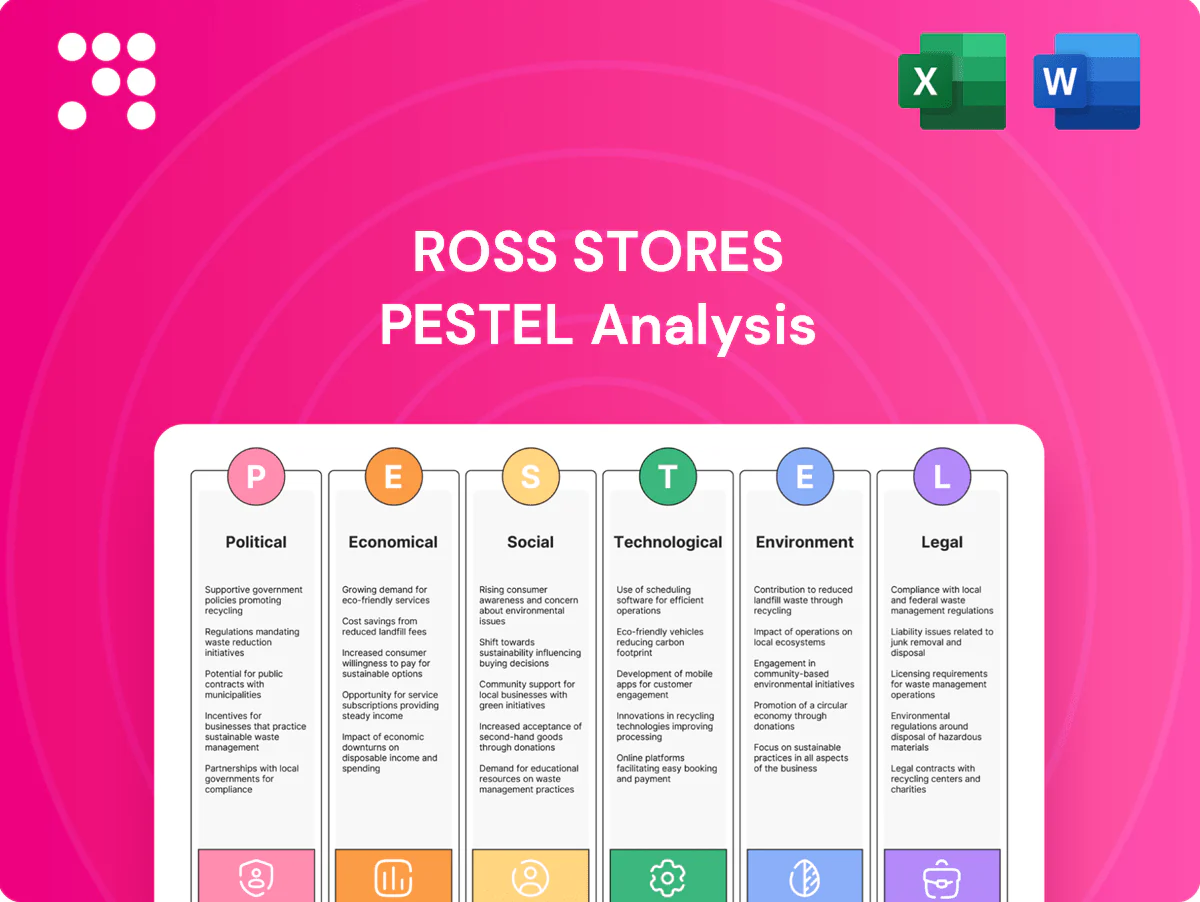
Ross Stores PESTLE Analysis
This Ross Stores PESTLE Analysis preview is the exact document you’ll receive after purchase—fully formatted and ready to use. It contains the complete political, economic, social, technological, legal and environmental review. No placeholders or teasers—what you see is the final, professionally structured file available for immediate download.

Product Information
Product Information
Shipping & Returns
Shipping & Returns
Description
Your Shortcut to Market Insight Starts Here
Discover how political, economic, social, technological, legal, and environmental forces are reshaping Ross Stores’ competitive landscape in our concise PESTLE overview. This snapshot highlights key risks and opportunities for investors and strategists. For the complete, actionable analysis with data-driven recommendations, purchase the full PESTLE report and download instantly.
Political factors
U.S.–China trade and tariff policy exposure
Many apparel and home-goods categories are sourced from Asia, leaving landed costs exposed to Section 301 tariffs that target roughly $370 billion of Chinese goods with rates up to 25% (many at 7.5%); shifts or retaliatory measures can quickly compress off-price margins or force merchandise-mix changes, so Ross must sustain diversified sourcing and agile buying to mitigate policy volatility.
State and local policy variability for a national store base
Operating over 2,300 stores nationwide exposes Ross to varying state and local rules on zoning, permitting and store hours, which can delay openings and add costs; political shifts can change incentives or distribution-center costs—impacting CAPEX for expansion tied to FY2024 net sales of about $20.9 billion—so proactive government relations and rigorous site-selection diligence are essential.
Minimum wage and labor policy changes
Local and state minimum wage hikes—federal minimum still $7.25/hr while California reached $16/hr in 2024—directly raise labor and distribution center expenses across Ross Stores' network of over 2,200 stores. Scheduling and benefits mandates (predictive scheduling, paid leave) further increase compliance complexity and administrative cost. Ross must optimize labor productivity and invest in targeted training and scheduling tech to sustain service levels while controlling unit labor costs.
Trade agreements and import compliance
Changes to trade agreements since USMCA took effect (2020) continue to shift duty rates and documentation expectations, affecting sourcing costs; U.S. merchandise imports were about 3.3 trillion in 2023, underscoring exposure. Customs enforcement is tightening on valuation, country-of-origin rules and forced-labor prohibitions, raising seizure and compliance risks. Robust vendor due diligence and automated compliance systems reduce interruption risk and protect Ross Stores reputation.
- Trade rule shifts: duty and paperwork pressure
- Enforcement focus: valuation, origin, forced labor
- Mitigation: vendor due diligence, compliance automation
Public health and emergency policies
Public health and emergency policies can force temporary closures or capacity limits that disrupt Ross Stores operations and supply chains, shifting sales online and altering inventory turnover. Flexible allocation, inventory buffers and tested business continuity plans minimize margin impact and speed store reopenings. Government mandates remain a material operational risk.
- Operational disruptions from closures
- Shift to e‑commerce and altered inventory flows
- Importance of continuity planning and flexible allocation
Tariffs, customs & labor rules squeeze off-price margins; diversify sourcing, bolster continuity
Ross faces tariff risk from Section 301 (up to 25%, many at 7.5%) and customs enforcement, threatening off‑price margins and requiring diversified sourcing; operating 2,300+ stores ties it to varying state/local rules and labor mandates (federal $7.25, CA $16 in 2024) that raise operating costs against FY2024 sales of ~$20.9B. Public‑health closures and trade shifts (US imports ~$3.3T in 2023) make compliance, continuity and agile buying critical.
| Factor | Metric | Impact/Mitigation |
|---|---|---|
| Tariffs/Trade | Section 301 up to 25% | Diversify sourcing, compliance automation |
| Labor/Regulation | 2,300+ stores; CA $16 | Scheduling tech, productivity training |
| Operational risk | US imports $3.3T (2023) | Continuity plans, inventory buffers |
What is included in the product
Detailed Word Document
Explores how macro-environmental factors specifically affect Ross Stores across Political, Economic, Social, Technological, Environmental and Legal dimensions, highlighting competitive and operational implications.
Customizable Excel Spreadsheet
A concise, PESTLE-segmented summary of Ross Stores' external landscape, ideal for slide decks or meetings, helping teams quickly align on regulatory, economic and competitive risks while allowing users to add region- or business-specific notes for faster decision-making.
Economic factors
Consumer income pressure and value migration
US CPI rose 3.4% in 2024 while real average hourly earnings fell about 0.9% year-over-year (BLS), driving trade-down to off-price retailers. Ross benefits from this value-seeking shift but must tightly manage price perception to avoid discount erosion. Aggressive promotions and a broad, changing assortment support share gains in softer macro conditions.
Inventory availability from brand overstocks
Off-price thrives on brand overstocks from forecasting errors or demand shocks; economic volatility in 2023–24 expanded closeout pipelines, letting buyers capture inventory at deep discounts. Ross’s scale—over 2,000 stores—and vendor relationships helped secure high-quality packs, supporting FY2024 net sales of about $21.4 billion and margin resilience versus full-price peers.
Freight, logistics, and fuel cost swings
Ocean spot rates, which averaged about USD 2,000 per 40ft in 2024 (Drewry WCI), port dwell times for LA/LB eased to roughly 3.5 days in 2024 and U.S. diesel averaged about USD 4.10/gal (EIA), all raising Ross Stores total landed cost and slowing speed-to-floor. Tight trucking and chassis markets in 2024 pushed spot truck rates up ~12%, delaying assortments and reducing freshness of seasonal items. Strategic contracting, expanded intermodal use, and network optimization have been used to smooth volatility and preserve margins.
Interest rates and store economics
Higher interest rates raise occupancy and build-out costs and can damp discretionary spending; with the federal funds rate at 5.25–5.50% (July 2025) Ross faces higher financing and consumer-pressure headwinds. Elevated rates push up lease negotiation leverage and increase hurdle rates for new-store ROI. Prudent capital allocation and flexible lease structures help protect returns and maintain expansion discipline.
- Fed funds 5.25–5.50% (Jul 2025)
- Higher hurdle rates for new stores
- Flexible leases mitigate occupancy risk
Labor market tightness and productivity
Low US unemployment (annual average 3.7% in 2024, BLS) intensifies wage competition and turnover risk, forcing Ross Stores—which reported $18.55B net sales and ~88,000 employees in FY2023—to ensure hiring and training convert to higher sales per labor hour. Investments in workforce analytics and task simplification aim to preserve margins by improving labor efficiency and reducing shrink and overtime.
- US unemployment: 3.7% (2024, BLS)
- Ross FY2023 sales: $18.55B
- Workforce: ~88,000 employees
Tariffs, customs & labor rules squeeze off-price margins; diversify sourcing, bolster continuity
US CPI +3.4% (2024) and real average hourly earnings -0.9% drove trade-down to off-price, benefiting Ross but requiring price-perception control.
Supply-chain cost pressure—ocean ~USD2,000/40ft and diesel ~USD4.10/gal (2024)—raised landed costs; Ross used scale (≈2,000+ stores) to protect margins.
Higher rates (Fed funds 5.25–5.50% Jul 2025) and low unemployment (3.7% 2024) increase lease/hiring costs, tightening ROI on new stores.
| Metric | Value |
|---|---|
| CPI (2024) | +3.4% |
| Real wages (2024) | -0.9% YoY |
| Ross net sales (FY2024) | ≈$21.4B |
| Fed funds (Jul 2025) | 5.25–5.50% |
Preview Before You Purchase
Ross Stores PESTLE Analysis
This Ross Stores PESTLE Analysis preview is the exact document you’ll receive after purchase—fully formatted and ready to use. It contains the complete political, economic, social, technological, legal and environmental review. No placeholders or teasers—what you see is the final, professionally structured file available for immediate download.