Rolls Royce Holdings PESTLE Analysis

Your Competitive Advantage Starts with This Report
Unlock strategic clarity with our PESTLE analysis of Rolls‑Royce Holdings—examining political risks, economic cycles, tech disruption, social expectations, regulatory changes and environmental pressures shaping its future. Ideal for investors and strategists; purchase the full, ready-to-use report to get actionable insights and forecast-ready recommendations.
Political factors

Defense spending and strategic alliances
Government budgets in the UK, US, EU and allies—with NATO members collectively spending over $1.2 trillion in 2023 and the US FY2025 defense request near $850 billion—drive demand for Rolls‑Royce defense engines and services. NATO rearmament, AUKUS and Indo‑Pacific priorities underpin long‑cycle order books. Shifts in administrations can reweight procurement timelines and platform mix. Multi‑year funding stability improves capacity planning and capital allocation.
Geopolitical tensions and export controls
Since 2022 sanctions on Russia and tightened technology controls targeting China have constrained Rolls‑Royce’s market access and disrupted aero‑engine supply chains. ITAR and EAR regimes impose content restrictions and data‑transfer limits, adding licensing lead times measured in months and shaping engineering programmes. Export approvals determine which engines and upgrades can be sold into specific regions. Diversifying suppliers and forging local partnerships have become core mitigation strategies.

UK industrial policy and support
UK government backing—including ATI programmes that have channelled over £1bn into aerospace R&D and a reported up to £210m commitment to Rolls‑Royce SMR development—shapes project economics for net‑zero aviation and SMRs. The National Security and Investment regime, covering 17 strategic sectors, constrains JV structures and M&A. Public grant cycles (typically 3–5 years) drive breakthrough tech timelines, and policy continuity is critical for SMR commercialization schedules.

Trade policy and post‑Brexit frictions
Post-Brexit customs processes, rules of origin, and regulatory divergence increase cost and lead times for Rolls‑Royce by adding certification and paperwork complexity for aero‑engine parts moving between UK and EU, affecting MRO and OEM flows. Bilateral agreements—where in place—can simplify parts movement and mutual recognition of certifications. Sterling volatility versus USD/EUR complicates tariff and sourcing choices; supply‑chain localization is used to hedge border risks.
- Customs complexity: higher compliance burden
- Rules of origin: affects duty exposure
- Bilateral accords: ease certification/parts flow
- FX volatility: influences sourcing/tariffs
- Localization: mitigates border risk
Public procurement transparency
Defense and nuclear contracts for Rolls-Royce face intensive political and parliamentary scrutiny on cost, schedule and domestic value, intensified by the UK Procurement Act 2023 and frequent National Audit Office reviews. Local content and workforce commitments often decide award outcomes, and program overruns trigger formal reviews and potential scope changes. Proactive stakeholder management preserves the companys licence to operate and access to UK strategic programmes.
- Procurement Act 2023 increased transparency requirements
- NAO and parliamentary reviews target overruns
- Local content/workforce clauses decisive in awards
- Stakeholder engagement critical to retain programme access
Defence budgets, export controls and UK support reshape aerospace supply outlook
Government defence budgets drive Rolls‑Royce demand (NATO ~$1.2tn 2023; US FY2025 request ~$850bn). Since 2022 sanctions and ITAR/EAR controls limit market access and add licensing delays. UK support (ATI >£1bn; up to £210m for SMR) and Procurement Act 2023 raise funding and scrutiny; post‑Brexit customs add cost and certification friction.
| Factor | Key data | Impact |
|---|---|---|
| Defence spend | NATO $1.2tn; US $850bn | Order visibility |
| Controls | Sanctions since 2022; ITAR/EAR | Market access limits |
| UK support | ATI >£1bn; SMR £210m | Project economics |
| Regulation | Procurement Act 2023 | Higher scrutiny |
| Brexit | Customs/rules of origin | Higher costs |
What is included in the product
 Detailed Word Document
Explores how Political, Economic, Social, Technological, Environmental and Legal factors uniquely affect Rolls Royce Holdings, with each section backed by relevant data and current trends to identify risks and opportunities. Designed for executives and investors, the analysis offers forward-looking insights and clean, report-ready findings to support scenario planning and strategic decision-making.

 Customizable Excel Spreadsheet
A concise, visually segmented PESTLE summary for Rolls‑Royce that eases meeting prep and decision‑making by highlighting external risks, regulatory pressures, technological trends and market drivers for quick slide inclusion, annotation, and cross‑team alignment.
Economic factors

Civil aviation cycle and engine flying hours
Widebody recovery and long‑haul traffic — international RPKs reached about 95% of 2019 levels in 2024 (IATA) — boost Rolls‑Royce aftermarket revenue via long‑term service agreements tied to aircraft utilization. Engine flying hours, reported by Rolls‑Royce as returning near 2019 levels in 2024, are the primary earnings lever for Civil Aerospace. Airline financial health (IATA industry net profit ~USD24bn in 2024) and pace of fleet retirements versus new‑gen penetration materially affect shop visit timing, pricing and margins.
FX exposure and cost base
Rolls-Royce earns roughly 70% of civil aerospace revenues in USD while significant cost inputs remain in GBP and EUR, concentrating FX mismatch and sensitising reported margins and free cash flow to dollar/sterling/euro moves. Currency swings of 5–10% materially move operating profit and cash conversion in stress scenarios. The company runs rolling hedges that smooth near‑term volatility but cannot offset structural FX shifts; supplier contracts and price‑escalation clauses pass part of FX risk down the chain.

Inflation, rates, and capital intensity
Input cost inflation in materials and labour continues to pressure programme economics, squeezing margins despite productivity drives; Rolls‑Royce cites ongoing design‑to‑cost initiatives to protect returns. Higher interest rates — Bank of England 5.25% and US Fed funds ~5.25–5.50% (mid‑2025) — increase working capital and long‑cycle project financing costs, raising hurdle rates versus pre‑pandemic levels. Milestone cash profiles and timely milestone payments therefore remain critical for liquidity management.

Supply chain resilience
Titanium, precision castings and avionics electronics remain bottlenecks for Rolls‑Royce supply chains; China produced roughly 60% of global titanium sponge in 2023 and electronics lead times reached as high as 40 weeks in 2024, pressuring delivery slots. Dual‑sourcing and near‑shoring reduce disruption risk but add qualification and logistics complexity; supplier health and capacity investments drive ramp schedules while inventory strategy must trade resilience against cash discipline.
- Titanium concentration: ~60% China (2023)
- Electronics lead times: up to 40 weeks (2024)
- Dual‑sourcing raises supplier count and qual cost
- Inventory vs cash: critical for engine ramp
End‑market diversification
End‑market diversification at Rolls‑Royce—spanning aero, Power Systems (marine, rail, distributed power), Defence and SMRs—helps smooth aerospace cyclicality; Power Systems moderates swings while Defence delivers long‑duration, lower‑volatility revenue and backlog. SMR development offers strategic optionality but requires significant upfront capital and long lead times, supporting cash generation across cycles.
- Power Systems: moderates aero cyclicality
- Defence: long‑duration, lower volatility
- SMRs: high optionality, high upfront investment
- Balanced portfolio: supports cash through cycles
Defence budgets, export controls and UK support reshape aerospace supply outlook
Recovery in long‑haul demand (IATA RPKs ~95% of 2019 in 2024) and engine flying hours near 2019 levels lift aftermarket revenue; airline industry net profit ~USD24bn (2024) and fleet renewal pace drive shop visits and margins. FX mismatch (70% civil revenue USD vs GBP/EUR costs) and 5–10% currency moves materially affect profits despite rolling hedges. Higher rates (BoE 5.25%, Fed ~5.25–5.50% mid‑2025) raise financing and working‑capital costs.
| Metric | Value |
|---|---|
| IATA RPKs (2024) | ~95% of 2019 |
| Airline net profit (2024) | USD24bn |
| Titanium supply (2023) | ~60% China |
| Electronics lead times (2024) | up to 40 weeks |
What You See Is What You Get
Rolls Royce Holdings PESTLE Analysis
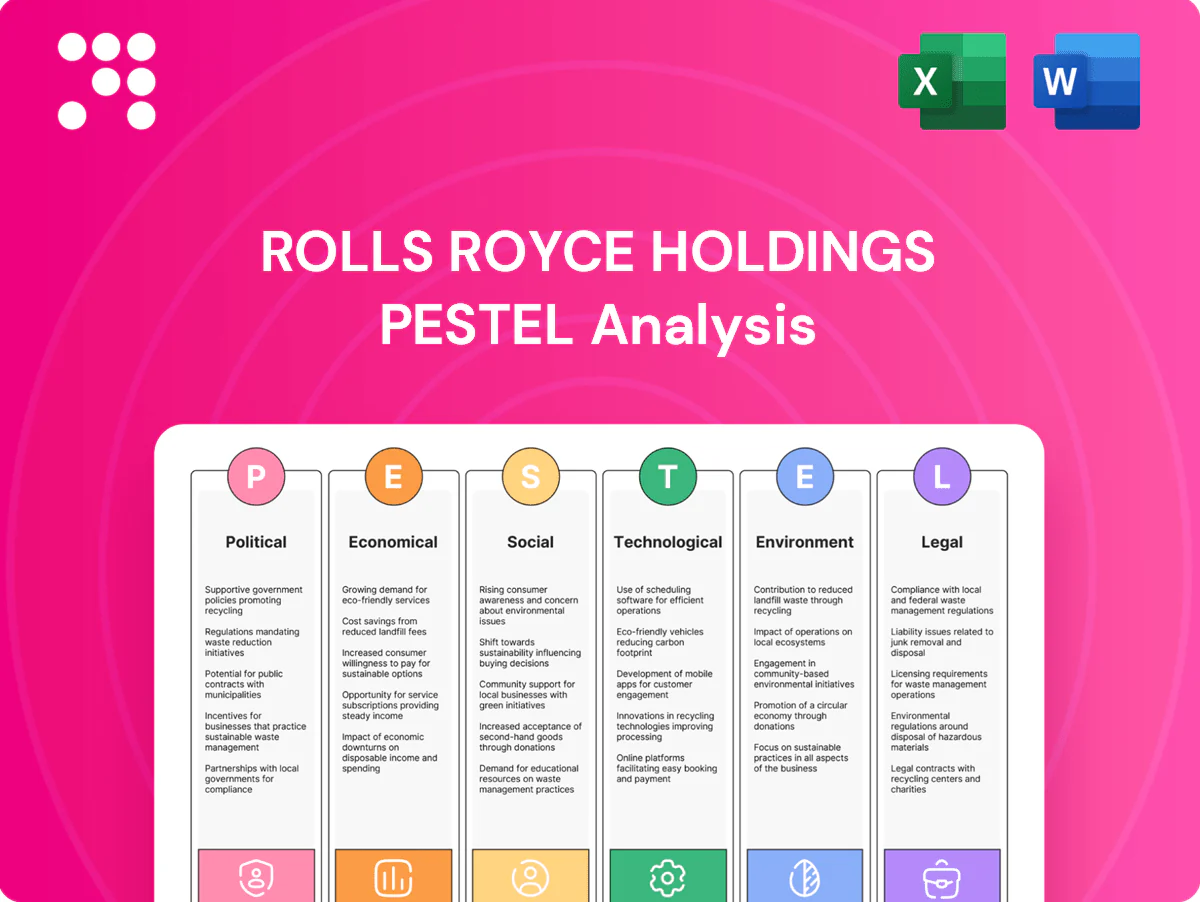
The Rolls‑Royce Holdings PESTLE analysis examines political, economic, social, technological, legal and environmental factors shaping the company’s strategic position, risk profile and growth opportunities across aerospace and power systems. It highlights regulatory pressures, supply‑chain risks, market demand trends and innovation drivers. The preview shown here is the exact document you’ll receive after purchase—fully formatted and ready to use.

Original: $10.00
-65%$10.00
$3.50Product Information
Product Information
Shipping & Returns
Shipping & Returns
Description
Your Competitive Advantage Starts with This Report
Unlock strategic clarity with our PESTLE analysis of Rolls‑Royce Holdings—examining political risks, economic cycles, tech disruption, social expectations, regulatory changes and environmental pressures shaping its future. Ideal for investors and strategists; purchase the full, ready-to-use report to get actionable insights and forecast-ready recommendations.
Political factors
Defense spending and strategic alliances
Government budgets in the UK, US, EU and allies—with NATO members collectively spending over $1.2 trillion in 2023 and the US FY2025 defense request near $850 billion—drive demand for Rolls‑Royce defense engines and services. NATO rearmament, AUKUS and Indo‑Pacific priorities underpin long‑cycle order books. Shifts in administrations can reweight procurement timelines and platform mix. Multi‑year funding stability improves capacity planning and capital allocation.
Geopolitical tensions and export controls
Since 2022 sanctions on Russia and tightened technology controls targeting China have constrained Rolls‑Royce’s market access and disrupted aero‑engine supply chains. ITAR and EAR regimes impose content restrictions and data‑transfer limits, adding licensing lead times measured in months and shaping engineering programmes. Export approvals determine which engines and upgrades can be sold into specific regions. Diversifying suppliers and forging local partnerships have become core mitigation strategies.
UK industrial policy and support
UK government backing—including ATI programmes that have channelled over £1bn into aerospace R&D and a reported up to £210m commitment to Rolls‑Royce SMR development—shapes project economics for net‑zero aviation and SMRs. The National Security and Investment regime, covering 17 strategic sectors, constrains JV structures and M&A. Public grant cycles (typically 3–5 years) drive breakthrough tech timelines, and policy continuity is critical for SMR commercialization schedules.
Trade policy and post‑Brexit frictions
Post-Brexit customs processes, rules of origin, and regulatory divergence increase cost and lead times for Rolls‑Royce by adding certification and paperwork complexity for aero‑engine parts moving between UK and EU, affecting MRO and OEM flows. Bilateral agreements—where in place—can simplify parts movement and mutual recognition of certifications. Sterling volatility versus USD/EUR complicates tariff and sourcing choices; supply‑chain localization is used to hedge border risks.
- Customs complexity: higher compliance burden
- Rules of origin: affects duty exposure
- Bilateral accords: ease certification/parts flow
- FX volatility: influences sourcing/tariffs
- Localization: mitigates border risk
Public procurement transparency
Defense and nuclear contracts for Rolls-Royce face intensive political and parliamentary scrutiny on cost, schedule and domestic value, intensified by the UK Procurement Act 2023 and frequent National Audit Office reviews. Local content and workforce commitments often decide award outcomes, and program overruns trigger formal reviews and potential scope changes. Proactive stakeholder management preserves the companys licence to operate and access to UK strategic programmes.
- Procurement Act 2023 increased transparency requirements
- NAO and parliamentary reviews target overruns
- Local content/workforce clauses decisive in awards
- Stakeholder engagement critical to retain programme access
Defence budgets, export controls and UK support reshape aerospace supply outlook
Government defence budgets drive Rolls‑Royce demand (NATO ~$1.2tn 2023; US FY2025 request ~$850bn). Since 2022 sanctions and ITAR/EAR controls limit market access and add licensing delays. UK support (ATI >£1bn; up to £210m for SMR) and Procurement Act 2023 raise funding and scrutiny; post‑Brexit customs add cost and certification friction.
| Factor | Key data | Impact |
|---|---|---|
| Defence spend | NATO $1.2tn; US $850bn | Order visibility |
| Controls | Sanctions since 2022; ITAR/EAR | Market access limits |
| UK support | ATI >£1bn; SMR £210m | Project economics |
| Regulation | Procurement Act 2023 | Higher scrutiny |
| Brexit | Customs/rules of origin | Higher costs |
What is included in the product
Detailed Word Document
Explores how Political, Economic, Social, Technological, Environmental and Legal factors uniquely affect Rolls Royce Holdings, with each section backed by relevant data and current trends to identify risks and opportunities. Designed for executives and investors, the analysis offers forward-looking insights and clean, report-ready findings to support scenario planning and strategic decision-making.
Customizable Excel Spreadsheet
A concise, visually segmented PESTLE summary for Rolls‑Royce that eases meeting prep and decision‑making by highlighting external risks, regulatory pressures, technological trends and market drivers for quick slide inclusion, annotation, and cross‑team alignment.
Economic factors
Civil aviation cycle and engine flying hours
Widebody recovery and long‑haul traffic — international RPKs reached about 95% of 2019 levels in 2024 (IATA) — boost Rolls‑Royce aftermarket revenue via long‑term service agreements tied to aircraft utilization. Engine flying hours, reported by Rolls‑Royce as returning near 2019 levels in 2024, are the primary earnings lever for Civil Aerospace. Airline financial health (IATA industry net profit ~USD24bn in 2024) and pace of fleet retirements versus new‑gen penetration materially affect shop visit timing, pricing and margins.
FX exposure and cost base
Rolls-Royce earns roughly 70% of civil aerospace revenues in USD while significant cost inputs remain in GBP and EUR, concentrating FX mismatch and sensitising reported margins and free cash flow to dollar/sterling/euro moves. Currency swings of 5–10% materially move operating profit and cash conversion in stress scenarios. The company runs rolling hedges that smooth near‑term volatility but cannot offset structural FX shifts; supplier contracts and price‑escalation clauses pass part of FX risk down the chain.
Inflation, rates, and capital intensity
Input cost inflation in materials and labour continues to pressure programme economics, squeezing margins despite productivity drives; Rolls‑Royce cites ongoing design‑to‑cost initiatives to protect returns. Higher interest rates — Bank of England 5.25% and US Fed funds ~5.25–5.50% (mid‑2025) — increase working capital and long‑cycle project financing costs, raising hurdle rates versus pre‑pandemic levels. Milestone cash profiles and timely milestone payments therefore remain critical for liquidity management.
Supply chain resilience
Titanium, precision castings and avionics electronics remain bottlenecks for Rolls‑Royce supply chains; China produced roughly 60% of global titanium sponge in 2023 and electronics lead times reached as high as 40 weeks in 2024, pressuring delivery slots. Dual‑sourcing and near‑shoring reduce disruption risk but add qualification and logistics complexity; supplier health and capacity investments drive ramp schedules while inventory strategy must trade resilience against cash discipline.
- Titanium concentration: ~60% China (2023)
- Electronics lead times: up to 40 weeks (2024)
- Dual‑sourcing raises supplier count and qual cost
- Inventory vs cash: critical for engine ramp
End‑market diversification
End‑market diversification at Rolls‑Royce—spanning aero, Power Systems (marine, rail, distributed power), Defence and SMRs—helps smooth aerospace cyclicality; Power Systems moderates swings while Defence delivers long‑duration, lower‑volatility revenue and backlog. SMR development offers strategic optionality but requires significant upfront capital and long lead times, supporting cash generation across cycles.
- Power Systems: moderates aero cyclicality
- Defence: long‑duration, lower volatility
- SMRs: high optionality, high upfront investment
- Balanced portfolio: supports cash through cycles
Defence budgets, export controls and UK support reshape aerospace supply outlook
Recovery in long‑haul demand (IATA RPKs ~95% of 2019 in 2024) and engine flying hours near 2019 levels lift aftermarket revenue; airline industry net profit ~USD24bn (2024) and fleet renewal pace drive shop visits and margins. FX mismatch (70% civil revenue USD vs GBP/EUR costs) and 5–10% currency moves materially affect profits despite rolling hedges. Higher rates (BoE 5.25%, Fed ~5.25–5.50% mid‑2025) raise financing and working‑capital costs.
| Metric | Value |
|---|---|
| IATA RPKs (2024) | ~95% of 2019 |
| Airline net profit (2024) | USD24bn |
| Titanium supply (2023) | ~60% China |
| Electronics lead times (2024) | up to 40 weeks |
What You See Is What You Get
Rolls Royce Holdings PESTLE Analysis
The Rolls‑Royce Holdings PESTLE analysis examines political, economic, social, technological, legal and environmental factors shaping the company’s strategic position, risk profile and growth opportunities across aerospace and power systems. It highlights regulatory pressures, supply‑chain risks, market demand trends and innovation drivers. The preview shown here is the exact document you’ll receive after purchase—fully formatted and ready to use.