Revolve PESTLE Analysis

Plan Smarter. Present Sharper. Compete Stronger.
Discover how political, economic, social, technological, legal, and environmental forces are shaping Revolve’s strategic outlook in our concise PESTLE snapshot—ideal for investors and strategists. This expert analysis highlights risks and growth levers you can act on immediately. Purchase the full PESTLE to get the complete, editable report and deploy data-driven decisions today.
Political factors

Tariffs and trade policy on apparel
Apparel import duties and shifting trade agreements materially affect Revolve’s landed costs, with U.S. Section 301 tariffs on Chinese goods reaching up to 25% and MFN apparel duties varying by tariff line (commonly 0–32%).
Escalation in China–U.S. policy or sourcing-country measures can compress margins or force vendor shifts; Revolve mitigates risk by diversifying suppliers and nearshoring to Mexico/Central America.
Proactive monitoring enables timely pricing and merchandising adjustments to preserve margins.
Cross-border e-commerce regulations
VAT/GST rules and removal of EU de minimis mean more parcels require VAT collection at sale, while the US de minimis remains $800, and customs processing can add 3–7 days to delivery. Harmonized digital tax efforts across 130+ jurisdictions raise compliance complexity and costs. Localizing checkout and offering duties‑paid options can lift cross‑border conversion by ~15–25%. Strategic focus on high‑LTV markets offsets regulatory overhead.

Social media platform governance
Policy shifts on content moderation and political ad rules can quickly change influencer reach and ROI; the global influencer market was about 21.1 billion in 2023 and remains sensitive to platform policies. Platform-specific restrictions on discovery—notably on apps like TikTok (≈1.1 billion MAUs in 2024)—reshape paid versus organic performance. Revolve must diversify channels and grow first-party audiences to buffer algorithm and policy shocks.

Industrial policy and supply chain resilience
Government reshoring incentives such as the CHIPS and Science Act (about 52 billion USD for semiconductors) and the Inflation Reduction Act (roughly 369 billion USD for clean energy/manufacturing) can reshape vendor economics and drive nearshoring decisions for Revolve suppliers.
Export controls and sanctions have periodically constrained sourcing of fabrics and trims, while participation in trusted-trader programs like CTPAT (over 11,000 partners) speeds customs clearance; scenario planning reduces exposure to geopolitical bottlenecks.
- Reshoring incentives: CHIPS 52B, IRA ~369B
- Trusted-trader: CTPAT >11,000 partners
- Risk: export controls disrupt fabric/trims sourcing
- Mitigation: scenario planning, friendshoring
Data localization and digital sovereignty
Country-level data localization and digital sovereignty rules force analytics stacks onto regional infrastructure or vetted vendors; noncompliance risks fines and loss of market access, notably GDPR penalties up to 4% of global turnover or €20m and China PIPL fines up to 5% of annual revenue or RMB50m. Building privacy-by-design and data minimization lowers regulatory friction and hosting costs while easing audits.
- Compliance: regional infra or vetted vendors
- Penalties: GDPR 4%/€20m, PIPL up to 5%/RMB50m
- Risks: fines, revoked operating privileges
- Mitigation: data minimization, privacy-by-design
Tariffs to 25%, reshoring incentives $421B, de minimis shifts
Tariffs (US Section 301 up to 25%; MFN apparel 0–32%) and reshoring incentives (CHIPS 52B, IRA ~369B) materially affect landed costs and supplier location choices. VAT/GST de minimis changes (US $800 vs EU removal) raise compliance and delivery friction. Platform policy risk (influencer market $21.1B 2023; TikTok ~1.1B MAU 2024) requires channel diversification and first‑party audiences.
| Factor | Key Metric |
|---|---|
| Tariffs | Section 301 up to 25%; MFN 0–32% |
| De minimis | US $800; EU removal increases VAT collection |
| Incentives | CHIPS 52B; IRA ~369B |
| Platforms | Influencer market $21.1B (2023); TikTok ~1.1B MAU (2024) |
| Compliance | GDPR 4%/€20M; PIPL ≤5% revenue |
What is included in the product
 Detailed Word Document
Explores how macro-environmental forces uniquely impact Revolve across Political, Economic, Social, Technological, Environmental, and Legal dimensions, with data-backed trends and market/regulatory context; designed for executives and investors, it offers forward-looking insights and ready-to-use findings for strategy, risk mitigation, and pitch materials.

 Customizable Excel Spreadsheet
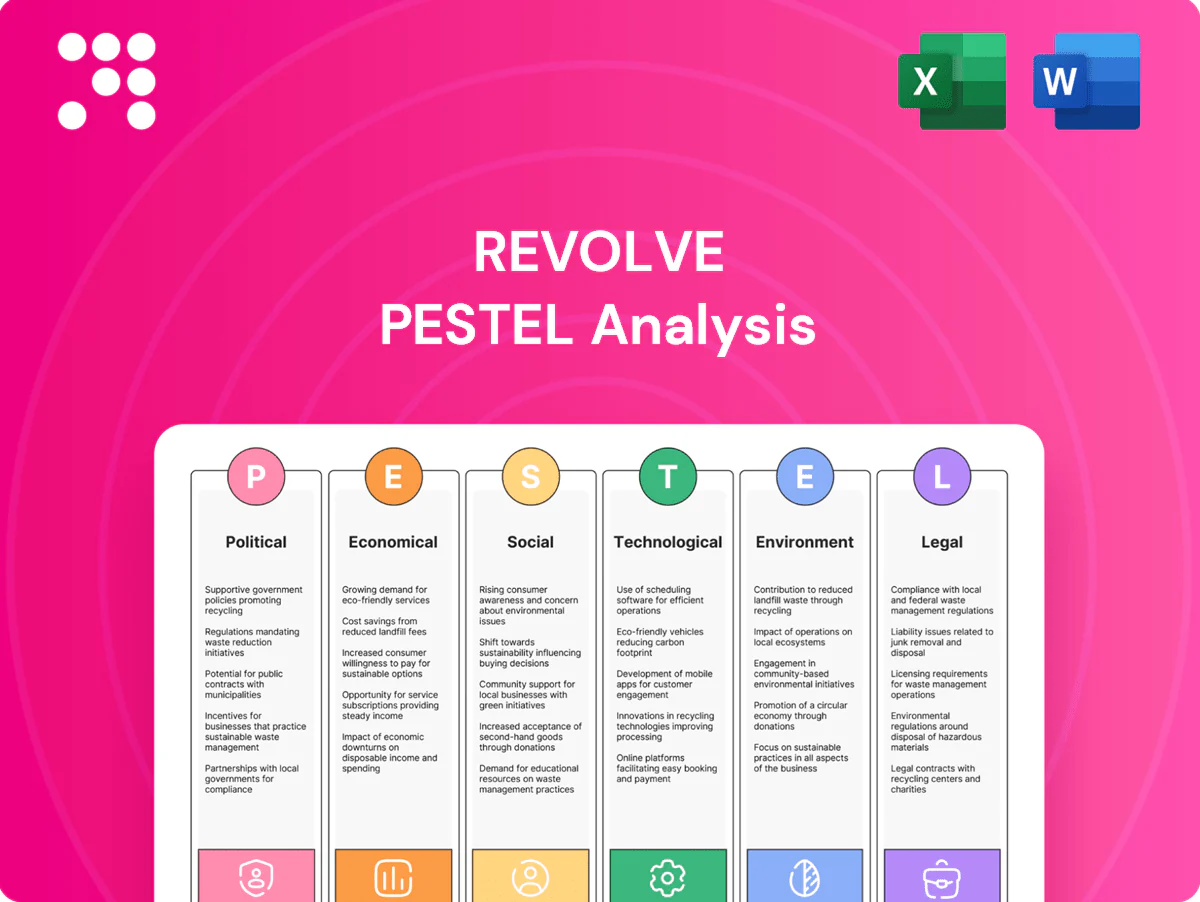
Revolve's PESTLE analysis is a clean, visually segmented summary that simplifies external risk and market-position discussions, making it easy to drop into presentations or share across teams for quick alignment.
Economic factors

Consumer spending and fashion cycle
Discretionary demand for apparel is cyclically sensitive to employment and confidence—US unemployment averaged about 3.9% in 2024, tightening discretionary budgets. Trend velocity determines full-price sell-through versus markdowns; faster cycles favor Revolve’s digital-first drops. With ~30% of apparel sales online in 2024, Revolve can balance novelty with evergreen SKUs. Agile merchandising cuts inventory carrying risk across cycles.
Inflation and logistics costs
Input cost inflation (US CPI 2024 3.4%) and parcel rate increases (FedEx/UPS 2024 general rate increases ~5.9%) compress gross margin and lift CAC. Fuel surcharges and higher fulfillment wages raise variable cost per order, squeezing unit economics. Negotiated carrier contracts and network optimization preserve margins at scale. Dynamic pricing and order-value incentives mitigate margin pressure by boosting AOV and conversion.

Foreign exchange and revenue mix
USD strength/weakness (DXY ~105 in mid-2025) directly alters international pricing and reported USD results, amplifying FX translation gains or losses for Revolve. Supplier contracts denominated in multiple currencies create margin volatility as COGS shifts with FX moves. Natural hedges from geographically matched revenues and selective forward/option hedging can stabilize COGS. Localized pricing and currency checkout improve conversion and protect margins abroad.

Returns rate and reverse logistics
High online-fashion return rates—industry studies show ~20–30% in 2023–24—erode contribution margin for Revolve as fit uncertainty and occasion-driven buying dominate returns. Investments in virtual try-on, improved size charts and policy tuning have been shown to cut return frequency meaningfully, while efficient consolidation, refurbishment and resale flow preserve gross margin and recovery rates.
- Returns rate: ~20–30% (2023–24 industry)
- Drivers: fit uncertainty, occasion buying
- Mitigants: sizing tools, policy tuning (reduces returns)
- Margin defense: consolidation, refurbishment, resale
Capital markets and cost of capital
Higher rate environment (federal funds 5.25–5.50% mid‑2025) raises hurdle rates for tech and inventory investments while Revolve reported $1.28B revenue in 2023, underscoring scale-sensitive capex decisions. 2024 Fed SLOOS signaled net tightening, pressuring vendor and influencer liquidity; strong cash conversion and inventory turns sustain optionality and disciplined spend preserves ROIC through cycles.
- hurdle-rate: fed funds 5.25–5.50% (mid‑2025)
- scale: Revolve revenue $1.28B (2023)
- credit: 2024 SLOOS net tightening
- strategy: cash conversion + disciplined spend = preserved ROIC
Tariffs to 25%, reshoring incentives $421B, de minimis shifts
Discretionary apparel demand tracks employment/confidence (US unemployment ~3.9% 2024) and faster trend velocity favors Revolve’s digital drops; online share ~30% (2024) aids SKU agility. Input inflation (CPI 2024 3.4%) and parcel hikes (~5.9% 2024) compress margins; fed funds 5.25–5.50% (mid‑2025) raises hurdle rates; DXY ~105 (mid‑2025) adds FX volatility.
| Metric | Value |
|---|---|
| Unemployment (US) | 3.9% (2024) |
| Online apparel share | ~30% (2024) |
| CPI | 3.4% (2024) |
| Parcel rate hikes | ~5.9% (2024) |
| Fed funds | 5.25–5.50% (mid‑2025) |
| DXY | ~105 (mid‑2025) |
| Revolve revenue | $1.28B (2023) |
| Returns | 20–30% (2023–24) |
Preview Before You Purchase
Revolve PESTLE Analysis
The Revolve PESTLE Analysis preview shown here is the exact document you’ll receive after purchase—fully formatted and ready to use. The layout, content, and structure visible are identical to the downloadable file, with no placeholders or teasers. After checkout you’ll instantly get this finished, professionally structured analysis.

Product Information
Product Information
Shipping & Returns
Shipping & Returns
Description
Plan Smarter. Present Sharper. Compete Stronger.
Discover how political, economic, social, technological, legal, and environmental forces are shaping Revolve’s strategic outlook in our concise PESTLE snapshot—ideal for investors and strategists. This expert analysis highlights risks and growth levers you can act on immediately. Purchase the full PESTLE to get the complete, editable report and deploy data-driven decisions today.
Political factors
Tariffs and trade policy on apparel
Apparel import duties and shifting trade agreements materially affect Revolve’s landed costs, with U.S. Section 301 tariffs on Chinese goods reaching up to 25% and MFN apparel duties varying by tariff line (commonly 0–32%).
Escalation in China–U.S. policy or sourcing-country measures can compress margins or force vendor shifts; Revolve mitigates risk by diversifying suppliers and nearshoring to Mexico/Central America.
Proactive monitoring enables timely pricing and merchandising adjustments to preserve margins.
Cross-border e-commerce regulations
VAT/GST rules and removal of EU de minimis mean more parcels require VAT collection at sale, while the US de minimis remains $800, and customs processing can add 3–7 days to delivery. Harmonized digital tax efforts across 130+ jurisdictions raise compliance complexity and costs. Localizing checkout and offering duties‑paid options can lift cross‑border conversion by ~15–25%. Strategic focus on high‑LTV markets offsets regulatory overhead.
Social media platform governance
Policy shifts on content moderation and political ad rules can quickly change influencer reach and ROI; the global influencer market was about 21.1 billion in 2023 and remains sensitive to platform policies. Platform-specific restrictions on discovery—notably on apps like TikTok (≈1.1 billion MAUs in 2024)—reshape paid versus organic performance. Revolve must diversify channels and grow first-party audiences to buffer algorithm and policy shocks.
Industrial policy and supply chain resilience
Government reshoring incentives such as the CHIPS and Science Act (about 52 billion USD for semiconductors) and the Inflation Reduction Act (roughly 369 billion USD for clean energy/manufacturing) can reshape vendor economics and drive nearshoring decisions for Revolve suppliers.
Export controls and sanctions have periodically constrained sourcing of fabrics and trims, while participation in trusted-trader programs like CTPAT (over 11,000 partners) speeds customs clearance; scenario planning reduces exposure to geopolitical bottlenecks.
- Reshoring incentives: CHIPS 52B, IRA ~369B
- Trusted-trader: CTPAT >11,000 partners
- Risk: export controls disrupt fabric/trims sourcing
- Mitigation: scenario planning, friendshoring
Data localization and digital sovereignty
Country-level data localization and digital sovereignty rules force analytics stacks onto regional infrastructure or vetted vendors; noncompliance risks fines and loss of market access, notably GDPR penalties up to 4% of global turnover or €20m and China PIPL fines up to 5% of annual revenue or RMB50m. Building privacy-by-design and data minimization lowers regulatory friction and hosting costs while easing audits.
- Compliance: regional infra or vetted vendors
- Penalties: GDPR 4%/€20m, PIPL up to 5%/RMB50m
- Risks: fines, revoked operating privileges
- Mitigation: data minimization, privacy-by-design
Tariffs to 25%, reshoring incentives $421B, de minimis shifts
Tariffs (US Section 301 up to 25%; MFN apparel 0–32%) and reshoring incentives (CHIPS 52B, IRA ~369B) materially affect landed costs and supplier location choices. VAT/GST de minimis changes (US $800 vs EU removal) raise compliance and delivery friction. Platform policy risk (influencer market $21.1B 2023; TikTok ~1.1B MAU 2024) requires channel diversification and first‑party audiences.
| Factor | Key Metric |
|---|---|
| Tariffs | Section 301 up to 25%; MFN 0–32% |
| De minimis | US $800; EU removal increases VAT collection |
| Incentives | CHIPS 52B; IRA ~369B |
| Platforms | Influencer market $21.1B (2023); TikTok ~1.1B MAU (2024) |
| Compliance | GDPR 4%/€20M; PIPL ≤5% revenue |
What is included in the product
Detailed Word Document
Explores how macro-environmental forces uniquely impact Revolve across Political, Economic, Social, Technological, Environmental, and Legal dimensions, with data-backed trends and market/regulatory context; designed for executives and investors, it offers forward-looking insights and ready-to-use findings for strategy, risk mitigation, and pitch materials.
Customizable Excel Spreadsheet
Revolve's PESTLE analysis is a clean, visually segmented summary that simplifies external risk and market-position discussions, making it easy to drop into presentations or share across teams for quick alignment.
Economic factors
Consumer spending and fashion cycle
Discretionary demand for apparel is cyclically sensitive to employment and confidence—US unemployment averaged about 3.9% in 2024, tightening discretionary budgets. Trend velocity determines full-price sell-through versus markdowns; faster cycles favor Revolve’s digital-first drops. With ~30% of apparel sales online in 2024, Revolve can balance novelty with evergreen SKUs. Agile merchandising cuts inventory carrying risk across cycles.
Inflation and logistics costs
Input cost inflation (US CPI 2024 3.4%) and parcel rate increases (FedEx/UPS 2024 general rate increases ~5.9%) compress gross margin and lift CAC. Fuel surcharges and higher fulfillment wages raise variable cost per order, squeezing unit economics. Negotiated carrier contracts and network optimization preserve margins at scale. Dynamic pricing and order-value incentives mitigate margin pressure by boosting AOV and conversion.
Foreign exchange and revenue mix
USD strength/weakness (DXY ~105 in mid-2025) directly alters international pricing and reported USD results, amplifying FX translation gains or losses for Revolve. Supplier contracts denominated in multiple currencies create margin volatility as COGS shifts with FX moves. Natural hedges from geographically matched revenues and selective forward/option hedging can stabilize COGS. Localized pricing and currency checkout improve conversion and protect margins abroad.
Returns rate and reverse logistics
High online-fashion return rates—industry studies show ~20–30% in 2023–24—erode contribution margin for Revolve as fit uncertainty and occasion-driven buying dominate returns. Investments in virtual try-on, improved size charts and policy tuning have been shown to cut return frequency meaningfully, while efficient consolidation, refurbishment and resale flow preserve gross margin and recovery rates.
- Returns rate: ~20–30% (2023–24 industry)
- Drivers: fit uncertainty, occasion buying
- Mitigants: sizing tools, policy tuning (reduces returns)
- Margin defense: consolidation, refurbishment, resale
Capital markets and cost of capital
Higher rate environment (federal funds 5.25–5.50% mid‑2025) raises hurdle rates for tech and inventory investments while Revolve reported $1.28B revenue in 2023, underscoring scale-sensitive capex decisions. 2024 Fed SLOOS signaled net tightening, pressuring vendor and influencer liquidity; strong cash conversion and inventory turns sustain optionality and disciplined spend preserves ROIC through cycles.
- hurdle-rate: fed funds 5.25–5.50% (mid‑2025)
- scale: Revolve revenue $1.28B (2023)
- credit: 2024 SLOOS net tightening
- strategy: cash conversion + disciplined spend = preserved ROIC
Tariffs to 25%, reshoring incentives $421B, de minimis shifts
Discretionary apparel demand tracks employment/confidence (US unemployment ~3.9% 2024) and faster trend velocity favors Revolve’s digital drops; online share ~30% (2024) aids SKU agility. Input inflation (CPI 2024 3.4%) and parcel hikes (~5.9% 2024) compress margins; fed funds 5.25–5.50% (mid‑2025) raises hurdle rates; DXY ~105 (mid‑2025) adds FX volatility.
| Metric | Value |
|---|---|
| Unemployment (US) | 3.9% (2024) |
| Online apparel share | ~30% (2024) |
| CPI | 3.4% (2024) |
| Parcel rate hikes | ~5.9% (2024) |
| Fed funds | 5.25–5.50% (mid‑2025) |
| DXY | ~105 (mid‑2025) |
| Revolve revenue | $1.28B (2023) |
| Returns | 20–30% (2023–24) |
Preview Before You Purchase
Revolve PESTLE Analysis
The Revolve PESTLE Analysis preview shown here is the exact document you’ll receive after purchase—fully formatted and ready to use. The layout, content, and structure visible are identical to the downloadable file, with no placeholders or teasers. After checkout you’ll instantly get this finished, professionally structured analysis.