Repligen PESTLE Analysis

Your Competitive Advantage Starts with This Report
Discover how political, economic, social, technological, legal and environmental forces are shaping Repligen’s trajectory in our concise PESTLE summary. Use these insights to spot risks and growth levers for investment or strategy. For the full, actionable breakdown—download the complete PESTLE analysis now.
Political factors

Regulatory priorities for biopharma manufacturing
Shifts toward healthcare resilience and biologics manufacturing have driven national incentives exceeding $10B across the US, EU and Asia since 2020, accelerating facility build-outs and funding that boost demand for single-use consumables. Policies promoting domestic biomanufacturing support planned biologics capacity additions of roughly 2.5–3.0 million liters through 2025, directly benefiting Repligen’s product lines. Conversely, deprioritization or budget cuts can stall capital projects and delay consumable purchases. Repligen must align product roadmaps with stated policy priorities in key markets to capture stimulus-driven demand.
Trade policy, tariffs, and supply chain localization
Export controls and US Section 301 tariffs of up to 25% on certain Chinese imports raise input costs for specialty-chemical components and can force price increases. Country-of-origin rules and government incentives for onshore production may require local sourcing or assembly, pressuring margins. Repligen must balance global sourcing economics with targeted localization to stay competitive. Diversifying manufacturing footprints mitigates political-friction risk.

Public funding for pandemics and advanced therapies
Government grants for vaccine and gene therapy capacity — with the global vaccine market near $70B in 2024 — can rapidly boost demand for filtration, chromatography and analytics. Funding cycles often produce sharp demand spikes followed by normalization risks. Repligen should build flexible, modular capacity to capture upside without overextending capital. Partnerships on publicly funded projects can increase visibility and help shape technical standards.

Geopolitical tensions and export compliance
Heightened scrutiny since the US Commerce Department expanded biotech export controls in October 2023 increases licensing friction for process analytics and single‑use technologies; firms face longer lead times and potential denial for sensitive items. Sanctions and regional conflicts since 2022 have disrupted logistics for resins, membranes and components, forcing rerouting and cost increases. Robust compliance programs preserve channel continuity and reputation, while scenario planning supports prioritized customer allocation and alternate-sourcing.
- Export controls: US Oct 2023 expansion raises licensing risk
- Supply shocks: sanctions/conflicts since 2022 disrupt critical inputs
- Mitigation: compliance programs protect channels
- Resilience: scenario planning for rerouting and customer prioritization
Health authority harmonization and standards setting
Convergence of standards via bodies such as ICH and joint FDA–EMA initiatives streamlines validation expectations for single-use systems and analytics, lowering duplication in protocols and accelerating submissions. Divergent national requirements increase customization, documentation and validation costs for Repligen, adding operational friction. Active participation in standards bodies lets Repligen influence test methods and limit onerous requirements.
- ICH coordination reduces cross‑jurisdictional variability
- Harmonization cuts market‑entry friction for new platforms
- Divergence raises customization and documentation burden
- Engagement in standards bodies can shape favorable validation rules
Onshore biologics surge: >$10B incentives, 2.5–3.0M L capacity, $70B vaccine market
Political support for onshore biologics (>$10B incentives since 2020) and planned 2.5–3.0M L capacity additions to 2025 drive demand for Repligen’s consumables; vaccine market ~ $70B in 2024 amplifies opportunity. Export controls (US Oct 2023) and Section 301 tariffs raise licensing and input-cost risks, while ICH/FDA‑EMA harmonization reduces validation friction.
| Factor | 2024/25 Data |
|---|---|
| Govt incentives | >$10B since 2020 |
| Planned capacity | 2.5–3.0M L to 2025 |
| Vaccine market | $70B (2024) |
| Export controls | US Oct 2023 expansion |
What is included in the product
 Detailed Word Document
Explores how external macro-environmental factors uniquely affect Repligen across six dimensions: Political, Economic, Social, Technological, Environmental, and Legal. Every section is backed by current data and forward-looking insights, designed to support executives, consultants, and entrepreneurs in identifying threats, opportunities, and strategy-ready actions.

 Customizable Excel Spreadsheet
A concise, visually segmented PESTLE summary of Repligen that supports quick alignment across teams, allows editable notes for region or business-line context, and exports easily into slides or reports to streamline risk and market-position discussions during planning sessions.
Economic factors

Bioprocess capital cycles and customer budgets
Bioprocess capex cycles at biopharma and CDMOs drive demand for high-value equipment and recurring consumables; Repligen reported FY2024 revenue of about $845M, highlighting placement-led sales plus consumables. Slowdowns in VC and IPO activity in 2023–24 delayed some new facility builds and initial tool placement. Installed-base consumables provide recurring revenue resilience, so Repligen’s mix must balance placement-driven and pull-through products.
Biologics volume growth and modality mix
Rising monoclonal antibody and recombinant protein volumes — with the global mAb market estimated at about 255 billion USD in 2024 and a ~6.8% CAGR to 2030 — support steady demand for filtration and chromatography consumables and services.
Rapid expansion in cell and gene therapy (market ~6.8 billion USD in 2024, >20% CAGR) drives demand for specialized, higher-margin consumables and advanced analytics.
Modality mix shifts materially affect ASPs and gross margins, so aligning Repligen’s portfolio to faster-growing modalities is critical to sustain top-line momentum.

Input cost inflation and margin management
Costs for polymers, specialty resins and energy directly lift COGS and compress margins unless offset by pricing power tied to product differentiation, quality and regulatory validation; lean operations and long-term supplier contracts are used to hedge input volatility, while value-based pricing that captures downstream process-yield improvements preserves margins.

Currency fluctuations across global revenue base
USD strength, supported by higher US policy rates (federal funds ~5–5.5% in 2024), can compress reported revenue from EMEA and APAC when translated to USD; companies with significant foreign sales commonly report mid-single-digit translation headwinds in 2023–24. Natural hedges via local costs and pricing, plus formal FX hedging programs, help limit cash‑flow volatility. Clear FX disclosure improves investor confidence and valuation transparency.
- Translation headwinds: mid-single-digit range (2023–24)
- Fed funds: ~5–5.5% in 2024
- Mitigants: local cost/pricing + hedging programs
- Governance: transparent FX disclosure boosts investor confidence
Industry consolidation among CDMOs and biopharma
Mergers among CDMOs and biopharma create larger buyers with greater negotiation leverage, pressuring pricing and margin for suppliers; industry consolidation also standardizes platforms, potentially accelerating adoption of preferred technologies. Strategic partnerships with consolidators can secure preferred-supplier status, while vigilance on customer-concentration risk is essential as the CDMO market (≈$92bn in 2021) grows at an ~8–10% CAGR to 2030.
- Buyer leverage: greater pricing pressure
- Platform standardization: faster tech adoption
- Partnering: preferred-supplier opportunity; monitor customer concentration
Onshore biologics surge: >$10B incentives, 2.5–3.0M L capacity, $70B vaccine market
Bioprocess capex cycles drive placement and recurring consumables; Repligen FY2024 revenue ≈ $845M with installed-base resilience. Global mAb market ≈ $255B (2024, ~6.8% CAGR) and cell & gene ≈ $6.8B (2024, >20% CAGR) underpin consumables demand. Input-costs (polymers, resins, energy) and USD strength (Fed funds ~5–5.5% in 2024) pressure margins; hedging and value pricing mitigate risk.
| Metric | Value (year) |
|---|---|
| Repligen revenue | $845M (FY2024) |
| mAb market | $255B (2024) |
| Cell & gene | $6.8B (2024) |
| Fed funds | ~5–5.5% (2024) |
| CDMO market | ≈$92B (2021) |
Same Document Delivered
Repligen PESTLE Analysis
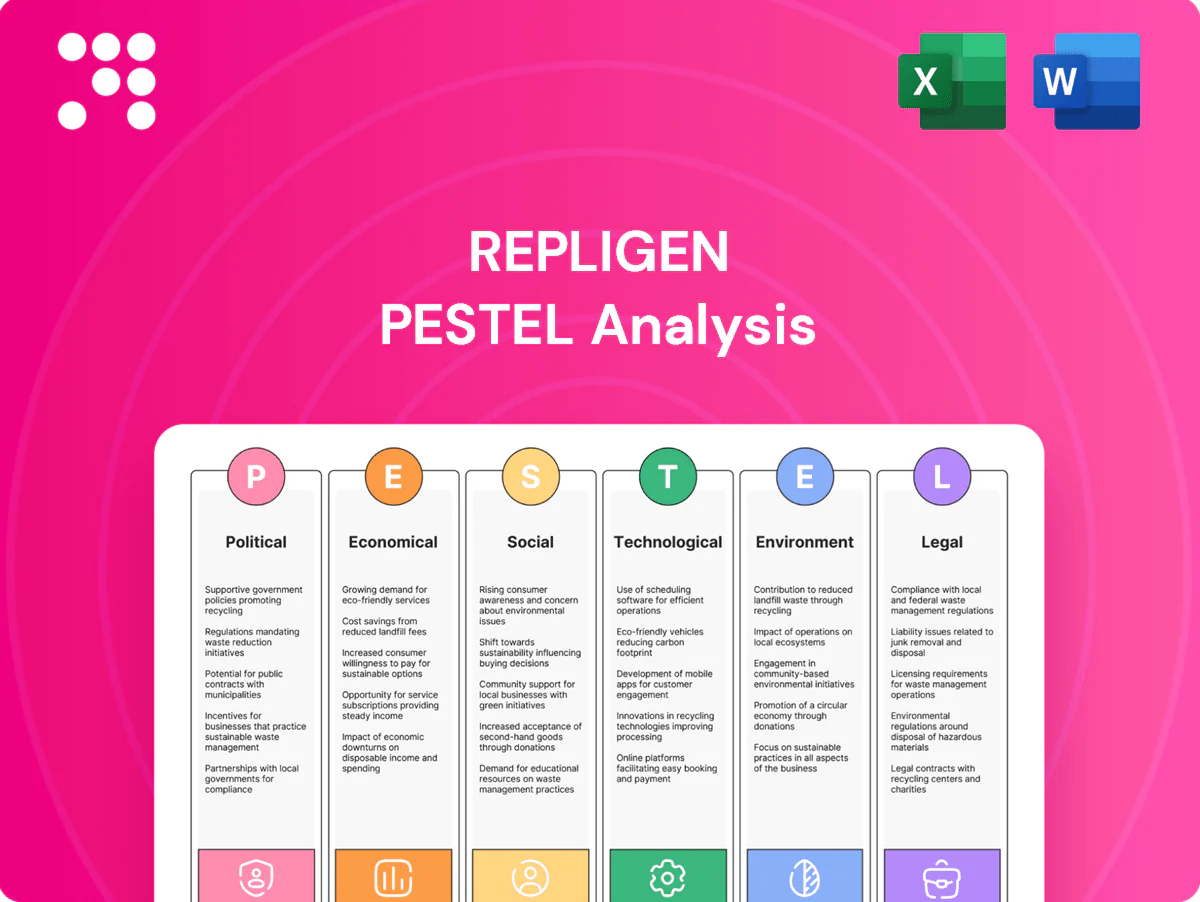
The preview shown here is the exact Repligen PESTLE Analysis you’ll receive after purchase—fully formatted and ready to use. It provides comprehensive political, economic, social, technological, legal and environmental insights tailored to Repligen’s strategic context. No placeholders or teasers—this is the real, final file you’ll download immediately after payment.

Original: $10.00
-65%$10.00
$3.50Product Information
Product Information
Shipping & Returns
Shipping & Returns
Description
Your Competitive Advantage Starts with This Report
Discover how political, economic, social, technological, legal and environmental forces are shaping Repligen’s trajectory in our concise PESTLE summary. Use these insights to spot risks and growth levers for investment or strategy. For the full, actionable breakdown—download the complete PESTLE analysis now.
Political factors
Regulatory priorities for biopharma manufacturing
Shifts toward healthcare resilience and biologics manufacturing have driven national incentives exceeding $10B across the US, EU and Asia since 2020, accelerating facility build-outs and funding that boost demand for single-use consumables. Policies promoting domestic biomanufacturing support planned biologics capacity additions of roughly 2.5–3.0 million liters through 2025, directly benefiting Repligen’s product lines. Conversely, deprioritization or budget cuts can stall capital projects and delay consumable purchases. Repligen must align product roadmaps with stated policy priorities in key markets to capture stimulus-driven demand.
Trade policy, tariffs, and supply chain localization
Export controls and US Section 301 tariffs of up to 25% on certain Chinese imports raise input costs for specialty-chemical components and can force price increases. Country-of-origin rules and government incentives for onshore production may require local sourcing or assembly, pressuring margins. Repligen must balance global sourcing economics with targeted localization to stay competitive. Diversifying manufacturing footprints mitigates political-friction risk.
Public funding for pandemics and advanced therapies
Government grants for vaccine and gene therapy capacity — with the global vaccine market near $70B in 2024 — can rapidly boost demand for filtration, chromatography and analytics. Funding cycles often produce sharp demand spikes followed by normalization risks. Repligen should build flexible, modular capacity to capture upside without overextending capital. Partnerships on publicly funded projects can increase visibility and help shape technical standards.
Geopolitical tensions and export compliance
Heightened scrutiny since the US Commerce Department expanded biotech export controls in October 2023 increases licensing friction for process analytics and single‑use technologies; firms face longer lead times and potential denial for sensitive items. Sanctions and regional conflicts since 2022 have disrupted logistics for resins, membranes and components, forcing rerouting and cost increases. Robust compliance programs preserve channel continuity and reputation, while scenario planning supports prioritized customer allocation and alternate-sourcing.
- Export controls: US Oct 2023 expansion raises licensing risk
- Supply shocks: sanctions/conflicts since 2022 disrupt critical inputs
- Mitigation: compliance programs protect channels
- Resilience: scenario planning for rerouting and customer prioritization
Health authority harmonization and standards setting
Convergence of standards via bodies such as ICH and joint FDA–EMA initiatives streamlines validation expectations for single-use systems and analytics, lowering duplication in protocols and accelerating submissions. Divergent national requirements increase customization, documentation and validation costs for Repligen, adding operational friction. Active participation in standards bodies lets Repligen influence test methods and limit onerous requirements.
- ICH coordination reduces cross‑jurisdictional variability
- Harmonization cuts market‑entry friction for new platforms
- Divergence raises customization and documentation burden
- Engagement in standards bodies can shape favorable validation rules
Onshore biologics surge: >$10B incentives, 2.5–3.0M L capacity, $70B vaccine market
Political support for onshore biologics (>$10B incentives since 2020) and planned 2.5–3.0M L capacity additions to 2025 drive demand for Repligen’s consumables; vaccine market ~ $70B in 2024 amplifies opportunity. Export controls (US Oct 2023) and Section 301 tariffs raise licensing and input-cost risks, while ICH/FDA‑EMA harmonization reduces validation friction.
| Factor | 2024/25 Data |
|---|---|
| Govt incentives | >$10B since 2020 |
| Planned capacity | 2.5–3.0M L to 2025 |
| Vaccine market | $70B (2024) |
| Export controls | US Oct 2023 expansion |
What is included in the product
Detailed Word Document
Explores how external macro-environmental factors uniquely affect Repligen across six dimensions: Political, Economic, Social, Technological, Environmental, and Legal. Every section is backed by current data and forward-looking insights, designed to support executives, consultants, and entrepreneurs in identifying threats, opportunities, and strategy-ready actions.
Customizable Excel Spreadsheet
A concise, visually segmented PESTLE summary of Repligen that supports quick alignment across teams, allows editable notes for region or business-line context, and exports easily into slides or reports to streamline risk and market-position discussions during planning sessions.
Economic factors
Bioprocess capital cycles and customer budgets
Bioprocess capex cycles at biopharma and CDMOs drive demand for high-value equipment and recurring consumables; Repligen reported FY2024 revenue of about $845M, highlighting placement-led sales plus consumables. Slowdowns in VC and IPO activity in 2023–24 delayed some new facility builds and initial tool placement. Installed-base consumables provide recurring revenue resilience, so Repligen’s mix must balance placement-driven and pull-through products.
Biologics volume growth and modality mix
Rising monoclonal antibody and recombinant protein volumes — with the global mAb market estimated at about 255 billion USD in 2024 and a ~6.8% CAGR to 2030 — support steady demand for filtration and chromatography consumables and services.
Rapid expansion in cell and gene therapy (market ~6.8 billion USD in 2024, >20% CAGR) drives demand for specialized, higher-margin consumables and advanced analytics.
Modality mix shifts materially affect ASPs and gross margins, so aligning Repligen’s portfolio to faster-growing modalities is critical to sustain top-line momentum.
Input cost inflation and margin management
Costs for polymers, specialty resins and energy directly lift COGS and compress margins unless offset by pricing power tied to product differentiation, quality and regulatory validation; lean operations and long-term supplier contracts are used to hedge input volatility, while value-based pricing that captures downstream process-yield improvements preserves margins.
Currency fluctuations across global revenue base
USD strength, supported by higher US policy rates (federal funds ~5–5.5% in 2024), can compress reported revenue from EMEA and APAC when translated to USD; companies with significant foreign sales commonly report mid-single-digit translation headwinds in 2023–24. Natural hedges via local costs and pricing, plus formal FX hedging programs, help limit cash‑flow volatility. Clear FX disclosure improves investor confidence and valuation transparency.
- Translation headwinds: mid-single-digit range (2023–24)
- Fed funds: ~5–5.5% in 2024
- Mitigants: local cost/pricing + hedging programs
- Governance: transparent FX disclosure boosts investor confidence
Industry consolidation among CDMOs and biopharma
Mergers among CDMOs and biopharma create larger buyers with greater negotiation leverage, pressuring pricing and margin for suppliers; industry consolidation also standardizes platforms, potentially accelerating adoption of preferred technologies. Strategic partnerships with consolidators can secure preferred-supplier status, while vigilance on customer-concentration risk is essential as the CDMO market (≈$92bn in 2021) grows at an ~8–10% CAGR to 2030.
- Buyer leverage: greater pricing pressure
- Platform standardization: faster tech adoption
- Partnering: preferred-supplier opportunity; monitor customer concentration
Onshore biologics surge: >$10B incentives, 2.5–3.0M L capacity, $70B vaccine market
Bioprocess capex cycles drive placement and recurring consumables; Repligen FY2024 revenue ≈ $845M with installed-base resilience. Global mAb market ≈ $255B (2024, ~6.8% CAGR) and cell & gene ≈ $6.8B (2024, >20% CAGR) underpin consumables demand. Input-costs (polymers, resins, energy) and USD strength (Fed funds ~5–5.5% in 2024) pressure margins; hedging and value pricing mitigate risk.
| Metric | Value (year) |
|---|---|
| Repligen revenue | $845M (FY2024) |
| mAb market | $255B (2024) |
| Cell & gene | $6.8B (2024) |
| Fed funds | ~5–5.5% (2024) |
| CDMO market | ≈$92B (2021) |
Same Document Delivered
Repligen PESTLE Analysis
The preview shown here is the exact Repligen PESTLE Analysis you’ll receive after purchase—fully formatted and ready to use. It provides comprehensive political, economic, social, technological, legal and environmental insights tailored to Repligen’s strategic context. No placeholders or teasers—this is the real, final file you’ll download immediately after payment.