Repco Home Finance PESTLE Analysis

Plan Smarter. Present Sharper. Compete Stronger.
Discover how political shifts, interest-rate cycles, and evolving consumer credit behaviour shape Repco Home Finance’s outlook in our concise PESTLE snapshot. This analysis highlights regulatory risks, economic pressures, and tech opportunities to inform smarter strategies. Buy the full PESTLE for the complete, actionable briefing and downloadable tools.
Political factors

Housing policy push
Central schemes like PMAY, which targeted 20 million houses by 2022, and state-level subsidies shape affordable-housing demand and borrower eligibility; prioritisation of EWS/LIG segments can materially expand Repco Home Finance’s addressable market in Tamil Nadu, Andhra and Telangana where urban housing shortages (18.78 million in 2012) persist. Recalibration of subsidy budgets or CLSS timelines alters disbursement momentum, while alignment with nodal agencies boosts conversion and turnaround.
RBI governance stance
RBI governance stance, including its supervisory tone toward HFC oversight and liquidity, shapes Repco Home Finance’s growth and risk appetite; with the policy repo at 6.5% (July 2025) stable lending pricing and ALM planning are facilitated. Tighter directions on underwriting or capital can moderate expansion into lower-income segments and raise funding costs. Supervisory expectations also push higher spending on risk systems and digital underwriting to meet compliance and stress-testing standards.

Center–state dynamics
Stamp duty, property registration and local taxes—which range roughly 3–10%, 1–2% and 0.5–2% respectively across South Indian states—directly affect housing affordability and loan sizing for Repco Home Finance. Variability between Tamil Nadu, Karnataka, Andhra Pradesh and Kerala forces localized pricing, sourcing and underwriting strategies. Improved state-level political stability in 2023–24 aided execution of land and housing programs, while incentives such as CLSS subsidies up to INR 2.5–2.7 lakh can fast-track penetration into new districts.

Land and urban reforms
- Digitization: SVAMITVA ~6.62 lakh villages mapped (2024)
- Risk: faster title clearance, lower collateral disputes
- Opportunity: urban redevelopment under PMAY-U expands mortgage market
- Threat: reform delays increase legal/recovery expenses
Election-cycle impacts
Election-cycle dynamics (general election May 2024) produce pre-election fiscal stimulus that can lift housing demand but policy uncertainty often delays purchases; Union Budget FY25 capex 10.62 lakh crore shifts post-election priorities toward infra-led jobs in target clusters. Credit sentiment and risk premiums swing around elections; RBI repo rate 6.50% (Jul 2025) underpins stability that supports long-tenor housing finance.
- Pre-election stimulus: temporary demand uptick
- FY25 capex 10.62 lakh crore: infra-led job creation
- Election volatility: higher risk premiums, deferred purchases
- RBI repo 6.50% (Jul 2025): supports long-tenor lending
PMAY/CLSS, SVAMITVA mapping drive affordable housing; 6.50% repo cushions lending
Political drivers — PMAY/CLSS subsidies (up to INR 2.7 lakh) and SVAMITVA mapping (6.62 lakh villages mapped by 2024) expand affordable-housing demand and reduce title risk; state taxes (stamp duty 3–10%) and election-cycle stimulus create volatility; RBI repo 6.50% (Jul 2025) supports long-tenor lending but tighter HFC oversight raises compliance costs.
| Factor | Metric |
|---|---|
| SVAMITVA | 6.62 lakh villages (2024) |
| CLSS subsidy | Up to INR 2.7 lakh |
| Stamp duty | 3–10% |
| Repo rate | 6.50% (Jul 2025) |
What is included in the product
 Detailed Word Document
Explores how macro-environmental forces uniquely affect Repco Home Finance across Political, Economic, Social, Technological, Environmental, and Legal dimensions, with data-driven insights tied to its mortgage and regional market dynamics. Designed for executives and investors, the analysis identifies threats, opportunities and forward-looking scenarios ready for strategic planning and funding materials.

 Customizable Excel Spreadsheet
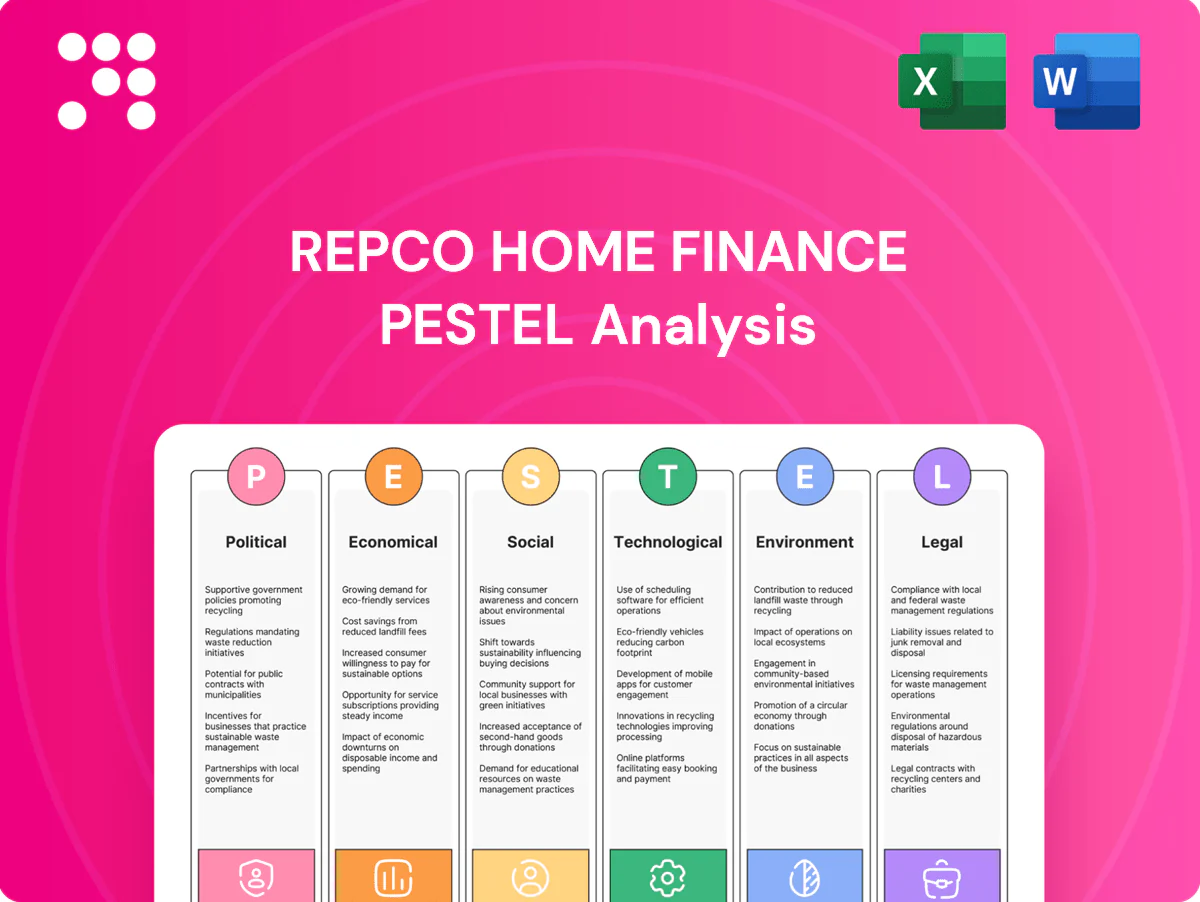
Concise, visually segmented Repco Home Finance PESTLE analysis that distills external risks and opportunities for quick reference in meetings or presentations, easily shared, edited for regional context, and dropped into pitch decks to streamline decision-making and stakeholder alignment.
Economic factors

Interest rate cycle
RBI repo at 6.5% (mid-2025) directly shapes Repco Home Finance borrowing costs and retail lending rates, with every 25bp move altering funding expense and retail yields. Lower rates boost affordability and prepayments; hikes squeeze demand and NIMs. Sensitivity is high among price-conscious LIG/MIG borrowers. Strong ALM discipline and a higher variable-rate mix mitigate volatility.
Income and employment
MSME and informal sector health—MSMEs account for about 30% of India’s GDP and employ over 100 million, directly driving cash flows for Repco’s core borrower base. Regional economic trends in South India (Tamil Nadu, Karnataka, Andhra Pradesh, Kerala) materially affect delinquencies and sourcing. Wage growth and migration patterns shape ticket sizes and loan tenures. Sectoral diversification reduces concentration risk.

Housing supply dynamics
Affordable launches made up around 40% of new supply in 2024, keeping price sensitivity high while input-cost pressure (steel, cement) limits developer pricing power. Inventory has gradually eased in primary cities, but stressed developer balance sheets and slower completion rates weigh on collateral quality. Government capex above INR 11 lakh crore in 2024–25 is expanding peripheral demand. Rising repair/extension spending offers countercyclical loan opportunities.

Liquidity and funding
Access to bank lines, NHB/RBI refinance and securitisation markets dictate Repco Home Finance growth; dependency on NHB refinance programs and investor demand determines origination capacity. Spread volatility and higher risk weights compress capital efficiency, while investor appetite for retail mortgage pools enables off‑balance‑sheet funding. A diversified tenure mix reduces refinancing concentration risk.
- Access: bank/NHB/securitisation
- Risks: spread volatility & risk weights
- Funding: investor appetite for RM pools
- Mitigation: diversified tenure mix
Competition and pricing
Banks, large HFCs and small NBFCs compete fiercely in the affordable housing segment, pressuring yields as banks leverage low-cost deposits and cross-sell products per RBI trends showing bank dominance in housing credit.
Repco’s niche underwriting in self-employed borrowers helps preserve spreads, while fee income and tight cost control support resilient ROA/ROE through cycles.
- Competitive pressure: banks/NBFCs
- Yield compression: low-cost deposits
- Niche strength: self-employed underwriting
- Financial resilience: fee income + cost control
PMAY/CLSS, SVAMITVA mapping drive affordable housing; 6.50% repo cushions lending
RBI repo 6.5% (mid‑2025) raises funding costs, compresses NIMs but variable‑rate mix and ALM limit shock; every 25bp shifts funding expense materially. MSMEs ~30% GDP; 100m employed—South India cycles drive delinquencies and demand. Affordable launches ~40% (2024); govt capex INR 11 lakh crore (2024–25) supports peripheral housing and repair/extension lending.
| Metric | Value (2024/25) |
|---|---|
| RBI repo | 6.5% |
| MSME share of GDP | ~30% |
| MSME employment | ~100m |
| Affordable new supply | ~40% |
| Govt capex | INR 11 lakh crore |
Full Version Awaits
Repco Home Finance PESTLE Analysis
The preview shown here is the exact document you’ll receive after purchase—fully formatted and ready to use. It contains the complete PESTLE analysis for Repco Home Finance with finalized content, structure and visuals. No placeholders or teasers—this is the real, downloadable file you’ll own immediately after checkout.

Product Information
Product Information
Shipping & Returns
Shipping & Returns
Description
Plan Smarter. Present Sharper. Compete Stronger.
Discover how political shifts, interest-rate cycles, and evolving consumer credit behaviour shape Repco Home Finance’s outlook in our concise PESTLE snapshot. This analysis highlights regulatory risks, economic pressures, and tech opportunities to inform smarter strategies. Buy the full PESTLE for the complete, actionable briefing and downloadable tools.
Political factors
Housing policy push
Central schemes like PMAY, which targeted 20 million houses by 2022, and state-level subsidies shape affordable-housing demand and borrower eligibility; prioritisation of EWS/LIG segments can materially expand Repco Home Finance’s addressable market in Tamil Nadu, Andhra and Telangana where urban housing shortages (18.78 million in 2012) persist. Recalibration of subsidy budgets or CLSS timelines alters disbursement momentum, while alignment with nodal agencies boosts conversion and turnaround.
RBI governance stance
RBI governance stance, including its supervisory tone toward HFC oversight and liquidity, shapes Repco Home Finance’s growth and risk appetite; with the policy repo at 6.5% (July 2025) stable lending pricing and ALM planning are facilitated. Tighter directions on underwriting or capital can moderate expansion into lower-income segments and raise funding costs. Supervisory expectations also push higher spending on risk systems and digital underwriting to meet compliance and stress-testing standards.
Center–state dynamics
Stamp duty, property registration and local taxes—which range roughly 3–10%, 1–2% and 0.5–2% respectively across South Indian states—directly affect housing affordability and loan sizing for Repco Home Finance. Variability between Tamil Nadu, Karnataka, Andhra Pradesh and Kerala forces localized pricing, sourcing and underwriting strategies. Improved state-level political stability in 2023–24 aided execution of land and housing programs, while incentives such as CLSS subsidies up to INR 2.5–2.7 lakh can fast-track penetration into new districts.
Land and urban reforms
- Digitization: SVAMITVA ~6.62 lakh villages mapped (2024)
- Risk: faster title clearance, lower collateral disputes
- Opportunity: urban redevelopment under PMAY-U expands mortgage market
- Threat: reform delays increase legal/recovery expenses
Election-cycle impacts
Election-cycle dynamics (general election May 2024) produce pre-election fiscal stimulus that can lift housing demand but policy uncertainty often delays purchases; Union Budget FY25 capex 10.62 lakh crore shifts post-election priorities toward infra-led jobs in target clusters. Credit sentiment and risk premiums swing around elections; RBI repo rate 6.50% (Jul 2025) underpins stability that supports long-tenor housing finance.
- Pre-election stimulus: temporary demand uptick
- FY25 capex 10.62 lakh crore: infra-led job creation
- Election volatility: higher risk premiums, deferred purchases
- RBI repo 6.50% (Jul 2025): supports long-tenor lending
PMAY/CLSS, SVAMITVA mapping drive affordable housing; 6.50% repo cushions lending
Political drivers — PMAY/CLSS subsidies (up to INR 2.7 lakh) and SVAMITVA mapping (6.62 lakh villages mapped by 2024) expand affordable-housing demand and reduce title risk; state taxes (stamp duty 3–10%) and election-cycle stimulus create volatility; RBI repo 6.50% (Jul 2025) supports long-tenor lending but tighter HFC oversight raises compliance costs.
| Factor | Metric |
|---|---|
| SVAMITVA | 6.62 lakh villages (2024) |
| CLSS subsidy | Up to INR 2.7 lakh |
| Stamp duty | 3–10% |
| Repo rate | 6.50% (Jul 2025) |
What is included in the product
Detailed Word Document
Explores how macro-environmental forces uniquely affect Repco Home Finance across Political, Economic, Social, Technological, Environmental, and Legal dimensions, with data-driven insights tied to its mortgage and regional market dynamics. Designed for executives and investors, the analysis identifies threats, opportunities and forward-looking scenarios ready for strategic planning and funding materials.
Customizable Excel Spreadsheet
Concise, visually segmented Repco Home Finance PESTLE analysis that distills external risks and opportunities for quick reference in meetings or presentations, easily shared, edited for regional context, and dropped into pitch decks to streamline decision-making and stakeholder alignment.
Economic factors
Interest rate cycle
RBI repo at 6.5% (mid-2025) directly shapes Repco Home Finance borrowing costs and retail lending rates, with every 25bp move altering funding expense and retail yields. Lower rates boost affordability and prepayments; hikes squeeze demand and NIMs. Sensitivity is high among price-conscious LIG/MIG borrowers. Strong ALM discipline and a higher variable-rate mix mitigate volatility.
Income and employment
MSME and informal sector health—MSMEs account for about 30% of India’s GDP and employ over 100 million, directly driving cash flows for Repco’s core borrower base. Regional economic trends in South India (Tamil Nadu, Karnataka, Andhra Pradesh, Kerala) materially affect delinquencies and sourcing. Wage growth and migration patterns shape ticket sizes and loan tenures. Sectoral diversification reduces concentration risk.
Housing supply dynamics
Affordable launches made up around 40% of new supply in 2024, keeping price sensitivity high while input-cost pressure (steel, cement) limits developer pricing power. Inventory has gradually eased in primary cities, but stressed developer balance sheets and slower completion rates weigh on collateral quality. Government capex above INR 11 lakh crore in 2024–25 is expanding peripheral demand. Rising repair/extension spending offers countercyclical loan opportunities.
Liquidity and funding
Access to bank lines, NHB/RBI refinance and securitisation markets dictate Repco Home Finance growth; dependency on NHB refinance programs and investor demand determines origination capacity. Spread volatility and higher risk weights compress capital efficiency, while investor appetite for retail mortgage pools enables off‑balance‑sheet funding. A diversified tenure mix reduces refinancing concentration risk.
- Access: bank/NHB/securitisation
- Risks: spread volatility & risk weights
- Funding: investor appetite for RM pools
- Mitigation: diversified tenure mix
Competition and pricing
Banks, large HFCs and small NBFCs compete fiercely in the affordable housing segment, pressuring yields as banks leverage low-cost deposits and cross-sell products per RBI trends showing bank dominance in housing credit.
Repco’s niche underwriting in self-employed borrowers helps preserve spreads, while fee income and tight cost control support resilient ROA/ROE through cycles.
- Competitive pressure: banks/NBFCs
- Yield compression: low-cost deposits
- Niche strength: self-employed underwriting
- Financial resilience: fee income + cost control
PMAY/CLSS, SVAMITVA mapping drive affordable housing; 6.50% repo cushions lending
RBI repo 6.5% (mid‑2025) raises funding costs, compresses NIMs but variable‑rate mix and ALM limit shock; every 25bp shifts funding expense materially. MSMEs ~30% GDP; 100m employed—South India cycles drive delinquencies and demand. Affordable launches ~40% (2024); govt capex INR 11 lakh crore (2024–25) supports peripheral housing and repair/extension lending.
| Metric | Value (2024/25) |
|---|---|
| RBI repo | 6.5% |
| MSME share of GDP | ~30% |
| MSME employment | ~100m |
| Affordable new supply | ~40% |
| Govt capex | INR 11 lakh crore |
Full Version Awaits
Repco Home Finance PESTLE Analysis
The preview shown here is the exact document you’ll receive after purchase—fully formatted and ready to use. It contains the complete PESTLE analysis for Repco Home Finance with finalized content, structure and visuals. No placeholders or teasers—this is the real, downloadable file you’ll own immediately after checkout.