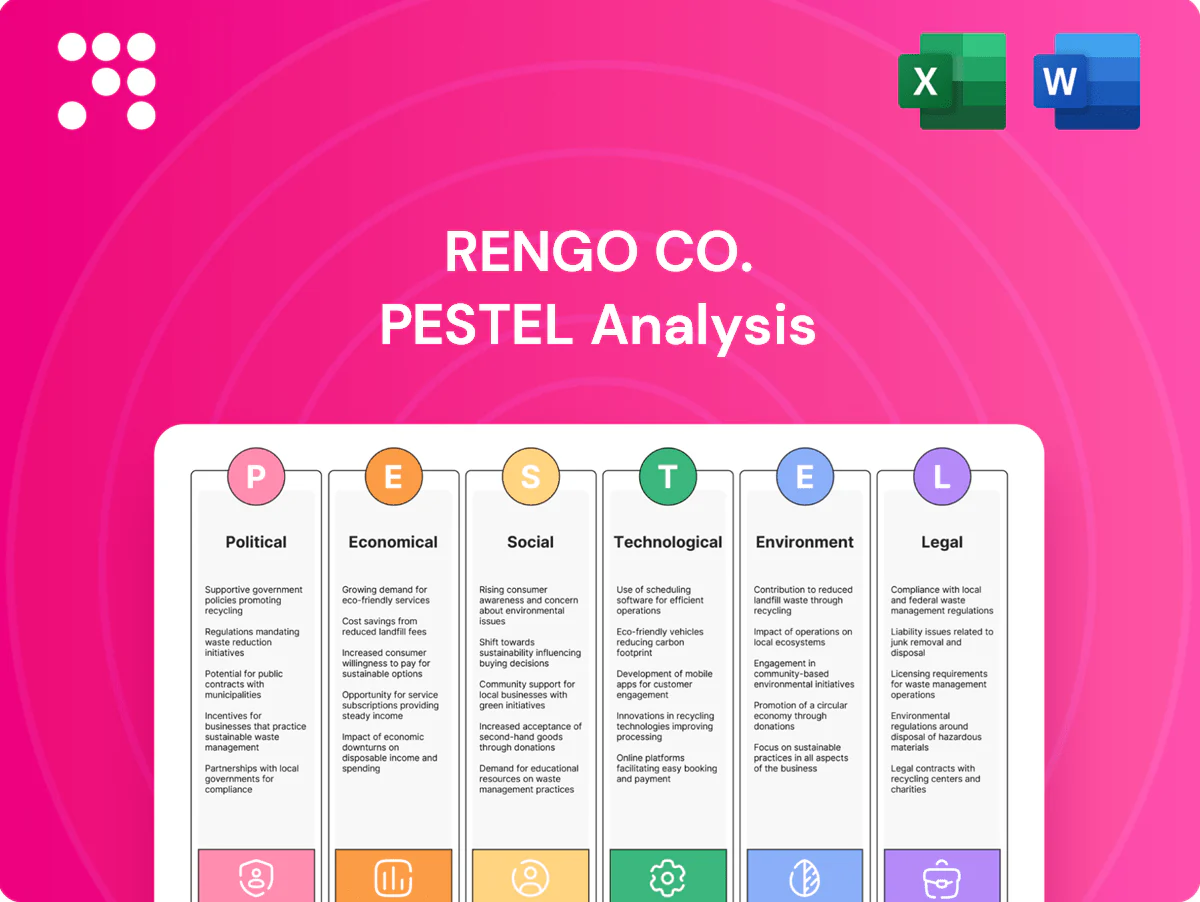
Rengo Co. PESTLE Analysis

Your Shortcut to Market Insight Starts Here
Unlock how political shifts, supply-chain economics, and sustainability trends are reshaping Rengo Co.’s strategic landscape in our concise PESTLE snapshot. Use these findings to anticipate risks, spot growth levers, and refine your market playbook. Buy the full PESTLE analysis for the complete, ready-to-use briefing and actionable recommendations you can deploy today.
Political factors

Japan industrial policy and subsidies
Japan's push for carbon neutrality by 2050 and its 46% GHG reduction target for 2030 mean METI-backed grants and low-interest financing increasingly support manufacturing decarbonization and digitalization, including packaging upgrades. Rengo can tap GX and METI programs for energy-efficient equipment and recycling infrastructure—Japan's corrugated paper recycling is about 95%, easing raw-material circularity. Compliance requirements and application timelines can delay capex execution, so close monitoring of policy shifts is essential.
Trade relations and tariffs
Trade tensions and tariff shifts directly affect Rengo’s inputs—paper pulp, chemicals and machinery—and its packaging exports, raising costs and disrupting supply chains. RCEP (in force 2022) covers about 30% of global GDP and CPTPP (in force 2018) about 13%, which can lower barriers and boost cross-border sales. Tariffs or non-tariff measures increase landed costs and complexity, so Rengo must diversify sourcing and optimize trade routes.

Government procurement and standards
Public-sector sustainability mandates, backed by Japan's 2050 net-zero pledge, increasingly favor recycled and low-carbon packaging, raising demand for suppliers like Rengo. Global public procurement represents about 12% of GDP (World Bank), so winning government-linked contracts can materially boost revenue but requires compliance with strict environmental and safety standards. Such compliance raises upfront costs, while proactive certification (eco-labels, ISO 14001) strengthens competitive positioning.

Local political stability in key markets
Japan's strong political stability and rule of law support predictable operations and long-term investment for Rengo, underpinning domestic supply chains and capital spending.
Exposure to Southeast Asia and emerging markets raises risks from policy shifts, currency controls and fuel-price regulation that can change logistics costs; scenario planning and diversified sourcing mitigate disruption.
- Domestic stability: supports capital allocation and long-term contracts
- Emerging markets: higher policy and FX volatility
- Energy/logistics: political shifts can spike costs
- Mitigation: scenario planning, supply diversification
Geopolitical supply chain security
Geopolitical conflicts disrupt shipping lanes and raise insurance and rerouting costs, undermining Rengo's access to inputs in a market where over 80% of global trade moves by sea; recent Red Sea tensions highlighted vulnerability of container flows and war-risk surcharges. Sanctions and export controls have increasingly restricted certain chemicals and specialized equipment used in packaging production.
- Dual sourcing for critical fibers/chemicals
- Inventory buffers and strategic stockpiles
- Regionalization of supply chains
Japan 2050 net-zero and 46% 2030 target boost low-carbon packaging; trade risks raise costs
Japan's 2050 net-zero and 46% 2030 GHG target drive METI grants for decarbonization and recycling (corrugated recycling ~95%), boosting demand for low‑carbon packaging. Trade deals (RCEP ~30% global GDP; CPTPP ~13%) lower barriers but tariffs, sanctions and Red Sea disruptions (2023–24) raise shipping/insurance costs; >80% trade moves by sea. Emerging‑market policy/FX volatility increases logistics risk; dual sourcing and stockpiles mitigate.
| Factor | Impact | Metric |
|---|---|---|
| Decarbonization policy | Capex grants/opportunity | 46% GHG cut by 2030 |
| Trade/geo | Cost/supply risk | RCEP ~30% GDP |
What is included in the product
 Detailed Word Document
Explores how Political, Economic, Social, Technological, Environmental and Legal forces uniquely shape Rengo Co., combining data-driven trends and region‑specific regulatory insights to highlight risks and opportunities; designed for executives, investors and strategists, the analysis offers detailed subpoints, forward-looking scenarios and clean formatting ready for reports, pitch decks and decision-making.

 Customizable Excel Spreadsheet
Visually segmented Rengo Co. PESTLE summary that can be dropped into presentations or shared across teams to quickly align stakeholders and support planning discussions on external risks and market positioning.
Economic factors

Global pulp and paper price cycles
Input cost volatility in pulp (avg ~USD 750/t in 2024), recycled fiber (around USD 150/t) and resin (~USD 1,200/t) drives Rengo’s margin swings, with tight supply episodes pushing spikes and downturns easing input costs but compressing selling prices. Hedging programs and multi-year supplier contracts have helped stabilize procurement economics. Effective cost pass-through clauses to customers remain vital for resilience against cyclical swings.
Currency fluctuations (JPY)
Yen depreciation (USD/JPY ~157 in mid-2025) lowers Rengo export prices but raises import costs for pulp, energy and machinery, increasing input bills. A stronger yen reverses this and compresses translated overseas revenue. Financial hedges and local procurement can offset swings, and a balanced geographic revenue mix reduces FX risk.

E-commerce and logistics demand
Rising e-commerce—global retail online sales grew from about $5.9 trillion in 2023 toward a projected $7.4 trillion by 2025—continues to lift corrugated box volumes and demand for specialized omnichannel packaging. Rengo can capture higher-margin logistics-optimization services and custom designs that increase customer stickiness, even as economic slowdowns compress volumes and shift demand to cost-efficient solutions.

Interest rates and capital intensity
Packaging plants require sustained capex in converting, printing and automation; with global 10-year yields around 4% in 2024–25, higher rates lift financing costs and raise internal hurdle rates for projects.
- Capex focus: converting, printing, automation
- Rates impact: 10y ~4% → higher financing/hurdle rates
- Priority: ROI-positive automation & energy efficiency
- Strategy: flexible capex pacing to protect balance sheet
Customer sector diversification
Rengo serves FMCG, food, electronics and industrials, smoothing sectoral cyclicality; its FY2024 consolidated net sales were about ¥472 billion, reflecting diversified demand across verticals. Sector-specific slowdowns (e.g., electronics) have been offset by FMCG/food resilience, while value-added design and sustainable materials bolster pricing power and margins. Portfolio balance reduces revenue volatility and supports steady free cash flow.
- Revenue FY2024: ≈¥472bn
- Key sectors: FMCG, food, electronics, industrials
- Drivers: design, sustainability = pricing power
- Benefit: lower revenue volatility
Japan 2050 net-zero and 46% 2030 target boost low-carbon packaging; trade risks raise costs
Input-cost volatility (pulp ~USD 750/t; recycled ~USD 150/t; resin ~USD 1,200/t) and FX (USD/JPY ~157 mid‑2025) drive margin swings despite hedges and multi‑year contracts. E‑commerce growth (global online retail ≈USD 7.4tn by 2025) sustains corrugated demand and higher‑margin services. Higher 10y yields (~4% in 2024–25) raise capex financing costs while FY2024 sales ≈¥472bn support diversification.
| Metric | Value |
|---|---|
| Pulp | ~USD 750/t (2024) |
| Recycled fiber | ~USD 150/t |
| Resin | ~USD 1,200/t |
| USD/JPY | ~157 (mid‑2025) |
| 10y yield | ~4% (2024–25) |
| Global e‑commerce | ~USD 7.4tn (2025) |
| Rengo FY2024 sales | ≈¥472bn |
Preview Before You Purchase
Rengo Co. PESTLE Analysis
The preview shown here is the exact Rengo Co. PESTLE Analysis document you’ll receive after purchase—fully formatted and ready to use. It contains political, economic, social, technological, legal, and environmental assessments tailored to Rengo Co. No placeholders or teasers; this is the final file available immediately after checkout.

Product Information
Product Information
Shipping & Returns
Shipping & Returns
Description
Your Shortcut to Market Insight Starts Here
Unlock how political shifts, supply-chain economics, and sustainability trends are reshaping Rengo Co.’s strategic landscape in our concise PESTLE snapshot. Use these findings to anticipate risks, spot growth levers, and refine your market playbook. Buy the full PESTLE analysis for the complete, ready-to-use briefing and actionable recommendations you can deploy today.
Political factors
Japan industrial policy and subsidies
Japan's push for carbon neutrality by 2050 and its 46% GHG reduction target for 2030 mean METI-backed grants and low-interest financing increasingly support manufacturing decarbonization and digitalization, including packaging upgrades. Rengo can tap GX and METI programs for energy-efficient equipment and recycling infrastructure—Japan's corrugated paper recycling is about 95%, easing raw-material circularity. Compliance requirements and application timelines can delay capex execution, so close monitoring of policy shifts is essential.
Trade relations and tariffs
Trade tensions and tariff shifts directly affect Rengo’s inputs—paper pulp, chemicals and machinery—and its packaging exports, raising costs and disrupting supply chains. RCEP (in force 2022) covers about 30% of global GDP and CPTPP (in force 2018) about 13%, which can lower barriers and boost cross-border sales. Tariffs or non-tariff measures increase landed costs and complexity, so Rengo must diversify sourcing and optimize trade routes.
Government procurement and standards
Public-sector sustainability mandates, backed by Japan's 2050 net-zero pledge, increasingly favor recycled and low-carbon packaging, raising demand for suppliers like Rengo. Global public procurement represents about 12% of GDP (World Bank), so winning government-linked contracts can materially boost revenue but requires compliance with strict environmental and safety standards. Such compliance raises upfront costs, while proactive certification (eco-labels, ISO 14001) strengthens competitive positioning.
Local political stability in key markets
Japan's strong political stability and rule of law support predictable operations and long-term investment for Rengo, underpinning domestic supply chains and capital spending.
Exposure to Southeast Asia and emerging markets raises risks from policy shifts, currency controls and fuel-price regulation that can change logistics costs; scenario planning and diversified sourcing mitigate disruption.
- Domestic stability: supports capital allocation and long-term contracts
- Emerging markets: higher policy and FX volatility
- Energy/logistics: political shifts can spike costs
- Mitigation: scenario planning, supply diversification
Geopolitical supply chain security
Geopolitical conflicts disrupt shipping lanes and raise insurance and rerouting costs, undermining Rengo's access to inputs in a market where over 80% of global trade moves by sea; recent Red Sea tensions highlighted vulnerability of container flows and war-risk surcharges. Sanctions and export controls have increasingly restricted certain chemicals and specialized equipment used in packaging production.
- Dual sourcing for critical fibers/chemicals
- Inventory buffers and strategic stockpiles
- Regionalization of supply chains
Japan 2050 net-zero and 46% 2030 target boost low-carbon packaging; trade risks raise costs
Japan's 2050 net-zero and 46% 2030 GHG target drive METI grants for decarbonization and recycling (corrugated recycling ~95%), boosting demand for low‑carbon packaging. Trade deals (RCEP ~30% global GDP; CPTPP ~13%) lower barriers but tariffs, sanctions and Red Sea disruptions (2023–24) raise shipping/insurance costs; >80% trade moves by sea. Emerging‑market policy/FX volatility increases logistics risk; dual sourcing and stockpiles mitigate.
| Factor | Impact | Metric |
|---|---|---|
| Decarbonization policy | Capex grants/opportunity | 46% GHG cut by 2030 |
| Trade/geo | Cost/supply risk | RCEP ~30% GDP |
What is included in the product
Detailed Word Document
Explores how Political, Economic, Social, Technological, Environmental and Legal forces uniquely shape Rengo Co., combining data-driven trends and region‑specific regulatory insights to highlight risks and opportunities; designed for executives, investors and strategists, the analysis offers detailed subpoints, forward-looking scenarios and clean formatting ready for reports, pitch decks and decision-making.
Customizable Excel Spreadsheet
Visually segmented Rengo Co. PESTLE summary that can be dropped into presentations or shared across teams to quickly align stakeholders and support planning discussions on external risks and market positioning.
Economic factors
Global pulp and paper price cycles
Input cost volatility in pulp (avg ~USD 750/t in 2024), recycled fiber (around USD 150/t) and resin (~USD 1,200/t) drives Rengo’s margin swings, with tight supply episodes pushing spikes and downturns easing input costs but compressing selling prices. Hedging programs and multi-year supplier contracts have helped stabilize procurement economics. Effective cost pass-through clauses to customers remain vital for resilience against cyclical swings.
Currency fluctuations (JPY)
Yen depreciation (USD/JPY ~157 in mid-2025) lowers Rengo export prices but raises import costs for pulp, energy and machinery, increasing input bills. A stronger yen reverses this and compresses translated overseas revenue. Financial hedges and local procurement can offset swings, and a balanced geographic revenue mix reduces FX risk.
E-commerce and logistics demand
Rising e-commerce—global retail online sales grew from about $5.9 trillion in 2023 toward a projected $7.4 trillion by 2025—continues to lift corrugated box volumes and demand for specialized omnichannel packaging. Rengo can capture higher-margin logistics-optimization services and custom designs that increase customer stickiness, even as economic slowdowns compress volumes and shift demand to cost-efficient solutions.
Interest rates and capital intensity
Packaging plants require sustained capex in converting, printing and automation; with global 10-year yields around 4% in 2024–25, higher rates lift financing costs and raise internal hurdle rates for projects.
- Capex focus: converting, printing, automation
- Rates impact: 10y ~4% → higher financing/hurdle rates
- Priority: ROI-positive automation & energy efficiency
- Strategy: flexible capex pacing to protect balance sheet
Customer sector diversification
Rengo serves FMCG, food, electronics and industrials, smoothing sectoral cyclicality; its FY2024 consolidated net sales were about ¥472 billion, reflecting diversified demand across verticals. Sector-specific slowdowns (e.g., electronics) have been offset by FMCG/food resilience, while value-added design and sustainable materials bolster pricing power and margins. Portfolio balance reduces revenue volatility and supports steady free cash flow.
- Revenue FY2024: ≈¥472bn
- Key sectors: FMCG, food, electronics, industrials
- Drivers: design, sustainability = pricing power
- Benefit: lower revenue volatility
Japan 2050 net-zero and 46% 2030 target boost low-carbon packaging; trade risks raise costs
Input-cost volatility (pulp ~USD 750/t; recycled ~USD 150/t; resin ~USD 1,200/t) and FX (USD/JPY ~157 mid‑2025) drive margin swings despite hedges and multi‑year contracts. E‑commerce growth (global online retail ≈USD 7.4tn by 2025) sustains corrugated demand and higher‑margin services. Higher 10y yields (~4% in 2024–25) raise capex financing costs while FY2024 sales ≈¥472bn support diversification.
| Metric | Value |
|---|---|
| Pulp | ~USD 750/t (2024) |
| Recycled fiber | ~USD 150/t |
| Resin | ~USD 1,200/t |
| USD/JPY | ~157 (mid‑2025) |
| 10y yield | ~4% (2024–25) |
| Global e‑commerce | ~USD 7.4tn (2025) |
| Rengo FY2024 sales | ≈¥472bn |
Preview Before You Purchase
Rengo Co. PESTLE Analysis
The preview shown here is the exact Rengo Co. PESTLE Analysis document you’ll receive after purchase—fully formatted and ready to use. It contains political, economic, social, technological, legal, and environmental assessments tailored to Rengo Co. No placeholders or teasers; this is the final file available immediately after checkout.











