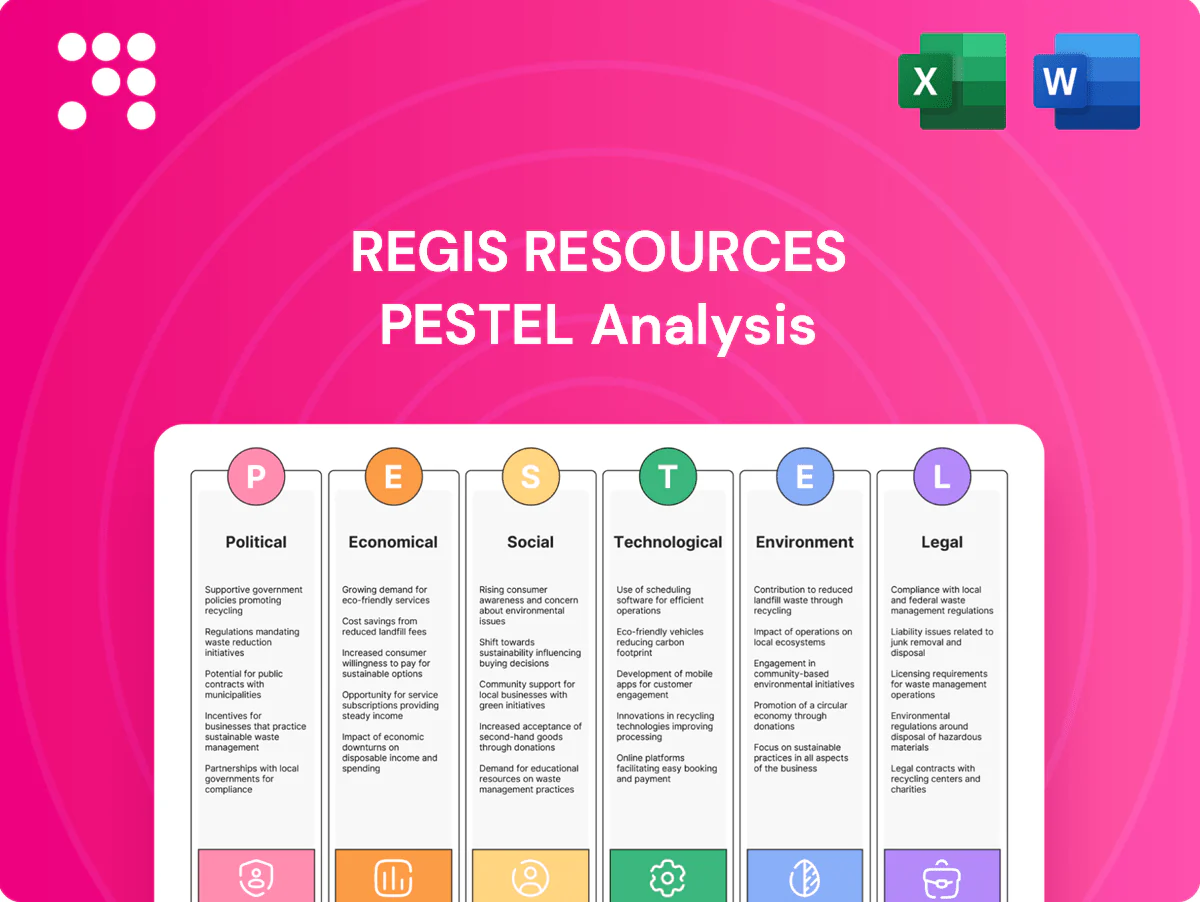
Regis Resources PESTLE Analysis

Make Smarter Strategic Decisions with a Complete PESTEL View
Uncover how political shifts, commodity cycles, and ESG pressures are shaping Regis Resources with our concise PESTLE snapshot—perfect for investors and strategists seeking actionable context. This analysis highlights key risks and growth levers impacting operations and valuation. Buy the full PESTLE to get the complete, ready-to-use intelligence now.
Political factors

Stable Australian mining policy
Australia offers a predictable regulatory regime for gold mining, reducing sovereign risk for Regis Resources. Federal-state coordination in Western Australia supports permitting clarity and operational continuity; WA accounts for roughly 70% of Australia’s gold output. Political stability underpins long-term mine planning and capital investment. Policy shifts typically occur with consultation, giving firms time to adapt.
Royalties and taxation settings
WA gold royalties (currently 2.5% of value for most gold production) and Australia’s 30% federal company tax directly shape Regis Resources’ project economics and free cash flow. Periodic reviews of royalty regimes and diesel fuel rebate schemes can rapidly alter operating cost structures and strip margin — a 1 percentage-point royalty rise can cut free cash flow materially. Stability aids multi-year planning; active engagement with government and industry bodies helps anticipate adjustments.

Indigenous affairs and native title
Native title determinations and heritage legislation in Western Australia directly shape land access and project timelines for Regis Resources, whose FY2024 production was about 288,000 oz, making timely approvals critical to revenue. Strong relationships and benefit‑sharing agreements have supported approvals and social license for Duketon and Garden Well operations. Policy strengthening on cultural heritage protection can add compliance requirements and incremental costs. Proactive consultation mitigates delays and reputational risk.

Infrastructure and regional development policy
Government support for regional roads, power and water in Western Australia materially affects Regis Resources by reducing transport bottlenecks and improving operating reliability at mines in the Yandal and Duketon belts. Co-investment initiatives with state agencies and mining towns lower upfront capital outlays for remote sites and speed project timelines. Policy incentives for regional renewables enhance energy economics and grid resilience, while any pullback in infrastructure support would raise self-provision and logistics costs.
- Regional road/power support reduces logistics risk
- Co-investment lowers capex and accelerates delivery
- Renewable incentives improve energy costs and decarbonisation
- Reduced support increases on-site utility and transport spend
Geopolitics influencing gold
Global geopolitical tensions elevate safe-haven demand, pushing gold to an average near US$2,150/oz in H1 2025 and indirectly boosting Regis Resources revenue through higher realised prices. Australia’s stable trade and diplomatic stance supports resource exports and market access for Regis. Sanctions or conflicts can disrupt equipment and reagent supply chains; diversified procurement lowers such exposure.
- Geopolitics → higher gold price (~US$2,150/oz H1 2025)
- Australia supportive of resource exports
- Sanctions/conflicts risk equipment/reagent delays
- Diversified procurement reduces supply-shock exposure
WA regulatory stability, fiscal settings and infrastructure underpin gold economics at ~US$2,150/oz
Regulatory stability in Western Australia reduces sovereign risk for Regis Resources and supports multi‑year planning. Key fiscal settings—WA gold royalty 2.5% and Australian company tax 30%—directly affect project economics. Native title/heritage approvals and regional infrastructure co‑investment materially influence timelines and capex. Geopolitical safe‑haven flows lifted gold to ~US$2,150/oz in H1 2025.
| Metric | Value |
|---|---|
| FY2024 production | 288,000 oz |
| WA share of Aus gold | ~70% |
| WA gold royalty | 2.5% |
| Australia company tax | 30% |
| Gold price H1 2025 | ~US$2,150/oz |
What is included in the product
 Detailed Word Document
Explores how macro-environmental factors uniquely affect Regis Resources across Political, Economic, Social, Technological, Environmental and Legal dimensions—grounded in Australian gold‑mining market data and regulatory dynamics—to identify risks, opportunities and strategic responses for executives, investors and advisors.

 Customizable Excel Spreadsheet
A clean, summarized PESTLE of Regis Resources for quick referencing in meetings or presentations, visually segmented by PESTEL categories for instant interpretation and easily dropped into PowerPoints or shared across teams.
Economic factors

Gold price volatility
Regis Resources revenue is highly sensitive to USD gold prices — with spot gold near USD 2,300/oz in mid‑2025, a 10% move would materially shift cash flow and capital allocation. Price surges can justify mine expansions and accelerate sanctioning, while downturns force tight cost discipline and deferment of projects. Strategic hedging can smooth reported earnings but limits upside, making project sanction timing critical to capture favorable price windows.
AUD/USD exchange rate
Regis costs largely occur in AUD while gold sales are USD-linked, creating a natural hedge between cost base and revenue. AUD averaged about 0.67 USD in 2024; a weaker AUD (eg 0.60) materially boosts AUD margins while a stronger AUD (eg 0.75) compresses them. Currency volatility affects budgeting and USD-denominated debt servicing, and Regis uses financial risk management and hedging to help stabilize outcomes.

Input cost inflation
Input-cost inflation—driven by diesel (+≈30% YoY for mining-grade fuel), explosives, steel and reagent price rises—continues to pressure Regis’s all-in sustaining costs (AISC), even as gold averaged about US$2,300/oz in 2024–25. Tight WA labour markets (unemployment ~3.6%) elevate wages and contractor rates, adding to unit costs. Persistent inflation (CPI ~3–4%) squeezes margins, though disciplined procurement and processing efficiencies have reduced cost escalation.

Labor availability and productivity
FIFO models at Regis face intense competition from other WA miners, constraining hiring and retention and raising labour costs.
Productivity hinges on skilled operators and reliable contractors; gaps in either reduce output per labour hour and inflate unit costs.
Focused training, selective automation and optimized roster design can materially lift output per labour hour, while labour disruptions risk delaying production targets.
- Competition: FIFO hiring pressure
- Productivity: skilled operators + contractors
- Improvements: training, automation, roster design
- Risk: labour disruptions delay production
Exploration success and capital allocation
Resource conversion and new discoveries underpin Regis Resources' mine-life and valuation; 2024 updates from the company extended effective mine life to over 8 years and reinforced reserve confidence, supporting valuation upside. Disciplined capital allocation between growth, sustaining capex and shareholder returns remains pivotal as Regis balances expansion with cash returns. Targeted M&A can accelerate growth but introduces integration risk; active portfolio optimisation improves resilience across cycles.
WA regulatory stability, fiscal settings and infrastructure underpin gold economics at ~US$2,150/oz
Regis revenue is highly sensitive to USD gold (~US$2,300/oz mid‑2025); a 10% move materially alters cash flow and project timing. Costs are AUD‑based (AUD ~0.67 in 2024), so FX swings and diesel (+≈30% YoY) drive AISC pressure. WA labour tight (unemployment ~3.6%), mine life >8 years supports near‑term valuation.
| Metric | Value |
|---|---|
| Gold price (mid‑2025) | US$2,300/oz |
| AUD/USD (2024 avg) | 0.67 |
| Diesel change | +≈30% YoY |
| WA unemployment | ~3.6% |
| Mine life (2024) | >8 yrs |
Preview the Actual Deliverable
Regis Resources PESTLE Analysis
The preview shown here is the exact Regis Resources PESTLE Analysis you’ll receive after purchase—fully formatted and ready to use. It covers political, economic, social, technological, legal, and environmental factors affecting Regis Resources, with actionable insights and concise evaluation. No placeholders or teasers—this is the final, professionally structured file available for immediate download.

Product Information
Product Information
Shipping & Returns
Shipping & Returns
Description
Make Smarter Strategic Decisions with a Complete PESTEL View
Uncover how political shifts, commodity cycles, and ESG pressures are shaping Regis Resources with our concise PESTLE snapshot—perfect for investors and strategists seeking actionable context. This analysis highlights key risks and growth levers impacting operations and valuation. Buy the full PESTLE to get the complete, ready-to-use intelligence now.
Political factors
Stable Australian mining policy
Australia offers a predictable regulatory regime for gold mining, reducing sovereign risk for Regis Resources. Federal-state coordination in Western Australia supports permitting clarity and operational continuity; WA accounts for roughly 70% of Australia’s gold output. Political stability underpins long-term mine planning and capital investment. Policy shifts typically occur with consultation, giving firms time to adapt.
Royalties and taxation settings
WA gold royalties (currently 2.5% of value for most gold production) and Australia’s 30% federal company tax directly shape Regis Resources’ project economics and free cash flow. Periodic reviews of royalty regimes and diesel fuel rebate schemes can rapidly alter operating cost structures and strip margin — a 1 percentage-point royalty rise can cut free cash flow materially. Stability aids multi-year planning; active engagement with government and industry bodies helps anticipate adjustments.
Indigenous affairs and native title
Native title determinations and heritage legislation in Western Australia directly shape land access and project timelines for Regis Resources, whose FY2024 production was about 288,000 oz, making timely approvals critical to revenue. Strong relationships and benefit‑sharing agreements have supported approvals and social license for Duketon and Garden Well operations. Policy strengthening on cultural heritage protection can add compliance requirements and incremental costs. Proactive consultation mitigates delays and reputational risk.
Infrastructure and regional development policy
Government support for regional roads, power and water in Western Australia materially affects Regis Resources by reducing transport bottlenecks and improving operating reliability at mines in the Yandal and Duketon belts. Co-investment initiatives with state agencies and mining towns lower upfront capital outlays for remote sites and speed project timelines. Policy incentives for regional renewables enhance energy economics and grid resilience, while any pullback in infrastructure support would raise self-provision and logistics costs.
- Regional road/power support reduces logistics risk
- Co-investment lowers capex and accelerates delivery
- Renewable incentives improve energy costs and decarbonisation
- Reduced support increases on-site utility and transport spend
Geopolitics influencing gold
Global geopolitical tensions elevate safe-haven demand, pushing gold to an average near US$2,150/oz in H1 2025 and indirectly boosting Regis Resources revenue through higher realised prices. Australia’s stable trade and diplomatic stance supports resource exports and market access for Regis. Sanctions or conflicts can disrupt equipment and reagent supply chains; diversified procurement lowers such exposure.
- Geopolitics → higher gold price (~US$2,150/oz H1 2025)
- Australia supportive of resource exports
- Sanctions/conflicts risk equipment/reagent delays
- Diversified procurement reduces supply-shock exposure
WA regulatory stability, fiscal settings and infrastructure underpin gold economics at ~US$2,150/oz
Regulatory stability in Western Australia reduces sovereign risk for Regis Resources and supports multi‑year planning. Key fiscal settings—WA gold royalty 2.5% and Australian company tax 30%—directly affect project economics. Native title/heritage approvals and regional infrastructure co‑investment materially influence timelines and capex. Geopolitical safe‑haven flows lifted gold to ~US$2,150/oz in H1 2025.
| Metric | Value |
|---|---|
| FY2024 production | 288,000 oz |
| WA share of Aus gold | ~70% |
| WA gold royalty | 2.5% |
| Australia company tax | 30% |
| Gold price H1 2025 | ~US$2,150/oz |
What is included in the product
Detailed Word Document
Explores how macro-environmental factors uniquely affect Regis Resources across Political, Economic, Social, Technological, Environmental and Legal dimensions—grounded in Australian gold‑mining market data and regulatory dynamics—to identify risks, opportunities and strategic responses for executives, investors and advisors.
Customizable Excel Spreadsheet
A clean, summarized PESTLE of Regis Resources for quick referencing in meetings or presentations, visually segmented by PESTEL categories for instant interpretation and easily dropped into PowerPoints or shared across teams.
Economic factors
Gold price volatility
Regis Resources revenue is highly sensitive to USD gold prices — with spot gold near USD 2,300/oz in mid‑2025, a 10% move would materially shift cash flow and capital allocation. Price surges can justify mine expansions and accelerate sanctioning, while downturns force tight cost discipline and deferment of projects. Strategic hedging can smooth reported earnings but limits upside, making project sanction timing critical to capture favorable price windows.
AUD/USD exchange rate
Regis costs largely occur in AUD while gold sales are USD-linked, creating a natural hedge between cost base and revenue. AUD averaged about 0.67 USD in 2024; a weaker AUD (eg 0.60) materially boosts AUD margins while a stronger AUD (eg 0.75) compresses them. Currency volatility affects budgeting and USD-denominated debt servicing, and Regis uses financial risk management and hedging to help stabilize outcomes.
Input cost inflation
Input-cost inflation—driven by diesel (+≈30% YoY for mining-grade fuel), explosives, steel and reagent price rises—continues to pressure Regis’s all-in sustaining costs (AISC), even as gold averaged about US$2,300/oz in 2024–25. Tight WA labour markets (unemployment ~3.6%) elevate wages and contractor rates, adding to unit costs. Persistent inflation (CPI ~3–4%) squeezes margins, though disciplined procurement and processing efficiencies have reduced cost escalation.
Labor availability and productivity
FIFO models at Regis face intense competition from other WA miners, constraining hiring and retention and raising labour costs.
Productivity hinges on skilled operators and reliable contractors; gaps in either reduce output per labour hour and inflate unit costs.
Focused training, selective automation and optimized roster design can materially lift output per labour hour, while labour disruptions risk delaying production targets.
- Competition: FIFO hiring pressure
- Productivity: skilled operators + contractors
- Improvements: training, automation, roster design
- Risk: labour disruptions delay production
Exploration success and capital allocation
Resource conversion and new discoveries underpin Regis Resources' mine-life and valuation; 2024 updates from the company extended effective mine life to over 8 years and reinforced reserve confidence, supporting valuation upside. Disciplined capital allocation between growth, sustaining capex and shareholder returns remains pivotal as Regis balances expansion with cash returns. Targeted M&A can accelerate growth but introduces integration risk; active portfolio optimisation improves resilience across cycles.
WA regulatory stability, fiscal settings and infrastructure underpin gold economics at ~US$2,150/oz
Regis revenue is highly sensitive to USD gold (~US$2,300/oz mid‑2025); a 10% move materially alters cash flow and project timing. Costs are AUD‑based (AUD ~0.67 in 2024), so FX swings and diesel (+≈30% YoY) drive AISC pressure. WA labour tight (unemployment ~3.6%), mine life >8 years supports near‑term valuation.
| Metric | Value |
|---|---|
| Gold price (mid‑2025) | US$2,300/oz |
| AUD/USD (2024 avg) | 0.67 |
| Diesel change | +≈30% YoY |
| WA unemployment | ~3.6% |
| Mine life (2024) | >8 yrs |
Preview the Actual Deliverable
Regis Resources PESTLE Analysis
The preview shown here is the exact Regis Resources PESTLE Analysis you’ll receive after purchase—fully formatted and ready to use. It covers political, economic, social, technological, legal, and environmental factors affecting Regis Resources, with actionable insights and concise evaluation. No placeholders or teasers—this is the final, professionally structured file available for immediate download.











