RAND PESTLE Analysis

Your Shortcut to Market Insight Starts Here
Unlock how political shifts, economic trends, social dynamics, technological advances, legal frameworks, and environmental pressures are shaping RAND’s strategic outlook—our PESTLE analysis distills these forces into clear, actionable insights. Ideal for investors, consultants, and strategists, this concise report highlights risks and opportunity areas you can act on today. Purchase the full PESTLE to get the detailed, editable breakdown and an immediate edge.
Political factors

Shifting public policy priorities
Shifting federal and state agendas redirect research funding toward favored domains, with the FY2024 NDAA authorizing about 858 billion dollars for defense, illustrating how election cycles reweight focus among health, education, and defense. RAND must align proposals to funder priorities without compromising objectivity or rigorous methods. Robust scenario planning and portfolio stress-testing preserve balance across short- and long-term projects.
Bipartisan credibility and independence
Perceived neutrality is critical for RAND’s access and impact across administrations; founded in 1948 and employing approximately 1,800 staff worldwide (2024), any politicization risks funding and stakeholder trust. Robust governance, public financial disclosures and third-party audits bolster impartiality, while transparent methods and peer review—used across RAND’s policy reports—sustain legitimacy and cross-party credibility.

National security and defense posture
Defense strategy updates drive demand for analyses on deterrence, innovation, and force structure. Classified work requires security clearances such as TS/SCI, shaping staffing, vetting timelines, and facilities. US defense spending exceeded 800 billion dollars in 2024, and DoD budget reprogramming has historically accelerated or paused study timelines. Partnerships with OSD, DARPA, and combatant commands determine scope and data access.

Geopolitical tensions shaping research
Rising great-power rivalry drives expanded demand for cyber, space and supply-chain resilience, with global military spending at about 2.24 trillion USD in 2023 (SIPRI) and the cybersecurity market near 190 billion USD in 2023, forcing RAND to prioritize hard-to-share capabilities. Sanctions and diplomatic frictions increasingly restrict collaborations and cross-border data flows, while international fieldwork faces access constraints; risk management and alternative data sources become essential.
- geopolitics: 2.24T global military spend (2023)
- cyber: ~190B cybersecurity market (2023)
- restrictions: sanctions limit data/collab
- response: shift to risk mgmt and alt data
Government procurement and oversight
Competitive contracting, audits, and performance metrics guide award decisions; U.S. federal contracting obligations were roughly $700 billion annually in 2023–24, increasing pressure for measurable outcomes. Shifts toward evidence-based policymaking and OMB guidance have raised demand for rigorous, reproducible studies, while procurement streamlining or delays can compress contractors' cash flow and working capital. Compliance quality directly affects eligibility for future task orders and set-asides.
- Competitive awards tied to performance metrics
- ~$700B federal contracting (2023–24)
- Evidence-based policy raises demand for reproducible studies
- Procurement delays harm cash flow; compliance affects future orders
FY2024 Defense Funding Shift Spurs Demand for Secure, Classified Analysis
Shifts in federal/state agendas and FY2024 NDAA $858B redirect funding across health, education, and defense, requiring RAND to align proposals while protecting objectivity. Perceived neutrality and governance (founded 1948, ~1,800 staff) preserve access across administrations. Great-power rivalry, $2.24T global military (2023) and ~$190B cyber market (2023), increase demand for classified, secure analyses.
| Metric | Value |
|---|---|
| FY2024 NDAA | $858B |
| US defense (2024) | >$800B |
| Global military (2023) | $2.24T |
| Cyber market (2023) | ~$190B |
| Federal contracting (2023–24) | ~$700B |
What is included in the product
 Detailed Word Document
Explores how external macro-environmental factors uniquely affect RAND across Political, Economic, Social, Technological, Environmental and Legal dimensions, with each category expanded into data-backed sub-points and sector-specific examples. Designed for executives and investors, it delivers forward-looking insights to inform scenario planning, risk mitigation and opportunity identification.

 Customizable Excel Spreadsheet
Condenses the full RAND PESTLE into a clean, shareable summary segmented by factor for quick reference in meetings, presentations, or client reports.
Economic factors

Budget cycles and fiscal consolidation
Federal deficits near $1.7 trillion (FY2023) and roughly $1.6 trillion (FY2024) pressure discretionary research funds, tightening grants and contracts. Continuing resolutions—used repeatedly in 2023–24—delay starts and payments, creating cash-flow timing risk for RAND. RAND must manage reserves and bridge financing to cover gaps. Expanding multi-year contracts smooths revenue volatility and lowers refinancing costs.
Philanthropy and grant market dynamics
Foundation priorities evolve with societal needs and donor sentiment, shifting funding toward climate, racial equity and health causes. Giving USA 2024 reports US charitable giving reached $499.33 billion in 2023, shaping grant flows and competition. Endowment performance affects grant availability and matching requirements, tightening budgets in weak market years. Diversifying sponsors reduces concentration risk and co-funding models unlock larger, multi‑partner programs.

Talent market and compensation pressures
Competition for data scientists and subject-matter experts has driven US median total compensation up roughly 8% year-over-year to about $130,000 in 2024, pressuring project margins. Remote work, now adopted by roughly 35–40% of tech roles, widens recruiting pools but raises retention volatility and churn risk. Investment in training and clear career pathways boosts productivity and reduces expensive external hiring. Balanced staffing mixes and junior-senior blends protect margins on fixed-price engagements.

Inflation and overhead recovery
Rising wages, data licenses (Bloomberg ~27,000 USD/yr) and travel push RAND project budgets higher, with wage pressures and supplier inflation increasing direct costs; indirect rate negotiations (commonly 35–65% for research orgs) determine how much of that is recovered, while efficient procurement and tooling reduce unit costs and accurate scoping avoids under-recovery.
- Rising wages
- Data licenses ~27,000 USD/yr
- Travel inflation
- Indirect rates 35–65%
- Procurement/tooling efficiency
- Accurate scoping
Revenue diversification and international work
Expanding into multilateral and foreign government contracts spreads revenue risk and taps a public procurement market estimated at about USD 12 trillion annually (2023). Currency and payment-term mismatches introduce FX and receivable exposure, while local compliance and reputational due diligence are mandatory for award and performance. Partnership models and local JV arrangements frequently ease market entry and contract execution.
- Spreads risk: access to USD 12T public procurement (2023)
- FX exposure: payment-term and currency mismatch
- Compliance: local law and reputational due diligence
- Entry: partnerships/JVs to shorten market access
FY2024 Defense Funding Shift Spurs Demand for Secure, Classified Analysis
Federal deficits (~$1.6T FY2024) and repeated continuing resolutions tighten research funding; diversify sponsors and expand multi-year contracts. US charitable giving $499.3B (2023) and endowment returns drive grant availability. Median data-scientist pay ~$130,000 (2024) and rising vendor costs (Bloomberg ~$27,000/yr) pressure margins; manage staffing mix and indirect rates (35–65%).
| Metric | Value |
|---|---|
| Federal deficit FY24 | $1.6T |
| Charitable giving 2023 | $499.3B |
| Median pay 2024 | $130,000 |
| Bloomberg license | $27,000/yr |
| Public procurement 2023 | $12T |
Preview Before You Purchase
RAND PESTLE Analysis
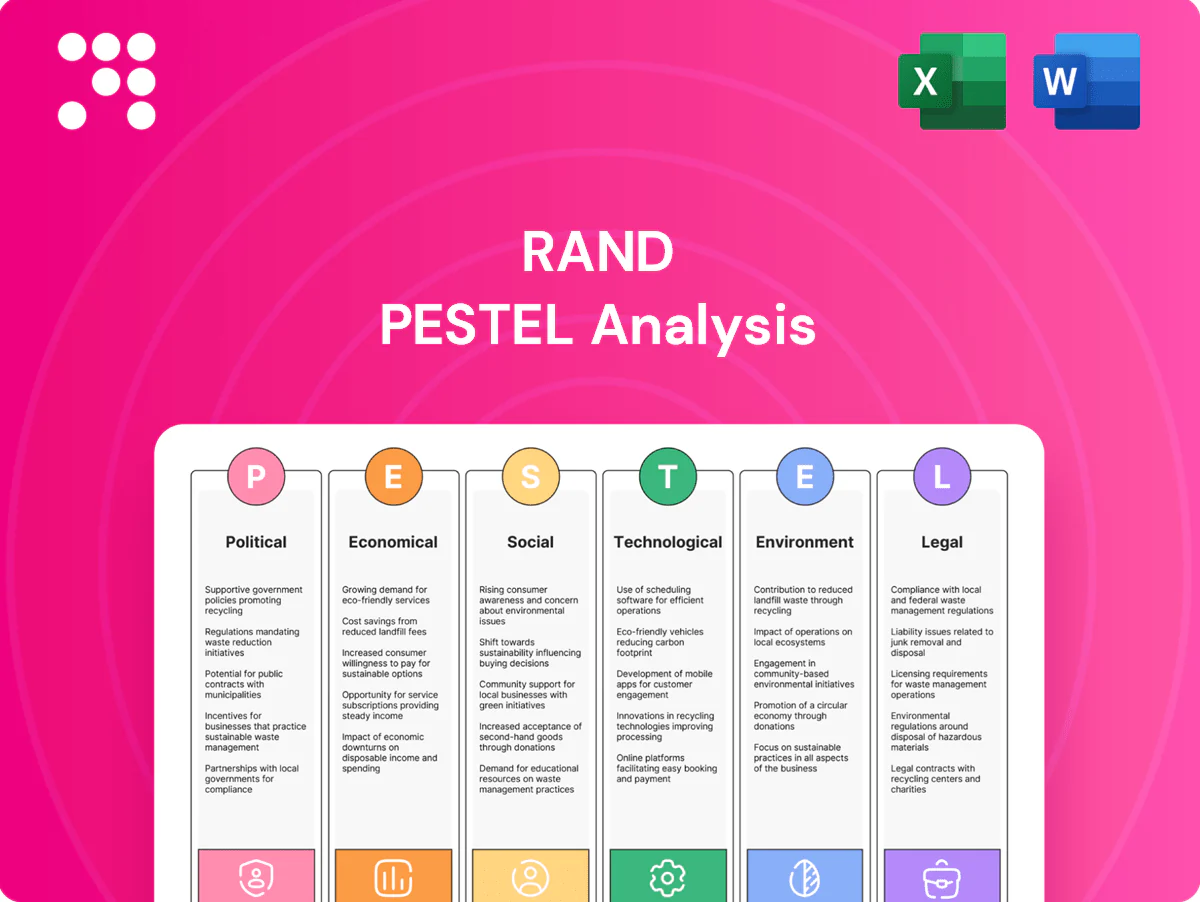
The preview shown here is the exact RAND PESTLE Analysis you’ll receive after purchase—fully formatted and ready to use. This is a real screenshot of the product you’re buying, delivered exactly as shown with no placeholders or surprises. After payment you’ll instantly download the same professionally structured, final file.

Original: $10.00
-65%$10.00
$3.50Product Information
Product Information
Shipping & Returns
Shipping & Returns
Description
Your Shortcut to Market Insight Starts Here
Unlock how political shifts, economic trends, social dynamics, technological advances, legal frameworks, and environmental pressures are shaping RAND’s strategic outlook—our PESTLE analysis distills these forces into clear, actionable insights. Ideal for investors, consultants, and strategists, this concise report highlights risks and opportunity areas you can act on today. Purchase the full PESTLE to get the detailed, editable breakdown and an immediate edge.
Political factors
Shifting public policy priorities
Shifting federal and state agendas redirect research funding toward favored domains, with the FY2024 NDAA authorizing about 858 billion dollars for defense, illustrating how election cycles reweight focus among health, education, and defense. RAND must align proposals to funder priorities without compromising objectivity or rigorous methods. Robust scenario planning and portfolio stress-testing preserve balance across short- and long-term projects.
Bipartisan credibility and independence
Perceived neutrality is critical for RAND’s access and impact across administrations; founded in 1948 and employing approximately 1,800 staff worldwide (2024), any politicization risks funding and stakeholder trust. Robust governance, public financial disclosures and third-party audits bolster impartiality, while transparent methods and peer review—used across RAND’s policy reports—sustain legitimacy and cross-party credibility.
National security and defense posture
Defense strategy updates drive demand for analyses on deterrence, innovation, and force structure. Classified work requires security clearances such as TS/SCI, shaping staffing, vetting timelines, and facilities. US defense spending exceeded 800 billion dollars in 2024, and DoD budget reprogramming has historically accelerated or paused study timelines. Partnerships with OSD, DARPA, and combatant commands determine scope and data access.
Geopolitical tensions shaping research
Rising great-power rivalry drives expanded demand for cyber, space and supply-chain resilience, with global military spending at about 2.24 trillion USD in 2023 (SIPRI) and the cybersecurity market near 190 billion USD in 2023, forcing RAND to prioritize hard-to-share capabilities. Sanctions and diplomatic frictions increasingly restrict collaborations and cross-border data flows, while international fieldwork faces access constraints; risk management and alternative data sources become essential.
- geopolitics: 2.24T global military spend (2023)
- cyber: ~190B cybersecurity market (2023)
- restrictions: sanctions limit data/collab
- response: shift to risk mgmt and alt data
Government procurement and oversight
Competitive contracting, audits, and performance metrics guide award decisions; U.S. federal contracting obligations were roughly $700 billion annually in 2023–24, increasing pressure for measurable outcomes. Shifts toward evidence-based policymaking and OMB guidance have raised demand for rigorous, reproducible studies, while procurement streamlining or delays can compress contractors' cash flow and working capital. Compliance quality directly affects eligibility for future task orders and set-asides.
- Competitive awards tied to performance metrics
- ~$700B federal contracting (2023–24)
- Evidence-based policy raises demand for reproducible studies
- Procurement delays harm cash flow; compliance affects future orders
FY2024 Defense Funding Shift Spurs Demand for Secure, Classified Analysis
Shifts in federal/state agendas and FY2024 NDAA $858B redirect funding across health, education, and defense, requiring RAND to align proposals while protecting objectivity. Perceived neutrality and governance (founded 1948, ~1,800 staff) preserve access across administrations. Great-power rivalry, $2.24T global military (2023) and ~$190B cyber market (2023), increase demand for classified, secure analyses.
| Metric | Value |
|---|---|
| FY2024 NDAA | $858B |
| US defense (2024) | >$800B |
| Global military (2023) | $2.24T |
| Cyber market (2023) | ~$190B |
| Federal contracting (2023–24) | ~$700B |
What is included in the product
Detailed Word Document
Explores how external macro-environmental factors uniquely affect RAND across Political, Economic, Social, Technological, Environmental and Legal dimensions, with each category expanded into data-backed sub-points and sector-specific examples. Designed for executives and investors, it delivers forward-looking insights to inform scenario planning, risk mitigation and opportunity identification.
Customizable Excel Spreadsheet
Condenses the full RAND PESTLE into a clean, shareable summary segmented by factor for quick reference in meetings, presentations, or client reports.
Economic factors
Budget cycles and fiscal consolidation
Federal deficits near $1.7 trillion (FY2023) and roughly $1.6 trillion (FY2024) pressure discretionary research funds, tightening grants and contracts. Continuing resolutions—used repeatedly in 2023–24—delay starts and payments, creating cash-flow timing risk for RAND. RAND must manage reserves and bridge financing to cover gaps. Expanding multi-year contracts smooths revenue volatility and lowers refinancing costs.
Philanthropy and grant market dynamics
Foundation priorities evolve with societal needs and donor sentiment, shifting funding toward climate, racial equity and health causes. Giving USA 2024 reports US charitable giving reached $499.33 billion in 2023, shaping grant flows and competition. Endowment performance affects grant availability and matching requirements, tightening budgets in weak market years. Diversifying sponsors reduces concentration risk and co-funding models unlock larger, multi‑partner programs.
Talent market and compensation pressures
Competition for data scientists and subject-matter experts has driven US median total compensation up roughly 8% year-over-year to about $130,000 in 2024, pressuring project margins. Remote work, now adopted by roughly 35–40% of tech roles, widens recruiting pools but raises retention volatility and churn risk. Investment in training and clear career pathways boosts productivity and reduces expensive external hiring. Balanced staffing mixes and junior-senior blends protect margins on fixed-price engagements.
Inflation and overhead recovery
Rising wages, data licenses (Bloomberg ~27,000 USD/yr) and travel push RAND project budgets higher, with wage pressures and supplier inflation increasing direct costs; indirect rate negotiations (commonly 35–65% for research orgs) determine how much of that is recovered, while efficient procurement and tooling reduce unit costs and accurate scoping avoids under-recovery.
- Rising wages
- Data licenses ~27,000 USD/yr
- Travel inflation
- Indirect rates 35–65%
- Procurement/tooling efficiency
- Accurate scoping
Revenue diversification and international work
Expanding into multilateral and foreign government contracts spreads revenue risk and taps a public procurement market estimated at about USD 12 trillion annually (2023). Currency and payment-term mismatches introduce FX and receivable exposure, while local compliance and reputational due diligence are mandatory for award and performance. Partnership models and local JV arrangements frequently ease market entry and contract execution.
- Spreads risk: access to USD 12T public procurement (2023)
- FX exposure: payment-term and currency mismatch
- Compliance: local law and reputational due diligence
- Entry: partnerships/JVs to shorten market access
FY2024 Defense Funding Shift Spurs Demand for Secure, Classified Analysis
Federal deficits (~$1.6T FY2024) and repeated continuing resolutions tighten research funding; diversify sponsors and expand multi-year contracts. US charitable giving $499.3B (2023) and endowment returns drive grant availability. Median data-scientist pay ~$130,000 (2024) and rising vendor costs (Bloomberg ~$27,000/yr) pressure margins; manage staffing mix and indirect rates (35–65%).
| Metric | Value |
|---|---|
| Federal deficit FY24 | $1.6T |
| Charitable giving 2023 | $499.3B |
| Median pay 2024 | $130,000 |
| Bloomberg license | $27,000/yr |
| Public procurement 2023 | $12T |
Preview Before You Purchase
RAND PESTLE Analysis
The preview shown here is the exact RAND PESTLE Analysis you’ll receive after purchase—fully formatted and ready to use. This is a real screenshot of the product you’re buying, delivered exactly as shown with no placeholders or surprises. After payment you’ll instantly download the same professionally structured, final file.