Rallis India PESTLE Analysis

Your Shortcut to Market Insight Starts Here
Unlock how regulatory shifts, commodity cycles, and technological adoption are reshaping Rallis India's prospects in our concise PESTLE snapshot. This analysis equips investors and strategists with actionable signals to refine forecasts and spot risks. Purchase the full report for the detailed, ready-to-use intelligence you need today.
Political factors

Agri subsidies and MSP policy alignment
Government input subsidies and MSP decisions materially shape crop economics and pesticide demand; fertiliser subsidies were about ₹1.47 lakh crore in FY24 and India’s net sown area is ~141.9 million hectares, so favorable MSPs/subsidies can spur acreage and input purchases while cuts depress volumes. Rallis must align portfolio and pricing to Union Budget and state budget cycles and adjust channel stocking to procurement seasons. Active engagement with Ministry of Agriculture and state agri departments is critical for policy signalling and trade-offs.
State-level agri schemes and procurement
State schemes such as PMFBY (launched 2016) and state soil health missions vary widely across states, creating regional sales differentials and affecting Rallis’ market penetration.
Tender-based procurement by state agencies leads to lumpy demand and price pressure during peak buying windows, forcing margin compression for input suppliers.
Rallis must deploy state-tailored go-to-market plans and maintain consistent government liaison and field-level engagement to mitigate volatility and secure tenders.

Trade policy and import/export controls
Changes in import duties, anti-dumping measures and export curbs on technicals directly raise input costs for agrochemical firms, and recent policy shifts have tightened margin visibility.
Restrictions on Chinese intermediates have elevated COGS for the industry, making diversified sourcing increasingly important.
Rallis mitigates risk through multi-source procurement and active tariff monitoring, and it engages industry bodies for policy advocacy to influence favorable trade outcomes.

Pesticide regulation and approvals pace
Central and state approvals in India, often taking 18–36 months for new agrochemical registrations, directly set Rallis India’s time-to-market; slow clearances compress commercial launch windows and erode the 20-year patent lifecycle. Delays can defer revenue recognition and reduce peak sales opportunity in a market valued around USD 8–9bn (≈INR 60–70k crore) in 2023. Robust regulatory dossiers and proactive compliance shorten review times and lower political scrutiny.
- Approval timeline: 18–36 months
- Patent term: 20 years
- India crop-protection market: USD 8–9bn (2023)
- Mitigation: strong dossiers, proactive compliance
Rural development and election cycles
Election-year rural spending (2024 polls saw 66.91% turnout) typically boosts farm liquidity and input uptake, while post-election budget resets can tighten discretionary spend; Rallis should align inventory and seasonal credit lines with political calendars to avoid stockouts or overhangs. Outreach can link to government rural missions to amplify adoption.
- Align inventory and credit with election calendars
- Use outreach tied to rural missions
- Monitor post-election budget shifts
Fertiliser subsidies, rural liquidity spur launches; approvals and trade shifts lift COGS
Government MSPs/subsidies (fertiliser subsidy ~₹1.47 lakh crore FY24) and state schemes drive acreage and input demand; approval timelines (18–36 months) and market size (USD 8–9bn 2023) affect launches. Election-year rural liquidity (turnout 66.91% in 2024) boosts uptake; trade/tariff shifts and Chinese input restrictions raise COGS. Rallis uses multi-source procurement, state GTM and active government liaison.
| Metric | Value |
|---|---|
| Fertiliser subsidy FY24 | ₹1.47 lakh crore |
| Approval timeline | 18–36 months |
| Market size (2023) | USD 8–9bn |
| 2024 turnout | 66.91% |
What is included in the product
 Detailed Word Document
Explores how macro-environmental factors uniquely affect Rallis India across Political, Economic, Social, Technological, Environmental and Legal dimensions, with data-backed trends and industry-specific examples. Designed for executives and investors, it highlights threats, opportunities and forward-looking insights to support scenario planning, strategy design and funding-ready presentations.

 Customizable Excel Spreadsheet
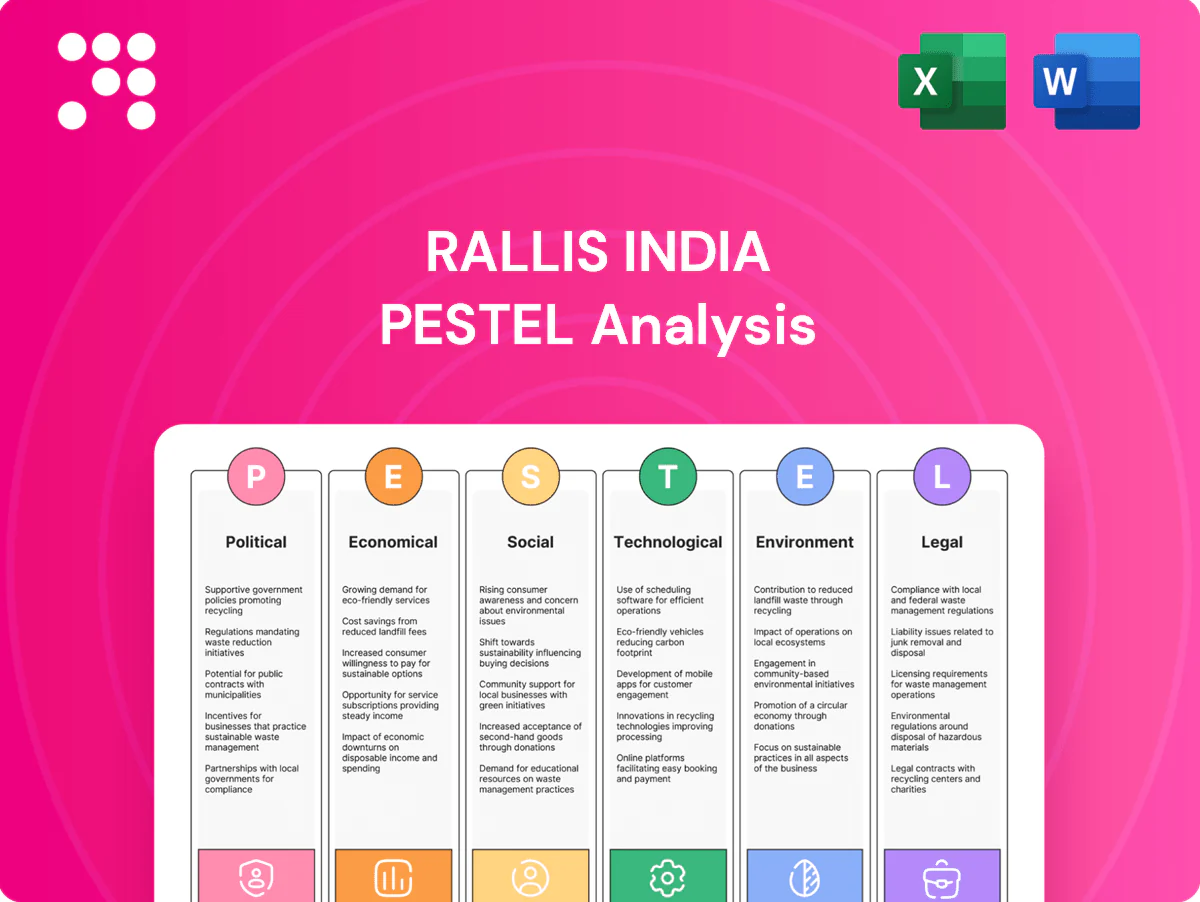
A concise, visually segmented PESTLE summary of Rallis India that can be dropped into presentations, shared across teams, and edited with notes to quickly align stakeholders on external risks, regulatory impacts, and market positioning.
Economic factors

Monsoon dependence and farm income
Rallis sales remain tightly linked to the southwest monsoon, which supplies roughly 70% of India’s annual rainfall; normal monsoons lift yields and pesticide use while deficits sharply dampen demand. Volatile farm incomes — agriculture still employs about 45% of the workforce — prompt farmer downtrading or selective premium adoption, so Rallis must plan flexible SKUs and tailored credit terms. Deploying weather hedging and demand-sensing analytics reduces revenue shocks and inventory waste.
Commodity price cycles
Commodity cycles in cotton, rice, wheat and horticulture drive Rallis India crop-protection demand: higher price realizations correlate with 10–20% upticks in per-hectare input spend as farmers shift to intensive regimes. With India producing over 330 million tonnes of horticulture (2023–24, Ministry of Agriculture), specialty chemistries gain share. Rallis must align portfolio mix to profitable crops and use dynamic channel incentives tied to crop-price swings.

Inflation and forex on raw materials
Many actives and intermediates are imported, exposing Rallis to INR/USD volatility as USD/INR traded around 83–84 in 2024–25; inflationary pressure (India CPI ~5.1% in 2024) can squeeze margins if price hikes lag. Rallis uses hedging and multi-sourcing to stabilize input costs and reduce FX pass-through. Ongoing efficiency programs and cost controls aim to protect EBITDA and margin resilience.

Rural credit and dealer liquidity
NBFC and cooperative lending cycles directly curb farmer purchases and dealer stocking; India's agricultural credit target for 2024–25 was set at ₹20 lakh crore, shaping rural liquidity. Tighter credit increases receivable and channel risk, so Rallis must tighten channel finance and collections. Use of structured schemes and crop insurance reduces default exposure.
- NBFC/co-op lending impact on demand
- Tighter credit => higher receivables risk
- Need active channel finance & collections
- Structured schemes & insurance mitigate defaults
Competitive intensity and consolidation
Rallis faces intense competition from global MNCs, domestic generics and Chinese imports that compress pricing and margins; consolidation among distributors shifts bargaining power toward large channels, forcing tighter trade terms. Differentiated formulations and strong brand equity help defend market share while cost leadership and scale lower per-unit costs, supporting competitiveness.
- Competition: MNCs, generics, Chinese imports
- Distribution: consolidation increases buyer power
- Defense: differentiated formulations, brand equity
- Advantage: cost leadership and scale
Fertiliser subsidies, rural liquidity spur launches; approvals and trade shifts lift COGS
Rallis revenue swings with the southwest monsoon (≈70% rainfall); normal monsoons boost input use while deficits cut demand. Crop-price cycles (cotton, rice, wheat) and 330 MT horticulture (2023–24) drive specialty demand. USD/INR ~83–84 (2024–25) and CPI ~5.1% squeeze margins; agri credit target ₹20 lakh crore (2024–25) shapes rural liquidity.
| Metric | Value |
|---|---|
| Monsoon reliance | ≈70% |
| Horticulture (2023–24) | 330 MT |
| USD/INR (2024–25) | 83–84 |
| CPI (2024) | 5.1% |
| Agri credit (2024–25) | ₹20 Lakh Cr |
What You See Is What You Get
Rallis India PESTLE Analysis
The preview shown here is the exact Rallis India PESTLE Analysis you’ll receive after purchase—fully formatted and ready to use. The content, layout, and professional structure visible in this sample are identical to the downloadable file. No placeholders or surprises; instant access after payment.

Product Information
Product Information
Shipping & Returns
Shipping & Returns
Description
Your Shortcut to Market Insight Starts Here
Unlock how regulatory shifts, commodity cycles, and technological adoption are reshaping Rallis India's prospects in our concise PESTLE snapshot. This analysis equips investors and strategists with actionable signals to refine forecasts and spot risks. Purchase the full report for the detailed, ready-to-use intelligence you need today.
Political factors
Agri subsidies and MSP policy alignment
Government input subsidies and MSP decisions materially shape crop economics and pesticide demand; fertiliser subsidies were about ₹1.47 lakh crore in FY24 and India’s net sown area is ~141.9 million hectares, so favorable MSPs/subsidies can spur acreage and input purchases while cuts depress volumes. Rallis must align portfolio and pricing to Union Budget and state budget cycles and adjust channel stocking to procurement seasons. Active engagement with Ministry of Agriculture and state agri departments is critical for policy signalling and trade-offs.
State-level agri schemes and procurement
State schemes such as PMFBY (launched 2016) and state soil health missions vary widely across states, creating regional sales differentials and affecting Rallis’ market penetration.
Tender-based procurement by state agencies leads to lumpy demand and price pressure during peak buying windows, forcing margin compression for input suppliers.
Rallis must deploy state-tailored go-to-market plans and maintain consistent government liaison and field-level engagement to mitigate volatility and secure tenders.
Trade policy and import/export controls
Changes in import duties, anti-dumping measures and export curbs on technicals directly raise input costs for agrochemical firms, and recent policy shifts have tightened margin visibility.
Restrictions on Chinese intermediates have elevated COGS for the industry, making diversified sourcing increasingly important.
Rallis mitigates risk through multi-source procurement and active tariff monitoring, and it engages industry bodies for policy advocacy to influence favorable trade outcomes.
Pesticide regulation and approvals pace
Central and state approvals in India, often taking 18–36 months for new agrochemical registrations, directly set Rallis India’s time-to-market; slow clearances compress commercial launch windows and erode the 20-year patent lifecycle. Delays can defer revenue recognition and reduce peak sales opportunity in a market valued around USD 8–9bn (≈INR 60–70k crore) in 2023. Robust regulatory dossiers and proactive compliance shorten review times and lower political scrutiny.
- Approval timeline: 18–36 months
- Patent term: 20 years
- India crop-protection market: USD 8–9bn (2023)
- Mitigation: strong dossiers, proactive compliance
Rural development and election cycles
Election-year rural spending (2024 polls saw 66.91% turnout) typically boosts farm liquidity and input uptake, while post-election budget resets can tighten discretionary spend; Rallis should align inventory and seasonal credit lines with political calendars to avoid stockouts or overhangs. Outreach can link to government rural missions to amplify adoption.
- Align inventory and credit with election calendars
- Use outreach tied to rural missions
- Monitor post-election budget shifts
Fertiliser subsidies, rural liquidity spur launches; approvals and trade shifts lift COGS
Government MSPs/subsidies (fertiliser subsidy ~₹1.47 lakh crore FY24) and state schemes drive acreage and input demand; approval timelines (18–36 months) and market size (USD 8–9bn 2023) affect launches. Election-year rural liquidity (turnout 66.91% in 2024) boosts uptake; trade/tariff shifts and Chinese input restrictions raise COGS. Rallis uses multi-source procurement, state GTM and active government liaison.
| Metric | Value |
|---|---|
| Fertiliser subsidy FY24 | ₹1.47 lakh crore |
| Approval timeline | 18–36 months |
| Market size (2023) | USD 8–9bn |
| 2024 turnout | 66.91% |
What is included in the product
Detailed Word Document
Explores how macro-environmental factors uniquely affect Rallis India across Political, Economic, Social, Technological, Environmental and Legal dimensions, with data-backed trends and industry-specific examples. Designed for executives and investors, it highlights threats, opportunities and forward-looking insights to support scenario planning, strategy design and funding-ready presentations.
Customizable Excel Spreadsheet
A concise, visually segmented PESTLE summary of Rallis India that can be dropped into presentations, shared across teams, and edited with notes to quickly align stakeholders on external risks, regulatory impacts, and market positioning.
Economic factors
Monsoon dependence and farm income
Rallis sales remain tightly linked to the southwest monsoon, which supplies roughly 70% of India’s annual rainfall; normal monsoons lift yields and pesticide use while deficits sharply dampen demand. Volatile farm incomes — agriculture still employs about 45% of the workforce — prompt farmer downtrading or selective premium adoption, so Rallis must plan flexible SKUs and tailored credit terms. Deploying weather hedging and demand-sensing analytics reduces revenue shocks and inventory waste.
Commodity price cycles
Commodity cycles in cotton, rice, wheat and horticulture drive Rallis India crop-protection demand: higher price realizations correlate with 10–20% upticks in per-hectare input spend as farmers shift to intensive regimes. With India producing over 330 million tonnes of horticulture (2023–24, Ministry of Agriculture), specialty chemistries gain share. Rallis must align portfolio mix to profitable crops and use dynamic channel incentives tied to crop-price swings.
Inflation and forex on raw materials
Many actives and intermediates are imported, exposing Rallis to INR/USD volatility as USD/INR traded around 83–84 in 2024–25; inflationary pressure (India CPI ~5.1% in 2024) can squeeze margins if price hikes lag. Rallis uses hedging and multi-sourcing to stabilize input costs and reduce FX pass-through. Ongoing efficiency programs and cost controls aim to protect EBITDA and margin resilience.
Rural credit and dealer liquidity
NBFC and cooperative lending cycles directly curb farmer purchases and dealer stocking; India's agricultural credit target for 2024–25 was set at ₹20 lakh crore, shaping rural liquidity. Tighter credit increases receivable and channel risk, so Rallis must tighten channel finance and collections. Use of structured schemes and crop insurance reduces default exposure.
- NBFC/co-op lending impact on demand
- Tighter credit => higher receivables risk
- Need active channel finance & collections
- Structured schemes & insurance mitigate defaults
Competitive intensity and consolidation
Rallis faces intense competition from global MNCs, domestic generics and Chinese imports that compress pricing and margins; consolidation among distributors shifts bargaining power toward large channels, forcing tighter trade terms. Differentiated formulations and strong brand equity help defend market share while cost leadership and scale lower per-unit costs, supporting competitiveness.
- Competition: MNCs, generics, Chinese imports
- Distribution: consolidation increases buyer power
- Defense: differentiated formulations, brand equity
- Advantage: cost leadership and scale
Fertiliser subsidies, rural liquidity spur launches; approvals and trade shifts lift COGS
Rallis revenue swings with the southwest monsoon (≈70% rainfall); normal monsoons boost input use while deficits cut demand. Crop-price cycles (cotton, rice, wheat) and 330 MT horticulture (2023–24) drive specialty demand. USD/INR ~83–84 (2024–25) and CPI ~5.1% squeeze margins; agri credit target ₹20 lakh crore (2024–25) shapes rural liquidity.
| Metric | Value |
|---|---|
| Monsoon reliance | ≈70% |
| Horticulture (2023–24) | 330 MT |
| USD/INR (2024–25) | 83–84 |
| CPI (2024) | 5.1% |
| Agri credit (2024–25) | ₹20 Lakh Cr |
What You See Is What You Get
Rallis India PESTLE Analysis
The preview shown here is the exact Rallis India PESTLE Analysis you’ll receive after purchase—fully formatted and ready to use. The content, layout, and professional structure visible in this sample are identical to the downloadable file. No placeholders or surprises; instant access after payment.