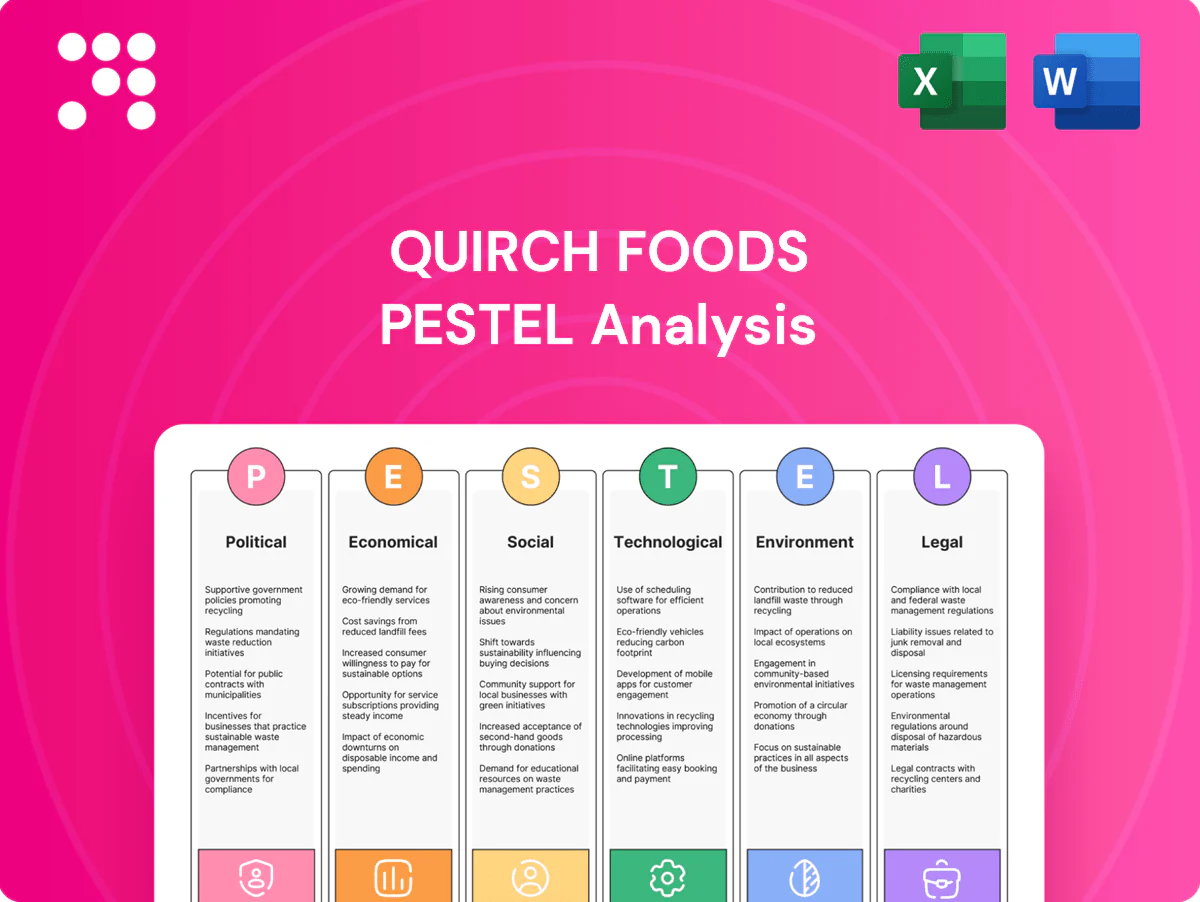
Quirch Foods PESTLE Analysis

Plan Smarter. Present Sharper. Compete Stronger.
Discover how political shifts, economic trends, social preferences, technological advances, legal changes, and environmental pressures are shaping Quirch Foods' strategy and risks. Our PESTLE distills these forces into actionable insights for investors and strategists. Purchase the full analysis to get the complete, editable report and use it to sharpen decisions and spot growth opportunities.
Political factors

Trade policies and tariffs
Meat and seafood imports face shifting tariffs, quotas and sanitary-phytosanitary rules that can add 5–20% to landed costs. Changes in USMCA, CARICOM and bilateral agreements reshape sourcing routes and price competitiveness across North American and Caribbean supply chains. Quirch must diversify suppliers, pre-clear compliance and invest in lobbying and trade intelligence to reduce tariff-shock and disruption risk.
Cross-border logistics and customs
Operations across the US, Caribbean and Latin America hinge on efficient customs clearance and port infrastructure; Panama Canal handled about 12,500 transits in 2023, illustrating choke-point exposure. Political choices on port privatization, security protocols and customs digitization directly affect lead times and demurrage costs. Quirch requires bonded warehousing and experienced brokers to navigate varied regimes, plus contingency routings to sustain service during bottlenecks.

Food security and agricultural policies
Government pushes for domestic protein production and targeted subsidies can reallocate supply and distort prices; Quirch must monitor subsidy programs and tariff shifts that alter feedstock and meat economics. Export restrictions during shocks, as seen in past animal-disease episodes, can sharply tighten availability. Quirch should keep multi-origin sourcing, scenario plans and strategic inventory buffers of 8–12 weeks to protect key customers.

Regime stability and governance
- Country risk assessments
- Political risk insurance
- Local partnerships & compliance
- Focus on FX and payment continuity
Sanctions and geopolitical risk
Evolving US sanctions and export controls (OFAC SDN list >9,700 as of 2024) restrict counterparties and vessels, while Russia/Black Sea disruptions and China–US tensions have rerouted protein flows and raised freight volatility; Drewry reported 2024 container rates roughly 25% above 2019 averages. Quirch requires screening tools, legal oversight and flexible procurement to avoid violations and mitigate market shocks.
- Sanctions: OFAC SDN >9,700 (2024)
- Freight: +~25% vs 2019 (Drewry, 2024)
- Needs: screening, legal review
- Mitigation: diversified suppliers, agile contracts
Tariffs add 5-20% landed cost, diversify suppliers, keep 8-12 week buffer
Meat/seafood tariffs, quotas and SPS rules add ~5–20% landed cost; USMCA/CARICOM shifts alter sourcing—Quirch needs supplier diversification, compliance and lobbying. Port chokepoints (Panama Canal ~12,500 transits 2023) and customs digitization affect lead times; maintain bonded warehousing and 8–12 week buffers. Sanctions (OFAC SDN >9,700 in 2024) and freight +~25% vs 2019 (Drewry 2024) require screening and agile contracts.
| Tag | Metric | Value |
|---|---|---|
| Tariff impact | Landed cost increase | 5–20% |
| Chokepoint | Panama transits (2023) | ~12,500 |
| Sanctions | OFAC SDN (2024) | >9,700 |
| Freight | Container rates vs 2019 | +~25% |
| Remittances | Latin Am. 2023 | $146B |
| Inventory | Recommended buffer | 8–12 weeks |
What is included in the product
 Detailed Word Document
Explores how macro-environmental forces uniquely affect Quirch Foods across Political, Economic, Social, Technological, Environmental and Legal dimensions, with data-backed trends and examples specific to its sector and region, providing forward-looking insights and formatted findings ready for business plans, investor briefs and strategic scenario planning.

 Customizable Excel Spreadsheet
Compact, visually segmented PESTLE summary of Quirch Foods that’s editable and shareable for quick inclusion in slides or strategy sessions, aiding external risk discussions, cross‑team alignment, and consultant reports.
Economic factors

Protein commodity price volatility
Protein commodity prices for beef, pork, poultry and seafood swing with feed costs, disease cycles and global demand, with year-on-year swings of roughly 15–30% observed across major markets in 2023–24.
Margin management requires hedging, indexed contracts and SKU-mix optimization to protect gross margins.
Quirch must adjust pricing cadence by customer segment to reflect differing elasticity.
Data-driven forecasting tied to POS and supplier indices helps smooth procurement and reduce exposure.
Fuel and freight cost inflation
Diesel and ocean freight rates materially drive Quirch Foods distribution costs across regions; U.S. average diesel was about $3.75/gal in late 2024 (EIA) and global container rates averaged near 1,200–1,500 USD per FEU through 2024 (SCFI/BIMCO ranges). Tight capacity and surcharges squeeze margins and service levels, so Quirch can use route optimization, modal shifts, and fuel surcharges to recover costs, while long-term carrier partnerships improve reliability.

Currency fluctuations
Multi-currency exposure across Latin America and the Caribbean affects Quirch Foods’ sourcing and receivables as the US dollar trade-weighted index rose about 8% in 2024 to near 105, tightening local buyer margins and lengthening reorder cycles. USD strength can compress demand; Quirch should expand FX hedging, use natural currency offsets, and implement currency-adjusted pricing. Tightened credit controls and shorter payment terms must reflect FX risk.

Consumer spending cycles
Retail and foodservice demand tracks employment, tourism, and real incomes; US unemployment was about 3.7% in 2024 (BLS) while UNWTO reported international arrivals at ~88% of 2019 levels in 2023, supporting eating-out. Downturns shift mix to value proteins and private label (private-label share ~18% in grocery, NielsenIQ 2023). Quirch can use tiered assortments, promotional packs and POS analytics for agile allocation and share retention.
- Track: employment, tourism, real incomes
- Response: tiered SKUs, promo packs, POS-driven allocation
Labor availability and wage trends
Warehouse, processing and trucking labor markets remain tight in major hubs; U.S. heavy and tractor-trailer truck drivers had a median annual wage of about $54,760 in May 2024 (BLS) while warehousing pay rose roughly 8% year-over-year in 2024, pressuring margins and raising turnover risk.
- Tight labor pools in hubs — higher recruitment costs
- Wage/benefit inflation — rising operating costs
- Invest in automation and retention to stabilize productivity
- Cross-training enables peak-season flexibility
Tariffs add 5-20% landed cost, diversify suppliers, keep 8-12 week buffer
Protein prices swung 15–30% in 2023–24, pressuring gross margins and requiring hedging.
Freight/diesel costs (diesel ~$3.75/gal, containers $1,200–1,500/FEU in 2024) raise distribution spend.
USD strength (+8% TWI in 2024) and tight labor (truckers median $54,760; warehousing +8% y/y) compress local demand and raise operating costs.
| Factor | Key data | Implication |
|---|---|---|
| Commodities | 15–30% swing | Hedge/SKU mix |
| Logistics | $3.75/gal; $1.2–1.5k FEU | Route opt./surcharges |
| FX | +8% TWI | FX hedging |
| Labor | $54.8k; +8% pay | Automation/retention |
Preview the Actual Deliverable
Quirch Foods PESTLE Analysis
Our Quirch Foods PESTLE Analysis examines political, economic, social, technological, legal and environmental factors affecting strategy and risk. It highlights regulatory impacts, market trends, supply-chain vulnerabilities and sustainability considerations, with actionable implications for growth and mitigation. The preview shown here is the exact document you’ll receive after purchase—fully formatted and ready to use.

Original: $10.00
-65%$10.00
$3.50Product Information
Product Information
Shipping & Returns
Shipping & Returns
Description
Plan Smarter. Present Sharper. Compete Stronger.
Discover how political shifts, economic trends, social preferences, technological advances, legal changes, and environmental pressures are shaping Quirch Foods' strategy and risks. Our PESTLE distills these forces into actionable insights for investors and strategists. Purchase the full analysis to get the complete, editable report and use it to sharpen decisions and spot growth opportunities.
Political factors
Trade policies and tariffs
Meat and seafood imports face shifting tariffs, quotas and sanitary-phytosanitary rules that can add 5–20% to landed costs. Changes in USMCA, CARICOM and bilateral agreements reshape sourcing routes and price competitiveness across North American and Caribbean supply chains. Quirch must diversify suppliers, pre-clear compliance and invest in lobbying and trade intelligence to reduce tariff-shock and disruption risk.
Cross-border logistics and customs
Operations across the US, Caribbean and Latin America hinge on efficient customs clearance and port infrastructure; Panama Canal handled about 12,500 transits in 2023, illustrating choke-point exposure. Political choices on port privatization, security protocols and customs digitization directly affect lead times and demurrage costs. Quirch requires bonded warehousing and experienced brokers to navigate varied regimes, plus contingency routings to sustain service during bottlenecks.
Food security and agricultural policies
Government pushes for domestic protein production and targeted subsidies can reallocate supply and distort prices; Quirch must monitor subsidy programs and tariff shifts that alter feedstock and meat economics. Export restrictions during shocks, as seen in past animal-disease episodes, can sharply tighten availability. Quirch should keep multi-origin sourcing, scenario plans and strategic inventory buffers of 8–12 weeks to protect key customers.
Regime stability and governance
- Country risk assessments
- Political risk insurance
- Local partnerships & compliance
- Focus on FX and payment continuity
Sanctions and geopolitical risk
Evolving US sanctions and export controls (OFAC SDN list >9,700 as of 2024) restrict counterparties and vessels, while Russia/Black Sea disruptions and China–US tensions have rerouted protein flows and raised freight volatility; Drewry reported 2024 container rates roughly 25% above 2019 averages. Quirch requires screening tools, legal oversight and flexible procurement to avoid violations and mitigate market shocks.
- Sanctions: OFAC SDN >9,700 (2024)
- Freight: +~25% vs 2019 (Drewry, 2024)
- Needs: screening, legal review
- Mitigation: diversified suppliers, agile contracts
Tariffs add 5-20% landed cost, diversify suppliers, keep 8-12 week buffer
Meat/seafood tariffs, quotas and SPS rules add ~5–20% landed cost; USMCA/CARICOM shifts alter sourcing—Quirch needs supplier diversification, compliance and lobbying. Port chokepoints (Panama Canal ~12,500 transits 2023) and customs digitization affect lead times; maintain bonded warehousing and 8–12 week buffers. Sanctions (OFAC SDN >9,700 in 2024) and freight +~25% vs 2019 (Drewry 2024) require screening and agile contracts.
| Tag | Metric | Value |
|---|---|---|
| Tariff impact | Landed cost increase | 5–20% |
| Chokepoint | Panama transits (2023) | ~12,500 |
| Sanctions | OFAC SDN (2024) | >9,700 |
| Freight | Container rates vs 2019 | +~25% |
| Remittances | Latin Am. 2023 | $146B |
| Inventory | Recommended buffer | 8–12 weeks |
What is included in the product
Detailed Word Document
Explores how macro-environmental forces uniquely affect Quirch Foods across Political, Economic, Social, Technological, Environmental and Legal dimensions, with data-backed trends and examples specific to its sector and region, providing forward-looking insights and formatted findings ready for business plans, investor briefs and strategic scenario planning.
Customizable Excel Spreadsheet
Compact, visually segmented PESTLE summary of Quirch Foods that’s editable and shareable for quick inclusion in slides or strategy sessions, aiding external risk discussions, cross‑team alignment, and consultant reports.
Economic factors
Protein commodity price volatility
Protein commodity prices for beef, pork, poultry and seafood swing with feed costs, disease cycles and global demand, with year-on-year swings of roughly 15–30% observed across major markets in 2023–24.
Margin management requires hedging, indexed contracts and SKU-mix optimization to protect gross margins.
Quirch must adjust pricing cadence by customer segment to reflect differing elasticity.
Data-driven forecasting tied to POS and supplier indices helps smooth procurement and reduce exposure.
Fuel and freight cost inflation
Diesel and ocean freight rates materially drive Quirch Foods distribution costs across regions; U.S. average diesel was about $3.75/gal in late 2024 (EIA) and global container rates averaged near 1,200–1,500 USD per FEU through 2024 (SCFI/BIMCO ranges). Tight capacity and surcharges squeeze margins and service levels, so Quirch can use route optimization, modal shifts, and fuel surcharges to recover costs, while long-term carrier partnerships improve reliability.
Currency fluctuations
Multi-currency exposure across Latin America and the Caribbean affects Quirch Foods’ sourcing and receivables as the US dollar trade-weighted index rose about 8% in 2024 to near 105, tightening local buyer margins and lengthening reorder cycles. USD strength can compress demand; Quirch should expand FX hedging, use natural currency offsets, and implement currency-adjusted pricing. Tightened credit controls and shorter payment terms must reflect FX risk.
Consumer spending cycles
Retail and foodservice demand tracks employment, tourism, and real incomes; US unemployment was about 3.7% in 2024 (BLS) while UNWTO reported international arrivals at ~88% of 2019 levels in 2023, supporting eating-out. Downturns shift mix to value proteins and private label (private-label share ~18% in grocery, NielsenIQ 2023). Quirch can use tiered assortments, promotional packs and POS analytics for agile allocation and share retention.
- Track: employment, tourism, real incomes
- Response: tiered SKUs, promo packs, POS-driven allocation
Labor availability and wage trends
Warehouse, processing and trucking labor markets remain tight in major hubs; U.S. heavy and tractor-trailer truck drivers had a median annual wage of about $54,760 in May 2024 (BLS) while warehousing pay rose roughly 8% year-over-year in 2024, pressuring margins and raising turnover risk.
- Tight labor pools in hubs — higher recruitment costs
- Wage/benefit inflation — rising operating costs
- Invest in automation and retention to stabilize productivity
- Cross-training enables peak-season flexibility
Tariffs add 5-20% landed cost, diversify suppliers, keep 8-12 week buffer
Protein prices swung 15–30% in 2023–24, pressuring gross margins and requiring hedging.
Freight/diesel costs (diesel ~$3.75/gal, containers $1,200–1,500/FEU in 2024) raise distribution spend.
USD strength (+8% TWI in 2024) and tight labor (truckers median $54,760; warehousing +8% y/y) compress local demand and raise operating costs.
| Factor | Key data | Implication |
|---|---|---|
| Commodities | 15–30% swing | Hedge/SKU mix |
| Logistics | $3.75/gal; $1.2–1.5k FEU | Route opt./surcharges |
| FX | +8% TWI | FX hedging |
| Labor | $54.8k; +8% pay | Automation/retention |
Preview the Actual Deliverable
Quirch Foods PESTLE Analysis
Our Quirch Foods PESTLE Analysis examines political, economic, social, technological, legal and environmental factors affecting strategy and risk. It highlights regulatory impacts, market trends, supply-chain vulnerabilities and sustainability considerations, with actionable implications for growth and mitigation. The preview shown here is the exact document you’ll receive after purchase—fully formatted and ready to use.