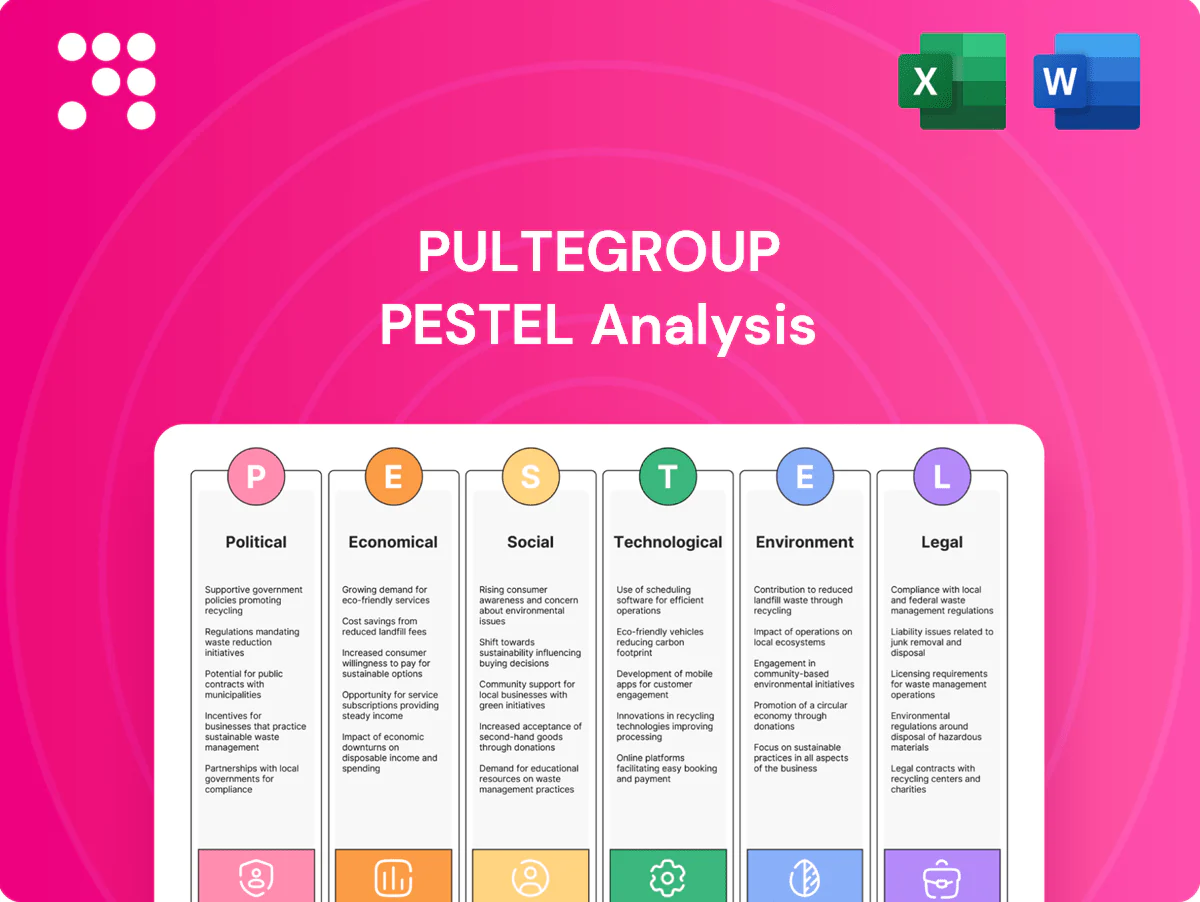
PulteGroup PESTLE Analysis

Your Competitive Advantage Starts with This Report
Gain a competitive edge with our PulteGroup PESTLE analysis that maps political, economic, social, technological, legal, and environmental forces shaping its homebuilding strategy. Ideal for investors and strategists, it highlights actionable risks and opportunities. Buy the full, editable report for immediate, detailed insights you can use today.
Political factors

Housing policies and incentives
Federal and state housing initiatives, including tax credits and down-payment assistance, directly lift demand in PulteGroup’s first-time and move-up segments; stronger programs can quicken sales velocity for Centex and Pulte Homes. Pullbacks in incentives or tighter underwriting reduce buyer qualification via Pulte Financial Services, especially with 30-year rates near 7% in 2024. Monitoring HUD priorities and GSE moves (conforming limit $766,550 in 2024) is critical for pipeline planning.
Zoning and land-use regulation
Local zoning, density caps and permitting timelines (commonly 6–18 months) directly shape community mix, cycle times and lot availability for PulteGroup, with stringent approvals delaying Del Webb and luxury projects and increasing carrying costs. Proactive municipal engagement and land optioning reduce entitlement risk and smooth starts across Pulte’s controlled lot base. Policy shifts in 2024 toward upzoning and ADUs in some markets increased theoretical infill capacity by up to 20%, unlocking incremental opportunities.

Infrastructure and public spending
The Bipartisan Infrastructure Law’s $1.2 trillion package (including roughly $110 billion for roads/bridges and $55 billion for water) improves access, utilities and commute times around new communities, lifting absorption and supporting PulteGroup’s faster turn and pricing power. Delays in roads, water hookups or school capacity still stall closings and can push lot delivery timelines. Political shifts reprioritizing budgets can rapidly change metro selection and ROI.

Trade policy and material tariffs
Tariffs on steel (25% under Section 232) and aluminum (10%) directly raise PulteGroup build costs and compress margins, with material cost swings contributing to ±5–8% variability in community-level gross margins in recent years.
- Diversify suppliers to lower import risk
- Use hedging/contracts to stabilize costs
- Advocate for stable trade rules for predictable pricing
Election cycles and regulatory volatility
Election outcomes at federal, state, and local levels (post-2024 election cycle) can reset housing, energy, and labor rules, prompting anticipatory demand swings that pull forward or delay orders; Freddie Mac shows the 30-year fixed averaged about 7.0% in 2024, intensifying buyer timing decisions. Scenario planning helps align spec inventory and incentives across brands while a balanced geographic footprint buffers jurisdictional shocks.
- Federal/state rule shifts: post-2024 policy reset
- Mortgage context: 30-yr avg ~7.0% in 2024 (Freddie Mac)
- Operational hedge: scenario planning for spec inventory
- Risk mitigation: diversified geography to absorb local shocks
Housing: 30-yr ~7.0%, limit $766,550, tariffs+
Federal/state housing programs, HUD/GSE moves (conforming limit $766,550 in 2024) and post-2024 election shifts alter demand and underwriting; 30-yr avg ~7.0% in 2024 tightened buyer affordability. Local permitting (commonly 6–18 months) and upzoning/ADU policy change lot supply and cycle times. Tariffs (steel 25%, aluminum 10%) and Infrastructure Act ($1.2T; roads $110B, water $55B) shift costs and access.
| Factor | 2024/25 Metric |
|---|---|
| 30-yr rate | ~7.0% (Freddie Mac, 2024) |
| Conforming limit | $766,550 (2024) |
| Permitting | 6–18 months |
| Tariffs | Steel 25%, Al 10% |
| Infrastructure | $1.2T (roads $110B, water $55B) |
What is included in the product
 Detailed Word Document
Explores how macro-environmental factors uniquely affect PulteGroup across Political, Economic, Social, Technological, Environmental, and Legal dimensions, with data-driven insights and trend analysis; designed to inform executives and investors, reflect actual market/regulatory dynamics, and provide forward-looking guidance ready for business plans and strategic reports.

 Customizable Excel Spreadsheet
A concise, visually segmented PulteGroup PESTLE tailored for meetings—easily dropped into slides, annotated for local markets, and shareable across teams to streamline external risk discussions and align strategy.
Economic factors

Mortgage rates and credit availability
Mortgage rates directly shape Pulte buyer affordability and conversion—Freddie Mac showed 30-year fixed near 6.8% in H1 2025, tightening monthly payments and pressuring demand for entry and move-up buyers. Tight credit standards limit first-time buyers while easing credit and Pulte Financial Services buydowns sustain volume. Pulte hedges its mortgage pipeline and uses flexible pricing to protect margins amid rate swings.
Labor and materials inflation
Skilled trade shortages and commodity volatility in 2024 increased build times and amplified gross margin variability for PulteGroup, pressuring margins and delivery cadence. Strategic trade partnerships and standardized plans have lifted labor productivity and reduced schedule drift. Value engineering and national purchasing leverage blunt raw-material spikes, while strict cycle-time discipline remains essential to protect ROIC.

Land costs and lot supply
Rising finished-lot prices—up roughly 15% year-over-year in 2024—compress entry-level price points and community IRRs for PulteGroup. Option-heavy land strategies continued in 2024, lowering balance-sheet risk by shifting fixed-cost exposure. Deep lot pipelines in high-growth Sun Belt metros support steadier closings and revenue cadence. Disciplined underwriting on absorption and price/mix preserved targeted returns through 2024–2025.

Macro demand and household formation
Job growth, rising wages and consumer confidence remain primary drivers of PulteGroup order rates across entry, move-up and active-adult segments; NAR reports median first-time buyer age 36 (2024). Demographic tailwinds from millennials (~72M) and Gen Z (~67M) support entry demand while boomer downsizing sustains Del Webb; downturns push mix to lower price points and incentives, and geographic diversification smooths regional swings.
- Millennials ~72M, Gen Z ~67M (Pew)
- Median first-time buyer age 36 (NAR 2024)
- US single-family starts ~900k (2024 Census est.)
- Del Webb targets 55+ downsizers
Supply-chain reliability
Backlogs in HVAC, windows and appliances have stretched PulteGroup build times—industry reports showed supply delays through 2024 pushing select subsystem lead times into the 12–20 week range, elevating WIP and extending cycle times; PulteGroup carried a backlog exceeding $10 billion in 2024, making component reliability critical. Multiple-source procurement and inventory buffers have improved on-time deliveries, while digital vendor visibility raised scheduling accuracy; stable supply improves cash conversion predictability.
- Backlog: >$10B (2024)
- Subsystem lead times: 12–20 weeks (2024)
- WIP increase: ~15–25% vs pre‑pandemic norms
- Mitigants: multi‑sourcing, buffer inventory, digital vendor tracking
Housing: 30-yr ~7.0%, limit $766,550, tariffs+
Higher mortgage rates (~6.8% 30‑yr H1 2025) and tighter credit reduced affordability and slowed orders, while strong job growth and demographic demand (median first‑time buyer age 36; millennials ~72M) supported volume. Rising finished‑lot prices (~+15% YoY 2024) and subsystem lead times (12–20 weeks) pressured margins and cycle times; Pulte mitigates via lot optioning and hedges. Backlog >$10B and US single‑family starts ~900k (2024) shape revenue cadence.
| Metric | Value |
|---|---|
| 30‑yr mortgage | ~6.8% H1 2025 |
| Finished‑lot prices | +15% YoY 2024 |
| Backlog | >$10B (2024) |
| SF starts | ~900k (2024) |
Preview Before You Purchase
PulteGroup PESTLE Analysis
This PulteGroup PESTLE Analysis provides a concise, professional review of political, economic, social, technological, legal, and environmental factors affecting the homebuilder. The preview shown here is the exact document you’ll receive after purchase—fully formatted and ready to use. No placeholders, no teasers—this is the real, ready-to-use file you’ll get upon checkout.

Original: $10.00
-65%$10.00
$3.50Product Information
Product Information
Shipping & Returns
Shipping & Returns
Description
Your Competitive Advantage Starts with This Report
Gain a competitive edge with our PulteGroup PESTLE analysis that maps political, economic, social, technological, legal, and environmental forces shaping its homebuilding strategy. Ideal for investors and strategists, it highlights actionable risks and opportunities. Buy the full, editable report for immediate, detailed insights you can use today.
Political factors
Housing policies and incentives
Federal and state housing initiatives, including tax credits and down-payment assistance, directly lift demand in PulteGroup’s first-time and move-up segments; stronger programs can quicken sales velocity for Centex and Pulte Homes. Pullbacks in incentives or tighter underwriting reduce buyer qualification via Pulte Financial Services, especially with 30-year rates near 7% in 2024. Monitoring HUD priorities and GSE moves (conforming limit $766,550 in 2024) is critical for pipeline planning.
Zoning and land-use regulation
Local zoning, density caps and permitting timelines (commonly 6–18 months) directly shape community mix, cycle times and lot availability for PulteGroup, with stringent approvals delaying Del Webb and luxury projects and increasing carrying costs. Proactive municipal engagement and land optioning reduce entitlement risk and smooth starts across Pulte’s controlled lot base. Policy shifts in 2024 toward upzoning and ADUs in some markets increased theoretical infill capacity by up to 20%, unlocking incremental opportunities.
Infrastructure and public spending
The Bipartisan Infrastructure Law’s $1.2 trillion package (including roughly $110 billion for roads/bridges and $55 billion for water) improves access, utilities and commute times around new communities, lifting absorption and supporting PulteGroup’s faster turn and pricing power. Delays in roads, water hookups or school capacity still stall closings and can push lot delivery timelines. Political shifts reprioritizing budgets can rapidly change metro selection and ROI.
Trade policy and material tariffs
Tariffs on steel (25% under Section 232) and aluminum (10%) directly raise PulteGroup build costs and compress margins, with material cost swings contributing to ±5–8% variability in community-level gross margins in recent years.
- Diversify suppliers to lower import risk
- Use hedging/contracts to stabilize costs
- Advocate for stable trade rules for predictable pricing
Election cycles and regulatory volatility
Election outcomes at federal, state, and local levels (post-2024 election cycle) can reset housing, energy, and labor rules, prompting anticipatory demand swings that pull forward or delay orders; Freddie Mac shows the 30-year fixed averaged about 7.0% in 2024, intensifying buyer timing decisions. Scenario planning helps align spec inventory and incentives across brands while a balanced geographic footprint buffers jurisdictional shocks.
- Federal/state rule shifts: post-2024 policy reset
- Mortgage context: 30-yr avg ~7.0% in 2024 (Freddie Mac)
- Operational hedge: scenario planning for spec inventory
- Risk mitigation: diversified geography to absorb local shocks
Housing: 30-yr ~7.0%, limit $766,550, tariffs+
Federal/state housing programs, HUD/GSE moves (conforming limit $766,550 in 2024) and post-2024 election shifts alter demand and underwriting; 30-yr avg ~7.0% in 2024 tightened buyer affordability. Local permitting (commonly 6–18 months) and upzoning/ADU policy change lot supply and cycle times. Tariffs (steel 25%, aluminum 10%) and Infrastructure Act ($1.2T; roads $110B, water $55B) shift costs and access.
| Factor | 2024/25 Metric |
|---|---|
| 30-yr rate | ~7.0% (Freddie Mac, 2024) |
| Conforming limit | $766,550 (2024) |
| Permitting | 6–18 months |
| Tariffs | Steel 25%, Al 10% |
| Infrastructure | $1.2T (roads $110B, water $55B) |
What is included in the product
Detailed Word Document
Explores how macro-environmental factors uniquely affect PulteGroup across Political, Economic, Social, Technological, Environmental, and Legal dimensions, with data-driven insights and trend analysis; designed to inform executives and investors, reflect actual market/regulatory dynamics, and provide forward-looking guidance ready for business plans and strategic reports.
Customizable Excel Spreadsheet
A concise, visually segmented PulteGroup PESTLE tailored for meetings—easily dropped into slides, annotated for local markets, and shareable across teams to streamline external risk discussions and align strategy.
Economic factors
Mortgage rates and credit availability
Mortgage rates directly shape Pulte buyer affordability and conversion—Freddie Mac showed 30-year fixed near 6.8% in H1 2025, tightening monthly payments and pressuring demand for entry and move-up buyers. Tight credit standards limit first-time buyers while easing credit and Pulte Financial Services buydowns sustain volume. Pulte hedges its mortgage pipeline and uses flexible pricing to protect margins amid rate swings.
Labor and materials inflation
Skilled trade shortages and commodity volatility in 2024 increased build times and amplified gross margin variability for PulteGroup, pressuring margins and delivery cadence. Strategic trade partnerships and standardized plans have lifted labor productivity and reduced schedule drift. Value engineering and national purchasing leverage blunt raw-material spikes, while strict cycle-time discipline remains essential to protect ROIC.
Land costs and lot supply
Rising finished-lot prices—up roughly 15% year-over-year in 2024—compress entry-level price points and community IRRs for PulteGroup. Option-heavy land strategies continued in 2024, lowering balance-sheet risk by shifting fixed-cost exposure. Deep lot pipelines in high-growth Sun Belt metros support steadier closings and revenue cadence. Disciplined underwriting on absorption and price/mix preserved targeted returns through 2024–2025.
Macro demand and household formation
Job growth, rising wages and consumer confidence remain primary drivers of PulteGroup order rates across entry, move-up and active-adult segments; NAR reports median first-time buyer age 36 (2024). Demographic tailwinds from millennials (~72M) and Gen Z (~67M) support entry demand while boomer downsizing sustains Del Webb; downturns push mix to lower price points and incentives, and geographic diversification smooths regional swings.
- Millennials ~72M, Gen Z ~67M (Pew)
- Median first-time buyer age 36 (NAR 2024)
- US single-family starts ~900k (2024 Census est.)
- Del Webb targets 55+ downsizers
Supply-chain reliability
Backlogs in HVAC, windows and appliances have stretched PulteGroup build times—industry reports showed supply delays through 2024 pushing select subsystem lead times into the 12–20 week range, elevating WIP and extending cycle times; PulteGroup carried a backlog exceeding $10 billion in 2024, making component reliability critical. Multiple-source procurement and inventory buffers have improved on-time deliveries, while digital vendor visibility raised scheduling accuracy; stable supply improves cash conversion predictability.
- Backlog: >$10B (2024)
- Subsystem lead times: 12–20 weeks (2024)
- WIP increase: ~15–25% vs pre‑pandemic norms
- Mitigants: multi‑sourcing, buffer inventory, digital vendor tracking
Housing: 30-yr ~7.0%, limit $766,550, tariffs+
Higher mortgage rates (~6.8% 30‑yr H1 2025) and tighter credit reduced affordability and slowed orders, while strong job growth and demographic demand (median first‑time buyer age 36; millennials ~72M) supported volume. Rising finished‑lot prices (~+15% YoY 2024) and subsystem lead times (12–20 weeks) pressured margins and cycle times; Pulte mitigates via lot optioning and hedges. Backlog >$10B and US single‑family starts ~900k (2024) shape revenue cadence.
| Metric | Value |
|---|---|
| 30‑yr mortgage | ~6.8% H1 2025 |
| Finished‑lot prices | +15% YoY 2024 |
| Backlog | >$10B (2024) |
| SF starts | ~900k (2024) |
Preview Before You Purchase
PulteGroup PESTLE Analysis
This PulteGroup PESTLE Analysis provides a concise, professional review of political, economic, social, technological, legal, and environmental factors affecting the homebuilder. The preview shown here is the exact document you’ll receive after purchase—fully formatted and ready to use. No placeholders, no teasers—this is the real, ready-to-use file you’ll get upon checkout.











