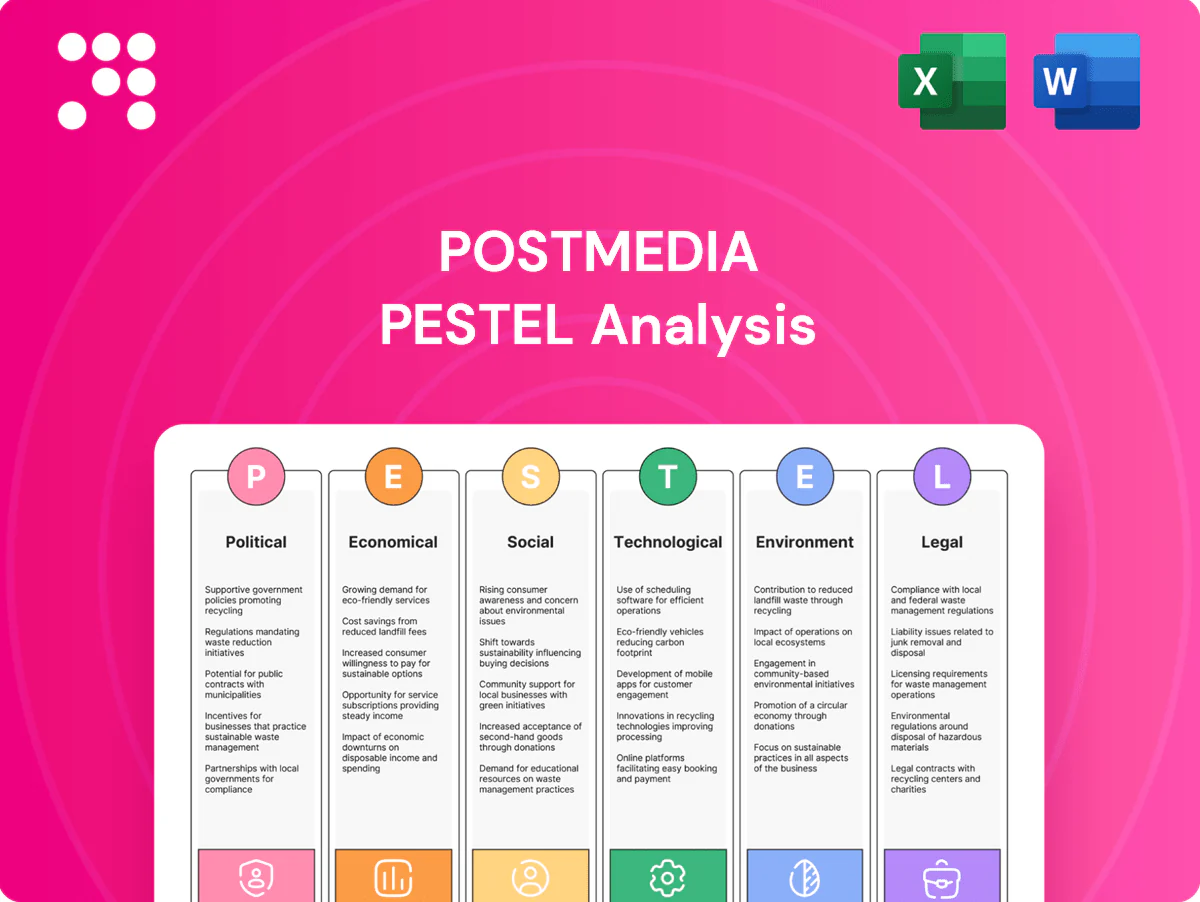
Postmedia PESTLE Analysis

Your Shortcut to Market Insight Starts Here
Unlock strategic foresight with our PESTLE Analysis of Postmedia—three-plus pages of concise, actionable insight into political, economic, social, technological, legal, and environmental drivers affecting the company. Perfect for investors and strategists seeking a competitive edge. Purchase the full report to access detailed risks, opportunities, and ready-to-use recommendations.
Political factors

Canadian media policy and subsidies
Federal programs like the Local Journalism Initiative, launched in 2019 with roughly CAD 50 million committed, and journalism tax credits can materially offset newsroom costs and expand coverage capacity for Postmedia.
Access to these supports hinges on compliance, eligibility and shifting political priorities that can change after elections, affecting stability of funds.
Postmedia must optimize applications and reporting to secure support while protecting editorial independence, since reliance risk rises if future governments cut or reallocate funding.
Online News Act (Bill C-18) impacts
Bill C-18, passed in June 2023, forces large platforms to negotiate compensation with publishers and reshapes referral traffic and bargaining dynamics. Meta's news restrictions in Canada sharply reduced social referrals for outlets, while platform programs such as Google's US$1 billion News Showcase and bilateral search deals offer potential revenue upside. Postmedia must diversify acquisition channels and secure favorable terms; execution will determine whether net effects are accretive or disruptive.

Regulatory scrutiny of media concentration
Proposed consolidations by Postmedia, which owns more than 120 news brands and claims a monthly reach of about 14 million Canadians, routinely face Competition Bureau and cultural policy reviews that can extend timelines.
High market concentration has in past reviews led to divestiture conditions or mandated newsroom commitments; regulators may impose similar remedies to protect plurality.
Postmedia’s strategic M&A must meet public-interest tests to avoid delays or rejection, so detailed compliance plans and proactive stakeholder engagement are used to mitigate approval risk.

Public broadcaster competition
CBC/Radio-Canada’s public mandate and funding (public appropriation above CAD 1 billion) shape advertising inventory and audience share, notably in digital where CBC reports monthly reach exceeding 10 million users. Ongoing policy debates on CBC’s ad presence could shift market dynamics; Postmedia should emphasize distinct local reporting and opinion to differentiate. Policy shifts may expand or compress ad and subscription revenue opportunities.
- Funding: public appropriation above CAD 1 billion
- Digital reach: CBC monthly users >10 million
- Strategy: double down on local and opinion content
- Risk/Opportunity: policy changes can expand or squeeze revenue
Election cycles and political polarization
Elections drive short-term traffic and ad demand but also increase scrutiny over bias and misinformation; Canada’s 2021 federal election had 62.3% turnout, highlighting heightened engagement and audience spikes. Political polarization raises reputational risk and pressures editorial standards, so Postmedia must maintain clear transparency and rigorous fact-checking. Monetization strategies must balance audience growth with journalistic integrity to protect long-term trust.
- Election traffic spikes — higher ad demand
- 62.3% turnout (Canada 2021) — increased scrutiny
- Polarization — reputational and regulatory risk
- Transparency + fact-checking — trust safeguard
Federal support (CAD50M) and Bill C-18 reshape concentrated news market
Federal supports (Local Journalism Initiative ~CAD50M) and journalism tax credits can offset costs but depend on eligibility and shifting politics; Bill C-18 (June 2023) altered platform negotiations. High market concentration, CBC funding >CAD1B and reach >10M, plus Postmedia reach ~14M, raise regulator and competitive risks; elections (62.3% turnout 2021) spike traffic and scrutiny.
| Metric | Value |
|---|---|
| Local Journalism Initiative | ~CAD50M |
| Bill | C-18 (Jun 2023) |
| Postmedia reach | ~14M/mo |
| CBC funding/reach | >CAD1B / >10M |
| Voter turnout | 62.3% (2021) |
What is included in the product
 Detailed Word Document
Explores how Political, Economic, Social, Technological, Environmental and Legal forces uniquely impact Postmedia, with data-backed trends, region-specific regulatory context and forward-looking insights to inform executives, investors and strategists; delivered in clean, report-ready format to support scenario planning and fundraising.

 Customizable Excel Spreadsheet
A concise, visually segmented Postmedia PESTLE summary for quick reference in meetings or presentations, editable for local context and notes, and ideal for aligning teams on external risks and market positioning.
Economic factors

Structural print decline
Print circulation and ad revenues continue to contract, pressuring Postmedia's legacy operations; Canadian newspaper print circulation has fallen over 30% since 2015, intensifying revenue erosion.
High fixed costs in printing and distribution reduce flexibility during downturns, forcing disciplined cost transformation and selective market exits to protect margins.
Cash flow preservation hinges on accelerating the digital mix and monetizing digital subscribers and programmatic advertising to offset print declines.
Digital ad volatility and CPM compression
Programmatic markets remain price-sensitive and competitive with platforms, now accounting for roughly 75% of display spending in major markets, intensifying CPM compression. Economic slowdowns in 2023–24 tightened advertiser budgets, lowering open-market CPMs by an estimated 10–25% in many categories. Strengthening direct-sold premium sponsorships and vertical-focused packages stabilizes yield, while leveraging first-party data can boost effective CPMs by around 20–30%.

Subscription growth vs. fatigue
Consumers face multiple paywalls—Deloitte 2024 finds the average US household holds about six paid streaming subscriptions—raising churn risk for news publishers competing for wallet share. Value perception hinges on exclusivity, local depth and product experience; Reuters Institute 2024 shows ~11% globally pay for online news. Dynamic pricing and bundles can lift LTV, while cohort analytics and retention playbooks are essential to sustain net adds.

Costs: newsprint, labor, and energy
Inflation and USD-priced newsprint — with the USD–CAD around 1.35 in 2024–25 — compress Postmedia margins as raw-materials cost exposure is FX-sensitive; unionized staff and competition for digital talent push wages higher (wage growth roughly 3–5% in recent labour markets), while energy costs (global oil ~US$85/bbl in 2024) raise printing and distribution spend; hedging, vendor consolidation and footprint optimization are used to dampen volatility.
- FX exposure: USD–CAD ~1.35 (2024–25)
- Energy: oil ~US$85/bbl (2024)
- Wage pressure: unionized + talent competition, wage growth ~3–5%
- Mitigants: hedging, vendor consolidation, printing footprint optimization
Interest rates and leverage
Higher interest rates (Bank of Canada policy rate ~5% in mid‑2025) increase Postmedia's debt service and constrain capital spending; refinancing terms and covenants will directly shape strategic flexibility and M&A capacity. Prioritizing free cash flow and asset monetizations can de‑risk the balance sheet, while strict digital ROI discipline is critical under tighter capital conditions.
- Rate: BoC ~5% (mid‑2025)
- Focus: free cash flow & asset sales
- Risk: tighter covenants limit moves
- Priority: measurable digital ROI
Federal support (CAD50M) and Bill C-18 reshape concentrated news market
Print revenue down >30% since 2015; high fixed printing/distribution costs force cost cuts and market exits. Digital mix, subscriber monetization and premium direct sales must offset programmatic CPM compression (75% display; CPMs -10–25% in 2023–24). USD–CAD ~1.35, oil ~US$85/bbl, BoC ~5% raise debt service; wage growth ~3–5% pressures margins.
| Metric | Value |
|---|---|
| Print decline | >30% (since 2015) |
| Programmatic share | ~75% |
| CPM change | -10–25% (2023–24) |
| USD–CAD | ~1.35 (2024–25) |
| Oil | ~US$85/bbl (2024) |
| BoC rate | ~5% (mid‑2025) |
| Wage growth | ~3–5% |
Preview the Actual Deliverable
Postmedia PESTLE Analysis
The preview shown here is the exact Postmedia PESTLE Analysis document you’ll receive after purchase—fully formatted and ready to use. It contains the complete political, economic, social, technological, legal and environmental assessment as displayed, with no placeholders or edits. After payment you’ll instantly download this same finished file.

Product Information
Product Information
Shipping & Returns
Shipping & Returns
Description
Your Shortcut to Market Insight Starts Here
Unlock strategic foresight with our PESTLE Analysis of Postmedia—three-plus pages of concise, actionable insight into political, economic, social, technological, legal, and environmental drivers affecting the company. Perfect for investors and strategists seeking a competitive edge. Purchase the full report to access detailed risks, opportunities, and ready-to-use recommendations.
Political factors
Canadian media policy and subsidies
Federal programs like the Local Journalism Initiative, launched in 2019 with roughly CAD 50 million committed, and journalism tax credits can materially offset newsroom costs and expand coverage capacity for Postmedia.
Access to these supports hinges on compliance, eligibility and shifting political priorities that can change after elections, affecting stability of funds.
Postmedia must optimize applications and reporting to secure support while protecting editorial independence, since reliance risk rises if future governments cut or reallocate funding.
Online News Act (Bill C-18) impacts
Bill C-18, passed in June 2023, forces large platforms to negotiate compensation with publishers and reshapes referral traffic and bargaining dynamics. Meta's news restrictions in Canada sharply reduced social referrals for outlets, while platform programs such as Google's US$1 billion News Showcase and bilateral search deals offer potential revenue upside. Postmedia must diversify acquisition channels and secure favorable terms; execution will determine whether net effects are accretive or disruptive.
Regulatory scrutiny of media concentration
Proposed consolidations by Postmedia, which owns more than 120 news brands and claims a monthly reach of about 14 million Canadians, routinely face Competition Bureau and cultural policy reviews that can extend timelines.
High market concentration has in past reviews led to divestiture conditions or mandated newsroom commitments; regulators may impose similar remedies to protect plurality.
Postmedia’s strategic M&A must meet public-interest tests to avoid delays or rejection, so detailed compliance plans and proactive stakeholder engagement are used to mitigate approval risk.
Public broadcaster competition
CBC/Radio-Canada’s public mandate and funding (public appropriation above CAD 1 billion) shape advertising inventory and audience share, notably in digital where CBC reports monthly reach exceeding 10 million users. Ongoing policy debates on CBC’s ad presence could shift market dynamics; Postmedia should emphasize distinct local reporting and opinion to differentiate. Policy shifts may expand or compress ad and subscription revenue opportunities.
- Funding: public appropriation above CAD 1 billion
- Digital reach: CBC monthly users >10 million
- Strategy: double down on local and opinion content
- Risk/Opportunity: policy changes can expand or squeeze revenue
Election cycles and political polarization
Elections drive short-term traffic and ad demand but also increase scrutiny over bias and misinformation; Canada’s 2021 federal election had 62.3% turnout, highlighting heightened engagement and audience spikes. Political polarization raises reputational risk and pressures editorial standards, so Postmedia must maintain clear transparency and rigorous fact-checking. Monetization strategies must balance audience growth with journalistic integrity to protect long-term trust.
- Election traffic spikes — higher ad demand
- 62.3% turnout (Canada 2021) — increased scrutiny
- Polarization — reputational and regulatory risk
- Transparency + fact-checking — trust safeguard
Federal support (CAD50M) and Bill C-18 reshape concentrated news market
Federal supports (Local Journalism Initiative ~CAD50M) and journalism tax credits can offset costs but depend on eligibility and shifting politics; Bill C-18 (June 2023) altered platform negotiations. High market concentration, CBC funding >CAD1B and reach >10M, plus Postmedia reach ~14M, raise regulator and competitive risks; elections (62.3% turnout 2021) spike traffic and scrutiny.
| Metric | Value |
|---|---|
| Local Journalism Initiative | ~CAD50M |
| Bill | C-18 (Jun 2023) |
| Postmedia reach | ~14M/mo |
| CBC funding/reach | >CAD1B / >10M |
| Voter turnout | 62.3% (2021) |
What is included in the product
Detailed Word Document
Explores how Political, Economic, Social, Technological, Environmental and Legal forces uniquely impact Postmedia, with data-backed trends, region-specific regulatory context and forward-looking insights to inform executives, investors and strategists; delivered in clean, report-ready format to support scenario planning and fundraising.
Customizable Excel Spreadsheet
A concise, visually segmented Postmedia PESTLE summary for quick reference in meetings or presentations, editable for local context and notes, and ideal for aligning teams on external risks and market positioning.
Economic factors
Structural print decline
Print circulation and ad revenues continue to contract, pressuring Postmedia's legacy operations; Canadian newspaper print circulation has fallen over 30% since 2015, intensifying revenue erosion.
High fixed costs in printing and distribution reduce flexibility during downturns, forcing disciplined cost transformation and selective market exits to protect margins.
Cash flow preservation hinges on accelerating the digital mix and monetizing digital subscribers and programmatic advertising to offset print declines.
Digital ad volatility and CPM compression
Programmatic markets remain price-sensitive and competitive with platforms, now accounting for roughly 75% of display spending in major markets, intensifying CPM compression. Economic slowdowns in 2023–24 tightened advertiser budgets, lowering open-market CPMs by an estimated 10–25% in many categories. Strengthening direct-sold premium sponsorships and vertical-focused packages stabilizes yield, while leveraging first-party data can boost effective CPMs by around 20–30%.
Subscription growth vs. fatigue
Consumers face multiple paywalls—Deloitte 2024 finds the average US household holds about six paid streaming subscriptions—raising churn risk for news publishers competing for wallet share. Value perception hinges on exclusivity, local depth and product experience; Reuters Institute 2024 shows ~11% globally pay for online news. Dynamic pricing and bundles can lift LTV, while cohort analytics and retention playbooks are essential to sustain net adds.
Costs: newsprint, labor, and energy
Inflation and USD-priced newsprint — with the USD–CAD around 1.35 in 2024–25 — compress Postmedia margins as raw-materials cost exposure is FX-sensitive; unionized staff and competition for digital talent push wages higher (wage growth roughly 3–5% in recent labour markets), while energy costs (global oil ~US$85/bbl in 2024) raise printing and distribution spend; hedging, vendor consolidation and footprint optimization are used to dampen volatility.
- FX exposure: USD–CAD ~1.35 (2024–25)
- Energy: oil ~US$85/bbl (2024)
- Wage pressure: unionized + talent competition, wage growth ~3–5%
- Mitigants: hedging, vendor consolidation, printing footprint optimization
Interest rates and leverage
Higher interest rates (Bank of Canada policy rate ~5% in mid‑2025) increase Postmedia's debt service and constrain capital spending; refinancing terms and covenants will directly shape strategic flexibility and M&A capacity. Prioritizing free cash flow and asset monetizations can de‑risk the balance sheet, while strict digital ROI discipline is critical under tighter capital conditions.
- Rate: BoC ~5% (mid‑2025)
- Focus: free cash flow & asset sales
- Risk: tighter covenants limit moves
- Priority: measurable digital ROI
Federal support (CAD50M) and Bill C-18 reshape concentrated news market
Print revenue down >30% since 2015; high fixed printing/distribution costs force cost cuts and market exits. Digital mix, subscriber monetization and premium direct sales must offset programmatic CPM compression (75% display; CPMs -10–25% in 2023–24). USD–CAD ~1.35, oil ~US$85/bbl, BoC ~5% raise debt service; wage growth ~3–5% pressures margins.
| Metric | Value |
|---|---|
| Print decline | >30% (since 2015) |
| Programmatic share | ~75% |
| CPM change | -10–25% (2023–24) |
| USD–CAD | ~1.35 (2024–25) |
| Oil | ~US$85/bbl (2024) |
| BoC rate | ~5% (mid‑2025) |
| Wage growth | ~3–5% |
Preview the Actual Deliverable
Postmedia PESTLE Analysis
The preview shown here is the exact Postmedia PESTLE Analysis document you’ll receive after purchase—fully formatted and ready to use. It contains the complete political, economic, social, technological, legal and environmental assessment as displayed, with no placeholders or edits. After payment you’ll instantly download this same finished file.