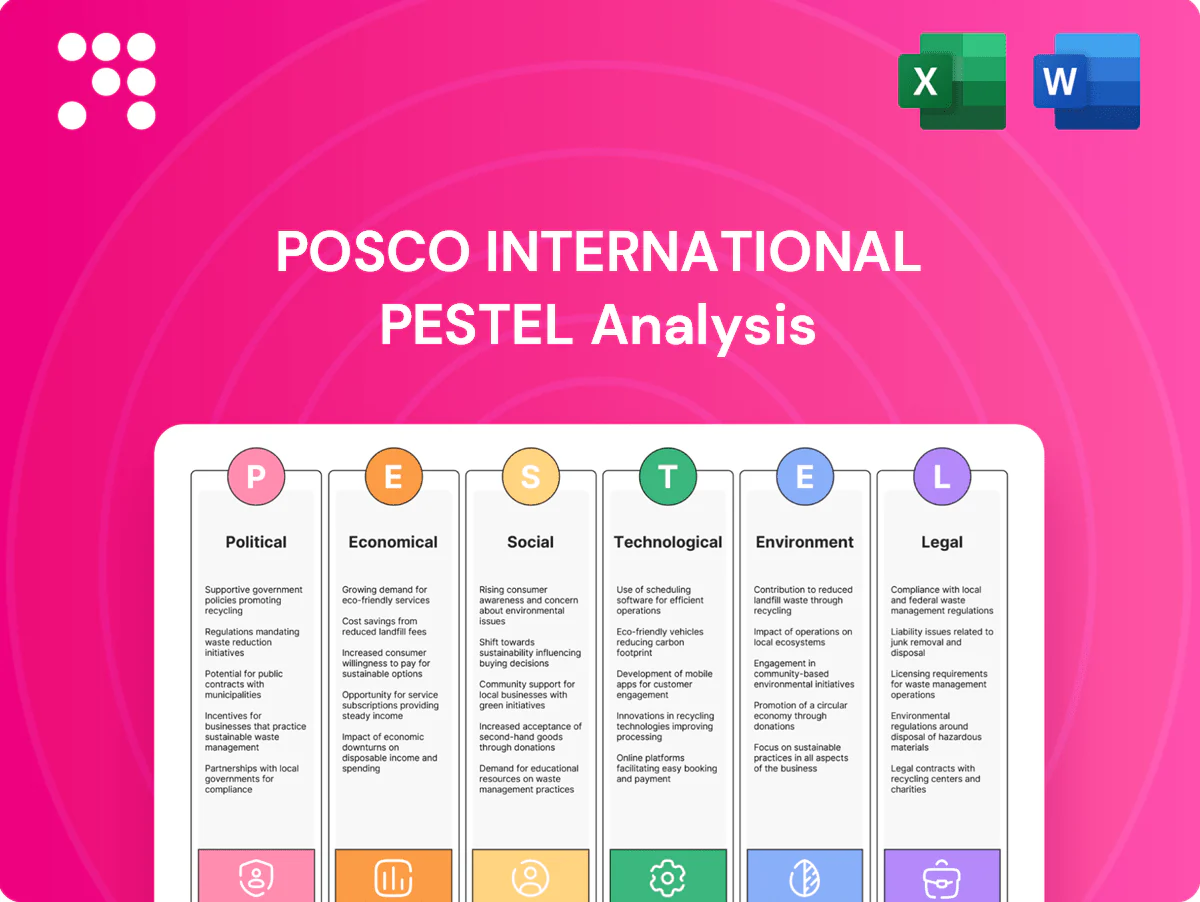
Posco International PESTLE Analysis

Make Smarter Strategic Decisions with a Complete PESTEL View
Unlock how political shifts, economic cycles, social trends, technological advances, legal changes, and environmental pressures shape Posco International’s strategic outlook in our concise PESTLE summary — perfect for investors and strategists who need a clear external-risk map. Purchase the full PESTLE Analysis to get detailed, actionable insights and ready-to-use slides and spreadsheets for immediate decision-making.
Political factors

Trade policy volatility
Shifting tariffs, quotas and FTAs—notably US Section 301 duties covering roughly $370bn of Chinese goods and evolving Indo-Pacific frameworks like RCEP (covers ~30% of global GDP) —can rapidly swing margins across steel, chemicals and metals. POSCO International must hedge exposure to US–China tensions, use proactive scenario planning and flexible contracts, and localize supply chains where feasible to blunt policy shocks.
Sanctions and export controls
Expanding sanctions and dual-use export controls—OFAC SDN entries surpassed 6,000 by 2024 and the Wassenaar Arrangement has 42 participating states—can disrupt metals and energy deals and raise compliance costs. Rigorous counterparty screening and origin checks are critical to avoid multi-million-dollar penalties and transaction freezes. Diversifying markets and establishing compliant routing preserves continuity. Continuous regulatory monitoring reduces deal fallout.

Resource nationalism
Host governments increasingly tighten control over minerals, energy and agri assets—Indonesia, for example, accounted for roughly 50% of global nickel output in 2023 (USGS), heightening exposure for traders like Posco International. Royalties, local‑content mandates or expropriation claims can materially erode project economics, often cutting returns by several percentage points. Strong government relations and benefit‑sharing models improve resilience, while contract stabilization clauses and political risk insurance (e.g., MIGA/private PRI) provide legal and financial backstops.

Korean policy direction
Seoul’s industrial and energy-transition policies, anchored by Korea’s 2050 net-zero pledge, shape Posco International’s access to financing and incentives for hydrogen, renewables, and strategic materials projects.
Alignment with national hydrogen and renewables agendas can unlock government subsidies and concessional finance; coordination with KEXIM and K-Sure improves project competitiveness in overseas markets.
Outbound investment reviews and tightened controls are increasing scrutiny on strategic deals, raising compliance and transaction timelines.
Geopolitical logistics risk
Conflicts and chokepoint tensions (Red Sea/Strait of Hormuz incidents) raised maritime war-risk premiums and forced many carriers to reroute, increasing voyage distances and delivery lead times; global seaborne trade was about 11.2 billion tonnes in 2023 (UNCTAD), amplifying exposure for Posco International's bulk shipments. Rerouting raises working capital requirements as transit times lengthen; multi-origin sourcing and inventory buffers reduce stockout risk. Strategic port and terminal partnerships create operational optionality and faster recovery pathways.
- Increased war-risk premiums — higher freight insurance costs
- Longer transit = higher working capital needs
- Multi-origin sourcing + inventory buffers = disruption resilience
- Port/terminal partnerships = operational optionality
Tariffs, sanctions and resource nationalism shift margins; Seoul net-zero steers green finance
Geopolitical tariffs and FTAs (RCEP ≈30% global GDP; US Section 301 ≈$370bn) can swing margins across steel, chemicals and metals. Sanctions/controls (OFAC SDN >6,000) and resource nationalism (Indonesia ≈50% nickel) raise compliance and project risk. Seoul policy (2050 net-zero) plus KEXIM/K-Sure support shape financing for hydrogen/renewables.
| Factor | Metric | Impact | Mitigation |
|---|---|---|---|
| Tariffs/FTAs | RCEP ~30% GDP | Margin volatility | Hedge/localize |
| Sanctions | OFAC>6,000 | Deal freezes | Screening |
| Resource risk | Indonesia 50% nickel | Project erosion | PRI/relations |
What is included in the product
 Detailed Word Document
Explores how Political, Economic, Social, Technological, Environmental and Legal forces uniquely affect Posco International, combining data-backed trends and region-specific examples to identify risks and opportunities for executives, investors and strategists; formatted for easy insertion into plans and offering forward-looking insights for scenario planning.

 Customizable Excel Spreadsheet
A concise, visually segmented PESTLE summary for Posco International that streamlines meetings and planning, supports external risk and market-position discussions, and is easily shared or dropped into presentations, with editable notes for region- or business-specific context.
Economic factors

Commodity cycle exposure
Posco Internationals revenues are highly sensitive to price swings in steel, chemicals, LNG, grains and metals, with LNG spot easing to roughly $12/MMBtu in 2024 reducing margin volatility. Active hedging and diversified offtake across regions/products are pivotal to limit earnings shocks. Counter-cyclical inventory builds and indexed contract structures have stabilized cash flow in recent cycles. Capital allocation must be adjusted to cycle positioning to protect ROE.
Global growth and demand
Industrial demand in China, the US and ASEAN underpins trading volumes and spreads, with China accounting for about 53% of global steel production (World Steel Association 2023), amplifying price and volume swings for Posco International. Economic slowdowns compress trading margins and reduce utilization of logistics and infrastructure assets, hitting EBITDA and ROIC. Monitoring PMI, construction starts and capex trends guides volume planning and inventory. Maintaining a flexible cost base and variable logistics contracts preserves profitability through cycles.

FX and interest rates
KRW volatility—around 1,350 per USD in mid‑2025—plus higher USD funding (US fed funds ~5.25%) compresses POSCO International purchasing power and raises dollar debt service. Active FX hedging and duration management have preserved margins by cutting realized FX losses. Rising rates lift infra hurdle rates by ~200–300bps, increasing equity needs; diversified bank lines and KEXIM/K‑SURE ECA coverments reduce refinancing risk.

Logistics and freight costs
Container and bulk freight rate spikes (SCFI peaked near 4,000 USD/FEU in 2021; Baltic Dry Index hit ~5,650) can quickly erase commodity arbitrage for Posco International, while long-term charters and index-linked contracts—covering as much as 40–60% of flows—smooth earnings volatility. Nearshoring and multimodal options raise supply resilience, and digital freight visibility tools improved ETA accuracy to within 6–12 hours in 2024 pilots, aiding inventory planning.
- freight spikes: SCFI ~4,000; BDI ~5,650
- hedge effect: long-term charters/index-linking ~40–60%
- visibility: ETA accuracy improved to 6–12h (2024)
- resilience: nearshoring + multimodal raised flexibility
Working capital intensity
Trading is working-capital intensive for Posco International because large receivables, inventory and letters of credit tie cash; global trade finance gap was about 1.7 trillion USD in 2022 (IFC/ICC), and tight 2023–24 credit conditions constrained deal flow. Strengthened counterparty credit checks and supply-chain finance programs can unlock capacity, while faster cash-conversion cycles raise ROIC by shortening cash tied-up periods.
- High receivables/inventory/LCs
- Global trade finance gap ~1.7T USD (2022)
- Credit tightening 2023–24 limits deals
- Stronger credit checks + SCF frees capacity
- Faster CCC improves ROIC
Tariffs, sanctions and resource nationalism shift margins; Seoul net-zero steers green finance
Posco International faces commodity-price sensitivity (LNG spot ~12 USD/MMBtu in 2024), with active hedging and indexed contracts (40–60% coverage) reducing earnings shocks. Demand concentrated in China (≈53% of global steel, World Steel 2023) and macro cycles; KRW ~1,350/USD (mid‑2025) and US rates ~5.25% raise funding costs. Trade finance gap ~$1.7T (2022) and volatile freight (SCFI ~4,000; BDI ~5,650) amplify working-capital needs.
| Metric | Value |
|---|---|
| LNG price (2024) | ~12 USD/MMBtu |
| China steel share | ~53% |
| KRW/USD (mid‑2025) | ~1,350 |
| Trade finance gap (2022) | ~1.7T USD |
Full Version Awaits
Posco International PESTLE Analysis
The Posco International PESTLE Analysis preview shown here is the exact document you’ll receive after purchase—fully formatted and ready to use. The layout, content, and structure visible are exactly what you’ll download immediately after buying. No placeholders, no teasers—this is the real, finished file.

Original: $10.00
-65%$10.00
$3.50Product Information
Product Information
Shipping & Returns
Shipping & Returns
Description
Make Smarter Strategic Decisions with a Complete PESTEL View
Unlock how political shifts, economic cycles, social trends, technological advances, legal changes, and environmental pressures shape Posco International’s strategic outlook in our concise PESTLE summary — perfect for investors and strategists who need a clear external-risk map. Purchase the full PESTLE Analysis to get detailed, actionable insights and ready-to-use slides and spreadsheets for immediate decision-making.
Political factors
Trade policy volatility
Shifting tariffs, quotas and FTAs—notably US Section 301 duties covering roughly $370bn of Chinese goods and evolving Indo-Pacific frameworks like RCEP (covers ~30% of global GDP) —can rapidly swing margins across steel, chemicals and metals. POSCO International must hedge exposure to US–China tensions, use proactive scenario planning and flexible contracts, and localize supply chains where feasible to blunt policy shocks.
Sanctions and export controls
Expanding sanctions and dual-use export controls—OFAC SDN entries surpassed 6,000 by 2024 and the Wassenaar Arrangement has 42 participating states—can disrupt metals and energy deals and raise compliance costs. Rigorous counterparty screening and origin checks are critical to avoid multi-million-dollar penalties and transaction freezes. Diversifying markets and establishing compliant routing preserves continuity. Continuous regulatory monitoring reduces deal fallout.
Resource nationalism
Host governments increasingly tighten control over minerals, energy and agri assets—Indonesia, for example, accounted for roughly 50% of global nickel output in 2023 (USGS), heightening exposure for traders like Posco International. Royalties, local‑content mandates or expropriation claims can materially erode project economics, often cutting returns by several percentage points. Strong government relations and benefit‑sharing models improve resilience, while contract stabilization clauses and political risk insurance (e.g., MIGA/private PRI) provide legal and financial backstops.
Korean policy direction
Seoul’s industrial and energy-transition policies, anchored by Korea’s 2050 net-zero pledge, shape Posco International’s access to financing and incentives for hydrogen, renewables, and strategic materials projects.
Alignment with national hydrogen and renewables agendas can unlock government subsidies and concessional finance; coordination with KEXIM and K-Sure improves project competitiveness in overseas markets.
Outbound investment reviews and tightened controls are increasing scrutiny on strategic deals, raising compliance and transaction timelines.
Geopolitical logistics risk
Conflicts and chokepoint tensions (Red Sea/Strait of Hormuz incidents) raised maritime war-risk premiums and forced many carriers to reroute, increasing voyage distances and delivery lead times; global seaborne trade was about 11.2 billion tonnes in 2023 (UNCTAD), amplifying exposure for Posco International's bulk shipments. Rerouting raises working capital requirements as transit times lengthen; multi-origin sourcing and inventory buffers reduce stockout risk. Strategic port and terminal partnerships create operational optionality and faster recovery pathways.
- Increased war-risk premiums — higher freight insurance costs
- Longer transit = higher working capital needs
- Multi-origin sourcing + inventory buffers = disruption resilience
- Port/terminal partnerships = operational optionality
Tariffs, sanctions and resource nationalism shift margins; Seoul net-zero steers green finance
Geopolitical tariffs and FTAs (RCEP ≈30% global GDP; US Section 301 ≈$370bn) can swing margins across steel, chemicals and metals. Sanctions/controls (OFAC SDN >6,000) and resource nationalism (Indonesia ≈50% nickel) raise compliance and project risk. Seoul policy (2050 net-zero) plus KEXIM/K-Sure support shape financing for hydrogen/renewables.
| Factor | Metric | Impact | Mitigation |
|---|---|---|---|
| Tariffs/FTAs | RCEP ~30% GDP | Margin volatility | Hedge/localize |
| Sanctions | OFAC>6,000 | Deal freezes | Screening |
| Resource risk | Indonesia 50% nickel | Project erosion | PRI/relations |
What is included in the product
Detailed Word Document
Explores how Political, Economic, Social, Technological, Environmental and Legal forces uniquely affect Posco International, combining data-backed trends and region-specific examples to identify risks and opportunities for executives, investors and strategists; formatted for easy insertion into plans and offering forward-looking insights for scenario planning.
Customizable Excel Spreadsheet
A concise, visually segmented PESTLE summary for Posco International that streamlines meetings and planning, supports external risk and market-position discussions, and is easily shared or dropped into presentations, with editable notes for region- or business-specific context.
Economic factors
Commodity cycle exposure
Posco Internationals revenues are highly sensitive to price swings in steel, chemicals, LNG, grains and metals, with LNG spot easing to roughly $12/MMBtu in 2024 reducing margin volatility. Active hedging and diversified offtake across regions/products are pivotal to limit earnings shocks. Counter-cyclical inventory builds and indexed contract structures have stabilized cash flow in recent cycles. Capital allocation must be adjusted to cycle positioning to protect ROE.
Global growth and demand
Industrial demand in China, the US and ASEAN underpins trading volumes and spreads, with China accounting for about 53% of global steel production (World Steel Association 2023), amplifying price and volume swings for Posco International. Economic slowdowns compress trading margins and reduce utilization of logistics and infrastructure assets, hitting EBITDA and ROIC. Monitoring PMI, construction starts and capex trends guides volume planning and inventory. Maintaining a flexible cost base and variable logistics contracts preserves profitability through cycles.
FX and interest rates
KRW volatility—around 1,350 per USD in mid‑2025—plus higher USD funding (US fed funds ~5.25%) compresses POSCO International purchasing power and raises dollar debt service. Active FX hedging and duration management have preserved margins by cutting realized FX losses. Rising rates lift infra hurdle rates by ~200–300bps, increasing equity needs; diversified bank lines and KEXIM/K‑SURE ECA coverments reduce refinancing risk.
Logistics and freight costs
Container and bulk freight rate spikes (SCFI peaked near 4,000 USD/FEU in 2021; Baltic Dry Index hit ~5,650) can quickly erase commodity arbitrage for Posco International, while long-term charters and index-linked contracts—covering as much as 40–60% of flows—smooth earnings volatility. Nearshoring and multimodal options raise supply resilience, and digital freight visibility tools improved ETA accuracy to within 6–12 hours in 2024 pilots, aiding inventory planning.
- freight spikes: SCFI ~4,000; BDI ~5,650
- hedge effect: long-term charters/index-linking ~40–60%
- visibility: ETA accuracy improved to 6–12h (2024)
- resilience: nearshoring + multimodal raised flexibility
Working capital intensity
Trading is working-capital intensive for Posco International because large receivables, inventory and letters of credit tie cash; global trade finance gap was about 1.7 trillion USD in 2022 (IFC/ICC), and tight 2023–24 credit conditions constrained deal flow. Strengthened counterparty credit checks and supply-chain finance programs can unlock capacity, while faster cash-conversion cycles raise ROIC by shortening cash tied-up periods.
- High receivables/inventory/LCs
- Global trade finance gap ~1.7T USD (2022)
- Credit tightening 2023–24 limits deals
- Stronger credit checks + SCF frees capacity
- Faster CCC improves ROIC
Tariffs, sanctions and resource nationalism shift margins; Seoul net-zero steers green finance
Posco International faces commodity-price sensitivity (LNG spot ~12 USD/MMBtu in 2024), with active hedging and indexed contracts (40–60% coverage) reducing earnings shocks. Demand concentrated in China (≈53% of global steel, World Steel 2023) and macro cycles; KRW ~1,350/USD (mid‑2025) and US rates ~5.25% raise funding costs. Trade finance gap ~$1.7T (2022) and volatile freight (SCFI ~4,000; BDI ~5,650) amplify working-capital needs.
| Metric | Value |
|---|---|
| LNG price (2024) | ~12 USD/MMBtu |
| China steel share | ~53% |
| KRW/USD (mid‑2025) | ~1,350 |
| Trade finance gap (2022) | ~1.7T USD |
Full Version Awaits
Posco International PESTLE Analysis
The Posco International PESTLE Analysis preview shown here is the exact document you’ll receive after purchase—fully formatted and ready to use. The layout, content, and structure visible are exactly what you’ll download immediately after buying. No placeholders, no teasers—this is the real, finished file.