Posco PESTLE Analysis

Your Shortcut to Market Insight Starts Here
Discover how geopolitical shifts, commodity cycles, and green‑steel innovations are reshaping Posco’s strategic path in our concise PESTLE snapshot—ideal for investors and strategists seeking clarity. This expert analysis highlights regulatory risks, market opportunities, and technological drivers you need to forecast performance. Buy the full PESTLE to access the complete, editable report and actionable insights instantly.
Political factors

Trade policy and tariffs
Steel faces frequent anti-dumping and safeguard measures across the US, EU, India and ASEAN, disrupting market access and pricing; global crude steel production was about 1,878 Mt in 2023 (Worldsteel), increasing policy significance. Policy swings alter POSCOs capacity allocation and margins, so monitoring bilateral deals and WTO disputes is vital. Hedging via diversified export portfolios helps stabilize revenue.
Korean industrial strategy
Seoul’s industrial strategy—anchored in a 2050 carbon neutrality pledge and a hydrogen roadmap targeting 6.2 million tH2 by 2040—shapes incentives and capex timing for Posco’s advanced materials, hydrogen and shipbuilding investments. Grants and tax credits for green projects lower project risk and financing costs. Shifts in priority can reallocate funding between steel and new-energy ventures; alignment with national plans accelerates approvals and access to concessional finance.

Geopolitical tensions
US–China rivalry and regional security issues reshape demand, supply chains and tech access; China produced 54% of global crude steel in 2023, concentrating market risk for POSCO. Sanctions and entity lists (US export controls on advanced tech since 2022) can constrain customers or suppliers. Routing trade via neutral markets and hubs can reduce exposure. Scenario planning for shipping lanes and insurance is critical given that over 80% of global trade moves by sea.

Resource nationalism
Resource nationalism—evident in Indonesia’s 2020 nickel ore export ban and Australia’s status as the world’s largest iron‑ore exporter—can alter royalties and export rules, creating sudden quotas or bans that squeeze feedstock security and margins. Long‑term offtakes and equity stakes in mines lower feedstock volatility, while diversifying suppliers and raising recycled steel content buffer policy shocks.
- Risk: sudden export bans (Indonesia 2020)
- Mitigation: offtakes/equity in mines
- Buffer: supply diversification + recycling
Infrastructure and public spending
Government stimulus in construction, energy and transport — e.g., the US $1.2 trillion Infrastructure Investment and Jobs Act and the EU’s €800 billion NextGenerationEU package — continues to lift global steel plate and long-product demand, while delayed or reduced fiscal spending abruptly trims order books and margins. Monitoring multi-year budgets and tender pipelines to 2027–2028 is essential for POSCO capacity planning and capex phasing, and regional diversification cushions country-specific fiscal swings.
- Stimulus drivers: US $1.2T, EU €800B
- Risk: austerity or delays cut plate/long product orders
- Action: track multi-year budgets through 2027–28
- Mitigation: regional diversification smooths cycles
Political risks, 54% China share and Korea H2 shift stoke steel volatility
Political risks—trade remedies, resource nationalism and US–China rivalry—drive volatility in POSCOs market access, margins and tech flows; global crude steel was 1,878 Mt in 2023 and China produced 54%. Seoul’s 2050 carbon pledge and H2 roadmap (6.2 MtH2 by 2040) steers green capex and incentives. Fiscal stimulus (US $1.2T, EU €800B) lifts demand but shifts can cut orders.
| Indicator | Value/Year |
|---|---|
| Global crude steel | 1,878 Mt (2023) |
| China share | 54% (2023) |
| Korea H2 target | 6.2 MtH2 by 2040 |
| Stimulus | US $1.2T / EU €800B |
| Notable ban | Indonesia nickel export ban 2020 |
What is included in the product
 Detailed Word Document
Explores how external macro-environmental factors uniquely affect Posco across six dimensions—Political, Economic, Social, Technological, Environmental, and Legal—backed by current data and trends to identify threats and opportunities. Designed for executives and investors, it offers detailed sub-points, forward-looking insights, and clean formatting ready for plans, decks, or reports.

 Customizable Excel Spreadsheet
A concise, visually segmented POSCO PESTLE summary that’s editable and shareable—ideal for meetings, presentations, and cross‑team alignment; supports quick external risk discussions, market positioning and can be dropped into slides, strategy packs or client reports.
Economic factors

Steel demand cyclicality
Steel demand cyclicality at POSCO is driven by auto, shipbuilding and construction cycles; POSCO's crude steel output of about 42 million tonnes annually anchors exposure to these sectors. Inventory destocking/restocking can amplify price swings—steel HRC spreads have moved +/-20–25% in recent 12‑month cycles (2023–24). Flexible production and order‑mix adjustments improved utilization rates, while balanced OEM and distributor exposure spreads demand risk.
Input cost volatility
Iron ore (62% Fe avg ~USD115/t in 2024) and premium coking coal (around USD260/t in 2024) materially swing POSCO margins, with each USD10/t ore move impacting steel spread by several dollars per tonne. Index-linked contracts and hedging have reduced volatility in recent years, preserving spreads. Where feasible, shifting between BF-BOF and EAF routes adds operational flexibility. Strategic stockpiles cushion short-term supply shocks.

China’s supply-demand balance
China's crude steel output of roughly 1 billion tonnes annually, combined with periodic export rebates and seasonal environmental curbs, effectively sets a global price floor; tightening in China can lift Asian spreads while easing risks flooding world markets. Monitoring mill utilization rates and monthly export volumes is crucial for Posco's pricing outlook. Focus on differentiated, high-value steel reduces exposure to commodity price swings.

FX and interest rates
KRW moves (roughly 1,300–1,350 per USD in H1 2025) directly affect POSCOs export pricing and the cost of imported coking coal and nickel, tightening margins when won strengthens. Higher interest rates (Bank of Korea policy rate ~3.5% mid‑2025) lift capex financing and working capital costs. Natural hedges from currency‑matched revenues/costs and robust liquidity buffers underpin downturn resilience.
- FX exposure: export competitiveness vs import cost
- Interest costs: higher capex and WC financing
- Hedge: currency‑matched revenues/costs
- Liquidity: cash and undrawn lines sustain resilience
Diversification earnings
Materials, energy and construction provide counter-cyclical cash flows that soften steel volatility; battery materials and hydrogen development, with POSCO targeting 500,000 tonnes/year green hydrogen by 2030, offer higher-growth multiple potential. Strict governance and capital-allocation discipline are essential to avoid conglomerate discounts, while portfolio pruning improves ROIC and strategic focus.
- Counter-cyclical cash flows: materials, energy, construction
- Growth drivers: battery materials, hydrogen (500,000 t/yr by 2030)
- Key enablers: governance, capital allocation discipline
- Outcome: portfolio pruning → higher ROIC, reduced conglomerate discount
Political risks, 54% China share and Korea H2 shift stoke steel volatility
Steel cyclicality (42 Mt/yr), ore USD115/t (2024) and coking coal USD260/t (2024) drive margins; China ~1,000 Mt output sets price floor; KRW ~1,300–1,350/USD (H1 2025), BOK rate ~3.5% (mid‑2025); hydrogen target 500,000 t/yr by 2030.
| Metric | Value |
|---|---|
| Crude steel | 42 Mt/yr |
| Iron ore | USD115/t (2024) |
| Coking coal | USD260/t (2024) |
| China steel | ~1,000 Mt |
| KRW/USD | 1,300–1,350 (H1 2025) |
| BOK rate | ~3.5% (mid‑2025) |
| Green H2 | 500,000 t/yr by 2030 |
Preview Before You Purchase
Posco PESTLE Analysis
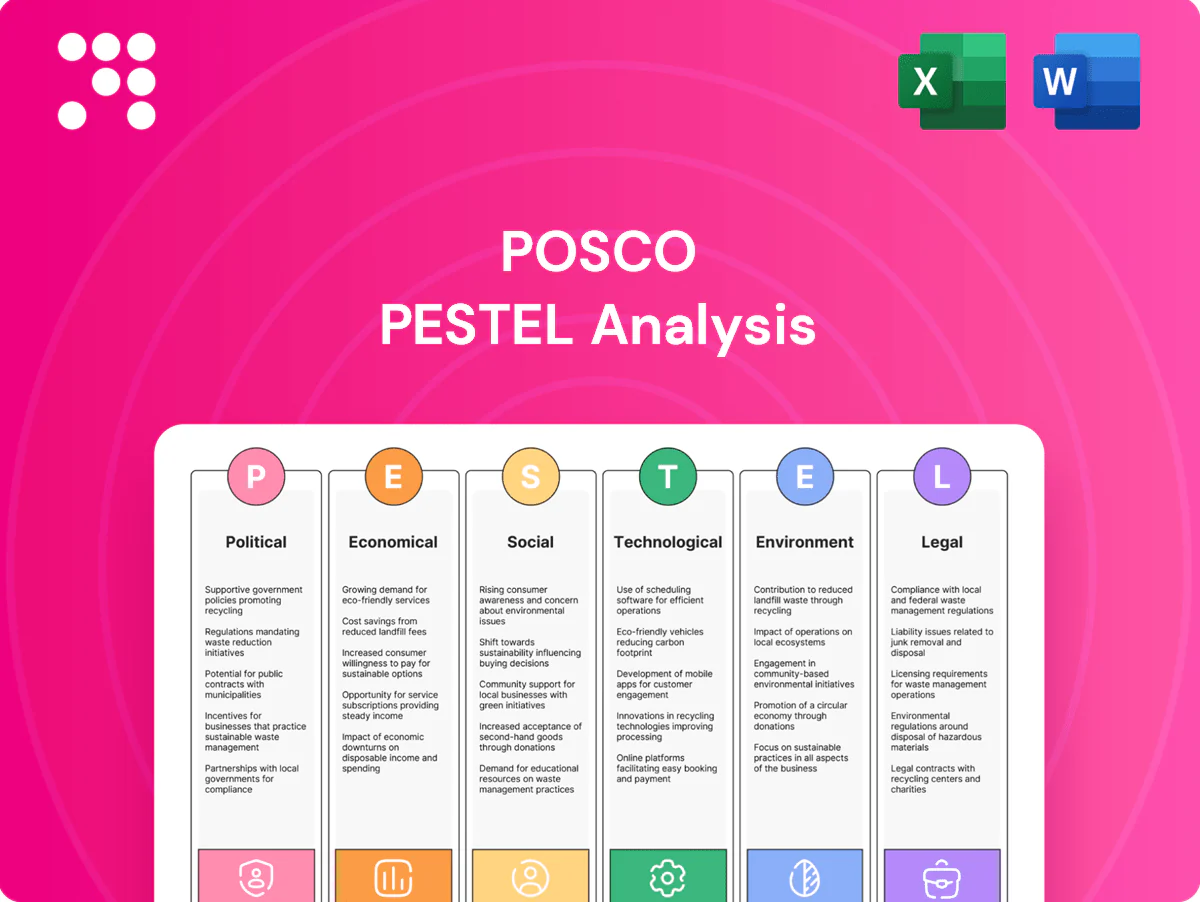
This Posco PESTLE Analysis preview is the exact document you’ll receive after purchase—fully formatted and ready to use. It covers political, economic, social, technological, legal, and environmental factors affecting Posco with concise insights and data. No placeholders or teasers; the content and structure shown match the downloadable file. You’ll get this final, professional report immediately after checkout.

Product Information
Product Information
Shipping & Returns
Shipping & Returns
Description
Your Shortcut to Market Insight Starts Here
Discover how geopolitical shifts, commodity cycles, and green‑steel innovations are reshaping Posco’s strategic path in our concise PESTLE snapshot—ideal for investors and strategists seeking clarity. This expert analysis highlights regulatory risks, market opportunities, and technological drivers you need to forecast performance. Buy the full PESTLE to access the complete, editable report and actionable insights instantly.
Political factors
Trade policy and tariffs
Steel faces frequent anti-dumping and safeguard measures across the US, EU, India and ASEAN, disrupting market access and pricing; global crude steel production was about 1,878 Mt in 2023 (Worldsteel), increasing policy significance. Policy swings alter POSCOs capacity allocation and margins, so monitoring bilateral deals and WTO disputes is vital. Hedging via diversified export portfolios helps stabilize revenue.
Korean industrial strategy
Seoul’s industrial strategy—anchored in a 2050 carbon neutrality pledge and a hydrogen roadmap targeting 6.2 million tH2 by 2040—shapes incentives and capex timing for Posco’s advanced materials, hydrogen and shipbuilding investments. Grants and tax credits for green projects lower project risk and financing costs. Shifts in priority can reallocate funding between steel and new-energy ventures; alignment with national plans accelerates approvals and access to concessional finance.
Geopolitical tensions
US–China rivalry and regional security issues reshape demand, supply chains and tech access; China produced 54% of global crude steel in 2023, concentrating market risk for POSCO. Sanctions and entity lists (US export controls on advanced tech since 2022) can constrain customers or suppliers. Routing trade via neutral markets and hubs can reduce exposure. Scenario planning for shipping lanes and insurance is critical given that over 80% of global trade moves by sea.
Resource nationalism
Resource nationalism—evident in Indonesia’s 2020 nickel ore export ban and Australia’s status as the world’s largest iron‑ore exporter—can alter royalties and export rules, creating sudden quotas or bans that squeeze feedstock security and margins. Long‑term offtakes and equity stakes in mines lower feedstock volatility, while diversifying suppliers and raising recycled steel content buffer policy shocks.
- Risk: sudden export bans (Indonesia 2020)
- Mitigation: offtakes/equity in mines
- Buffer: supply diversification + recycling
Infrastructure and public spending
Government stimulus in construction, energy and transport — e.g., the US $1.2 trillion Infrastructure Investment and Jobs Act and the EU’s €800 billion NextGenerationEU package — continues to lift global steel plate and long-product demand, while delayed or reduced fiscal spending abruptly trims order books and margins. Monitoring multi-year budgets and tender pipelines to 2027–2028 is essential for POSCO capacity planning and capex phasing, and regional diversification cushions country-specific fiscal swings.
- Stimulus drivers: US $1.2T, EU €800B
- Risk: austerity or delays cut plate/long product orders
- Action: track multi-year budgets through 2027–28
- Mitigation: regional diversification smooths cycles
Political risks, 54% China share and Korea H2 shift stoke steel volatility
Political risks—trade remedies, resource nationalism and US–China rivalry—drive volatility in POSCOs market access, margins and tech flows; global crude steel was 1,878 Mt in 2023 and China produced 54%. Seoul’s 2050 carbon pledge and H2 roadmap (6.2 MtH2 by 2040) steers green capex and incentives. Fiscal stimulus (US $1.2T, EU €800B) lifts demand but shifts can cut orders.
| Indicator | Value/Year |
|---|---|
| Global crude steel | 1,878 Mt (2023) |
| China share | 54% (2023) |
| Korea H2 target | 6.2 MtH2 by 2040 |
| Stimulus | US $1.2T / EU €800B |
| Notable ban | Indonesia nickel export ban 2020 |
What is included in the product
Detailed Word Document
Explores how external macro-environmental factors uniquely affect Posco across six dimensions—Political, Economic, Social, Technological, Environmental, and Legal—backed by current data and trends to identify threats and opportunities. Designed for executives and investors, it offers detailed sub-points, forward-looking insights, and clean formatting ready for plans, decks, or reports.
Customizable Excel Spreadsheet
A concise, visually segmented POSCO PESTLE summary that’s editable and shareable—ideal for meetings, presentations, and cross‑team alignment; supports quick external risk discussions, market positioning and can be dropped into slides, strategy packs or client reports.
Economic factors
Steel demand cyclicality
Steel demand cyclicality at POSCO is driven by auto, shipbuilding and construction cycles; POSCO's crude steel output of about 42 million tonnes annually anchors exposure to these sectors. Inventory destocking/restocking can amplify price swings—steel HRC spreads have moved +/-20–25% in recent 12‑month cycles (2023–24). Flexible production and order‑mix adjustments improved utilization rates, while balanced OEM and distributor exposure spreads demand risk.
Input cost volatility
Iron ore (62% Fe avg ~USD115/t in 2024) and premium coking coal (around USD260/t in 2024) materially swing POSCO margins, with each USD10/t ore move impacting steel spread by several dollars per tonne. Index-linked contracts and hedging have reduced volatility in recent years, preserving spreads. Where feasible, shifting between BF-BOF and EAF routes adds operational flexibility. Strategic stockpiles cushion short-term supply shocks.
China’s supply-demand balance
China's crude steel output of roughly 1 billion tonnes annually, combined with periodic export rebates and seasonal environmental curbs, effectively sets a global price floor; tightening in China can lift Asian spreads while easing risks flooding world markets. Monitoring mill utilization rates and monthly export volumes is crucial for Posco's pricing outlook. Focus on differentiated, high-value steel reduces exposure to commodity price swings.
FX and interest rates
KRW moves (roughly 1,300–1,350 per USD in H1 2025) directly affect POSCOs export pricing and the cost of imported coking coal and nickel, tightening margins when won strengthens. Higher interest rates (Bank of Korea policy rate ~3.5% mid‑2025) lift capex financing and working capital costs. Natural hedges from currency‑matched revenues/costs and robust liquidity buffers underpin downturn resilience.
- FX exposure: export competitiveness vs import cost
- Interest costs: higher capex and WC financing
- Hedge: currency‑matched revenues/costs
- Liquidity: cash and undrawn lines sustain resilience
Diversification earnings
Materials, energy and construction provide counter-cyclical cash flows that soften steel volatility; battery materials and hydrogen development, with POSCO targeting 500,000 tonnes/year green hydrogen by 2030, offer higher-growth multiple potential. Strict governance and capital-allocation discipline are essential to avoid conglomerate discounts, while portfolio pruning improves ROIC and strategic focus.
- Counter-cyclical cash flows: materials, energy, construction
- Growth drivers: battery materials, hydrogen (500,000 t/yr by 2030)
- Key enablers: governance, capital allocation discipline
- Outcome: portfolio pruning → higher ROIC, reduced conglomerate discount
Political risks, 54% China share and Korea H2 shift stoke steel volatility
Steel cyclicality (42 Mt/yr), ore USD115/t (2024) and coking coal USD260/t (2024) drive margins; China ~1,000 Mt output sets price floor; KRW ~1,300–1,350/USD (H1 2025), BOK rate ~3.5% (mid‑2025); hydrogen target 500,000 t/yr by 2030.
| Metric | Value |
|---|---|
| Crude steel | 42 Mt/yr |
| Iron ore | USD115/t (2024) |
| Coking coal | USD260/t (2024) |
| China steel | ~1,000 Mt |
| KRW/USD | 1,300–1,350 (H1 2025) |
| BOK rate | ~3.5% (mid‑2025) |
| Green H2 | 500,000 t/yr by 2030 |
Preview Before You Purchase
Posco PESTLE Analysis
This Posco PESTLE Analysis preview is the exact document you’ll receive after purchase—fully formatted and ready to use. It covers political, economic, social, technological, legal, and environmental factors affecting Posco with concise insights and data. No placeholders or teasers; the content and structure shown match the downloadable file. You’ll get this final, professional report immediately after checkout.