Pet Valu PESTLE Analysis

Make Smarter Strategic Decisions with a Complete PESTEL View
Discover how political, economic, social, technological, legal, and environmental forces are reshaping Pet Valu’s market position in our concise PESTLE overview. Use these insights to spot risks and growth opportunities fast. Purchase the full analysis for a complete, actionable roadmap you can deploy today.
Political factors

Canadian retail policy
Federal and provincial retail policies—including the 9% federal small business tax rate, GST 5% (HST up to 15% in some provinces), and provincial minimum wages (BC $16.75, ON $16.55, AB $15.00)—directly affect Pet Valu store margins and expansion pacing; changes to sales tax administration, wage subsidies or small business supports shift cash flows for corporate and franchised locations, while municipal bylaws on hours, signage and permits require local compliance monitoring.
Import tariffs & trade
CUSMA, effective July 1, 2020, shapes tariffs and customs procedures for pet food, accessories and inputs, supporting tariff-free trade for many processed goods between members; the North American pet market reached about 136 billion USD in 2023. Border inspections and sanitary rules for animal-origin products (CFIA/USDA regimes) can cause shipment delays and added carrying costs. Policy shifts on tariffs or non-tariff barriers directly move landed costs and retail pricing, so diversifying suppliers cuts exposure to trade frictions.

Provincial regulations
Provincial variation in combined sales tax (5%–15%), minimum wages (roughly C$15–C$17/hr) and differing EPR packaging rules increases operational complexity and compliance costs for Pet Valu. Quebec’s Bill 96 enforces French predominance on packaging, POS and customer communications, raising localization costs. Local zoning and permitting can delay new openings by months and trigger fines. Tailored provincial playbooks reduce approval delays and penalty risk.

Franchise relations policy
Franchise disclosure laws govern franchisor–franchisee relationships, dispute resolution and renewal terms. Six provinces — Ontario, Alberta, BC, Manitoba, New Brunswick and PEI — have franchise statutes requiring robust documentation and fair dealing. Policy updates can alter obligations around fees and terminations; strong compliance sustains network trust and growth.
- Six provinces with statutes
- Disclosure, renewal, dispute rules
- Compliance sustains trust & growth
Public health & emergencies
Taxes, wages and rules hit pet margins — 136B, 18%
Federal/provincial taxes and minimum wages (federal small‑biz 9%, GST 5%; BC $16.75, ON $16.55, AB $15.00) materially affect margins and expansion. CUSMA and CFIA/USDA rules shape imports; North American pet market ~136 billion USD (2023) and online share ~18% (2023). Franchise statutes in six provinces and provincial language/EPR rules raise compliance costs.
| Metric | Value |
|---|---|
| NA pet market (2023) | 136B USD |
| Online share (2023) | 18% |
| Federal small‑biz tax | 9% |
| GST | 5% |
What is included in the product
 Detailed Word Document
Explores how external macro-environmental factors uniquely affect Pet Valu across six dimensions—Political, Economic, Social, Technological, Environmental and Legal—with data-driven trends and region-specific regulatory context. Designed for executives, investors and advisors, it highlights threats, opportunities and forward-looking insights ready for business plans, pitch decks and scenario planning.

 Customizable Excel Spreadsheet
Cleanly summarized and visually segmented by PESTLE categories for quick interpretation, this Pet Valu PESTLE relieves meeting and planning pain points by being easily editable, shareable, and drop‑in ready for presentations or strategy packs.
Economic factors

Consumer spending cycles
Pet spend is relatively resilient—US pet industry outlays were $136.8 billion in 2022 (APPA), yet discretionary shifts mean downturns still pressure premium-to-value trade-ups; Pet Valu must balance assortment between premium and value tiers. Loyalty programs historically stabilize basket sizes and frequency, softening declines during slow cycles. Monitoring leading indicators—consumer confidence, disposable income and CPI—guides inventory and promo depth to protect margins.
Inflation & pricing
Input-cost inflation in proteins, grains, packaging and freight remained elevated into 2024 after 2021–23 spikes, pressuring gross margins and forcing selective price pass-through. Passing price increases requires careful elasticity management across premium and private-label lines to avoid share loss. Shrinkflation or pack-size changes can preserve value perception while maintaining price points. Data-driven pricing and SKU-level analytics protect mix and market share.

FX & import costs
CAD volatility—roughly a 20% swing versus USD since 2020—raises costs for U.S.-sourced brands at Pet Valu; robust FX hedging and multi-currency supplier contracts have been used to stabilize COGS. Active supplier negotiations on freight and fuel surcharges limit transient spikes, while increasing assortment localization (more Canadian-sourced SKUs) materially reduces FX exposure and pricing pass-through to customers.

Competition & consolidation
Competition from big-box retailers, grocers, online marketplaces and specialty peers compresses pricing and forces service differentiation for Pet Valu, driving investment in exclusive brands and in-store services to protect margins and traffic.
Industry consolidation among retailers and distributors shifts supplier power and slotting dynamics, while targeted M&A can extend scale, boost private-label penetration and provide cost synergies.
- Competitive pressure: multiplatform
- Consolidation: supplier leverage
- Defense: exclusive brands/services
- M&A: scale & private‑label growth
Labour market tightness
Tight Canadian retail labour markets (unemployment ~5.4% in 2024) push wages and training costs higher—retail average hourly wages rose ~4% y/y in 2023—increasing turnover risk and compressing margins for Pet Valu, where grooming and advice-led selling demand stable, skilled teams.
- Retention: flexible scheduling, incentives
- Cost: higher wages, training, turnover
- Service: grooming needs consistent staff
- Tech: self-checkout/automation can cut cashier hours ~15–20%
Taxes, wages and rules hit pet margins — 136B, 18%
Pet spending is resilient (US pet market $136.8B in 2022) but discretionary shifts pressure premium tiers; monitor consumer confidence, real disposable income and CPI to adjust promos. Input-cost inflation (proteins/grains/packaging) and ~20% CAD/USD swing since 2020 compress margins; wages ~+4% y/y (2023) raise retail costs.
| Metric | Value |
|---|---|
| US pet market (2022) | $136.8B |
| CAD/USD swing | ~20% since 2020 |
| Retail wages | +4% y/y (2023) |
Same Document Delivered
Pet Valu PESTLE Analysis
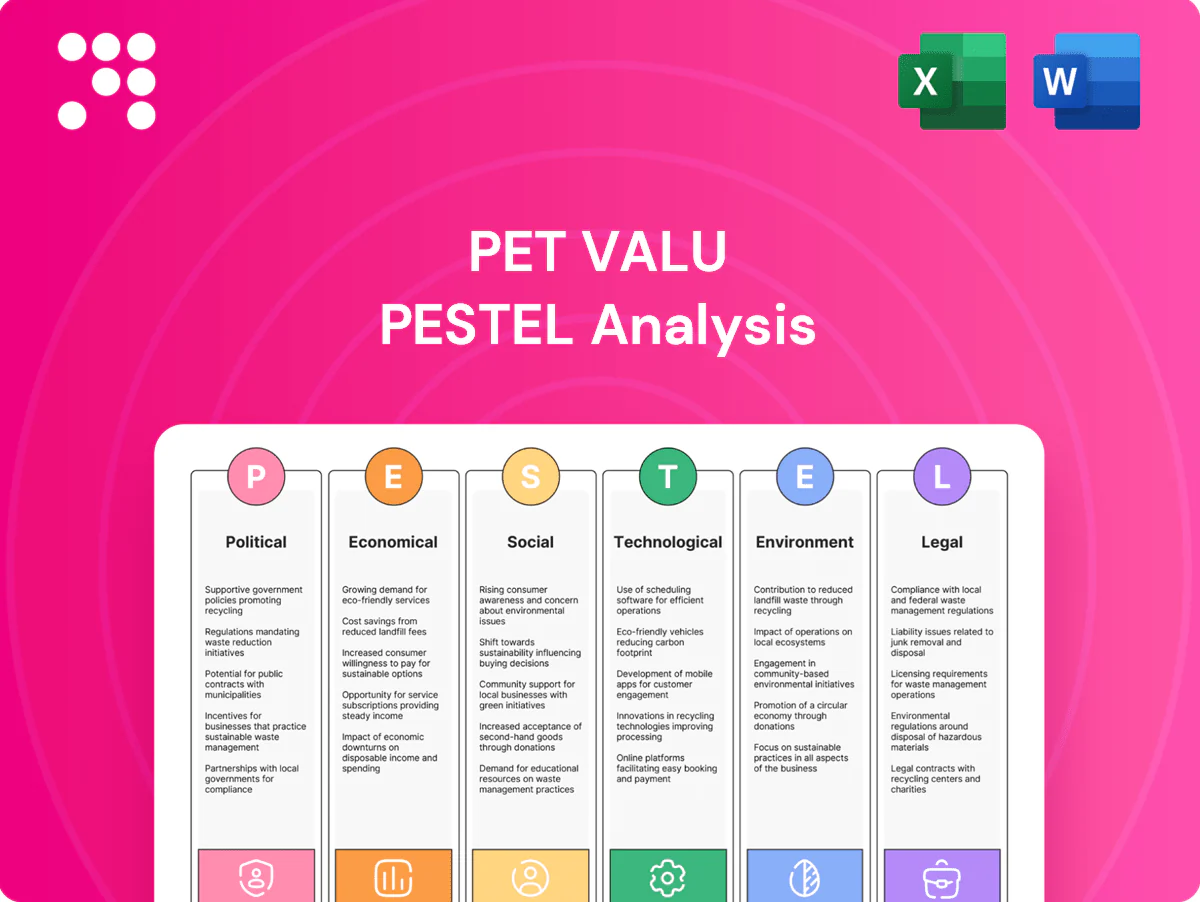
The Pet Valu PESTLE Analysis preview shown here is the exact, fully formatted document you’ll receive after purchase, with complete sections on Political, Economic, Social, Technological, Legal, and Environmental factors. No placeholders or teasers—this is the finished file, professionally structured and ready to download immediately after checkout. Use it as-is for presentations, reports, or strategic planning.

Original: $10.00
-65%$10.00
$3.50Product Information
Product Information
Shipping & Returns
Shipping & Returns
Description
Make Smarter Strategic Decisions with a Complete PESTEL View
Discover how political, economic, social, technological, legal, and environmental forces are reshaping Pet Valu’s market position in our concise PESTLE overview. Use these insights to spot risks and growth opportunities fast. Purchase the full analysis for a complete, actionable roadmap you can deploy today.
Political factors
Canadian retail policy
Federal and provincial retail policies—including the 9% federal small business tax rate, GST 5% (HST up to 15% in some provinces), and provincial minimum wages (BC $16.75, ON $16.55, AB $15.00)—directly affect Pet Valu store margins and expansion pacing; changes to sales tax administration, wage subsidies or small business supports shift cash flows for corporate and franchised locations, while municipal bylaws on hours, signage and permits require local compliance monitoring.
Import tariffs & trade
CUSMA, effective July 1, 2020, shapes tariffs and customs procedures for pet food, accessories and inputs, supporting tariff-free trade for many processed goods between members; the North American pet market reached about 136 billion USD in 2023. Border inspections and sanitary rules for animal-origin products (CFIA/USDA regimes) can cause shipment delays and added carrying costs. Policy shifts on tariffs or non-tariff barriers directly move landed costs and retail pricing, so diversifying suppliers cuts exposure to trade frictions.
Provincial regulations
Provincial variation in combined sales tax (5%–15%), minimum wages (roughly C$15–C$17/hr) and differing EPR packaging rules increases operational complexity and compliance costs for Pet Valu. Quebec’s Bill 96 enforces French predominance on packaging, POS and customer communications, raising localization costs. Local zoning and permitting can delay new openings by months and trigger fines. Tailored provincial playbooks reduce approval delays and penalty risk.
Franchise relations policy
Franchise disclosure laws govern franchisor–franchisee relationships, dispute resolution and renewal terms. Six provinces — Ontario, Alberta, BC, Manitoba, New Brunswick and PEI — have franchise statutes requiring robust documentation and fair dealing. Policy updates can alter obligations around fees and terminations; strong compliance sustains network trust and growth.
- Six provinces with statutes
- Disclosure, renewal, dispute rules
- Compliance sustains trust & growth
Public health & emergencies
Taxes, wages and rules hit pet margins — 136B, 18%
Federal/provincial taxes and minimum wages (federal small‑biz 9%, GST 5%; BC $16.75, ON $16.55, AB $15.00) materially affect margins and expansion. CUSMA and CFIA/USDA rules shape imports; North American pet market ~136 billion USD (2023) and online share ~18% (2023). Franchise statutes in six provinces and provincial language/EPR rules raise compliance costs.
| Metric | Value |
|---|---|
| NA pet market (2023) | 136B USD |
| Online share (2023) | 18% |
| Federal small‑biz tax | 9% |
| GST | 5% |
What is included in the product
Detailed Word Document
Explores how external macro-environmental factors uniquely affect Pet Valu across six dimensions—Political, Economic, Social, Technological, Environmental and Legal—with data-driven trends and region-specific regulatory context. Designed for executives, investors and advisors, it highlights threats, opportunities and forward-looking insights ready for business plans, pitch decks and scenario planning.
Customizable Excel Spreadsheet
Cleanly summarized and visually segmented by PESTLE categories for quick interpretation, this Pet Valu PESTLE relieves meeting and planning pain points by being easily editable, shareable, and drop‑in ready for presentations or strategy packs.
Economic factors
Consumer spending cycles
Pet spend is relatively resilient—US pet industry outlays were $136.8 billion in 2022 (APPA), yet discretionary shifts mean downturns still pressure premium-to-value trade-ups; Pet Valu must balance assortment between premium and value tiers. Loyalty programs historically stabilize basket sizes and frequency, softening declines during slow cycles. Monitoring leading indicators—consumer confidence, disposable income and CPI—guides inventory and promo depth to protect margins.
Inflation & pricing
Input-cost inflation in proteins, grains, packaging and freight remained elevated into 2024 after 2021–23 spikes, pressuring gross margins and forcing selective price pass-through. Passing price increases requires careful elasticity management across premium and private-label lines to avoid share loss. Shrinkflation or pack-size changes can preserve value perception while maintaining price points. Data-driven pricing and SKU-level analytics protect mix and market share.
FX & import costs
CAD volatility—roughly a 20% swing versus USD since 2020—raises costs for U.S.-sourced brands at Pet Valu; robust FX hedging and multi-currency supplier contracts have been used to stabilize COGS. Active supplier negotiations on freight and fuel surcharges limit transient spikes, while increasing assortment localization (more Canadian-sourced SKUs) materially reduces FX exposure and pricing pass-through to customers.
Competition & consolidation
Competition from big-box retailers, grocers, online marketplaces and specialty peers compresses pricing and forces service differentiation for Pet Valu, driving investment in exclusive brands and in-store services to protect margins and traffic.
Industry consolidation among retailers and distributors shifts supplier power and slotting dynamics, while targeted M&A can extend scale, boost private-label penetration and provide cost synergies.
- Competitive pressure: multiplatform
- Consolidation: supplier leverage
- Defense: exclusive brands/services
- M&A: scale & private‑label growth
Labour market tightness
Tight Canadian retail labour markets (unemployment ~5.4% in 2024) push wages and training costs higher—retail average hourly wages rose ~4% y/y in 2023—increasing turnover risk and compressing margins for Pet Valu, where grooming and advice-led selling demand stable, skilled teams.
- Retention: flexible scheduling, incentives
- Cost: higher wages, training, turnover
- Service: grooming needs consistent staff
- Tech: self-checkout/automation can cut cashier hours ~15–20%
Taxes, wages and rules hit pet margins — 136B, 18%
Pet spending is resilient (US pet market $136.8B in 2022) but discretionary shifts pressure premium tiers; monitor consumer confidence, real disposable income and CPI to adjust promos. Input-cost inflation (proteins/grains/packaging) and ~20% CAD/USD swing since 2020 compress margins; wages ~+4% y/y (2023) raise retail costs.
| Metric | Value |
|---|---|
| US pet market (2022) | $136.8B |
| CAD/USD swing | ~20% since 2020 |
| Retail wages | +4% y/y (2023) |
Same Document Delivered
Pet Valu PESTLE Analysis
The Pet Valu PESTLE Analysis preview shown here is the exact, fully formatted document you’ll receive after purchase, with complete sections on Political, Economic, Social, Technological, Legal, and Environmental factors. No placeholders or teasers—this is the finished file, professionally structured and ready to download immediately after checkout. Use it as-is for presentations, reports, or strategic planning.