Persol Holdings Co. SWOT Analysis

Your Strategic Toolkit Starts Here
Persol Holdings shows strengths in diversified HR services and strong Japan/Asia market reach, but faces margin pressure from competition and demographic headwinds; digital transformation and overseas expansion are clear growth levers, while regulatory shifts and economic cycles pose risks. Discover the complete picture—purchase the full SWOT analysis for an editable, investor-ready report and Excel model to plan with confidence.
Strengths

Diversified HR service portfolio
Offering temporary staffing, permanent placement, BPO/RPO and career transition lowers reliance on any single revenue source and smooths cash flow across hiring cycles. Cross-selling these solutions deepens client relationships and boosts wallet share by solving multiple workforce needs. The breadth positions Persol as a one-stop partner able to pivot with cyclical shifts in demand.
Strong brand and scale in Japan
Persol, a leading Japanese staffing group, leverages strong brand recognition and trust with over 3.3 million registered candidates and about 140,000 corporate clients, enhancing candidate pools and client access. Scale drives operational efficiency and higher matching velocity, improving fill rates. High placement volumes create a defensible network effect in core markets.

Deep client relationships across sectors
Persol serves manufacturing, services, tech, healthcare and public sectors, smoothing sector-specific volatility while reporting ¥1.01 trillion consolidated revenue in FY2024. Long-term contracts and MSP/RPO engagements boost revenue visibility and recurring cash flow. Embedded teams deepen understanding of client needs and pain points. This structure drives higher retention and increased upsell opportunities.

Data assets and matching capabilities
Persol Holdings leverages extensive candidate and assignment data to sharpen job-matching algorithms and reduce time-to-fill; the group, listed on TSE code 2181 and founded in 1973, is one of Japan's largest staffing firms. Process know-how and workflow systems bolster quality and regulatory compliance, while data-driven pricing, demand forecasting, and workforce planning create measurable efficiency advantages in a cost-sensitive market.
- Data-driven matching
- Compliance-ready workflows
- Pricing & demand forecasting
- Operational differentiation
Regional footprint in APAC
Persol Holdings’ operations across Asia-Pacific extend growth optionality beyond Japan by enabling cross-border placements and project staffing that leverage regional talent flows and skills arbitrage. This geographic diversification reduces country-specific exposure and supports multinational clients with integrated local-to-regional workforce solutions. The APAC footprint enhances revenue resilience and commercial scalability for regional mandates.
- Regional reach supports multinational clients
- Cross-border placements tap talent flows
- Diversification lowers country risk
¥1.01T revenue, 3.3M candidates power diverse staffing
Diversified services (temp, perm, BPO/RPO, career transition) reduce single-source risk and enable cross-sell, stabilizing cash flow. Strong brand with 3.3M registered candidates and ~140k clients drives matching efficiency and network effects. FY2024 revenue ¥1.01 trillion and APAC footprint support scale, data-driven operations, and regional growth optionality.
| Metric | Value |
|---|---|
| FY2024 revenue | ¥1.01T |
| Registered candidates | 3.3M |
| Corporate clients | 140k |
What is included in the product
 Detailed Word Document
Delivers a strategic overview of Persol Holdings Co.’s internal and external business factors, outlining strengths, weaknesses, opportunities, and threats to assess its competitive position and future risks.

 Customizable Excel Spreadsheet
Provides a concise SWOT matrix for Persol Holdings Co., enabling quick identification of workforce strengths, regulatory and market risks, and growth opportunities across staffing and HR services.
Weaknesses

Exposure to economic cycles
Staffing volumes typically fall during recessions as clients freeze hiring, a sensitivity underscored when global GDP contracted 3.4% in 2020 (IMF). Temp hours and permanent placements are highly correlated with GDP and business sentiment, and even with Japan’s unemployment near 2.6% in 2024 Persol faces demand swings. Revenue volatility complicates capacity planning and this cyclicality pressures margins and cash flow.
Margin constraints in commoditized segments
General staffing at Persol faces intense price competition and limited differentiation; Persol reported an operating margin near 4% in FY2023, while higher-value HR-tech peers often post double-digit margins (~10–15%). Rising compliance and labor costs increasingly compress spreads and cannot always be passed to clients. Utilization swings amplify operating leverage volatility, keeping Persol structurally below HR-tech profitability levels.

High dependence on domestic market
Japan accounts for roughly three-quarters of Persol Holdings revenue (≈75%), concentrating macro and regulatory risk in one market. Aging demographics and local labor policies tightly drive demand for staffing services, limiting upside. With only modest APAC mix, currency translation provides little hedge, and geographic concentration can cap growth prospects.

Talent supply bottlenecks
Aging demographics (65+ ≈29% of Japan's population in 2024) and skill mismatches shrink candidate pools, while a tight labor market (job openings-to-applicants ratio ≈1.3) lifts sourcing costs and lengthens fill times. Shortages of digital and healthcare talent intensify competition, pressuring fill rates and client satisfaction.
- High 65+ share: ≈29% (2024)
- Tight market: job openings-to-applicants ≈1.3
- Critical shortages: digital & healthcare skills
Complexity from systems and M&A integration
Multiple brands and acquired platforms fragment processes and data, creating silos that raise reconciliation and reporting costs. Integration delays have repeatedly slowed synergy capture and cross-selling across business units. Disparate IT stacks increase maintenance burden and cybersecurity exposure, and operational complexity can slow product and service innovation.
- Fragmented processes and data
- Integration delays hinder synergies
- Disparate IT stacks raise cyber/maintenance risk
- Operational complexity slows innovation
Cyclical staffing business: Japan revenue ≈75%, operating margin ≈4%
Heavy cyclicality drives revenue and margin volatility (temp hours and placements tied to GDP), limiting cash flow stability. Low differentiation and pricing pressure keep operating margin near 4% (FY2023) versus HR-tech peers ~10–15%. Revenue concentrated in Japan (~75%) exposes Persol to aging-population risks (65+ ≈29% in 2024) and tight labor market (openings-to-applicants ≈1.3).
| Metric | Value |
|---|---|
| Japan revenue share | ≈75% |
| Operating margin (FY2023) | ≈4% |
| 65+ population (2024) | ≈29% |
| Openings-to-applicants | ≈1.3 |
Preview the Actual Deliverable
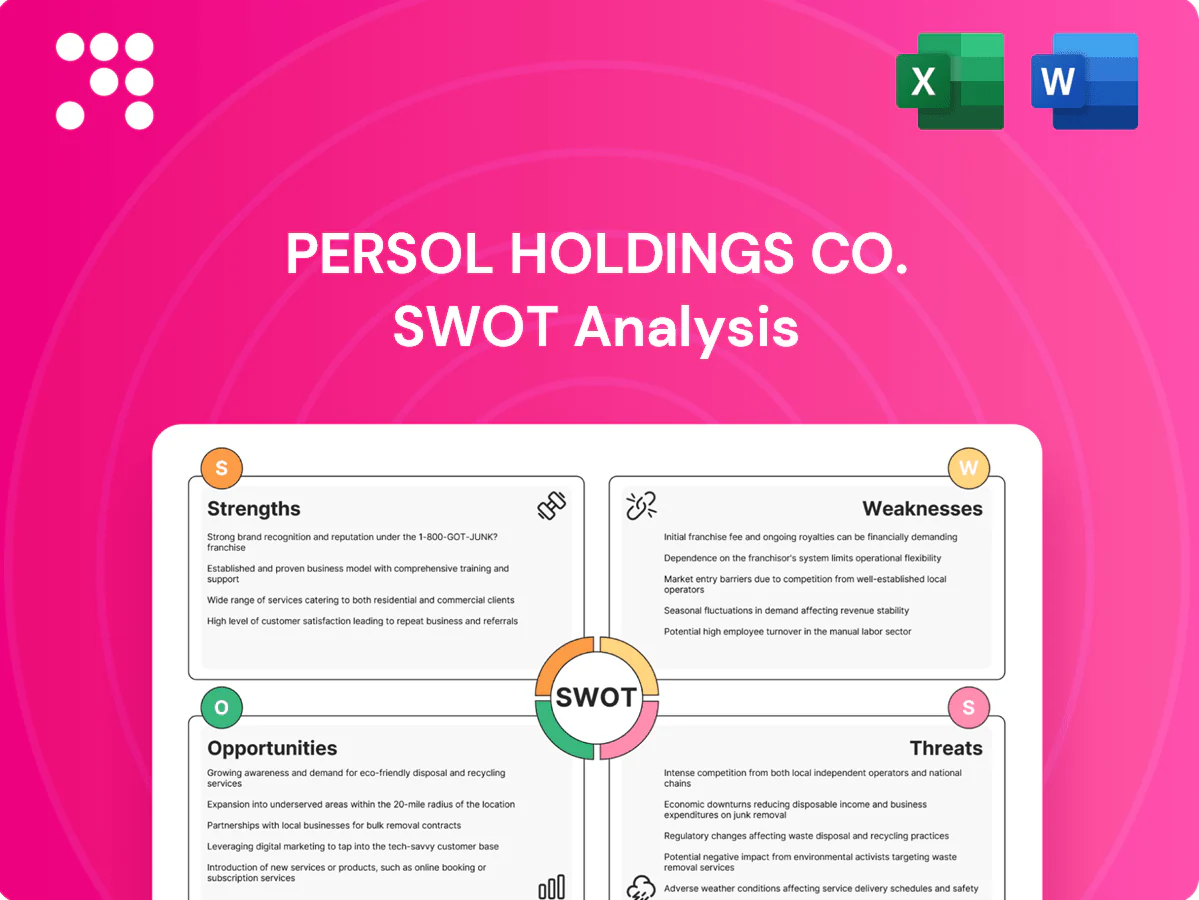
Persol Holdings Co. SWOT Analysis
This is the actual SWOT analysis document for Persol Holdings Co. you’ll receive upon purchase—no surprises, just professional quality. The preview below is taken directly from the full report; buy now to unlock the complete, editable version with detailed strengths, weaknesses, opportunities and threats.

Product Information
Product Information
Shipping & Returns
Shipping & Returns
Description
Your Strategic Toolkit Starts Here
Persol Holdings shows strengths in diversified HR services and strong Japan/Asia market reach, but faces margin pressure from competition and demographic headwinds; digital transformation and overseas expansion are clear growth levers, while regulatory shifts and economic cycles pose risks. Discover the complete picture—purchase the full SWOT analysis for an editable, investor-ready report and Excel model to plan with confidence.
Strengths
Diversified HR service portfolio
Offering temporary staffing, permanent placement, BPO/RPO and career transition lowers reliance on any single revenue source and smooths cash flow across hiring cycles. Cross-selling these solutions deepens client relationships and boosts wallet share by solving multiple workforce needs. The breadth positions Persol as a one-stop partner able to pivot with cyclical shifts in demand.
Strong brand and scale in Japan
Persol, a leading Japanese staffing group, leverages strong brand recognition and trust with over 3.3 million registered candidates and about 140,000 corporate clients, enhancing candidate pools and client access. Scale drives operational efficiency and higher matching velocity, improving fill rates. High placement volumes create a defensible network effect in core markets.
Deep client relationships across sectors
Persol serves manufacturing, services, tech, healthcare and public sectors, smoothing sector-specific volatility while reporting ¥1.01 trillion consolidated revenue in FY2024. Long-term contracts and MSP/RPO engagements boost revenue visibility and recurring cash flow. Embedded teams deepen understanding of client needs and pain points. This structure drives higher retention and increased upsell opportunities.
Data assets and matching capabilities
Persol Holdings leverages extensive candidate and assignment data to sharpen job-matching algorithms and reduce time-to-fill; the group, listed on TSE code 2181 and founded in 1973, is one of Japan's largest staffing firms. Process know-how and workflow systems bolster quality and regulatory compliance, while data-driven pricing, demand forecasting, and workforce planning create measurable efficiency advantages in a cost-sensitive market.
- Data-driven matching
- Compliance-ready workflows
- Pricing & demand forecasting
- Operational differentiation
Regional footprint in APAC
Persol Holdings’ operations across Asia-Pacific extend growth optionality beyond Japan by enabling cross-border placements and project staffing that leverage regional talent flows and skills arbitrage. This geographic diversification reduces country-specific exposure and supports multinational clients with integrated local-to-regional workforce solutions. The APAC footprint enhances revenue resilience and commercial scalability for regional mandates.
- Regional reach supports multinational clients
- Cross-border placements tap talent flows
- Diversification lowers country risk
¥1.01T revenue, 3.3M candidates power diverse staffing
Diversified services (temp, perm, BPO/RPO, career transition) reduce single-source risk and enable cross-sell, stabilizing cash flow. Strong brand with 3.3M registered candidates and ~140k clients drives matching efficiency and network effects. FY2024 revenue ¥1.01 trillion and APAC footprint support scale, data-driven operations, and regional growth optionality.
| Metric | Value |
|---|---|
| FY2024 revenue | ¥1.01T |
| Registered candidates | 3.3M |
| Corporate clients | 140k |
What is included in the product
Detailed Word Document
Delivers a strategic overview of Persol Holdings Co.’s internal and external business factors, outlining strengths, weaknesses, opportunities, and threats to assess its competitive position and future risks.
Customizable Excel Spreadsheet
Provides a concise SWOT matrix for Persol Holdings Co., enabling quick identification of workforce strengths, regulatory and market risks, and growth opportunities across staffing and HR services.
Weaknesses
Exposure to economic cycles
Staffing volumes typically fall during recessions as clients freeze hiring, a sensitivity underscored when global GDP contracted 3.4% in 2020 (IMF). Temp hours and permanent placements are highly correlated with GDP and business sentiment, and even with Japan’s unemployment near 2.6% in 2024 Persol faces demand swings. Revenue volatility complicates capacity planning and this cyclicality pressures margins and cash flow.
Margin constraints in commoditized segments
General staffing at Persol faces intense price competition and limited differentiation; Persol reported an operating margin near 4% in FY2023, while higher-value HR-tech peers often post double-digit margins (~10–15%). Rising compliance and labor costs increasingly compress spreads and cannot always be passed to clients. Utilization swings amplify operating leverage volatility, keeping Persol structurally below HR-tech profitability levels.
High dependence on domestic market
Japan accounts for roughly three-quarters of Persol Holdings revenue (≈75%), concentrating macro and regulatory risk in one market. Aging demographics and local labor policies tightly drive demand for staffing services, limiting upside. With only modest APAC mix, currency translation provides little hedge, and geographic concentration can cap growth prospects.
Talent supply bottlenecks
Aging demographics (65+ ≈29% of Japan's population in 2024) and skill mismatches shrink candidate pools, while a tight labor market (job openings-to-applicants ratio ≈1.3) lifts sourcing costs and lengthens fill times. Shortages of digital and healthcare talent intensify competition, pressuring fill rates and client satisfaction.
- High 65+ share: ≈29% (2024)
- Tight market: job openings-to-applicants ≈1.3
- Critical shortages: digital & healthcare skills
Complexity from systems and M&A integration
Multiple brands and acquired platforms fragment processes and data, creating silos that raise reconciliation and reporting costs. Integration delays have repeatedly slowed synergy capture and cross-selling across business units. Disparate IT stacks increase maintenance burden and cybersecurity exposure, and operational complexity can slow product and service innovation.
- Fragmented processes and data
- Integration delays hinder synergies
- Disparate IT stacks raise cyber/maintenance risk
- Operational complexity slows innovation
Cyclical staffing business: Japan revenue ≈75%, operating margin ≈4%
Heavy cyclicality drives revenue and margin volatility (temp hours and placements tied to GDP), limiting cash flow stability. Low differentiation and pricing pressure keep operating margin near 4% (FY2023) versus HR-tech peers ~10–15%. Revenue concentrated in Japan (~75%) exposes Persol to aging-population risks (65+ ≈29% in 2024) and tight labor market (openings-to-applicants ≈1.3).
| Metric | Value |
|---|---|
| Japan revenue share | ≈75% |
| Operating margin (FY2023) | ≈4% |
| 65+ population (2024) | ≈29% |
| Openings-to-applicants | ≈1.3 |
Preview the Actual Deliverable
Persol Holdings Co. SWOT Analysis
This is the actual SWOT analysis document for Persol Holdings Co. you’ll receive upon purchase—no surprises, just professional quality. The preview below is taken directly from the full report; buy now to unlock the complete, editable version with detailed strengths, weaknesses, opportunities and threats.