Paul Weiss PESTLE Analysis

Plan Smarter. Present Sharper. Compete Stronger.
Discover how political shifts, economic trends, social change, technological disruption, legal pressures, and environmental risks converge to shape Paul Weiss’s strategic outlook in our concise PESTLE summary. This snapshot highlights critical external forces affecting operations and reputation, ideal for quick decision-making. Purchase the full PESTLE for detailed, actionable insights and editable charts you can use immediately.
Political factors

Geopolitical volatility
Geopolitical volatility—notably shifts in US-China ties, expanding sanctions regimes, and regional conflicts—has materially reshaped cross-border deal flow and investigations, driving clients to seek counsel on investment screening, export controls, and sanctions exposure; a 2024 industry survey found roughly 60% of multinational legal teams increased compliance budgets. Paul Weiss can leverage crisis-response and public policy interfaces to guide multinational strategies, integrating political risk advisory with litigation, white-collar defense, and transactional work.
Regulatory enforcement priorities
Changes in administration recalibrate DOJ, SEC and antitrust agendas, with the SEC and DOJ together recovering over 4.5 billion USD in enforcement remedies across FY2023–FY2024 and heightened FCPA and merger scrutiny. Emphasis on corporate crime, antitrust and ESG disclosures can surge, raising monitorships and penalties. Paul Weiss can position integrated cross-practice teams to anticipate rulemaking waves and offer proactive compliance audits that become client differentiators.

Trade and industrial policy
Industrial policy steers capital: the CHIPS and Science Act’s $52.7 billion for semiconductors, global clean-energy investment of about $1.7 trillion in 2023, and a roughly $858 billion US defense budget (FY2024) shift deals toward chips, energy transition and defense. Export controls and CFIUS reviews constrain tech transfers and M&A timing, so advisory teams must map deal structures to security-sensitive assets early, while advocacy and comment letters can materially shape evolving frameworks.

Public procurement and infrastructure
Government funding from the $1.2 trillion Bipartisan Infrastructure Law (including $550B new spending) is driving PPPs and complex contracting, while federal contracting obligations reached about $782B in FY2023; GAO saw ~3,855 bid protests in FY2023 and DOJ False Claims Act recoveries hit roughly $3.0B, elevating labor and compliance risk.
- Regulatory blend: government contracts + investigations
- Client strategy: capture infrastructure funds, mitigate FCA/bid-protest risk
- Compliance focus: Buy America, Davis-Bacon, heightened labor rules
Global governance and standards
Geopolitics, industrial policy and Pillar Two drive higher compliance and deal complexity
Geopolitical volatility and sanctions reshaped cross-border work; ~60% of multinationals raised compliance budgets in 2024. SEC/DOJ recovered >4.5B USD in enforcement FY2023–24, increasing FCPA/antitrust scrutiny. Industrial policy (CHIPS 52.7B; US infrastructure 1.2T) and Pillar Two (140+ jurisdictions) drive deal structuring and multi-jurisdictional compliance.
| Metric | Value |
|---|---|
| Compliance budgets↑ (2024) | ~60% |
| Enforcement recoveries | >4.5B USD |
| CHIPS | 52.7B USD |
| Pillar Two | 140+ juris. |
What is included in the product
 Detailed Word Document
Explores how macro-environmental factors uniquely affect Paul Weiss across six dimensions—Political, Economic, Social, Technological, Environmental, and Legal—providing data-backed, forward-looking insights and detailed sub-points to help executives, advisors, and investors identify risks, opportunities, and strategic responses.

 Customizable Excel Spreadsheet
A concise, visually segmented Paul Weiss PESTLE summary that’s easy to drop into presentations or share across teams, helping streamline external risk discussions and accelerate alignment during planning sessions.
Economic factors

Interest rates and credit cycles
Rate volatility—with the US federal funds target around 5.25–5.50% in 2024–25—has driven a surge in restructuring, liability management and distressed M&A mandates. High financing costs have slowed PE and strategic dealmaking despite roughly $2.1 trillion of PE dry powder as of 2024. Paul Weiss pivots between creditor, debtor and sponsor-side engagements, and capital solutions advisory deepens client stickiness across cycles.
Deal activity and private capital
Growing private capital reshapes deal dynamics: global private equity dry powder stood near $2.3 trillion by mid-2024, with private credit AUM around $1.2 trillion and infrastructure fundraising topping roughly $200 billion in 2023. Take-privates, carve-outs and secondaries drive complex, multi-jurisdictional work. Paul Weiss’s long-standing sponsor relationships and standardized playbooks give a measurable win-rate advantage. Cross-practice execution speed secures time-sensitive mandates.

Market volatility and litigation
Market dislocations have fueled securities class actions, valuation disputes and hundreds of SPAC-related claims since 2022, while volatility-linked disclosure and governance lapses draw intensified regulator and plaintiff scrutiny. Litigation and crisis communications must be tightly integrated for rapid response, and early case assessment demonstrably cuts legal costs and limits reputational damage.

Global growth divergence
Uneven recoveries—IMF WEO April 2025 projects global growth at 3.1% with advanced economies ~1.6% and EMDEs ~4.2%—force portfolio shifts and higher risk dispersion across regions. Currency swings (DXY ~+2% YTD 2025), sticky food energy inflation and reshuffled supply chains complicate pricing and contract risk. Paul Weiss must deliver localized legal tactics and scenario-based playbooks for multinationals.
- Regional growth tags: advanced 1.6%, EMDEs 4.2%
- Macro risk tags: FX volatility, inflation pass-through
- Operational tags: supply-chain relocation, contract hedges
- Advisory tags: localized playbooks, scenario workflows
Cost pressure and efficiency
Clients increasingly demand alternative fee arrangements and demonstrable value; the 2024 ACC Chief Legal Officers Survey reported about 60% of in-house teams expanding use of AFAs, driving pressure on margins. Process optimization and legal‑tech adoption raise firm productivity and margins, while flexible, data‑driven staffing and transparent KPIs improve retention and trust.
- AFAs: ~60% uptake (ACC 2024)
- Legal tech: boosts productivity, lowers cost per matter
- Staffing: flexible, metrics‑driven models
- KPIs: transparency improves client retention
Geopolitics, industrial policy and Pillar Two drive higher compliance and deal complexity
High rates (US fed funds ~5.25–5.50% in 2024–25) spurred restructuring and distressed M&A while slowing PE deals despite ~$2.3T PE dry powder (mid‑2024) and ~$1.2T private credit AUM. Market dislocations raised securities, SPAC and disclosure disputes; IMF Apr 2025 growth 3.1% (advanced 1.6%, EMDEs 4.2%) increases regional risk dispersion. Clients push AFAs (~60% ACC 2024) and legal‑tech for margin pressure.
| Tag | Value |
|---|---|
| Fed funds | 5.25–5.50% |
| PE dry powder | $2.3T |
| Private credit | $1.2T |
| Global growth (IMF Apr 2025) | 3.1% |
| AFA uptake (ACC 2024) | ~60% |
Full Version Awaits
Paul Weiss PESTLE Analysis
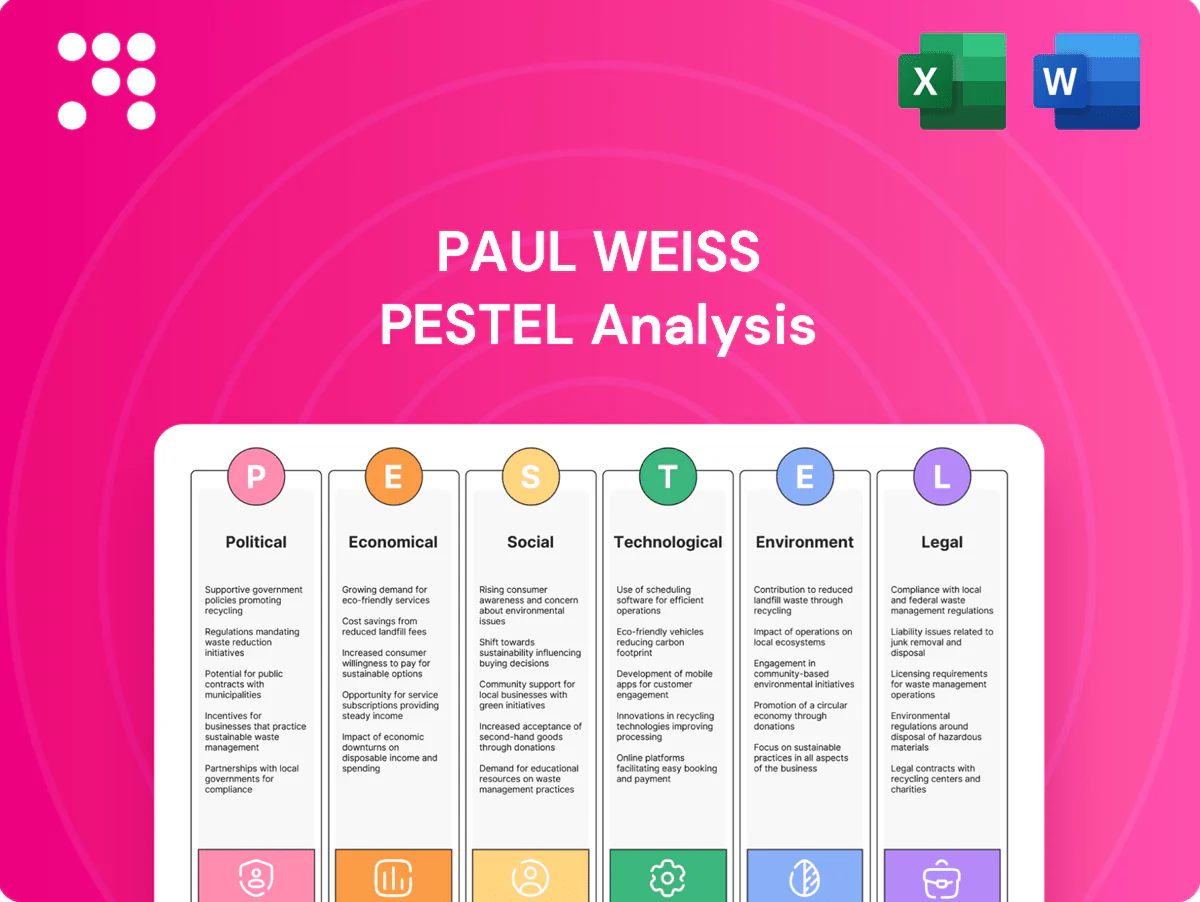
The Paul Weiss PESTLE Analysis preview shown here is the exact document you’ll receive after purchase—fully formatted and ready to use. The layout, content, and structure visible are precisely what you’ll download immediately after buying. No placeholders or teasers; this is the final, professionally structured file.

Original: $10.00
-65%$10.00
$3.50Product Information
Product Information
Shipping & Returns
Shipping & Returns
Description
Plan Smarter. Present Sharper. Compete Stronger.
Discover how political shifts, economic trends, social change, technological disruption, legal pressures, and environmental risks converge to shape Paul Weiss’s strategic outlook in our concise PESTLE summary. This snapshot highlights critical external forces affecting operations and reputation, ideal for quick decision-making. Purchase the full PESTLE for detailed, actionable insights and editable charts you can use immediately.
Political factors
Geopolitical volatility
Geopolitical volatility—notably shifts in US-China ties, expanding sanctions regimes, and regional conflicts—has materially reshaped cross-border deal flow and investigations, driving clients to seek counsel on investment screening, export controls, and sanctions exposure; a 2024 industry survey found roughly 60% of multinational legal teams increased compliance budgets. Paul Weiss can leverage crisis-response and public policy interfaces to guide multinational strategies, integrating political risk advisory with litigation, white-collar defense, and transactional work.
Regulatory enforcement priorities
Changes in administration recalibrate DOJ, SEC and antitrust agendas, with the SEC and DOJ together recovering over 4.5 billion USD in enforcement remedies across FY2023–FY2024 and heightened FCPA and merger scrutiny. Emphasis on corporate crime, antitrust and ESG disclosures can surge, raising monitorships and penalties. Paul Weiss can position integrated cross-practice teams to anticipate rulemaking waves and offer proactive compliance audits that become client differentiators.
Trade and industrial policy
Industrial policy steers capital: the CHIPS and Science Act’s $52.7 billion for semiconductors, global clean-energy investment of about $1.7 trillion in 2023, and a roughly $858 billion US defense budget (FY2024) shift deals toward chips, energy transition and defense. Export controls and CFIUS reviews constrain tech transfers and M&A timing, so advisory teams must map deal structures to security-sensitive assets early, while advocacy and comment letters can materially shape evolving frameworks.
Public procurement and infrastructure
Government funding from the $1.2 trillion Bipartisan Infrastructure Law (including $550B new spending) is driving PPPs and complex contracting, while federal contracting obligations reached about $782B in FY2023; GAO saw ~3,855 bid protests in FY2023 and DOJ False Claims Act recoveries hit roughly $3.0B, elevating labor and compliance risk.
- Regulatory blend: government contracts + investigations
- Client strategy: capture infrastructure funds, mitigate FCA/bid-protest risk
- Compliance focus: Buy America, Davis-Bacon, heightened labor rules
Global governance and standards
Geopolitics, industrial policy and Pillar Two drive higher compliance and deal complexity
Geopolitical volatility and sanctions reshaped cross-border work; ~60% of multinationals raised compliance budgets in 2024. SEC/DOJ recovered >4.5B USD in enforcement FY2023–24, increasing FCPA/antitrust scrutiny. Industrial policy (CHIPS 52.7B; US infrastructure 1.2T) and Pillar Two (140+ jurisdictions) drive deal structuring and multi-jurisdictional compliance.
| Metric | Value |
|---|---|
| Compliance budgets↑ (2024) | ~60% |
| Enforcement recoveries | >4.5B USD |
| CHIPS | 52.7B USD |
| Pillar Two | 140+ juris. |
What is included in the product
Detailed Word Document
Explores how macro-environmental factors uniquely affect Paul Weiss across six dimensions—Political, Economic, Social, Technological, Environmental, and Legal—providing data-backed, forward-looking insights and detailed sub-points to help executives, advisors, and investors identify risks, opportunities, and strategic responses.
Customizable Excel Spreadsheet
A concise, visually segmented Paul Weiss PESTLE summary that’s easy to drop into presentations or share across teams, helping streamline external risk discussions and accelerate alignment during planning sessions.
Economic factors
Interest rates and credit cycles
Rate volatility—with the US federal funds target around 5.25–5.50% in 2024–25—has driven a surge in restructuring, liability management and distressed M&A mandates. High financing costs have slowed PE and strategic dealmaking despite roughly $2.1 trillion of PE dry powder as of 2024. Paul Weiss pivots between creditor, debtor and sponsor-side engagements, and capital solutions advisory deepens client stickiness across cycles.
Deal activity and private capital
Growing private capital reshapes deal dynamics: global private equity dry powder stood near $2.3 trillion by mid-2024, with private credit AUM around $1.2 trillion and infrastructure fundraising topping roughly $200 billion in 2023. Take-privates, carve-outs and secondaries drive complex, multi-jurisdictional work. Paul Weiss’s long-standing sponsor relationships and standardized playbooks give a measurable win-rate advantage. Cross-practice execution speed secures time-sensitive mandates.
Market volatility and litigation
Market dislocations have fueled securities class actions, valuation disputes and hundreds of SPAC-related claims since 2022, while volatility-linked disclosure and governance lapses draw intensified regulator and plaintiff scrutiny. Litigation and crisis communications must be tightly integrated for rapid response, and early case assessment demonstrably cuts legal costs and limits reputational damage.
Global growth divergence
Uneven recoveries—IMF WEO April 2025 projects global growth at 3.1% with advanced economies ~1.6% and EMDEs ~4.2%—force portfolio shifts and higher risk dispersion across regions. Currency swings (DXY ~+2% YTD 2025), sticky food energy inflation and reshuffled supply chains complicate pricing and contract risk. Paul Weiss must deliver localized legal tactics and scenario-based playbooks for multinationals.
- Regional growth tags: advanced 1.6%, EMDEs 4.2%
- Macro risk tags: FX volatility, inflation pass-through
- Operational tags: supply-chain relocation, contract hedges
- Advisory tags: localized playbooks, scenario workflows
Cost pressure and efficiency
Clients increasingly demand alternative fee arrangements and demonstrable value; the 2024 ACC Chief Legal Officers Survey reported about 60% of in-house teams expanding use of AFAs, driving pressure on margins. Process optimization and legal‑tech adoption raise firm productivity and margins, while flexible, data‑driven staffing and transparent KPIs improve retention and trust.
- AFAs: ~60% uptake (ACC 2024)
- Legal tech: boosts productivity, lowers cost per matter
- Staffing: flexible, metrics‑driven models
- KPIs: transparency improves client retention
Geopolitics, industrial policy and Pillar Two drive higher compliance and deal complexity
High rates (US fed funds ~5.25–5.50% in 2024–25) spurred restructuring and distressed M&A while slowing PE deals despite ~$2.3T PE dry powder (mid‑2024) and ~$1.2T private credit AUM. Market dislocations raised securities, SPAC and disclosure disputes; IMF Apr 2025 growth 3.1% (advanced 1.6%, EMDEs 4.2%) increases regional risk dispersion. Clients push AFAs (~60% ACC 2024) and legal‑tech for margin pressure.
| Tag | Value |
|---|---|
| Fed funds | 5.25–5.50% |
| PE dry powder | $2.3T |
| Private credit | $1.2T |
| Global growth (IMF Apr 2025) | 3.1% |
| AFA uptake (ACC 2024) | ~60% |
Full Version Awaits
Paul Weiss PESTLE Analysis
The Paul Weiss PESTLE Analysis preview shown here is the exact document you’ll receive after purchase—fully formatted and ready to use. The layout, content, and structure visible are precisely what you’ll download immediately after buying. No placeholders or teasers; this is the final, professionally structured file.