Parkland PESTLE Analysis

Skip the Research. Get the Strategy.
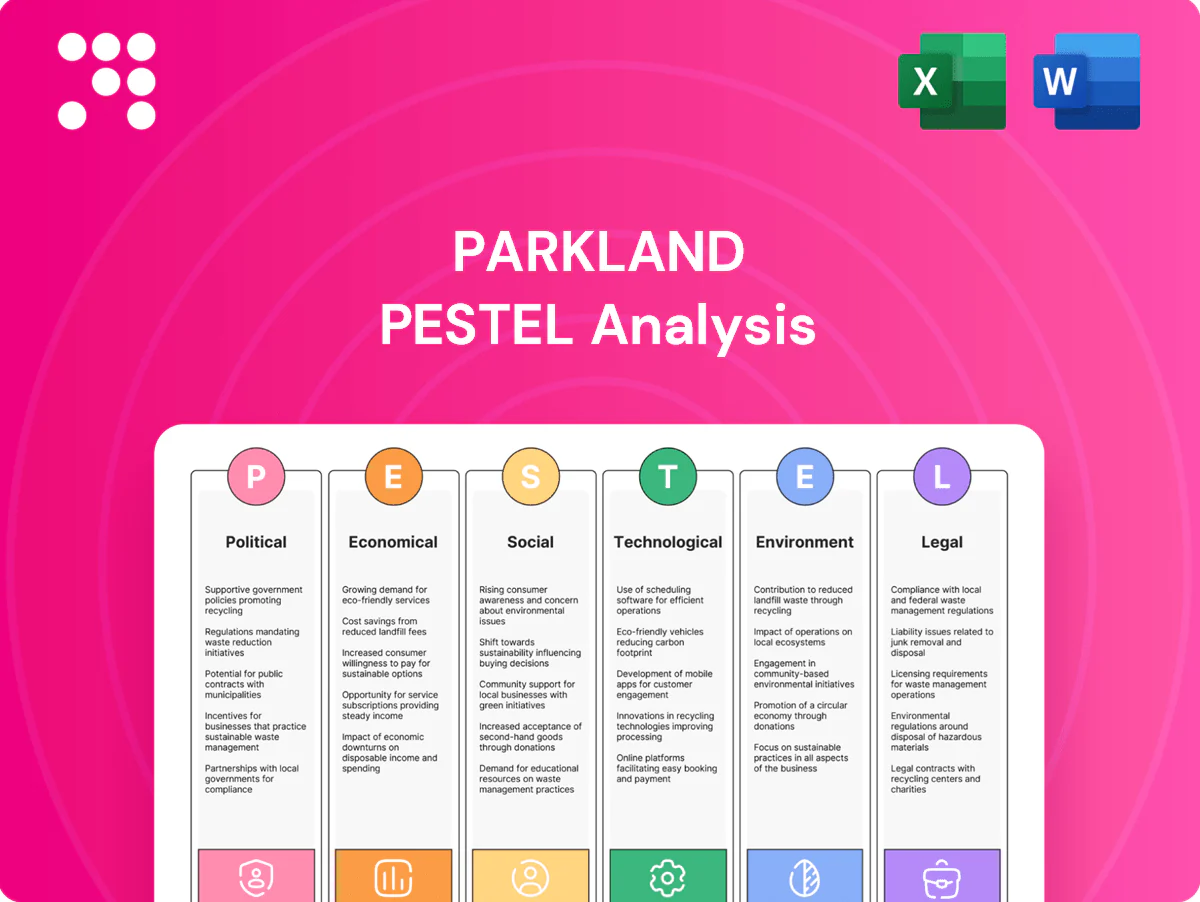
Gain strategic clarity with our Parkland PESTLE Analysis—concise, current insights into political, economic, social, technological, legal and environmental forces shaping the company. Perfect for investors and strategists, it translates external risks and opportunities into actionable recommendations. Buy the full report now for the complete, editable breakdown ready for boardrooms and pitches.
Political factors

Carbon pricing regimes
Canada’s federal carbon price (C$80/t in 2024) and provincial schemes raise delivered fuel costs and can compress margins if pass-through lags; Parkland faces similar exposure where governments apply fuel levies. The U.S. patchwork of LCFS programs (California/Oregon) saw credit prices near US$120/t in 2024, while Caribbean and South American policies vary widely. Parkland must optimize pricing and blending to meet intensity targets and use strategic sourcing and credits management to offset cost impacts.
Low-carbon incentives
Subsidies for EV charging, biofuels and renewable diesel—including US/Canada tax credits and investment grants that often reach up to 30% of eligible capex—create adjacent growth avenues for Parkland’s forecourt services. Accessing grants and tax credits can materially lower upfront costs for alternative-energy infrastructure and improve ROI. Policy support like the IRA and Canada’s clean-fuel measures can accelerate Parkland’s transition offerings, but timing and strict eligibility compliance are critical to capture value.

Trade and tariffs exposure
Cross-border fuel flows face tariff and border-rule risk; many refined petroleum products currently carry 0% US MFN tariffs, but changes to trade pacts or safeguard measures can alter route economics. The Jones Act (1920) constrains US domestic vessel use and raises coastal shipping costs versus foreign vessels. Diversified sourcing and storage capacity reduce supply disruptions, while robust customs documentation cuts clearance delays and penalty exposure.

Political stability and governance
Operations in the Caribbean and parts of South America expose Parkland to elevated political risk, including abrupt regulatory changes. Shifts in administrations can affect fuel price controls, subsidies and licensing, increasing operational uncertainty. Robust contingency planning, proactive stakeholder engagement, and insurance plus contractual protections are essential to mitigate disruption.
- Political risk: Caribbean & South America
- Regulatory levers: price controls, subsidies, licensing
- Mitigation: contingency planning & stakeholder engagement
- Protection: insurance and contractual safeguards
Municipal permitting and zoning
New stations, tanks and convenience-store remodels need local approvals; municipal commercial approval times in major Canadian cities averaged about 6–9 months in 2023, which can slow rollout and raise carrying and compliance costs. Community opposition or planning delays often push schedules and reduce IRR unless addressed early. Early engagement and strict site-selection discipline preserve Parkland return thresholds.
- Permitting delay: ~6–9 months (2023 municipal reports)
- Risk: community opposition → schedule/cost increases
- Mitigation: early engagement, local-compliance alignment
- Financial control: disciplined site selection to protect returns
Fuel squeeze: C$80/t carbon, US$120/t credits — diversify
Federal carbon pricing (C$80/t in 2024) and LCFS credits (~US$120/t in 2024) raise fuel costs and margin pressure; Parkland must manage pricing, blending and credits. EV/renewable fuel subsidies (up to 30% capex) and IRA/Canadian clean-fuel support create investment opportunities if eligibility/timing met. Cross-border tariffs, Jones Act and high political volatility in Caribbean/SA require diversified sourcing, permits and contingency planning.
| Metric | Value (year) |
|---|---|
| Carbon price | C$80/t (2024) |
| LCFS credit | ~US$120/t (2024) |
| Permitting | 6–9 months (2023) |
| Capex support | Up to 30% tax/grants |
What is included in the product
 Detailed Word Document
Explores how external macro-environmental factors uniquely affect Parkland across Political, Economic, Social, Technological, Environmental and Legal dimensions, with data-backed trends and forward-looking insights to inform executive strategy, risk mitigation and investor-ready planning.

 Customizable Excel Spreadsheet
A clean, summarized Parkland PESTLE for easy reference during meetings, visually segmented by PESTLE categories and editable for notes, making it easily shareable and drop‑in ready for presentations or strategy sessions.
Economic factors

Crude and refined price volatility
Parkland margin performance hinges on crack spreads and timing of cost pass-through; 3:2:1 crack spreads swung widely (roughly US$10–40/bbl across 2023–24), driving inventory gains/losses and elevated hedging activity. Volatility necessitates dynamic retail/pricing and disciplined risk management, which Parkland cites as stabilizers for earnings. Supply optionality and growing storage capacity (tens of millions of litres regionally) enhance resilience.
FX and multi-currency risk
CAD, USD and various Caribbean currencies create both translation and transaction exposure for Parkland, as the company operates in Canada and multiple Caribbean jurisdictions while global fuels remain priced in USD. Fuel purchases and refinery feedstock are typically settled in USD, while retail sales are denominated in local currencies, creating a cash‑flow mismatch. Hedging programs and natural operational offsets (sourcing, regional supply chains) reduce earnings volatility. Pricing clauses and short hedging tenors (commonly ≤12 months) preserve commercial flexibility.

Interest rates and consumer spend
Higher policy rates (Bank of Canada ~5.00% mid-2024; US Fed 5.25–5.50%) compress discretionary spend in convenience retail and car travel, reducing fuel and in-store impulse volumes. Financing costs for working capital, tank builds and M&A rise with benchmark rates and broader credit spreads, lifting borrowing costs for Parkland. Mix-shifting to value and private-label can protect basket size while tight inventory turns preserve cash conversion.

Tourism and mobility cycles
Cruise and seasonal travel drive Caribbean volumes; CLIA estimated ~27 million global cruise passengers in 2023 with the Caribbean a leading destination, boosting Parkland site traffic. Macroeconomic slowdowns trim miles driven—US VMT ~3.2 trillion miles in 2023—pressuring same-store fuel sales, often down mid-single digits in downturns. Diversifying into non-fuel retail and foodservice (now >30% of many site gross profits industry-wide) cushions demand dips, while localized merchandising can lift tourist ticket sizes 20-35%.
- Seasonal cruise traffic: CLIA ~27M (2023)
- US VMT: ~3.2T miles (2023) — fuels same-store sensitivity
- Non-fuel share: >30% of site gross profit (industry)
- Localized merchandising: +20-35% tourist ticket uplift
Inflation and wage pressures
Labor-intensive convenience operations face rising wage floors (Ontario minimum wage $16.55/hr since Oct 2023) while input-cost inflation stayed above the Bank of Canada 2% target through 2024–25, squeezing margins on packaged goods, prepared foods and logistics; pricing, assortment optimization and shrink control protect margins, and automation plus advanced labor-scheduling tools lift productivity.
- Wage pressure: provincial minimums (Ontario $16.55)
- Input inflation: food, packaging, logistics elevated
- Margin levers: pricing, assortment, shrink control
- Efficiency: automation & labor-scheduling tools
Fuel squeeze: C$80/t carbon, US$120/t credits — diversify
Parkland earnings remain driven by volatile crack spreads (roughly US$10–40/bbl in 2023–24), USD pricing of feedstock versus local currency sales, and elevated policy rates (BoC ~5.0% mid‑2024; Fed 5.25–5.50%) that compress discretionary fuel and convenience spend. Supply optionality, regional storage growth and hedging/short tenors (≤12 months) mitigate volatility while non‑fuel mix (>30% site gross profit) and tourism (CLIA ~27M cruise passengers 2023) support volumes.
| Metric | Value |
|---|---|
| Crack spread (2023–24) | US$10–40/bbl |
| BoC / Fed (mid‑2024) | ~5.0% / 5.25–5.50% |
| US VMT (2023) | ~3.2T miles |
| Non‑fuel share | >30% site GP |
| Cruise passengers (2023) | ~27M |
| Ontario min wage | $16.55/hr |
Full Version Awaits
Parkland PESTLE Analysis
The preview shown here is the exact document you’ll receive after purchase—fully formatted and ready to use. This Parkland PESTLE Analysis provides concise political, economic, social, technological, legal and environmental insights tailored for investors and strategists. Use it immediately after download to support valuation, risk assessment and strategic planning.

Product Information
Product Information
Shipping & Returns
Shipping & Returns
Description
Skip the Research. Get the Strategy.
Gain strategic clarity with our Parkland PESTLE Analysis—concise, current insights into political, economic, social, technological, legal and environmental forces shaping the company. Perfect for investors and strategists, it translates external risks and opportunities into actionable recommendations. Buy the full report now for the complete, editable breakdown ready for boardrooms and pitches.
Political factors
Carbon pricing regimes
Canada’s federal carbon price (C$80/t in 2024) and provincial schemes raise delivered fuel costs and can compress margins if pass-through lags; Parkland faces similar exposure where governments apply fuel levies. The U.S. patchwork of LCFS programs (California/Oregon) saw credit prices near US$120/t in 2024, while Caribbean and South American policies vary widely. Parkland must optimize pricing and blending to meet intensity targets and use strategic sourcing and credits management to offset cost impacts.
Low-carbon incentives
Subsidies for EV charging, biofuels and renewable diesel—including US/Canada tax credits and investment grants that often reach up to 30% of eligible capex—create adjacent growth avenues for Parkland’s forecourt services. Accessing grants and tax credits can materially lower upfront costs for alternative-energy infrastructure and improve ROI. Policy support like the IRA and Canada’s clean-fuel measures can accelerate Parkland’s transition offerings, but timing and strict eligibility compliance are critical to capture value.
Trade and tariffs exposure
Cross-border fuel flows face tariff and border-rule risk; many refined petroleum products currently carry 0% US MFN tariffs, but changes to trade pacts or safeguard measures can alter route economics. The Jones Act (1920) constrains US domestic vessel use and raises coastal shipping costs versus foreign vessels. Diversified sourcing and storage capacity reduce supply disruptions, while robust customs documentation cuts clearance delays and penalty exposure.
Political stability and governance
Operations in the Caribbean and parts of South America expose Parkland to elevated political risk, including abrupt regulatory changes. Shifts in administrations can affect fuel price controls, subsidies and licensing, increasing operational uncertainty. Robust contingency planning, proactive stakeholder engagement, and insurance plus contractual protections are essential to mitigate disruption.
- Political risk: Caribbean & South America
- Regulatory levers: price controls, subsidies, licensing
- Mitigation: contingency planning & stakeholder engagement
- Protection: insurance and contractual safeguards
Municipal permitting and zoning
New stations, tanks and convenience-store remodels need local approvals; municipal commercial approval times in major Canadian cities averaged about 6–9 months in 2023, which can slow rollout and raise carrying and compliance costs. Community opposition or planning delays often push schedules and reduce IRR unless addressed early. Early engagement and strict site-selection discipline preserve Parkland return thresholds.
- Permitting delay: ~6–9 months (2023 municipal reports)
- Risk: community opposition → schedule/cost increases
- Mitigation: early engagement, local-compliance alignment
- Financial control: disciplined site selection to protect returns
Fuel squeeze: C$80/t carbon, US$120/t credits — diversify
Federal carbon pricing (C$80/t in 2024) and LCFS credits (~US$120/t in 2024) raise fuel costs and margin pressure; Parkland must manage pricing, blending and credits. EV/renewable fuel subsidies (up to 30% capex) and IRA/Canadian clean-fuel support create investment opportunities if eligibility/timing met. Cross-border tariffs, Jones Act and high political volatility in Caribbean/SA require diversified sourcing, permits and contingency planning.
| Metric | Value (year) |
|---|---|
| Carbon price | C$80/t (2024) |
| LCFS credit | ~US$120/t (2024) |
| Permitting | 6–9 months (2023) |
| Capex support | Up to 30% tax/grants |
What is included in the product
Detailed Word Document
Explores how external macro-environmental factors uniquely affect Parkland across Political, Economic, Social, Technological, Environmental and Legal dimensions, with data-backed trends and forward-looking insights to inform executive strategy, risk mitigation and investor-ready planning.
Customizable Excel Spreadsheet
A clean, summarized Parkland PESTLE for easy reference during meetings, visually segmented by PESTLE categories and editable for notes, making it easily shareable and drop‑in ready for presentations or strategy sessions.
Economic factors
Crude and refined price volatility
Parkland margin performance hinges on crack spreads and timing of cost pass-through; 3:2:1 crack spreads swung widely (roughly US$10–40/bbl across 2023–24), driving inventory gains/losses and elevated hedging activity. Volatility necessitates dynamic retail/pricing and disciplined risk management, which Parkland cites as stabilizers for earnings. Supply optionality and growing storage capacity (tens of millions of litres regionally) enhance resilience.
FX and multi-currency risk
CAD, USD and various Caribbean currencies create both translation and transaction exposure for Parkland, as the company operates in Canada and multiple Caribbean jurisdictions while global fuels remain priced in USD. Fuel purchases and refinery feedstock are typically settled in USD, while retail sales are denominated in local currencies, creating a cash‑flow mismatch. Hedging programs and natural operational offsets (sourcing, regional supply chains) reduce earnings volatility. Pricing clauses and short hedging tenors (commonly ≤12 months) preserve commercial flexibility.
Interest rates and consumer spend
Higher policy rates (Bank of Canada ~5.00% mid-2024; US Fed 5.25–5.50%) compress discretionary spend in convenience retail and car travel, reducing fuel and in-store impulse volumes. Financing costs for working capital, tank builds and M&A rise with benchmark rates and broader credit spreads, lifting borrowing costs for Parkland. Mix-shifting to value and private-label can protect basket size while tight inventory turns preserve cash conversion.
Tourism and mobility cycles
Cruise and seasonal travel drive Caribbean volumes; CLIA estimated ~27 million global cruise passengers in 2023 with the Caribbean a leading destination, boosting Parkland site traffic. Macroeconomic slowdowns trim miles driven—US VMT ~3.2 trillion miles in 2023—pressuring same-store fuel sales, often down mid-single digits in downturns. Diversifying into non-fuel retail and foodservice (now >30% of many site gross profits industry-wide) cushions demand dips, while localized merchandising can lift tourist ticket sizes 20-35%.
- Seasonal cruise traffic: CLIA ~27M (2023)
- US VMT: ~3.2T miles (2023) — fuels same-store sensitivity
- Non-fuel share: >30% of site gross profit (industry)
- Localized merchandising: +20-35% tourist ticket uplift
Inflation and wage pressures
Labor-intensive convenience operations face rising wage floors (Ontario minimum wage $16.55/hr since Oct 2023) while input-cost inflation stayed above the Bank of Canada 2% target through 2024–25, squeezing margins on packaged goods, prepared foods and logistics; pricing, assortment optimization and shrink control protect margins, and automation plus advanced labor-scheduling tools lift productivity.
- Wage pressure: provincial minimums (Ontario $16.55)
- Input inflation: food, packaging, logistics elevated
- Margin levers: pricing, assortment, shrink control
- Efficiency: automation & labor-scheduling tools
Fuel squeeze: C$80/t carbon, US$120/t credits — diversify
Parkland earnings remain driven by volatile crack spreads (roughly US$10–40/bbl in 2023–24), USD pricing of feedstock versus local currency sales, and elevated policy rates (BoC ~5.0% mid‑2024; Fed 5.25–5.50%) that compress discretionary fuel and convenience spend. Supply optionality, regional storage growth and hedging/short tenors (≤12 months) mitigate volatility while non‑fuel mix (>30% site gross profit) and tourism (CLIA ~27M cruise passengers 2023) support volumes.
| Metric | Value |
|---|---|
| Crack spread (2023–24) | US$10–40/bbl |
| BoC / Fed (mid‑2024) | ~5.0% / 5.25–5.50% |
| US VMT (2023) | ~3.2T miles |
| Non‑fuel share | >30% site GP |
| Cruise passengers (2023) | ~27M |
| Ontario min wage | $16.55/hr |
Full Version Awaits
Parkland PESTLE Analysis
The preview shown here is the exact document you’ll receive after purchase—fully formatted and ready to use. This Parkland PESTLE Analysis provides concise political, economic, social, technological, legal and environmental insights tailored for investors and strategists. Use it immediately after download to support valuation, risk assessment and strategic planning.