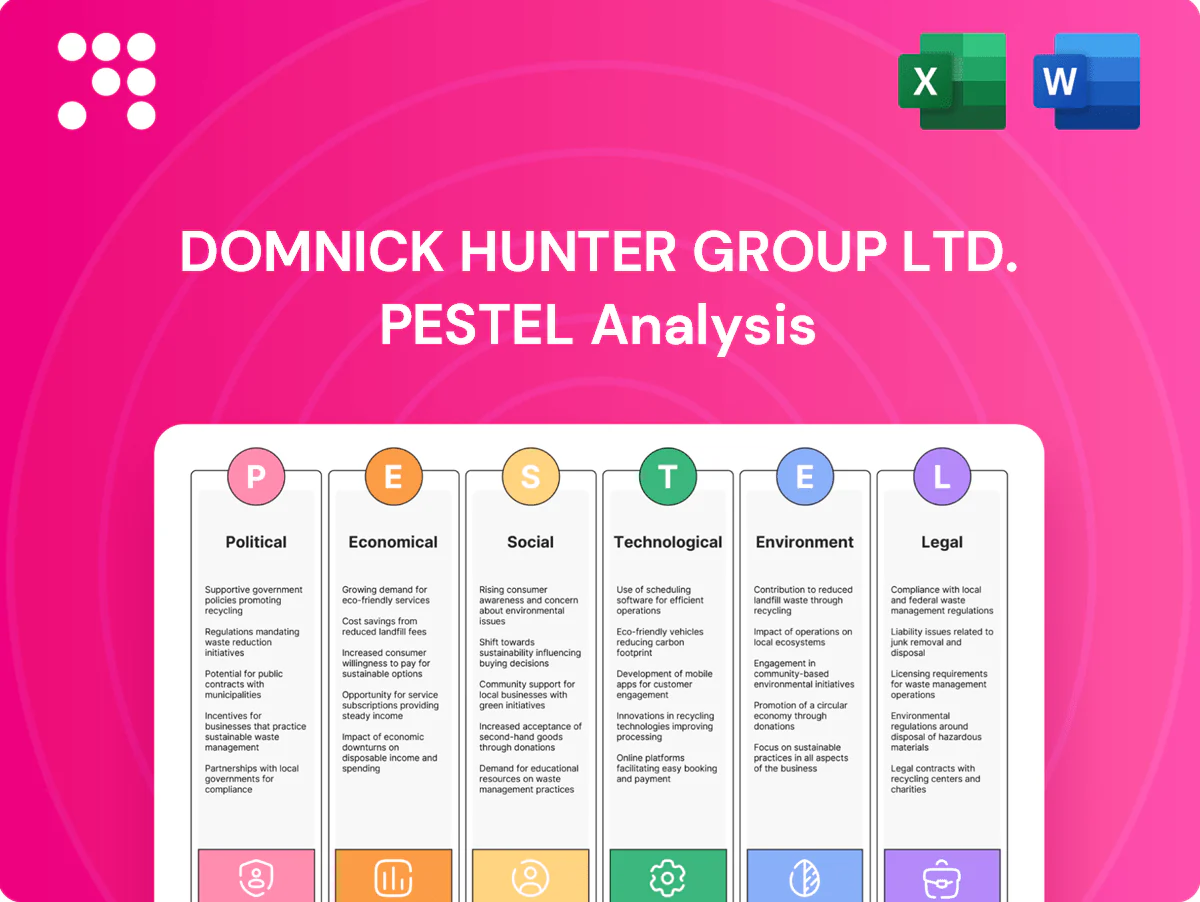
Domnick Hunter Group Ltd. PESTLE Analysis

Your Competitive Advantage Starts with This Report
Unlock strategic clarity with our PESTLE Analysis of Domnick Hunter Group Ltd.—three to five incisive sentences revealing how political, economic, social, technological, legal, and environmental forces shape its prospects. Ideal for investors and strategists, this report is ready to use and fully sourced. Purchase the full analysis now for actionable insights and boardroom-ready recommendations.
Political factors

Trade policies and tariffs
Shifts in tariffs on industrial components, membranes and stainless steel materially affect filtration system costs and pricing, with US Section 301 measures historically imposing tariffs up to 25% on some imports. Parker Domnick Hunter's global sourcing and sales into regulated markets make trade policy a direct margin lever, so monitoring US–EU–China tensions and regional content rules guides localization. Hedging and multi-source procurement strategies are used to reduce exposure.
Government infrastructure and industrial policy
US federal capital programs such as the $50B water infrastructure fund and the $52B CHIPS Act boost demand for high-purity filtration and compressed air treatment in water, pharma and energy projects. Bioprocessing and semiconductor incentives in 2024–25 accelerate orders for high-purity systems. Public-private water security programs expand retrofit markets. Sales should target funded sectors and geographies.

Healthcare and pharma policy
Regulatory funding and approval timelines drive bioprocess filtration adoption cycles, with the global single-use bioprocessing market estimated at about $6.8bn in 2023 and forecast to reach roughly $12bn by 2028 (≈10% CAGR), affecting Domnick Hunter Group Ltd sales timing. National vaccine and biologics self-sufficiency programs (post-2020 expansion in 30+ countries) boost single-use filtration demand. Reimbursement and procurement pressures (typical supplier margin squeezes of 3–8%) force pricing compression; early engagement with policymakers and standards bodies helps shape specifications and procurement criteria.

Geopolitical stability and sanctions
Sanctions and geopolitical risk constrain shipments of advanced filtration used in oil/gas and semiconductors, with over 40 active national/regional sanctions regimes as of 2024; US/EU export controls on advanced chips since 2022 directly affect component transfers. Regional conflicts have increased route disruption and logistics lead times—industry reports cite up to 15% higher supply-chain costs in energy filtration in 2023–24. Domnick Hunter should develop compliant alternatives, reroute via approved hubs, and maintain rigorous denied‑party screening and documentation to preserve supply continuity.
- Sanctions scope: 40+ regimes (2024)
- Cost impact: up to 15% rise in energy-filtration logistics (2023–24)
- Mitigation: compliant alternatives, approved-hub rerouting
- Controls: denied‑party screening, enhanced documentation
Public procurement and local content
Government tenders for water and industrial air systems increasingly mandate local content or technology transfer; World Bank estimates public procurement equals about 15% of global GDP (latest). Compliance drives partnerships, local assembly or licensing, while balancing IP protection with tender eligibility is critical. Modular product architectures enable localization without full redesign.
- Local content mandates → partnerships/licensing
- IP protection vs eligibility risk
- Modular design for scalable localization
Tariffs to 25%, 40+ sanctions and ≈15% logistics drag single‑use growth
Trade tariffs (up to 25%) and 40+ sanctions regimes (2024) directly affect margins and exportability. US federal programs ($50B water, $52B CHIPS) and a $6.8bn single‑use bioprocessing market (2023 → ~$12bn by 2028, ≈10% CAGR) drive demand. Regional content rules force local partnerships; logistics hits rose ≈15% (2023–24). Hedging, multi‑sourcing and compliant rerouting mitigate risks.
| Metric | Value |
|---|---|
| Max tariffs | 25% |
| Sanctions (2024) | 40+ |
| Water funding (US) | $50B |
| CHIPS | $52B |
| Single‑use market | $6.8B (2023) → ~$12B (2028) |
| Logistics cost rise | ≈15% |
What is included in the product
 Detailed Word Document
Explores how Political, Economic, Social, Technological, Environmental and Legal forces uniquely shape Domnick Hunter Group Ltd., with data-driven points and industry-specific examples to reveal risks and opportunities. Designed for executives and investors, it offers forward-looking insights to inform strategy, scenario planning and funding decisions.

 Customizable Excel Spreadsheet
Domnick Hunter Group Ltd. PESTLE analysis condenses regulatory, economic, social, technological, environmental and legal factors into a single, shareable summary to clarify external risks and opportunities quickly. It eases strategic planning by providing a ready-to-use, editable snapshot ideal for meetings, presentations, and cross-team alignment.
Economic factors

Industrial production cycles
Filtration demand tracks factory utilization, capex and maintenance budgets: downturns delay new systems but sustain consumables while expansions pull through both. Monitor S&P Global manufacturing PMI (global ~49.5 June 2025), UK PMI 47.2 June 2025 and US industrial capacity utilization ~77.3% May 2025. With manufacturing capex guidance broadly flat in 2025, adjust inventory and services to stabilize revenue.
Raw material and energy costs
Price swings in polymers, stainless steel and specialty media have materially raised COGS for Domnick Hunter Group, while industrial compressed air can consume up to 10% of a plant’s electricity, making energy prices a direct sales argument. Employing cost pass-through clauses and value engineering protects margins, and positioning energy-efficient filters and blowers gains traction as prices remain volatile post-2022–24.

Currency fluctuations
Global sales expose Domnick Hunter Group Ltd to FX translation and transaction risk, with a stronger dollar or euro reducing export competitiveness and compressing reported revenue. Natural hedging through local sourcing and local-currency invoicing mitigates much of this exposure. Management should use selective financial hedges tied to forecast visibility to limit residual volatility. Monitoring major cross rates remains essential.

Capital access and interest rates
Rising borrowing costs (UK Bank Rate ~5.25% mid‑2025) are deferring customer capex on treatment systems and stretching sales cycles; leasing and as‑a‑service uptake reduces upfront barriers and accelerates procurement. Parker’s internal ROI hurdles will tighten, so prioritize quick‑payback efficiency upgrades in the value proposition to retain deal flow.
- Higher rates: UK ~5.25% (mid‑2025)
- Mitigation: leasing / as‑a‑service
- Internal impact: tighter ROI thresholds
- Sales focus: quick‑payback efficiency measures
Sector mix and recession resilience
Sector mix favors pharmaceuticals, food/beverage and water utilities, which remain more defensive than electronics or general industry; the global pharmaceutical market surpassed $1.5 trillion in 2023, illustrating stable end-market demand that supports Domnick Hunter’s filtration consumables and service revenues. Consumables and service contracts generate recurring revenue buffers—industrial aftermarket often represents 20–30% of OEM revenue—so calibrating sales and inventory toward resilient end-markets in slowdowns reduces exposure. Expanding aftermarket contracts and service agreements can smooth volatility and improve margin predictability by shifting revenue from cyclical capital sales to recurring streams.
- Resilient end-markets: pharma, food/bev, water utilities
- Recurring revenue: consumables/services ~20–30% of OEM sales
- Inventory/sales: shift toward consumables in downturns
- Aftermarket: expand contracts to reduce revenue volatility
Tariffs to 25%, 40+ sanctions and ≈15% logistics drag single‑use growth
Demand follows manufacturing PMIs (Global 49.5 Jun‑2025; UK 47.2 Jun‑2025) and US capacity utilization 77.3% May‑2025, pressuring capex and favoring consumables/services. Input-cost inflation (polymers, stainless) and energy volatility make cost pass‑through and energy‑efficient offers essential. FX and higher UK Bank Rate ~5.25% mid‑2025 raise pricing and leasing importance; expand aftermarket to capture 20–30% recurring OEM revenue.
| Metric | Value |
|---|---|
| Global PMI | 49.5 (Jun‑2025) |
| UK PMI | 47.2 (Jun‑2025) |
| US capacity use | 77.3% (May‑2025) |
| UK Bank Rate | ~5.25% (mid‑2025) |
| Pharma market | >$1.5tn (2023) |
Full Version Awaits
Domnick Hunter Group Ltd. PESTLE Analysis
The Domnick Hunter Group Ltd. PESTLE Analysis shown here is the exact document you’ll receive after purchase, fully formatted and ready to use. The preview displays the complete content, structure and professional layout. No placeholders or teasers—this is the final file you’ll download immediately after payment.

Product Information
Product Information
Shipping & Returns
Shipping & Returns
Description
Your Competitive Advantage Starts with This Report
Unlock strategic clarity with our PESTLE Analysis of Domnick Hunter Group Ltd.—three to five incisive sentences revealing how political, economic, social, technological, legal, and environmental forces shape its prospects. Ideal for investors and strategists, this report is ready to use and fully sourced. Purchase the full analysis now for actionable insights and boardroom-ready recommendations.
Political factors
Trade policies and tariffs
Shifts in tariffs on industrial components, membranes and stainless steel materially affect filtration system costs and pricing, with US Section 301 measures historically imposing tariffs up to 25% on some imports. Parker Domnick Hunter's global sourcing and sales into regulated markets make trade policy a direct margin lever, so monitoring US–EU–China tensions and regional content rules guides localization. Hedging and multi-source procurement strategies are used to reduce exposure.
Government infrastructure and industrial policy
US federal capital programs such as the $50B water infrastructure fund and the $52B CHIPS Act boost demand for high-purity filtration and compressed air treatment in water, pharma and energy projects. Bioprocessing and semiconductor incentives in 2024–25 accelerate orders for high-purity systems. Public-private water security programs expand retrofit markets. Sales should target funded sectors and geographies.
Healthcare and pharma policy
Regulatory funding and approval timelines drive bioprocess filtration adoption cycles, with the global single-use bioprocessing market estimated at about $6.8bn in 2023 and forecast to reach roughly $12bn by 2028 (≈10% CAGR), affecting Domnick Hunter Group Ltd sales timing. National vaccine and biologics self-sufficiency programs (post-2020 expansion in 30+ countries) boost single-use filtration demand. Reimbursement and procurement pressures (typical supplier margin squeezes of 3–8%) force pricing compression; early engagement with policymakers and standards bodies helps shape specifications and procurement criteria.
Geopolitical stability and sanctions
Sanctions and geopolitical risk constrain shipments of advanced filtration used in oil/gas and semiconductors, with over 40 active national/regional sanctions regimes as of 2024; US/EU export controls on advanced chips since 2022 directly affect component transfers. Regional conflicts have increased route disruption and logistics lead times—industry reports cite up to 15% higher supply-chain costs in energy filtration in 2023–24. Domnick Hunter should develop compliant alternatives, reroute via approved hubs, and maintain rigorous denied‑party screening and documentation to preserve supply continuity.
- Sanctions scope: 40+ regimes (2024)
- Cost impact: up to 15% rise in energy-filtration logistics (2023–24)
- Mitigation: compliant alternatives, approved-hub rerouting
- Controls: denied‑party screening, enhanced documentation
Public procurement and local content
Government tenders for water and industrial air systems increasingly mandate local content or technology transfer; World Bank estimates public procurement equals about 15% of global GDP (latest). Compliance drives partnerships, local assembly or licensing, while balancing IP protection with tender eligibility is critical. Modular product architectures enable localization without full redesign.
- Local content mandates → partnerships/licensing
- IP protection vs eligibility risk
- Modular design for scalable localization
Tariffs to 25%, 40+ sanctions and ≈15% logistics drag single‑use growth
Trade tariffs (up to 25%) and 40+ sanctions regimes (2024) directly affect margins and exportability. US federal programs ($50B water, $52B CHIPS) and a $6.8bn single‑use bioprocessing market (2023 → ~$12bn by 2028, ≈10% CAGR) drive demand. Regional content rules force local partnerships; logistics hits rose ≈15% (2023–24). Hedging, multi‑sourcing and compliant rerouting mitigate risks.
| Metric | Value |
|---|---|
| Max tariffs | 25% |
| Sanctions (2024) | 40+ |
| Water funding (US) | $50B |
| CHIPS | $52B |
| Single‑use market | $6.8B (2023) → ~$12B (2028) |
| Logistics cost rise | ≈15% |
What is included in the product
Detailed Word Document
Explores how Political, Economic, Social, Technological, Environmental and Legal forces uniquely shape Domnick Hunter Group Ltd., with data-driven points and industry-specific examples to reveal risks and opportunities. Designed for executives and investors, it offers forward-looking insights to inform strategy, scenario planning and funding decisions.
Customizable Excel Spreadsheet
Domnick Hunter Group Ltd. PESTLE analysis condenses regulatory, economic, social, technological, environmental and legal factors into a single, shareable summary to clarify external risks and opportunities quickly. It eases strategic planning by providing a ready-to-use, editable snapshot ideal for meetings, presentations, and cross-team alignment.
Economic factors
Industrial production cycles
Filtration demand tracks factory utilization, capex and maintenance budgets: downturns delay new systems but sustain consumables while expansions pull through both. Monitor S&P Global manufacturing PMI (global ~49.5 June 2025), UK PMI 47.2 June 2025 and US industrial capacity utilization ~77.3% May 2025. With manufacturing capex guidance broadly flat in 2025, adjust inventory and services to stabilize revenue.
Raw material and energy costs
Price swings in polymers, stainless steel and specialty media have materially raised COGS for Domnick Hunter Group, while industrial compressed air can consume up to 10% of a plant’s electricity, making energy prices a direct sales argument. Employing cost pass-through clauses and value engineering protects margins, and positioning energy-efficient filters and blowers gains traction as prices remain volatile post-2022–24.
Currency fluctuations
Global sales expose Domnick Hunter Group Ltd to FX translation and transaction risk, with a stronger dollar or euro reducing export competitiveness and compressing reported revenue. Natural hedging through local sourcing and local-currency invoicing mitigates much of this exposure. Management should use selective financial hedges tied to forecast visibility to limit residual volatility. Monitoring major cross rates remains essential.
Capital access and interest rates
Rising borrowing costs (UK Bank Rate ~5.25% mid‑2025) are deferring customer capex on treatment systems and stretching sales cycles; leasing and as‑a‑service uptake reduces upfront barriers and accelerates procurement. Parker’s internal ROI hurdles will tighten, so prioritize quick‑payback efficiency upgrades in the value proposition to retain deal flow.
- Higher rates: UK ~5.25% (mid‑2025)
- Mitigation: leasing / as‑a‑service
- Internal impact: tighter ROI thresholds
- Sales focus: quick‑payback efficiency measures
Sector mix and recession resilience
Sector mix favors pharmaceuticals, food/beverage and water utilities, which remain more defensive than electronics or general industry; the global pharmaceutical market surpassed $1.5 trillion in 2023, illustrating stable end-market demand that supports Domnick Hunter’s filtration consumables and service revenues. Consumables and service contracts generate recurring revenue buffers—industrial aftermarket often represents 20–30% of OEM revenue—so calibrating sales and inventory toward resilient end-markets in slowdowns reduces exposure. Expanding aftermarket contracts and service agreements can smooth volatility and improve margin predictability by shifting revenue from cyclical capital sales to recurring streams.
- Resilient end-markets: pharma, food/bev, water utilities
- Recurring revenue: consumables/services ~20–30% of OEM sales
- Inventory/sales: shift toward consumables in downturns
- Aftermarket: expand contracts to reduce revenue volatility
Tariffs to 25%, 40+ sanctions and ≈15% logistics drag single‑use growth
Demand follows manufacturing PMIs (Global 49.5 Jun‑2025; UK 47.2 Jun‑2025) and US capacity utilization 77.3% May‑2025, pressuring capex and favoring consumables/services. Input-cost inflation (polymers, stainless) and energy volatility make cost pass‑through and energy‑efficient offers essential. FX and higher UK Bank Rate ~5.25% mid‑2025 raise pricing and leasing importance; expand aftermarket to capture 20–30% recurring OEM revenue.
| Metric | Value |
|---|---|
| Global PMI | 49.5 (Jun‑2025) |
| UK PMI | 47.2 (Jun‑2025) |
| US capacity use | 77.3% (May‑2025) |
| UK Bank Rate | ~5.25% (mid‑2025) |
| Pharma market | >$1.5tn (2023) |
Full Version Awaits
Domnick Hunter Group Ltd. PESTLE Analysis
The Domnick Hunter Group Ltd. PESTLE Analysis shown here is the exact document you’ll receive after purchase, fully formatted and ready to use. The preview displays the complete content, structure and professional layout. No placeholders or teasers—this is the final file you’ll download immediately after payment.