Aeroports de Paris SWOT Analysis

Dive Deeper Into the Company’s Strategic Blueprint
Aeroports de Paris combines a dominant Paris hub, diversified airport services and strong concession revenues, but faces cyclical traffic risk, regulatory scrutiny and decarbonization costs; growth hinges on recovery, international partnerships and sustainability investments. Purchase the full SWOT for a detailed, editable Word + Excel report to strategize and invest with confidence.
Strengths

Leading Paris hub network
Operating Charles de Gaulle, Orly and Le Bourget gives ADP unmatched scale in Paris, with c.100 million passengers in 2023 (CDG ~64 million, Orly ~27 million) and a leading share of France traffic. The multi-airport system lets ADP segment long-haul, short-haul and business aviation efficiently, boosting route density and airline partnerships. This concentration also underpins strong ancillary pricing power across retail, parking and ground handling.
Diversified non-aeronautical revenues
Retail, hospitality and on-site real estate diversify Groupe ADP income beyond aeronautical charges, capturing passenger spend and tenant rents; passenger traffic recovered to roughly 95% of 2019 levels in 2023, helping commercial take rates rebound. Higher-margin retail leases and F&B lift overall profitability, while mixed-use property development around Paris airports compounds long-term asset value and recurring rental income.

Integrated design-build-operate capabilities
Integrated design-build-operate capabilities let Aéroports de Paris plan expansions with tight phasing and cost control, leveraging end-to-end expertise to reduce rework and budget overruns. Vertical integration accelerates time-to-market for capacity projects and commercial rollouts, supporting faster revenue capture. It ensures a cohesive passenger journey across touchpoints, raising service quality and brand perception; Groupe ADP reported €4.9bn revenue in 2023.

Strong cargo and multimodal connectivity
Focus on passenger experience and efficiency
ADP’s integrated services streamline security, wayfinding and dwell-time monetization to boost throughput and reduce delays, lowering airline operating costs and improving on-time performance; Paris was the second-busiest European hub in 2019.
Enhanced passenger experience raises spend per passenger and strengthens Parisian hub attractiveness versus competing European gateways.
- Integrated services: faster security, better wayfinding
- Operational impact: improved throughput, fewer delays
- Commercial impact: higher spend per passenger
- Strategic: supports hub competitiveness in Europe
Paris hub airports drive c.100m pax and €4.9bn revenue
Operating CDG, Orly and Le Bourget gives ADP c.100m pax in 2023 (CDG ~64m, Orly ~27m), strong ancillary pricing power and hub scale. Diversified commercial and real‑estate income aided recovery to ~95% of 2019 traffic and supported €4.9bn revenue in 2023. Integrated DBO capabilities lower capex risk and speed commercial rollout.
| Metric | 2023 |
|---|---|
| Total passengers | c.100m |
| CDG | ~64m |
| Orly | ~27m |
| Revenue | €4.9bn |
What is included in the product
 Detailed Word Document
Provides a concise strategic overview of Aeroports de Paris’s internal strengths and weaknesses and the external opportunities and threats shaping its competitive position and future growth.

 Customizable Excel Spreadsheet
Provides a concise SWOT matrix tailored to Aéroports de Paris for rapid strategic alignment and stakeholder-ready summaries, easing decision-making across operations, commercial development, and regulatory planning.
Weaknesses

Geographic concentration in Île-de-France
Revenue and traffic remain heavily tied to the Paris region, with Paris airports driving the bulk of Groupe ADP’s flows; Paris traffic recovered to roughly 95% of 2019 levels by 2024, keeping the group exposed to local demand cycles.
Local shocks, strikes or French policy changes can therefore disproportionately hit results, as seen in past national strike episodes that dented monthly volumes.
Limited geographic diversification heightens systemic risk and means recovery is contingent on Île-de-France travel patterns and regional economic health.
High capital intensity and long paybacks
Runway, terminal and systems investments require large upfront outlays and paybacks over decades; Groupe ADP’s recovery is tied to passenger volumes, which by 2023 were roughly 90% of 2019 levels, making returns sensitive to traffic forecasts. Cost overruns or delays can sharply compress IRR, and funding needs leave the firm exposed to 2024–25 interest-rate cycles where ECB policy rates rose to around 4–4.5%.

Regulatory and tariff constraints
Airport charges at Groupe ADP are often subject to regulatory caps, limiting pricing flexibility and constraining aeronautical revenue growth. Compliance with EU and French safety, security and environmental regulations increases operating costs and complexity, while approvals for infrastructure projects (eg permitting and environmental reviews) can add months or years to timelines. Disputes over fee structures have periodically pressured margins as passenger traffic recovered to roughly 95% of 2019 levels in 2024.

Operational complexity and congestion risk
Managing multiple large terminals and stakeholders raises coordination challenges across Groupe ADP operations; Paris CDG has three main terminals and Orly two, within a network that served over 100 million passengers in 2019, amplifying peak-hour strain. Peak-hour congestion lowers punctuality and customer satisfaction, legacy layouts limit rapid process redesign, and local disruptions quickly ripple across the hub network affecting connections.
- Coordination: multiple terminals/stakeholders
- Capacity: >100M passengers (2019 baseline)
- Punctuality: peak-hour congestion impacts on-time performance
- Design: legacy layouts constrain redesign
- Contagion: disruptions ripple across hub
Exposure to cyclical air travel demand
Exposure to cyclical air travel demand makes Aeroports de Paris vulnerable: traffic fell from 108.6 million passengers in 2019 to roughly 96 million in 2023, driven by macro shifts, jet fuel volatility and airline capacity cuts; leisure rebounds faster than business travel, complicating revenue forecasting. New terminals risk underutilization in sharp downturns while variable commercial income magnifies cashflow swings.
- Traffic volatility: 2019 108.6m → 2023 ~96m
- Different recovery speeds: leisure vs business
- Underused capacity risk
- Commercial revenue amplifies volatility
Paris airports near 95% of 2019; capex, strikes and rates risk returns
Groupe ADP is highly concentrated on Paris demand, with Paris traffic recovering to about 95% of 2019 levels in 2024, leaving earnings tied to local cycles and strikes. Large, lumpy capex needs and long payback horizons make returns sensitive to traffic forecasts and 2024–25 ECB rates near 4–4.5%. Regulatory caps limit aeronautical pricing and environmental/permitting delays raise project risk.
| Metric | Value |
|---|---|
| 2019 passengers | 108.6m |
| 2023 passengers | ~96m |
| 2024 recovery vs 2019 | ~95% |
| ECB policy rate (2024–25) | ~4–4.5% |
What You See Is What You Get
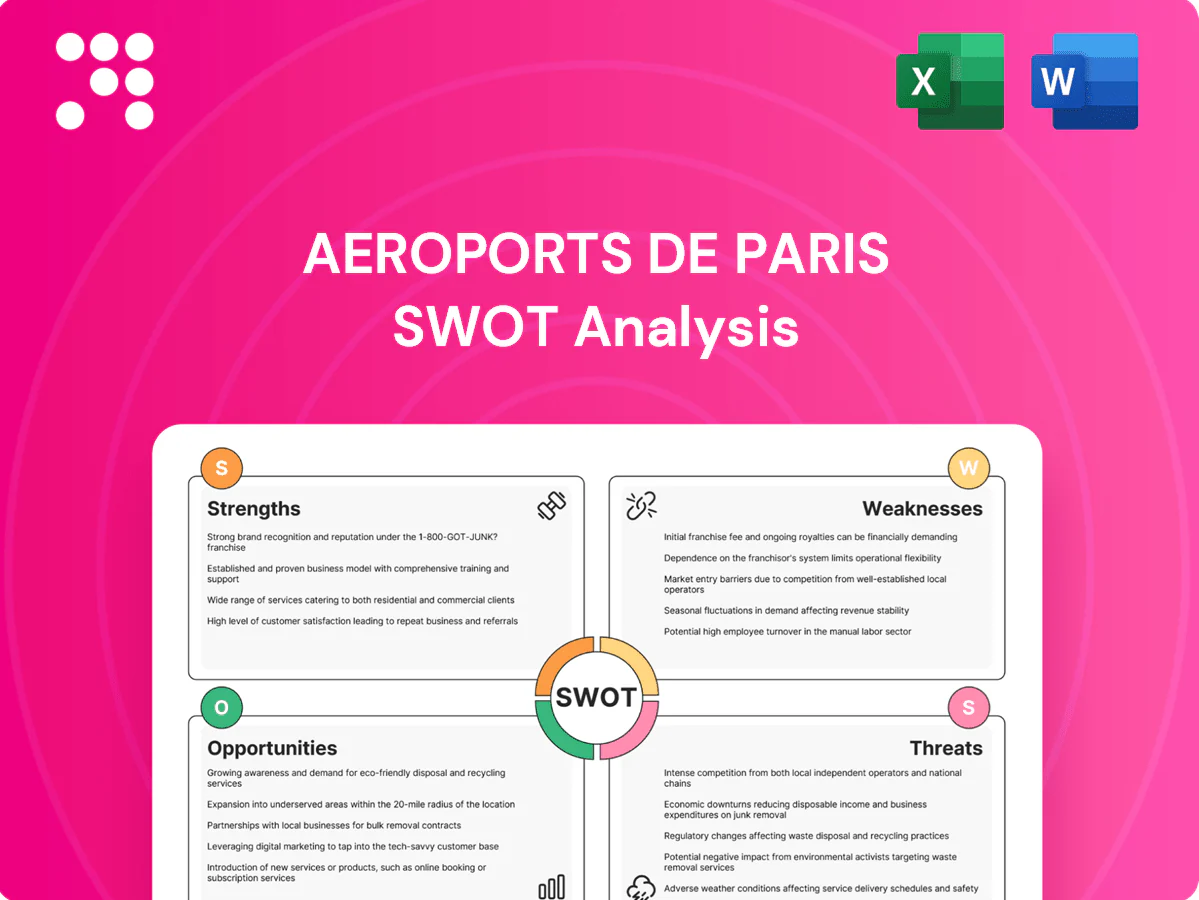
Aeroports de Paris SWOT Analysis
This is the actual SWOT analysis document for Aéroports de Paris you’ll receive upon purchase—no surprises, just professional quality. The preview below is taken directly from the full SWOT report you'll get. Buy now to unlock the complete, editable version.

Original: $10.00
-65%$10.00
$3.50Product Information
Product Information
Shipping & Returns
Shipping & Returns
Description
Dive Deeper Into the Company’s Strategic Blueprint
Aeroports de Paris combines a dominant Paris hub, diversified airport services and strong concession revenues, but faces cyclical traffic risk, regulatory scrutiny and decarbonization costs; growth hinges on recovery, international partnerships and sustainability investments. Purchase the full SWOT for a detailed, editable Word + Excel report to strategize and invest with confidence.
Strengths
Leading Paris hub network
Operating Charles de Gaulle, Orly and Le Bourget gives ADP unmatched scale in Paris, with c.100 million passengers in 2023 (CDG ~64 million, Orly ~27 million) and a leading share of France traffic. The multi-airport system lets ADP segment long-haul, short-haul and business aviation efficiently, boosting route density and airline partnerships. This concentration also underpins strong ancillary pricing power across retail, parking and ground handling.
Diversified non-aeronautical revenues
Retail, hospitality and on-site real estate diversify Groupe ADP income beyond aeronautical charges, capturing passenger spend and tenant rents; passenger traffic recovered to roughly 95% of 2019 levels in 2023, helping commercial take rates rebound. Higher-margin retail leases and F&B lift overall profitability, while mixed-use property development around Paris airports compounds long-term asset value and recurring rental income.
Integrated design-build-operate capabilities
Integrated design-build-operate capabilities let Aéroports de Paris plan expansions with tight phasing and cost control, leveraging end-to-end expertise to reduce rework and budget overruns. Vertical integration accelerates time-to-market for capacity projects and commercial rollouts, supporting faster revenue capture. It ensures a cohesive passenger journey across touchpoints, raising service quality and brand perception; Groupe ADP reported €4.9bn revenue in 2023.
Strong cargo and multimodal connectivity
Focus on passenger experience and efficiency
ADP’s integrated services streamline security, wayfinding and dwell-time monetization to boost throughput and reduce delays, lowering airline operating costs and improving on-time performance; Paris was the second-busiest European hub in 2019.
Enhanced passenger experience raises spend per passenger and strengthens Parisian hub attractiveness versus competing European gateways.
- Integrated services: faster security, better wayfinding
- Operational impact: improved throughput, fewer delays
- Commercial impact: higher spend per passenger
- Strategic: supports hub competitiveness in Europe
Paris hub airports drive c.100m pax and €4.9bn revenue
Operating CDG, Orly and Le Bourget gives ADP c.100m pax in 2023 (CDG ~64m, Orly ~27m), strong ancillary pricing power and hub scale. Diversified commercial and real‑estate income aided recovery to ~95% of 2019 traffic and supported €4.9bn revenue in 2023. Integrated DBO capabilities lower capex risk and speed commercial rollout.
| Metric | 2023 |
|---|---|
| Total passengers | c.100m |
| CDG | ~64m |
| Orly | ~27m |
| Revenue | €4.9bn |
What is included in the product
Detailed Word Document
Provides a concise strategic overview of Aeroports de Paris’s internal strengths and weaknesses and the external opportunities and threats shaping its competitive position and future growth.
Customizable Excel Spreadsheet
Provides a concise SWOT matrix tailored to Aéroports de Paris for rapid strategic alignment and stakeholder-ready summaries, easing decision-making across operations, commercial development, and regulatory planning.
Weaknesses
Geographic concentration in Île-de-France
Revenue and traffic remain heavily tied to the Paris region, with Paris airports driving the bulk of Groupe ADP’s flows; Paris traffic recovered to roughly 95% of 2019 levels by 2024, keeping the group exposed to local demand cycles.
Local shocks, strikes or French policy changes can therefore disproportionately hit results, as seen in past national strike episodes that dented monthly volumes.
Limited geographic diversification heightens systemic risk and means recovery is contingent on Île-de-France travel patterns and regional economic health.
High capital intensity and long paybacks
Runway, terminal and systems investments require large upfront outlays and paybacks over decades; Groupe ADP’s recovery is tied to passenger volumes, which by 2023 were roughly 90% of 2019 levels, making returns sensitive to traffic forecasts. Cost overruns or delays can sharply compress IRR, and funding needs leave the firm exposed to 2024–25 interest-rate cycles where ECB policy rates rose to around 4–4.5%.
Regulatory and tariff constraints
Airport charges at Groupe ADP are often subject to regulatory caps, limiting pricing flexibility and constraining aeronautical revenue growth. Compliance with EU and French safety, security and environmental regulations increases operating costs and complexity, while approvals for infrastructure projects (eg permitting and environmental reviews) can add months or years to timelines. Disputes over fee structures have periodically pressured margins as passenger traffic recovered to roughly 95% of 2019 levels in 2024.
Operational complexity and congestion risk
Managing multiple large terminals and stakeholders raises coordination challenges across Groupe ADP operations; Paris CDG has three main terminals and Orly two, within a network that served over 100 million passengers in 2019, amplifying peak-hour strain. Peak-hour congestion lowers punctuality and customer satisfaction, legacy layouts limit rapid process redesign, and local disruptions quickly ripple across the hub network affecting connections.
- Coordination: multiple terminals/stakeholders
- Capacity: >100M passengers (2019 baseline)
- Punctuality: peak-hour congestion impacts on-time performance
- Design: legacy layouts constrain redesign
- Contagion: disruptions ripple across hub
Exposure to cyclical air travel demand
Exposure to cyclical air travel demand makes Aeroports de Paris vulnerable: traffic fell from 108.6 million passengers in 2019 to roughly 96 million in 2023, driven by macro shifts, jet fuel volatility and airline capacity cuts; leisure rebounds faster than business travel, complicating revenue forecasting. New terminals risk underutilization in sharp downturns while variable commercial income magnifies cashflow swings.
- Traffic volatility: 2019 108.6m → 2023 ~96m
- Different recovery speeds: leisure vs business
- Underused capacity risk
- Commercial revenue amplifies volatility
Paris airports near 95% of 2019; capex, strikes and rates risk returns
Groupe ADP is highly concentrated on Paris demand, with Paris traffic recovering to about 95% of 2019 levels in 2024, leaving earnings tied to local cycles and strikes. Large, lumpy capex needs and long payback horizons make returns sensitive to traffic forecasts and 2024–25 ECB rates near 4–4.5%. Regulatory caps limit aeronautical pricing and environmental/permitting delays raise project risk.
| Metric | Value |
|---|---|
| 2019 passengers | 108.6m |
| 2023 passengers | ~96m |
| 2024 recovery vs 2019 | ~95% |
| ECB policy rate (2024–25) | ~4–4.5% |
What You See Is What You Get
Aeroports de Paris SWOT Analysis
This is the actual SWOT analysis document for Aéroports de Paris you’ll receive upon purchase—no surprises, just professional quality. The preview below is taken directly from the full SWOT report you'll get. Buy now to unlock the complete, editable version.