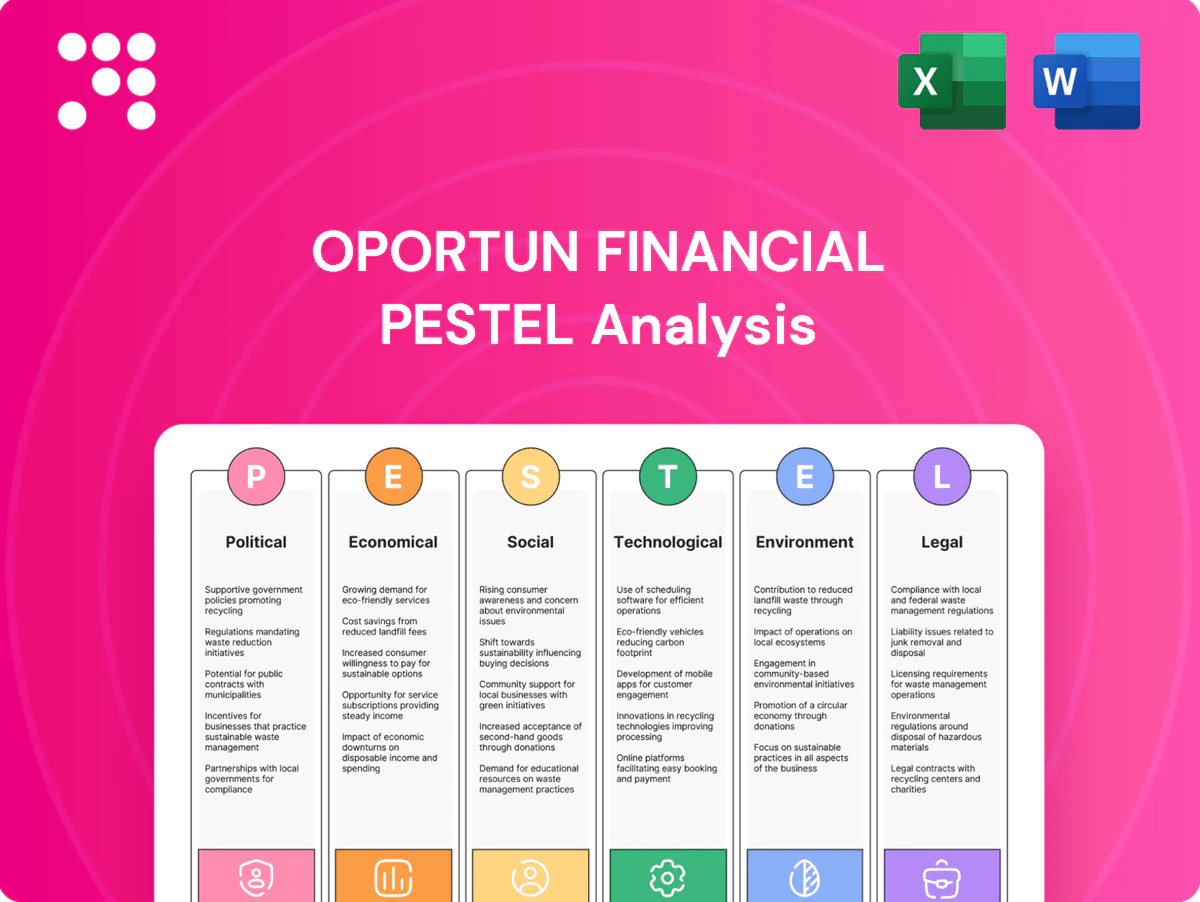
Oportun Financial PESTLE Analysis

Make Smarter Strategic Decisions with a Complete PESTEL View
Discover how political, economic, social, technological, legal, and environmental forces are reshaping Oportun Financial—our concise PESTLE highlights key risks and opportunities to inform smarter strategy and investment decisions. Purchase the full analysis for the complete, actionable breakdown and downloadable templates.
Political factors

Consumer protection agenda
Shifts in federal priorities toward stricter consumer protection—anchored by the CFPB created under Dodd-Frank and led by Rohit Chopra—can intensify oversight of pricing, underwriting and collections, raising compliance costs and constraining product design. A more activist CFPB increases supervisory risk for lenders serving underserved markets while inclusive policies could favor Oportun’s mission to reach the roughly 4.5% unbanked and ~13% underbanked U.S. adults (FDIC 2022). Monitoring election cycles, especially 2024–25, helps anticipate shifts in enforcement and funding that affect product strategy.
State-level rate caps
State legislatures may impose or tighten APR caps that affect small-dollar and near-prime lending, compounding compliance risk for lenders; the Military Lending Act already caps certain loans at 36% APR. Patchwork state rules complicate pricing and segment strategy across geographies, forcing Oportun to adjust product terms to stay compliant and preserve returns. Strategic market selection can mitigate margin compression.

Bank partnership stance
Political scrutiny of bank–fintech partnerships shapes access to bank charters and third‑party loan origination, with regulators signaling that clearer guidance could unlock broader scale while restrictive stances would constrain distribution.
Oportun’s ability to partner with banks directly affects its funding costs and customer reach, making regulatory clarity critical for lowering capital costs and expanding origination channels.
Active advocacy and transparent compliance practices reduce policy risk and help preserve access to bank sponsorships amid evolving CFPB and OCC scrutiny.

Financial inclusion incentives
Public programs that expand credit access create partnership and referral opportunities; Oportun, which has issued over 7 billion in loans since 2005, can leverage this to grow originations. Grants or government guarantees lower capital risk and can expand lending to underserved segments, improving outcomes and brand trust. Participation demands strict alignment with program requirements and reporting to realize scale and compliance.
- Partnerships: referral pipelines
- Risk: guarantees reduce charge-off exposure
- Brand: measurable impact boosts retention
- Execution: compliance and reporting mandatory
Immigration policy impact
Policy shifts affecting immigrants change Oportun’s addressable market given the US had about 44.9 million foreign-born residents in 2022 (13.5% of population), so tighter immigration rules can reduce demand and increase customer churn. Stricter documentation requirements raise KYC friction and can lower approval rates, while hostile political rhetoric erodes community trust and product uptake. Local outreach and bilingual programs have been shown to boost engagement and can partially offset participation barriers.
- Market exposure: foreign-born 44.9M (2022)
- KYC: stricter ID rules → lower approvals
- Trust: rhetoric reduces uptake
- Mitigation: local/bilingual outreach improves engagement
Enforcement surge and 2024–25 elections tighten lending; MLA 36%, market 44.9M
Activist federal regulators (CFPB under Rohit Chopra) and 2024–25 election outcomes heighten enforcement risk, raising compliance costs and constraining product design. State APR caps and patchwork rules compress margins; Military Lending Act sets 36% cap for servicemembers. Immigration policy and KYC rules affect addressable market (44.9M foreign‑born, 2022) and approval rates.
| Factor | 2024–25 Impact | Data |
|---|---|---|
| Federal enforcement | Higher compliance | CFPB active (R. Chopra) |
| State caps | Margin pressure | 36% MLA cap |
| Immigration/KYC | Market size | 44.9M foreign‑born (2022) |
What is included in the product
 Detailed Word Document
Explores how macro-environmental factors uniquely affect Oportun Financial across Political, Economic, Social, Technological, Environmental, and Legal dimensions, with data-driven trends and region-specific examples.

 Customizable Excel Spreadsheet
A concise, visually segmented PESTLE summary of Oportun Financial that’s easy to drop into presentations or share across teams, enabling quick alignment on regulatory, economic, and competitive risks and serving as a practical tool for strategy discussions or client reports.
Economic factors

Interest rate cycle
Rising rates, with the US fed funds near 5.25–5.50% in mid‑2024, elevate Oportun’s funding costs and compress net interest margins on unsecured installment loans. Higher APRs reduce borrower affordability and can depress originations, while easing cycles historically boost originations and lower charge-offs. Active hedging and disciplined pricing have been critical to protect margins and credit performance.
Employment and wage trends
Low-to-moderate-income Oportun customers are highly sensitive to job market swings; US unemployment was about 3.7% in Dec 2024 and average hourly earnings rose roughly 4.1% YoY then, supporting repayment and reducing charge-offs. Conversely, weaker labor markets historically increase delinquencies and loss provisioning. Oportun's dynamic underwriting and portfolio re-pricing help manage credit through employment cycles.

Inflation and cost of living
Rising inflation compresses disposable income—U.S. CPI averaged 3.4% y/y in 2024—heightening borrower credit stress and delinquencies. Demand for small-dollar liquidity typically rises even as default risk increases. Calibrating loan sizes, terms and pricing preserves portfolio outcomes. Scaled financial coaching reduced delinquency rates by up to 10% in comparable programs.

Credit cycle and delinquencies
Macro credit deterioration lifts expected losses and capital needs, and securitization spreads typically widen when risk sentiment turns; tightening underwriting preserves asset quality but slows originations, while Oportun’s data-driven monitoring enables faster adjustments to loss forecasts and credit boxes.
- Credit losses: higher expected loss reserves
- Securitization: wider spreads, higher funding costs
- Underwriting: tighter credit box, slower growth
- Data: faster repricing and portfolio actions
Capital markets access
Oportun funds growth primarily via warehouse lines and ABS securitizations, with roughly $1.0bn of securitization capacity active in 2024; market volatility can tighten capacity and increase funding spreads, raising cost of credit. Consistent portfolio vintage performance through 2023–2024 has supported investor appetite, while diversified funding (bank warehouses, ABS, retained capital) boosts resilience.
- Warehouse/ABS capacity: ~$1.0bn (2024)
- Performance stability: improved investor demand (2023–24)
- Diversification: warehouses, ABS, retained capital
Enforcement surge and 2024–25 elections tighten lending; MLA 36%, market 44.9M
Higher U.S. policy rates (~5.25–5.50% mid‑2024) raise funding costs and compress NIMs; elevated CPI (≈3.4% y/y 2024) and lower disposable income boost demand but increase delinquencies. Labor market strength (unemployment ≈3.7% Dec 2024; avg hourly earnings +4.1% y/y) supports repayments; securitization capacity (~$1.0bn 2024) underpins funding but widens in stress.
| Metric | Value (2024) |
|---|---|
| Fed funds | 5.25–5.50% |
| Unemployment | 3.7% |
| CPI | 3.4% y/y |
| ABS capacity | $1.0bn |
What You See Is What You Get
Oportun Financial PESTLE Analysis
The preview shown here is the exact Oportun Financial PESTLE Analysis you’ll receive after purchase — fully formatted, professionally structured, and ready to use. It contains the complete Political, Economic, Social, Technological, Legal, and Environmental assessment as presented in the sample. No placeholders or teasers — this is the final file you’ll download immediately after payment.

Original: $10.00
-65%$10.00
$3.50Product Information
Product Information
Shipping & Returns
Shipping & Returns
Description
Make Smarter Strategic Decisions with a Complete PESTEL View
Discover how political, economic, social, technological, legal, and environmental forces are reshaping Oportun Financial—our concise PESTLE highlights key risks and opportunities to inform smarter strategy and investment decisions. Purchase the full analysis for the complete, actionable breakdown and downloadable templates.
Political factors
Consumer protection agenda
Shifts in federal priorities toward stricter consumer protection—anchored by the CFPB created under Dodd-Frank and led by Rohit Chopra—can intensify oversight of pricing, underwriting and collections, raising compliance costs and constraining product design. A more activist CFPB increases supervisory risk for lenders serving underserved markets while inclusive policies could favor Oportun’s mission to reach the roughly 4.5% unbanked and ~13% underbanked U.S. adults (FDIC 2022). Monitoring election cycles, especially 2024–25, helps anticipate shifts in enforcement and funding that affect product strategy.
State-level rate caps
State legislatures may impose or tighten APR caps that affect small-dollar and near-prime lending, compounding compliance risk for lenders; the Military Lending Act already caps certain loans at 36% APR. Patchwork state rules complicate pricing and segment strategy across geographies, forcing Oportun to adjust product terms to stay compliant and preserve returns. Strategic market selection can mitigate margin compression.
Bank partnership stance
Political scrutiny of bank–fintech partnerships shapes access to bank charters and third‑party loan origination, with regulators signaling that clearer guidance could unlock broader scale while restrictive stances would constrain distribution.
Oportun’s ability to partner with banks directly affects its funding costs and customer reach, making regulatory clarity critical for lowering capital costs and expanding origination channels.
Active advocacy and transparent compliance practices reduce policy risk and help preserve access to bank sponsorships amid evolving CFPB and OCC scrutiny.
Financial inclusion incentives
Public programs that expand credit access create partnership and referral opportunities; Oportun, which has issued over 7 billion in loans since 2005, can leverage this to grow originations. Grants or government guarantees lower capital risk and can expand lending to underserved segments, improving outcomes and brand trust. Participation demands strict alignment with program requirements and reporting to realize scale and compliance.
- Partnerships: referral pipelines
- Risk: guarantees reduce charge-off exposure
- Brand: measurable impact boosts retention
- Execution: compliance and reporting mandatory
Immigration policy impact
Policy shifts affecting immigrants change Oportun’s addressable market given the US had about 44.9 million foreign-born residents in 2022 (13.5% of population), so tighter immigration rules can reduce demand and increase customer churn. Stricter documentation requirements raise KYC friction and can lower approval rates, while hostile political rhetoric erodes community trust and product uptake. Local outreach and bilingual programs have been shown to boost engagement and can partially offset participation barriers.
- Market exposure: foreign-born 44.9M (2022)
- KYC: stricter ID rules → lower approvals
- Trust: rhetoric reduces uptake
- Mitigation: local/bilingual outreach improves engagement
Enforcement surge and 2024–25 elections tighten lending; MLA 36%, market 44.9M
Activist federal regulators (CFPB under Rohit Chopra) and 2024–25 election outcomes heighten enforcement risk, raising compliance costs and constraining product design. State APR caps and patchwork rules compress margins; Military Lending Act sets 36% cap for servicemembers. Immigration policy and KYC rules affect addressable market (44.9M foreign‑born, 2022) and approval rates.
| Factor | 2024–25 Impact | Data |
|---|---|---|
| Federal enforcement | Higher compliance | CFPB active (R. Chopra) |
| State caps | Margin pressure | 36% MLA cap |
| Immigration/KYC | Market size | 44.9M foreign‑born (2022) |
What is included in the product
Detailed Word Document
Explores how macro-environmental factors uniquely affect Oportun Financial across Political, Economic, Social, Technological, Environmental, and Legal dimensions, with data-driven trends and region-specific examples.
Customizable Excel Spreadsheet
A concise, visually segmented PESTLE summary of Oportun Financial that’s easy to drop into presentations or share across teams, enabling quick alignment on regulatory, economic, and competitive risks and serving as a practical tool for strategy discussions or client reports.
Economic factors
Interest rate cycle
Rising rates, with the US fed funds near 5.25–5.50% in mid‑2024, elevate Oportun’s funding costs and compress net interest margins on unsecured installment loans. Higher APRs reduce borrower affordability and can depress originations, while easing cycles historically boost originations and lower charge-offs. Active hedging and disciplined pricing have been critical to protect margins and credit performance.
Employment and wage trends
Low-to-moderate-income Oportun customers are highly sensitive to job market swings; US unemployment was about 3.7% in Dec 2024 and average hourly earnings rose roughly 4.1% YoY then, supporting repayment and reducing charge-offs. Conversely, weaker labor markets historically increase delinquencies and loss provisioning. Oportun's dynamic underwriting and portfolio re-pricing help manage credit through employment cycles.
Inflation and cost of living
Rising inflation compresses disposable income—U.S. CPI averaged 3.4% y/y in 2024—heightening borrower credit stress and delinquencies. Demand for small-dollar liquidity typically rises even as default risk increases. Calibrating loan sizes, terms and pricing preserves portfolio outcomes. Scaled financial coaching reduced delinquency rates by up to 10% in comparable programs.
Credit cycle and delinquencies
Macro credit deterioration lifts expected losses and capital needs, and securitization spreads typically widen when risk sentiment turns; tightening underwriting preserves asset quality but slows originations, while Oportun’s data-driven monitoring enables faster adjustments to loss forecasts and credit boxes.
- Credit losses: higher expected loss reserves
- Securitization: wider spreads, higher funding costs
- Underwriting: tighter credit box, slower growth
- Data: faster repricing and portfolio actions
Capital markets access
Oportun funds growth primarily via warehouse lines and ABS securitizations, with roughly $1.0bn of securitization capacity active in 2024; market volatility can tighten capacity and increase funding spreads, raising cost of credit. Consistent portfolio vintage performance through 2023–2024 has supported investor appetite, while diversified funding (bank warehouses, ABS, retained capital) boosts resilience.
- Warehouse/ABS capacity: ~$1.0bn (2024)
- Performance stability: improved investor demand (2023–24)
- Diversification: warehouses, ABS, retained capital
Enforcement surge and 2024–25 elections tighten lending; MLA 36%, market 44.9M
Higher U.S. policy rates (~5.25–5.50% mid‑2024) raise funding costs and compress NIMs; elevated CPI (≈3.4% y/y 2024) and lower disposable income boost demand but increase delinquencies. Labor market strength (unemployment ≈3.7% Dec 2024; avg hourly earnings +4.1% y/y) supports repayments; securitization capacity (~$1.0bn 2024) underpins funding but widens in stress.
| Metric | Value (2024) |
|---|---|
| Fed funds | 5.25–5.50% |
| Unemployment | 3.7% |
| CPI | 3.4% y/y |
| ABS capacity | $1.0bn |
What You See Is What You Get
Oportun Financial PESTLE Analysis
The preview shown here is the exact Oportun Financial PESTLE Analysis you’ll receive after purchase — fully formatted, professionally structured, and ready to use. It contains the complete Political, Economic, Social, Technological, Legal, and Environmental assessment as presented in the sample. No placeholders or teasers — this is the final file you’ll download immediately after payment.