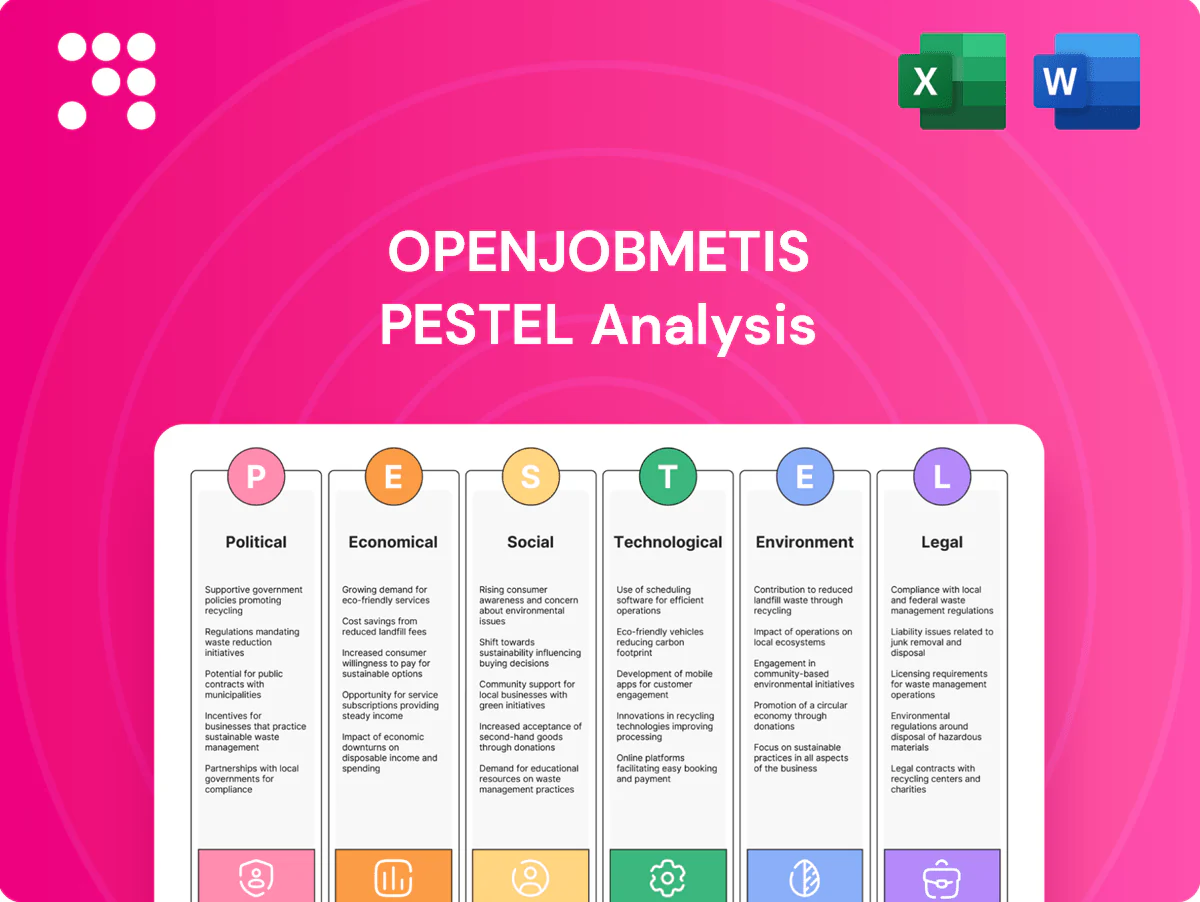
Openjobmetis PESTLE Analysis

Skip the Research. Get the Strategy.
Gain strategic clarity with our PESTLE Analysis of Openjobmetis—three to five expert-led perspectives on political, economic, social, technological, legal, and environmental forces shaping its future. Use these insights to spot risks and growth pockets for investment or strategy. Purchase the full report to download a ready-to-use, actionable breakdown now.
Political factors

Labor-market reform direction
Italian governments periodically revise rules on temporary and agency work—assignment duration, ceilings and conversion pathways—directly shaping Openjobmetis’s operating scope. Pro-flexibility moves can expand addressable market given temporary employment at around 10% of total employment (Eurostat 2024); restrictive shifts can compress volumes and margins. Continuous monitoring of decrees and implementing circulars is critical to pricing and contract design, while policy stability lowers compliance costs and operational volatility.
Public employment and active policies
State and regional active labor policies—reflected in Italy’s NextGenerationEU-funded plans (Italy allocation €191.5bn)—shape demand for Openjobmetis services; Eurostat 2024 unemployment 7.1% in Italy versus 6.1% EU-wide. Subsidies and hiring tax credits often boost agency placements, while direct public programs can crowd out intermediaries. Partnering on vocational training and re-skilling tenders opens revenue, but execution differs by region, requiring localized engagement.

EU mobility and funding
EU freedom of movement, with about 17.3 million EU citizens living in another member state (Eurostat 2023), expands candidate pools and cross-border placements for Openjobmetis. The ESF+ programme (2021–27 budget ~€99.3bn) offers consortium-based upskilling funds. Cross-border posting rules (Posted Workers Directive revision 2018; enforcement acts 2020) add administrative and payroll costs. EU directives like the Transparent and Predictable Working Conditions Directive (transposed by Aug 2022) set national timelines.

Regional policy disparities
Regional policy disparities matter: Italy’s regions set procurement rules, training grants and labor-inspection focus, with 2024 ISTAT data showing southern unemployment roughly double northern rates, driving southern emphasis on inclusion and youth employment while northern regions prioritize industrial competitiveness. Openjobmetis must align branches to local incentives and adapt to political turnover that alters tender pipelines.
- Procurement: regional rules vary
- Training: grants skewed south for inclusion
- Inspections: intensity differs by region
Immigration and work-permit policies
Quota systems and processing efficiency for non-EU workers directly affect candidate availability in shortage sectors; Italy's annual non-EU work flows have historically ranged in the tens of thousands, shaping placement pipelines.
Simplified pathways for critical skills (fast-track visas) can unlock placements quickly, while tighter controls constrain supply and raise recruitment costs.
Agencies must manage documentation and compliance workflows; public sentiment on migration influences policy cycles and enforcement intensity.
- quota impact: tens of thousands annually
- fast-track visas: unlock critical placements
- agencies: compliance/documentation burden
- public sentiment: shifts regulatory stance
Regulatory shifts reshape Italy's temp-work market, pressuring margins and boosting subsidy demand
Regulatory shifts on temporary/agency work directly change Openjobmetis’s market and margins. Temporary work ≈10% of employment; Italy unemployment 7.1% vs EU 6.1% (Eurostat 2024). NextGenerationEU Italy €191.5bn and ESF+ €99.3bn drive training/subsidy demand.
| Metric | Value | Source |
|---|---|---|
| Temporary work | ~10% | Eurostat 2024 |
| Italy unemployment | 7.1% | Eurostat 2024 |
| NextGenerationEU (Italy) | €191.5bn | EU data 2021–27 |
What is included in the product
 Detailed Word Document
Explores how macro-environmental factors uniquely affect Openjobmetis across Political, Economic, Social, Technological, Environmental and Legal dimensions, with each section backed by current data and industry-specific examples. Designed for executives and investors, it delivers forward-looking insights, ready formatting, and actionable risks and opportunities tied to regional market dynamics.

 Customizable Excel Spreadsheet
Provides a concise, visually segmented PESTLE summary of Openjobmetis that’s easily dropped into presentations or shared across teams to speed alignment and support planning discussions on external risks and market positioning.
Economic factors

GDP and employment cycle
Staffing demand closely tracks industrial and services output: IMF WEO April 2024 estimates global GDP growth at 3.0% in 2024, supporting higher hiring and outsourcing; in expansions clients outsource recruitment to scale quickly while downturns compress hours and assignments. Eurostat reports temporary contracts account for about 11.8% of EU employment, and temporary staffing typically leads recoveries but remains cyclical. Scenario-based capacity planning preserves margins by aligning headcount with demand swings.
Wage inflation and pricing
Rising negotiated wages and higher social charges—with euro‑area labour costs up about 5.8% YoY in 2024—push pass‑through bill rates and squeeze markups for Openjobmetis. Transparent pricing and dynamic rate cards (real‑time tiers, 勞 cost indexing) help defend spreads. Manufacturing wage rises (~4% in 2024) differ from healthcare (~6%), requiring granular pricing by sector. Indexation clauses cut renegotiation frictions and preserve margin stability.

Sector mix and client exposure
Demand for Openjobmetis varies across manufacturing, logistics, retail, healthcare and services, with temporary agency work representing about 2.1% of EU employment in 2023 (Eurostat), underscoring sector-dependent volatility. Overexposure to cyclical manufacturing or retail spikes revenue swings; diversification into healthcare and logistics stabilizes cash flow. High account concentration raises billing and bargaining risk, while tailored onsite and RPO solutions increase client stickiness and lifetime value.

Interest rates and working capital
Higher interest rates have increased financing costs for payroll prefinancing and receivables, pressuring margins; Euribor 3M averaged about 3.5% in 2024, lifting short-term funding costs for Italian staffing firms. Optimizing DSO, active factoring and credit insurance protects liquidity while strong cash management underpins branch expansion and digital investment. Rate cycles also materially influence M&A affordability and deal pricing.
- Higher funding costs: payroll prefinancing, receivables
- Liquidity levers: DSO reduction, factoring, credit insurance
- CapEx enabler: cash management for branches and digital
- M&A sensitivity: deal pricing tied to rate cycles
SME health and payment behavior
Italy's SME-dense economy (99.9% of firms, ~78% of employment) fuels staffing demand but brings uneven credit risk. Late commercial payments (≈61 days reported in 2023) squeeze margins on high-volume, low-margin contracts. Rigorous credit scoring, tiered terms and factoring mitigate exposure, while public-sector delays (commonly >60 days) complicate cash planning.
- SME share: 99.9% firms, ~78% employment
- Avg payment delay: ≈61 days (2023)
- Mitigants: credit scoring, tiered terms, factoring
- Public-sector delays: commonly >60 days
Regulatory shifts reshape Italy's temp-work market, pressuring margins and boosting subsidy demand
Global GDP +3.0% (IMF WEO Apr 2024) supports hiring; EU temporary staffing 2.1% (2023) and temp contracts ~11.8% guide cyclical demand. Euro‑area labour costs +5.8% YoY (2024) and sector wages (manufacturing ~4%, healthcare ~6%) squeeze spreads. Euribor 3M ~3.5% (2024) raises payroll funding costs; Italy SMEs 99.9% of firms and avg payment delay ≈61 days (2023) heighten liquidity risk.
| Metric | Value |
|---|---|
| Global GDP (2024) | +3.0% |
| EU temp staffing (2023) | 2.1% |
| Euro‑area labour costs (2024) | +5.8% |
| Euribor 3M (2024) | ~3.5% |
| Italy SMEs | 99.9% |
| Avg payment delay (IT, 2023) | ≈61 days |
Preview Before You Purchase
Openjobmetis PESTLE Analysis
The Openjobmetis PESTLE Analysis preview shown here is the exact document you’ll receive after purchase, fully formatted and ready to use. It contains the complete political, economic, social, technological, legal, and environmental assessment as displayed. No placeholders or teasers—this is the final file you’ll download immediately after payment.

Product Information
Product Information
Shipping & Returns
Shipping & Returns
Description
Skip the Research. Get the Strategy.
Gain strategic clarity with our PESTLE Analysis of Openjobmetis—three to five expert-led perspectives on political, economic, social, technological, legal, and environmental forces shaping its future. Use these insights to spot risks and growth pockets for investment or strategy. Purchase the full report to download a ready-to-use, actionable breakdown now.
Political factors
Labor-market reform direction
Italian governments periodically revise rules on temporary and agency work—assignment duration, ceilings and conversion pathways—directly shaping Openjobmetis’s operating scope. Pro-flexibility moves can expand addressable market given temporary employment at around 10% of total employment (Eurostat 2024); restrictive shifts can compress volumes and margins. Continuous monitoring of decrees and implementing circulars is critical to pricing and contract design, while policy stability lowers compliance costs and operational volatility.
Public employment and active policies
State and regional active labor policies—reflected in Italy’s NextGenerationEU-funded plans (Italy allocation €191.5bn)—shape demand for Openjobmetis services; Eurostat 2024 unemployment 7.1% in Italy versus 6.1% EU-wide. Subsidies and hiring tax credits often boost agency placements, while direct public programs can crowd out intermediaries. Partnering on vocational training and re-skilling tenders opens revenue, but execution differs by region, requiring localized engagement.
EU mobility and funding
EU freedom of movement, with about 17.3 million EU citizens living in another member state (Eurostat 2023), expands candidate pools and cross-border placements for Openjobmetis. The ESF+ programme (2021–27 budget ~€99.3bn) offers consortium-based upskilling funds. Cross-border posting rules (Posted Workers Directive revision 2018; enforcement acts 2020) add administrative and payroll costs. EU directives like the Transparent and Predictable Working Conditions Directive (transposed by Aug 2022) set national timelines.
Regional policy disparities
Regional policy disparities matter: Italy’s regions set procurement rules, training grants and labor-inspection focus, with 2024 ISTAT data showing southern unemployment roughly double northern rates, driving southern emphasis on inclusion and youth employment while northern regions prioritize industrial competitiveness. Openjobmetis must align branches to local incentives and adapt to political turnover that alters tender pipelines.
- Procurement: regional rules vary
- Training: grants skewed south for inclusion
- Inspections: intensity differs by region
Immigration and work-permit policies
Quota systems and processing efficiency for non-EU workers directly affect candidate availability in shortage sectors; Italy's annual non-EU work flows have historically ranged in the tens of thousands, shaping placement pipelines.
Simplified pathways for critical skills (fast-track visas) can unlock placements quickly, while tighter controls constrain supply and raise recruitment costs.
Agencies must manage documentation and compliance workflows; public sentiment on migration influences policy cycles and enforcement intensity.
- quota impact: tens of thousands annually
- fast-track visas: unlock critical placements
- agencies: compliance/documentation burden
- public sentiment: shifts regulatory stance
Regulatory shifts reshape Italy's temp-work market, pressuring margins and boosting subsidy demand
Regulatory shifts on temporary/agency work directly change Openjobmetis’s market and margins. Temporary work ≈10% of employment; Italy unemployment 7.1% vs EU 6.1% (Eurostat 2024). NextGenerationEU Italy €191.5bn and ESF+ €99.3bn drive training/subsidy demand.
| Metric | Value | Source |
|---|---|---|
| Temporary work | ~10% | Eurostat 2024 |
| Italy unemployment | 7.1% | Eurostat 2024 |
| NextGenerationEU (Italy) | €191.5bn | EU data 2021–27 |
What is included in the product
Detailed Word Document
Explores how macro-environmental factors uniquely affect Openjobmetis across Political, Economic, Social, Technological, Environmental and Legal dimensions, with each section backed by current data and industry-specific examples. Designed for executives and investors, it delivers forward-looking insights, ready formatting, and actionable risks and opportunities tied to regional market dynamics.
Customizable Excel Spreadsheet
Provides a concise, visually segmented PESTLE summary of Openjobmetis that’s easily dropped into presentations or shared across teams to speed alignment and support planning discussions on external risks and market positioning.
Economic factors
GDP and employment cycle
Staffing demand closely tracks industrial and services output: IMF WEO April 2024 estimates global GDP growth at 3.0% in 2024, supporting higher hiring and outsourcing; in expansions clients outsource recruitment to scale quickly while downturns compress hours and assignments. Eurostat reports temporary contracts account for about 11.8% of EU employment, and temporary staffing typically leads recoveries but remains cyclical. Scenario-based capacity planning preserves margins by aligning headcount with demand swings.
Wage inflation and pricing
Rising negotiated wages and higher social charges—with euro‑area labour costs up about 5.8% YoY in 2024—push pass‑through bill rates and squeeze markups for Openjobmetis. Transparent pricing and dynamic rate cards (real‑time tiers, 勞 cost indexing) help defend spreads. Manufacturing wage rises (~4% in 2024) differ from healthcare (~6%), requiring granular pricing by sector. Indexation clauses cut renegotiation frictions and preserve margin stability.
Sector mix and client exposure
Demand for Openjobmetis varies across manufacturing, logistics, retail, healthcare and services, with temporary agency work representing about 2.1% of EU employment in 2023 (Eurostat), underscoring sector-dependent volatility. Overexposure to cyclical manufacturing or retail spikes revenue swings; diversification into healthcare and logistics stabilizes cash flow. High account concentration raises billing and bargaining risk, while tailored onsite and RPO solutions increase client stickiness and lifetime value.
Interest rates and working capital
Higher interest rates have increased financing costs for payroll prefinancing and receivables, pressuring margins; Euribor 3M averaged about 3.5% in 2024, lifting short-term funding costs for Italian staffing firms. Optimizing DSO, active factoring and credit insurance protects liquidity while strong cash management underpins branch expansion and digital investment. Rate cycles also materially influence M&A affordability and deal pricing.
- Higher funding costs: payroll prefinancing, receivables
- Liquidity levers: DSO reduction, factoring, credit insurance
- CapEx enabler: cash management for branches and digital
- M&A sensitivity: deal pricing tied to rate cycles
SME health and payment behavior
Italy's SME-dense economy (99.9% of firms, ~78% of employment) fuels staffing demand but brings uneven credit risk. Late commercial payments (≈61 days reported in 2023) squeeze margins on high-volume, low-margin contracts. Rigorous credit scoring, tiered terms and factoring mitigate exposure, while public-sector delays (commonly >60 days) complicate cash planning.
- SME share: 99.9% firms, ~78% employment
- Avg payment delay: ≈61 days (2023)
- Mitigants: credit scoring, tiered terms, factoring
- Public-sector delays: commonly >60 days
Regulatory shifts reshape Italy's temp-work market, pressuring margins and boosting subsidy demand
Global GDP +3.0% (IMF WEO Apr 2024) supports hiring; EU temporary staffing 2.1% (2023) and temp contracts ~11.8% guide cyclical demand. Euro‑area labour costs +5.8% YoY (2024) and sector wages (manufacturing ~4%, healthcare ~6%) squeeze spreads. Euribor 3M ~3.5% (2024) raises payroll funding costs; Italy SMEs 99.9% of firms and avg payment delay ≈61 days (2023) heighten liquidity risk.
| Metric | Value |
|---|---|
| Global GDP (2024) | +3.0% |
| EU temp staffing (2023) | 2.1% |
| Euro‑area labour costs (2024) | +5.8% |
| Euribor 3M (2024) | ~3.5% |
| Italy SMEs | 99.9% |
| Avg payment delay (IT, 2023) | ≈61 days |
Preview Before You Purchase
Openjobmetis PESTLE Analysis
The Openjobmetis PESTLE Analysis preview shown here is the exact document you’ll receive after purchase, fully formatted and ready to use. It contains the complete political, economic, social, technological, legal, and environmental assessment as displayed. No placeholders or teasers—this is the final file you’ll download immediately after payment.











