ONGC PESTLE Analysis

Your Shortcut to Market Insight Starts Here
Discover how political shifts, economic cycles, and evolving environmental rules are redefining ONGC’s strategic landscape in our concise PESTLE snapshot. This analysis highlights risks and growth levers investors and strategists need now. Buy the full PESTLE to access detailed, actionable insights and ready-to-use charts for decision-making.
Political factors

State ownership and policy alignment
ONGC’s 60.41% government ownership ties its strategy to national energy security priorities, aligning projects with the Ministry of Petroleum & Natural Gas directives. Policy pushes—notably India’s target to raise gas share to about 15% by 2030—can hasten investments in domestic exploration and gasification. Mandated social obligations and subsidised supply commitments often compress returns. Board autonomy and project timelines remain subject to ministerial oversight.
Hydrocarbon licensing and fiscal regimes
Since HELP (2016) and OALP (launched 2018) replaced PSCs, revenue-sharing plus marketing freedom have shifted risk-reward for operators including ONGC. Faster, more transparent OALP bidding and streamlined clearances have unlocked previously underexplored acreage. Frequent adjustments to royalties and gas-pricing formulas create planning uncertainty. ONGC must continually recalibrate portfolios to evolving contractual terms.

Pricing controls and subsidies
Government interventions in gas and APM pricing materially affect ONGC cash flows, since administered domestic gas ceilings determine realizable revenue for upstream production and affect project sanctioning timelines. Occasional downstream support measures, such as price rebates or fiscal relief to fertilizer and power sectors, can cascade back to ONGC via intercompany transfer mechanisms and reduced offtake pricing. Predictability of gas price ceilings is crucial for sanction decisions and investment IRRs, and alignment with inflation and import parity is key to maintain project viability and attract capital.

Geopolitics and energy diplomacy
- Relations with Russia/Middle East: affect term contracts and spot sourcing
- Sanctions: complicate JV ops and financing
- Maritime security: Indian Ocean chokepoints affect offshore logistics
- Climate commitments: India NDC/net-zero 2070 shape strategy
Center–state dynamics and local content
Center–state dynamics shape ONGC project timelines through state-level approvals, land acquisition and labor policy variations that can cause delays or accelerate work; community permissions near onshore blocks remain politically sensitive and can trigger stoppages. Make in India and local content rules increase domestic participation and can raise procurement and compliance costs. Cooperative federalism practices have recently both expedited and stalled projects depending on state cooperation.
- State approvals: affect timelines
- Land acquisition & labor: cause delays
- Local content/Make in India: raises costs
- Community permissions: politically sensitive
- Cooperative federalism: can expedite or stall
60% state stake, 82% oil imports; gas to ~15% by 2030 amid planning and sanction risks
ONGC’s 60.41% government ownership aligns strategy with national energy security and Ministry directives; India imported ~82% of oil in 2023–24. Policy push to raise gas to ~15% by 2030 and India’s net-zero 2070 pledge drive gasification and low-carbon shifts. Royalties, administered gas ceilings and state approvals create planning and sanctioning risk.
| Metric | Value |
|---|---|
| Govt stake | 60.41% |
| Oil import | ~82% (2023–24) |
| Gas target 2030 | ~15% |
| Net-zero | 2070 |
What is included in the product
 Detailed Word Document
Explores how external macro-environmental factors uniquely affect ONGC across Political, Economic, Social, Technological, Environmental and Legal dimensions, backed by data-driven trends and region-specific regulatory context. Designed for executives and investors, it maps risks and opportunities, includes forward-looking insights and detailed sub-points ready for business plans and scenario planning.

 Customizable Excel Spreadsheet
A concise, visually segmented ONGC PESTLE summary that can be dropped into presentations, shared across teams, and annotated for local context—streamlining external risk discussions and speeding strategic alignment during planning sessions.
Economic factors

Oil and gas price volatility
Brent around 85 USD/bbl and Henry Hub ~3 USD/MMBtu in mid-2025 drive ONGC revenue and investment cycles, making cashflow highly cyclical. Policy limits and market liquidity restrict extensive hedging, leaving exposure to spot swings. Prolonged low prices compress upstream capex while spikes lift cash but invite windfall tax and regulatory scrutiny. A balanced gas, refining and petrochemicals mix helps smooth earnings volatility.
Currency and inflation pressures
Rupee weakness (USD/INR ~83.3 in mid-2025) raises costs of imported rigs, equipment and any external debt, while domestic inflation (CPI ~5.1% in 2024) lifts opex and wage bills for ONGC. Indexation clauses in contracts and local sourcing reduce pass-through, but FX hedging and cash management are critical for deepwater and technology-intensive projects.

India’s energy demand trajectory
Rising GDP (around 7% in 2024), rapid urbanization and industrial expansion sustain medium‑term hydrocarbon demand in India. Government gasification aims to raise natural gas share to about 15% by 2030 from roughly 6% in 2021–22, expanding domestic gas offtake. Efficiency improvements and EV uptake (passenger EV share near 4% in 2024) temper long‑run oil demand. ONGC’s downstream and power stakes diversify its end‑market exposure.

Capital intensity and financing cycle
Exploration and deepwater development need long-duration, lumpy capex, with individual projects often exceeding $1bn and multi-year payback timelines; ONGC’s quasi-sovereign profile (GOI stake c.60%) helps access lower-cost financing and supplier credit. Tight credit conditions and higher interest rates raise hurdle rates and can delay FIDs; partnership models and farm-outs are used to de-risk and share upfront capital intensity.
- Capex scale: projects often >$1bn
- Ownership: GOI stake c.60%
- Risk: tight credit delays FIDs
- Mitigation: farm-outs/partners to share capex
Petrochemicals and margin integration
Petrochemical demand in 2024 outpaced fuels, giving ONGC higher value uplift from chemicals versus fuel sales; integrated refining-petrochemical operations reduce exposure to volatile fuel crack spreads by capturing downstream margins. Flexibility in feedstocks and active by-product management (propylene, aromatics) boosts returns, though persistent global overcapacity cycles in 2024–25 keep downside margin risk.
- Value uplift: chemicals > fuels (2024)
- Integration: smooths crack spread cyclicality
- Feedstock flexibility: raises margin capture
- Risk: 2024–25 global overcapacity pressure
60% state stake, 82% oil imports; gas to ~15% by 2030 amid planning and sanction risks
Brent ~85 USD/bbl and Henry Hub ~3 USD/MMBtu (mid‑2025) make ONGC cashflow cyclical; limited hedging raises spot exposure. USD/INR ~83.3 (mid‑2025) and CPI ~5.1% (2024) lift imported capex and opex. India GDP ~7% (2024) and gas policy (target 15% share by 2030 from ~6% in 2021–22) support medium‑term demand; GOI stake c.60% eases financing.
| Metric | Value |
|---|---|
| Brent (mid‑2025) | ~85 USD/bbl |
| Henry Hub | ~3 USD/MMBtu |
| USD/INR | ~83.3 |
| CPI (2024) | 5.1% |
| GDP (2024) | ~7% |
| GOI stake | c.60% |
Preview Before You Purchase
ONGC PESTLE Analysis
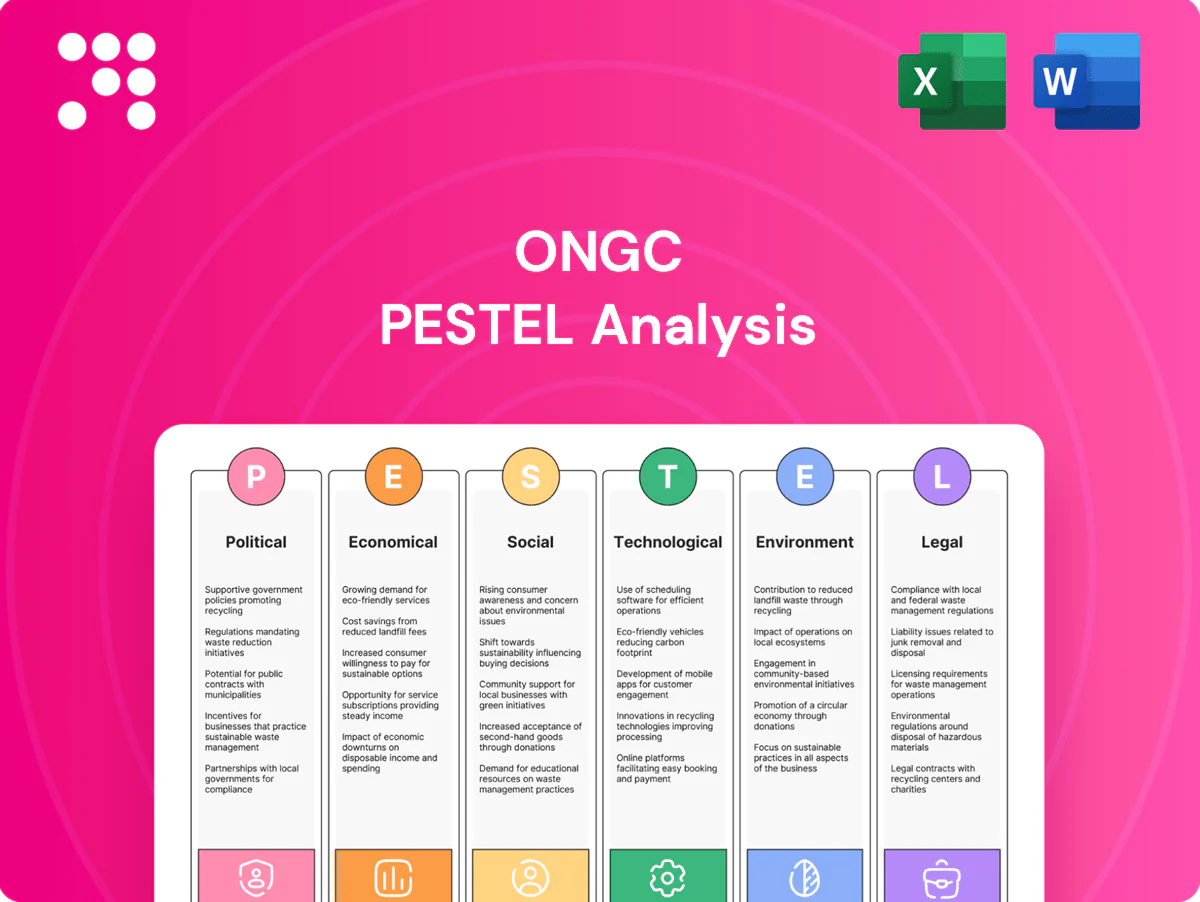
The preview shown here is the exact ONGC PESTLE Analysis document you’ll receive after purchase—fully formatted and ready to use. The layout, content, and structure visible are identical to the downloadable file; no placeholders or surprises. You’ll instantly get this final, professionally structured report upon checkout.

Product Information
Product Information
Shipping & Returns
Shipping & Returns
Description
Your Shortcut to Market Insight Starts Here
Discover how political shifts, economic cycles, and evolving environmental rules are redefining ONGC’s strategic landscape in our concise PESTLE snapshot. This analysis highlights risks and growth levers investors and strategists need now. Buy the full PESTLE to access detailed, actionable insights and ready-to-use charts for decision-making.
Political factors
State ownership and policy alignment
ONGC’s 60.41% government ownership ties its strategy to national energy security priorities, aligning projects with the Ministry of Petroleum & Natural Gas directives. Policy pushes—notably India’s target to raise gas share to about 15% by 2030—can hasten investments in domestic exploration and gasification. Mandated social obligations and subsidised supply commitments often compress returns. Board autonomy and project timelines remain subject to ministerial oversight.
Hydrocarbon licensing and fiscal regimes
Since HELP (2016) and OALP (launched 2018) replaced PSCs, revenue-sharing plus marketing freedom have shifted risk-reward for operators including ONGC. Faster, more transparent OALP bidding and streamlined clearances have unlocked previously underexplored acreage. Frequent adjustments to royalties and gas-pricing formulas create planning uncertainty. ONGC must continually recalibrate portfolios to evolving contractual terms.
Pricing controls and subsidies
Government interventions in gas and APM pricing materially affect ONGC cash flows, since administered domestic gas ceilings determine realizable revenue for upstream production and affect project sanctioning timelines. Occasional downstream support measures, such as price rebates or fiscal relief to fertilizer and power sectors, can cascade back to ONGC via intercompany transfer mechanisms and reduced offtake pricing. Predictability of gas price ceilings is crucial for sanction decisions and investment IRRs, and alignment with inflation and import parity is key to maintain project viability and attract capital.
Geopolitics and energy diplomacy
- Relations with Russia/Middle East: affect term contracts and spot sourcing
- Sanctions: complicate JV ops and financing
- Maritime security: Indian Ocean chokepoints affect offshore logistics
- Climate commitments: India NDC/net-zero 2070 shape strategy
Center–state dynamics and local content
Center–state dynamics shape ONGC project timelines through state-level approvals, land acquisition and labor policy variations that can cause delays or accelerate work; community permissions near onshore blocks remain politically sensitive and can trigger stoppages. Make in India and local content rules increase domestic participation and can raise procurement and compliance costs. Cooperative federalism practices have recently both expedited and stalled projects depending on state cooperation.
- State approvals: affect timelines
- Land acquisition & labor: cause delays
- Local content/Make in India: raises costs
- Community permissions: politically sensitive
- Cooperative federalism: can expedite or stall
60% state stake, 82% oil imports; gas to ~15% by 2030 amid planning and sanction risks
ONGC’s 60.41% government ownership aligns strategy with national energy security and Ministry directives; India imported ~82% of oil in 2023–24. Policy push to raise gas to ~15% by 2030 and India’s net-zero 2070 pledge drive gasification and low-carbon shifts. Royalties, administered gas ceilings and state approvals create planning and sanctioning risk.
| Metric | Value |
|---|---|
| Govt stake | 60.41% |
| Oil import | ~82% (2023–24) |
| Gas target 2030 | ~15% |
| Net-zero | 2070 |
What is included in the product
Detailed Word Document
Explores how external macro-environmental factors uniquely affect ONGC across Political, Economic, Social, Technological, Environmental and Legal dimensions, backed by data-driven trends and region-specific regulatory context. Designed for executives and investors, it maps risks and opportunities, includes forward-looking insights and detailed sub-points ready for business plans and scenario planning.
Customizable Excel Spreadsheet
A concise, visually segmented ONGC PESTLE summary that can be dropped into presentations, shared across teams, and annotated for local context—streamlining external risk discussions and speeding strategic alignment during planning sessions.
Economic factors
Oil and gas price volatility
Brent around 85 USD/bbl and Henry Hub ~3 USD/MMBtu in mid-2025 drive ONGC revenue and investment cycles, making cashflow highly cyclical. Policy limits and market liquidity restrict extensive hedging, leaving exposure to spot swings. Prolonged low prices compress upstream capex while spikes lift cash but invite windfall tax and regulatory scrutiny. A balanced gas, refining and petrochemicals mix helps smooth earnings volatility.
Currency and inflation pressures
Rupee weakness (USD/INR ~83.3 in mid-2025) raises costs of imported rigs, equipment and any external debt, while domestic inflation (CPI ~5.1% in 2024) lifts opex and wage bills for ONGC. Indexation clauses in contracts and local sourcing reduce pass-through, but FX hedging and cash management are critical for deepwater and technology-intensive projects.
India’s energy demand trajectory
Rising GDP (around 7% in 2024), rapid urbanization and industrial expansion sustain medium‑term hydrocarbon demand in India. Government gasification aims to raise natural gas share to about 15% by 2030 from roughly 6% in 2021–22, expanding domestic gas offtake. Efficiency improvements and EV uptake (passenger EV share near 4% in 2024) temper long‑run oil demand. ONGC’s downstream and power stakes diversify its end‑market exposure.
Capital intensity and financing cycle
Exploration and deepwater development need long-duration, lumpy capex, with individual projects often exceeding $1bn and multi-year payback timelines; ONGC’s quasi-sovereign profile (GOI stake c.60%) helps access lower-cost financing and supplier credit. Tight credit conditions and higher interest rates raise hurdle rates and can delay FIDs; partnership models and farm-outs are used to de-risk and share upfront capital intensity.
- Capex scale: projects often >$1bn
- Ownership: GOI stake c.60%
- Risk: tight credit delays FIDs
- Mitigation: farm-outs/partners to share capex
Petrochemicals and margin integration
Petrochemical demand in 2024 outpaced fuels, giving ONGC higher value uplift from chemicals versus fuel sales; integrated refining-petrochemical operations reduce exposure to volatile fuel crack spreads by capturing downstream margins. Flexibility in feedstocks and active by-product management (propylene, aromatics) boosts returns, though persistent global overcapacity cycles in 2024–25 keep downside margin risk.
- Value uplift: chemicals > fuels (2024)
- Integration: smooths crack spread cyclicality
- Feedstock flexibility: raises margin capture
- Risk: 2024–25 global overcapacity pressure
60% state stake, 82% oil imports; gas to ~15% by 2030 amid planning and sanction risks
Brent ~85 USD/bbl and Henry Hub ~3 USD/MMBtu (mid‑2025) make ONGC cashflow cyclical; limited hedging raises spot exposure. USD/INR ~83.3 (mid‑2025) and CPI ~5.1% (2024) lift imported capex and opex. India GDP ~7% (2024) and gas policy (target 15% share by 2030 from ~6% in 2021–22) support medium‑term demand; GOI stake c.60% eases financing.
| Metric | Value |
|---|---|
| Brent (mid‑2025) | ~85 USD/bbl |
| Henry Hub | ~3 USD/MMBtu |
| USD/INR | ~83.3 |
| CPI (2024) | 5.1% |
| GDP (2024) | ~7% |
| GOI stake | c.60% |
Preview Before You Purchase
ONGC PESTLE Analysis
The preview shown here is the exact ONGC PESTLE Analysis document you’ll receive after purchase—fully formatted and ready to use. The layout, content, and structure visible are identical to the downloadable file; no placeholders or surprises. You’ll instantly get this final, professionally structured report upon checkout.