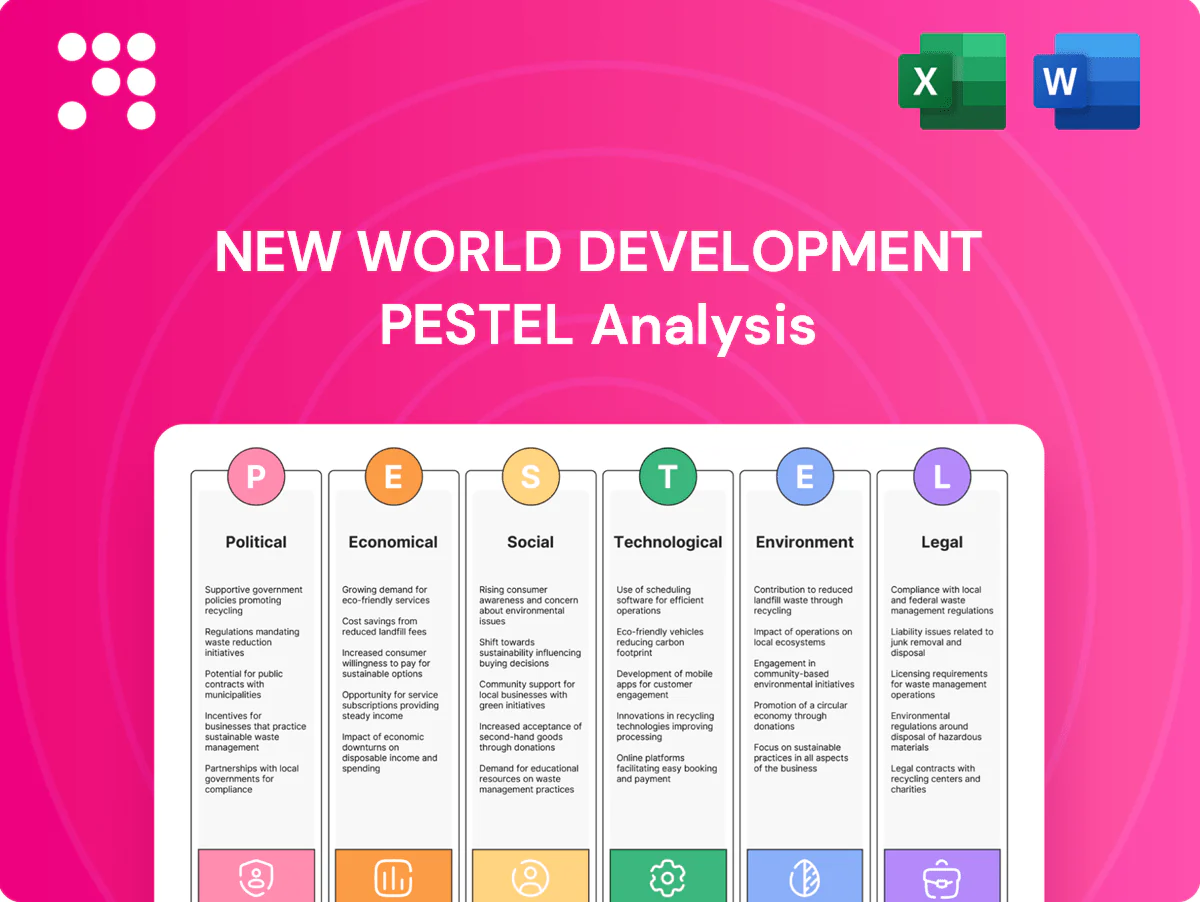
New World Development PESTLE Analysis

Make Smarter Strategic Decisions with a Complete PESTEL View
Discover how political shifts, economic cycles, social trends, technology adoption, legal reforms, and environmental pressures are reshaping New World Development’s strategy and risk profile in our concise PESTLE overview. This expert snapshot highlights actionable implications for investors and strategists—purchase the full PESTLE for the complete, editable analysis and data-driven recommendations.
Political factors

HK–Mainland policy alignment
Coordination between Hong Kong and Mainland policy shapes land supply, planning approvals and cross‑border capital flows that directly affect project timelines and financing; Greater Bay Area integration—home to about 86 million people and roughly US$1.8 trillion GDP—expands development and logistics opportunities. Divergences in standards or approval timelines create execution risk and cost overruns. Active government engagement and continuous policy monitoring are essential to de‑risk project pipelines.
Land and housing priorities
Land-use reforms and housing-affordability measures in Hong Kong—government 10-year supply target of about 430,000 flats and a public housing waiting list near 167,400 households (end-2024)—push rezoning, tighter tender rules and more public-private partnerships affecting New World Development’s project mix. Shifts toward public or transitional housing can reallocate land and subsidies, compressing commercial margins. Transparent tender participation and alignment with social goals improve access to sites and stakeholder trust.

Infrastructure spend & PPPs
Government-backed roads, ports and urban renewal drive PPP opportunities and yield long-term concessions, especially where authorities underwrite revenue or availability payments. Budget cycles and fiscal positions shape project pipelines and payment certainty, affecting deal timing and financing costs. Transparent contract structures and clear risk-sharing are critical to IRR outcomes, and strong political support expedites permitting and right-of-way acquisition.

Geopolitics & capital access
US–China tensions and sanctions regimes can raise financing costs and dent investor sentiment, affecting New World Development's supply chains; global FDI was $1.35 trillion in 2023 (UNCTAD) while currency fragmentation persists with the US dollar holding 58.5% of allocated FX reserves (IMF 2024), increasing hedging needs; diversified funding channels preserve project momentum amid tighter investment screening.
- Impact: higher risk premia, tighter project finance
- Regulation: rising investment screening across jurisdictions
- FX: USD 58.5% share → greater hedging
- Mitigation: diversified funding (equity, bonds, bank loans) sustains projects
Tourism and hospitality policy
Border controls, visa policies, and tourism promotion directly shape hotel and retail footfall, with eased entry boosting arrivals and tighter restrictions reducing demand; support for events and MICE raises occupancy and allows higher average rents. Abrupt policy shifts force dynamic pricing and rapid staffing adjustments, while strategic collaboration with tourism boards helps stabilize demand.
- Border/visa impact on footfall
- MICE drives occupancy/rents
- Policy shifts → dynamic pricing & staffing
- Tourism-board collaboration stabilizes demand
GBA expansion and HK housing targets drive PPPs as financing costs rise
Coordination HK–Mainland policy shapes land supply, approvals and cross‑border capital flows, with GBA ~86m people and ~US$1.8tn GDP expanding opportunities. HK housing targets (10‑yr ≈430,000 flats) and end‑2024 public housing queue ≈167,400 households shift tender rules and PPPs. Infrastructure PPPs depend on fiscal cycles; US–China tensions, 2023 global FDI US$1.35tn and USD 58.5% reserve share (IMF 2024), raise financing/hedging costs.
| Factor | Key Data | Impact |
|---|---|---|
| GBA scale | 86m; US$1.8tn | Market/logistics expansion |
| Housing policy | 430k target; 167,400 waitlist (end‑2024) | Rezoning; PPPs |
| Macro risk | FDI US$1.35tn (2023); USD 58.5% (IMF 2024) | Higher financing/hedging costs |
What is included in the product
 Detailed Word Document
Explores how macro-environmental factors uniquely affect New World Development across Political, Economic, Social, Technological, Environmental, and Legal dimensions, with data-backed trends and region-specific examples to identify risks and opportunities.

 Customizable Excel Spreadsheet
A compact, visually segmented PESTLE summary of New World Development that simplifies external risk assessment for fast decision-making. Easily shared or dropped into presentations, it helps teams align on market positioning and planning with editable notes for local context.
Economic factors

Property cycle sensitivity
Residential and commercial values in Hong Kong and Mainland China remain cyclical: Hong Kong prime office cap rates compressed to around 3% in 2024 while mainland tier‑1 commercial yields hovered near 4–5%, reflecting recovery after 2022–23 weakness. Sales velocity and presale cash flows hinge on buyer confidence; Hong Kong transaction volume recovered by roughly 20% year‑on‑year in 2024. Inventory management and phased launches mitigate downside risk by smoothing cash flow timing. Diversification into recurring income assets such as retail, logistics and hotels has raised NWD’s stable income share, helping smooth earnings volatility.
Interest rates & HKD peg
HK rates track US policy via the HKD peg (Convertibility band 7.75–7.85), so Fed moves transmit to HIBOR and mortgage pricing; 1M HIBOR spiked above 5% in 2023, tightening affordability and raising debt service. Higher rates compress development margins and valuations, making refinancing windows and duration management critical. Pre-sales and fixed-rate hedges can stabilize cash flows.

Mainland growth & urbanization
Mainland GDP growth slowed to roughly 5% in 2024 and ongoing property deleveraging has pushed residential investment down an estimated 6–8% YoY, dampening demand and tightening financing for developers.
Continued urbanization—national urbanization ~68% and GBA/city-tier-1 rates above 80%—sustains premium residential and logistics demand, supporting yield compression in core assets.
Targeted stimulus (select fiscal spending, targeted rate/RRR measures) has revived pockets of transactions and infrastructure work, while city-by-city allocations improve risk-adjusted returns through selective exposure.

Retail and consumer trends
Shifts to experiential retail and returning luxury tourism lift demand for flagship mall space, with global e-commerce penetration at about 22.7% of retail sales in 2024 pressuring weaker formats while boosting demand for logistics and last-mile space.
New World uses data-driven leasing and omnichannel strategies to protect NOI, deploying flexible fit-outs and turnover rents to align landlord-tenant incentives and enable faster tenant mix shifts.
- e-commerce penetration 2024: 22.7%
- luxury/experiential mix raises flagship rent premium
- logistics demand and last-mile rents rising
- data-led leasing, flexible fit-outs, turnover rents preserve NOI
FX and cost inflation
- RMB ~7.3/USD (mid-2025)
- HKD peg ~7.85/USD
- Construction wage growth ~5% (2024)
- Mitigation: early procurement, index-linked contracts, local sourcing, modular methods
GBA expansion and HK housing targets drive PPPs as financing costs rise
Recovery in 2024 tightened yields (HK prime office ~3%, mainland tier‑1 4–5%) while transaction volume rose ~20% YoY; urbanization (~68%) and experiential retail/logistics demand support core rents. HKD peg links HIBOR/Fed moves to funding (1M HIBOR >5% in 2023) and RMB ~7.3/USD (mid‑2025) raises input costs; construction wages +5% (2024).
| Metric | Value |
|---|---|
| HK prime office cap rate (2024) | ~3% |
| Mainland tier‑1 yields (2024) | 4–5% |
| Transaction vol change (HK 2024) | +20% YoY |
| RMB/USD (mid‑2025) | ~7.3 |
| E‑commerce share (2024) | 22.7% |
What You See Is What You Get
New World Development PESTLE Analysis
This PESTLE analysis for New World Development reviews political, economic, social, technological, legal and environmental forces shaping strategy and risk exposure. It highlights key drivers, quantified impacts and strategic recommendations tailored to the company’s assets and markets. The preview shown here is the exact document you’ll receive after purchase—fully formatted and ready to use.

Product Information
Product Information
Shipping & Returns
Shipping & Returns
Description
Make Smarter Strategic Decisions with a Complete PESTEL View
Discover how political shifts, economic cycles, social trends, technology adoption, legal reforms, and environmental pressures are reshaping New World Development’s strategy and risk profile in our concise PESTLE overview. This expert snapshot highlights actionable implications for investors and strategists—purchase the full PESTLE for the complete, editable analysis and data-driven recommendations.
Political factors
HK–Mainland policy alignment
Coordination between Hong Kong and Mainland policy shapes land supply, planning approvals and cross‑border capital flows that directly affect project timelines and financing; Greater Bay Area integration—home to about 86 million people and roughly US$1.8 trillion GDP—expands development and logistics opportunities. Divergences in standards or approval timelines create execution risk and cost overruns. Active government engagement and continuous policy monitoring are essential to de‑risk project pipelines.
Land and housing priorities
Land-use reforms and housing-affordability measures in Hong Kong—government 10-year supply target of about 430,000 flats and a public housing waiting list near 167,400 households (end-2024)—push rezoning, tighter tender rules and more public-private partnerships affecting New World Development’s project mix. Shifts toward public or transitional housing can reallocate land and subsidies, compressing commercial margins. Transparent tender participation and alignment with social goals improve access to sites and stakeholder trust.
Infrastructure spend & PPPs
Government-backed roads, ports and urban renewal drive PPP opportunities and yield long-term concessions, especially where authorities underwrite revenue or availability payments. Budget cycles and fiscal positions shape project pipelines and payment certainty, affecting deal timing and financing costs. Transparent contract structures and clear risk-sharing are critical to IRR outcomes, and strong political support expedites permitting and right-of-way acquisition.
Geopolitics & capital access
US–China tensions and sanctions regimes can raise financing costs and dent investor sentiment, affecting New World Development's supply chains; global FDI was $1.35 trillion in 2023 (UNCTAD) while currency fragmentation persists with the US dollar holding 58.5% of allocated FX reserves (IMF 2024), increasing hedging needs; diversified funding channels preserve project momentum amid tighter investment screening.
- Impact: higher risk premia, tighter project finance
- Regulation: rising investment screening across jurisdictions
- FX: USD 58.5% share → greater hedging
- Mitigation: diversified funding (equity, bonds, bank loans) sustains projects
Tourism and hospitality policy
Border controls, visa policies, and tourism promotion directly shape hotel and retail footfall, with eased entry boosting arrivals and tighter restrictions reducing demand; support for events and MICE raises occupancy and allows higher average rents. Abrupt policy shifts force dynamic pricing and rapid staffing adjustments, while strategic collaboration with tourism boards helps stabilize demand.
- Border/visa impact on footfall
- MICE drives occupancy/rents
- Policy shifts → dynamic pricing & staffing
- Tourism-board collaboration stabilizes demand
GBA expansion and HK housing targets drive PPPs as financing costs rise
Coordination HK–Mainland policy shapes land supply, approvals and cross‑border capital flows, with GBA ~86m people and ~US$1.8tn GDP expanding opportunities. HK housing targets (10‑yr ≈430,000 flats) and end‑2024 public housing queue ≈167,400 households shift tender rules and PPPs. Infrastructure PPPs depend on fiscal cycles; US–China tensions, 2023 global FDI US$1.35tn and USD 58.5% reserve share (IMF 2024), raise financing/hedging costs.
| Factor | Key Data | Impact |
|---|---|---|
| GBA scale | 86m; US$1.8tn | Market/logistics expansion |
| Housing policy | 430k target; 167,400 waitlist (end‑2024) | Rezoning; PPPs |
| Macro risk | FDI US$1.35tn (2023); USD 58.5% (IMF 2024) | Higher financing/hedging costs |
What is included in the product
Detailed Word Document
Explores how macro-environmental factors uniquely affect New World Development across Political, Economic, Social, Technological, Environmental, and Legal dimensions, with data-backed trends and region-specific examples to identify risks and opportunities.
Customizable Excel Spreadsheet
A compact, visually segmented PESTLE summary of New World Development that simplifies external risk assessment for fast decision-making. Easily shared or dropped into presentations, it helps teams align on market positioning and planning with editable notes for local context.
Economic factors
Property cycle sensitivity
Residential and commercial values in Hong Kong and Mainland China remain cyclical: Hong Kong prime office cap rates compressed to around 3% in 2024 while mainland tier‑1 commercial yields hovered near 4–5%, reflecting recovery after 2022–23 weakness. Sales velocity and presale cash flows hinge on buyer confidence; Hong Kong transaction volume recovered by roughly 20% year‑on‑year in 2024. Inventory management and phased launches mitigate downside risk by smoothing cash flow timing. Diversification into recurring income assets such as retail, logistics and hotels has raised NWD’s stable income share, helping smooth earnings volatility.
Interest rates & HKD peg
HK rates track US policy via the HKD peg (Convertibility band 7.75–7.85), so Fed moves transmit to HIBOR and mortgage pricing; 1M HIBOR spiked above 5% in 2023, tightening affordability and raising debt service. Higher rates compress development margins and valuations, making refinancing windows and duration management critical. Pre-sales and fixed-rate hedges can stabilize cash flows.
Mainland growth & urbanization
Mainland GDP growth slowed to roughly 5% in 2024 and ongoing property deleveraging has pushed residential investment down an estimated 6–8% YoY, dampening demand and tightening financing for developers.
Continued urbanization—national urbanization ~68% and GBA/city-tier-1 rates above 80%—sustains premium residential and logistics demand, supporting yield compression in core assets.
Targeted stimulus (select fiscal spending, targeted rate/RRR measures) has revived pockets of transactions and infrastructure work, while city-by-city allocations improve risk-adjusted returns through selective exposure.
Retail and consumer trends
Shifts to experiential retail and returning luxury tourism lift demand for flagship mall space, with global e-commerce penetration at about 22.7% of retail sales in 2024 pressuring weaker formats while boosting demand for logistics and last-mile space.
New World uses data-driven leasing and omnichannel strategies to protect NOI, deploying flexible fit-outs and turnover rents to align landlord-tenant incentives and enable faster tenant mix shifts.
- e-commerce penetration 2024: 22.7%
- luxury/experiential mix raises flagship rent premium
- logistics demand and last-mile rents rising
- data-led leasing, flexible fit-outs, turnover rents preserve NOI
FX and cost inflation
- RMB ~7.3/USD (mid-2025)
- HKD peg ~7.85/USD
- Construction wage growth ~5% (2024)
- Mitigation: early procurement, index-linked contracts, local sourcing, modular methods
GBA expansion and HK housing targets drive PPPs as financing costs rise
Recovery in 2024 tightened yields (HK prime office ~3%, mainland tier‑1 4–5%) while transaction volume rose ~20% YoY; urbanization (~68%) and experiential retail/logistics demand support core rents. HKD peg links HIBOR/Fed moves to funding (1M HIBOR >5% in 2023) and RMB ~7.3/USD (mid‑2025) raises input costs; construction wages +5% (2024).
| Metric | Value |
|---|---|
| HK prime office cap rate (2024) | ~3% |
| Mainland tier‑1 yields (2024) | 4–5% |
| Transaction vol change (HK 2024) | +20% YoY |
| RMB/USD (mid‑2025) | ~7.3 |
| E‑commerce share (2024) | 22.7% |
What You See Is What You Get
New World Development PESTLE Analysis
This PESTLE analysis for New World Development reviews political, economic, social, technological, legal and environmental forces shaping strategy and risk exposure. It highlights key drivers, quantified impacts and strategic recommendations tailored to the company’s assets and markets. The preview shown here is the exact document you’ll receive after purchase—fully formatted and ready to use.











