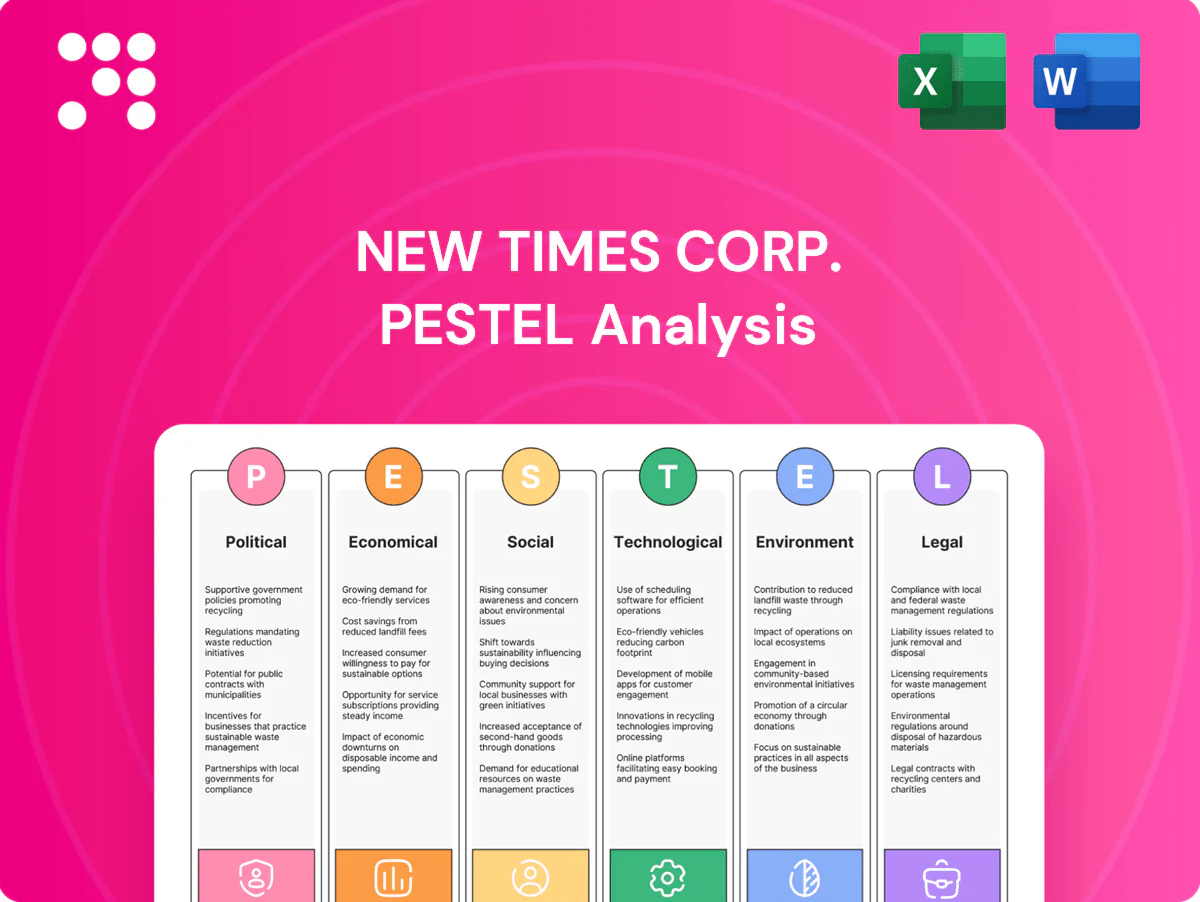
New Times Corp. PESTLE Analysis

Your Shortcut to Market Insight Starts Here
Unlock strategic clarity with our PESTLE Analysis of New Times Corp., revealing how political, economic, social, technological, legal and environmental forces shape its future. Ideal for investors and strategists, it translates trends into actionable risks and opportunities. Purchase the full report now for complete, editable intelligence you can use immediately.
Political factors

Resource nationalism risk
Host governments can tighten control over hydrocarbons via higher state participation or contract revisions, sometimes raising state stakes to majority levels (>50%), altering profit-sharing and capex mid-project. With global oil demand about 101 million barrels/day in 2024 (IEA), such moves can materially affect returns. New Times must diversify country exposure and embed stabilization clauses. Proactive government relations mitigate abrupt policy shifts.
Licensing and permit regimes
Access to acreage for New Times Corp depends on transparent, timely licensing and environmental permits; delays commonly extend project start by months and raise holding and financing costs. Strong compliance, early stakeholder mapping and community agreements cut bottlenecks and reputational risk. Bid strategy must embed fiscal terms and local-content obligations, which commonly range from 5-40% of contract value.

Geopolitical volatility
Geopolitical volatility—conflicts, sanctions and maritime disputes—can disrupt exploration and export routes, with about 12% of global trade transiting the Suez region and adjacent chokepoints. Insurance and security costs have spiked, with Red Sea/War Risk premiums reported at tens of thousands USD per transit in 2023–24. Scenario plans for evacuation, supply rerouting and force majeure are essential; hedging physical and price exposures adds measurable resilience.

Energy transition policy signals
Energy transition policy signals—carbon pricing (EU ETS ~€95/t in 2024), subsidy shifts and state-backed renewables—are reshaping upstream economics.
Governments may prioritize gas over oil or fast-track decommissioning (UK decommissioning est £44bn), altering asset valuations and project timelines.
New Times should align with gas-weighted portfolios and low-carbon options; targeted policy intelligence supports capital-timing decisions.
- Carbon price: EU ETS ~€95/t (2024)
- Subsidies/investment: global clean energy capex ≈ $1.4T (2024)
- Strategy: gas-weighted + low-carbon capex
- Tool: policy intelligence for capital timing
Relations with local communities
Local politics shape site access, protests, and benefit-sharing, with municipal leaders able to accelerate or halt New Times Corp operations through permits and local ordinances; early social investment and prioritized local hiring build tangible goodwill and reduce disruption.
- Municipal leadership: permit control
- Protests: operational risk
- Social investment: risk mitigation
- Local hiring: goodwill
- Community agreements: lower political interference
State control, permit delays and Suez risk raise premiums; diversify and lock stabilization clauses
Host-state contract shifts, license delays and local politics can swing returns; EU ETS ~€95/t (2024) and global clean-energy capex ~$1.4T (2024) reshape fiscal terms and demand. Geopolitical chokepoints (Suez ~12% trade) raise security premiums; UK decommissioning ≈£44bn alters asset timing. New Times needs country diversification, stabilization clauses and targeted policy intelligence.
| Risk | Metric | Implication |
|---|---|---|
| State control | Majority stakes possible | Lower IRR |
| Permitting | Delays months+ | Higher holding costs |
| Geopolitics | Suez ~12% trade | Security premiums |
What is included in the product
 Detailed Word Document
Examines how Political, Economic, Social, Technological, Environmental and Legal forces uniquely shape New Times Corp’s operating environment, with each dimension supported by relevant data and current trends. Designed for executives and investors, it highlights actionable risks, opportunities and forward-looking scenarios ready for reports or decks.

 Customizable Excel Spreadsheet
A clean, summarized PESTLE of New Times Corp. for easy referencing in meetings or presentations, highlighting key external risks and strategic implications to accelerate decision-making and team alignment.
Economic factors

Commodity price cyclicality
Oil/gas price swings—Brent averaged about $90/bbl in 2024—drive New Times Corp cash flow, reserves booking and project sanctioning; volatility makes disciplined breakevens (~$40–$55/bbl) and hedging (often 30–60% of production) essential. Stage-gating capex can cut discretionary spend by ~30% in downcycles, and flexible rig contracts preserve margins as rig counts shifted in 2024–H1 2025.
Capital availability and cost
Rising policy rates—US federal funds at 5.25–5.50% (July 2025)—and tighter credit have pushed upstream hurdle rates higher, increasing project financing costs. Major Western banks have tightened fossil‑fuel lending, prompting sponsors to rely on blended finance, farm‑outs and offtake prepayments to bridge funding gaps. Maintaining listing compliance preserves access to public equity needed for these structures.

Exchange rate and inflation
FX swings (DXY ~+3% in 2024) raise costs for imported equipment and dollar-linked local payrolls; US CPI averaged 3.4% in 2024 while Brent averaged about $86/bbl, and energy and steel inflation pushed drilling/completion costs materially higher. Indexation and local sourcing cut FX exposure; treasury should match currency inflows with outflows to hedge timing mismatches.

Global gas dynamics
Global LNG trade reached about 390 million tonnes in 2023 (IEA) and spot volumes exceeded 50%, raising price volatility and affecting monetization of discoveries. Spot versus long‑term contract mix changes revenue predictability and project NPV. Aligning development to liquefaction and pipeline timelines is critical; an oil–gas portfolio smooths earnings.
- 390 mtpa 2023 (IEA)
- spot >50% — higher volatility
- contract mix → cashflow stability
- infrastructure timing critical
- oil-gas balance smooths earnings
Minerals market cycles
Metal prices for targeted minerals provide diversification but increase exposure to cyclical swings; lithium carbonate fell from peaks above 70,000 USD/t in 2022 to ~20,000 USD/t in 2024, illustrating new price risk. Exploration spend should be disciplined, advancing only after meet-or-exceed discovery thresholds to control capital intensity. Offtake agreements, typically 3–10 year contracts, stabilize cash flows and de-risk financing. Shared services across oil, gas and minerals can cut operating costs by an estimated 10–20% in integrated groups.
- diversification: minerals reduce commodity correlation
- price risk: lithium ~20,000 USD/t (2024)
- exploration: follow discovery thresholds
- offtake: 3–10 year contracts stabilize cash flow
- shared services: ~10–20% OPEX reduction
State control, permit delays and Suez risk raise premiums; diversify and lock stabilization clauses
Commodity volatility (Brent ~$90/bbl 2024) and LNG spot expansion (390 mtpa 2023) drive cashflow swings; disciplined breakevens, hedging and portfolio balance are essential. Higher rates (US funds 5.25–5.50% Jul 2025) and tighter credit raise financing costs; blended finance and offtakes used. FX (DXY +3% 2024) and input inflation (lithium ~20,000 USD/t 2024) increase capex/OPEX risk.
| Metric | Value |
|---|---|
| Brent 2024 | $90/bbl |
| LNG 2023 | 390 mtpa |
| Fed funds Jul 2025 | 5.25–5.50% |
| DXY 2024 | +3% |
| Lithium 2024 | $20,000/t |
Same Document Delivered
New Times Corp. PESTLE Analysis
This New Times Corp. PESTLE Analysis summarizes the political, economic, social, technological, legal, and environmental factors shaping the company’s strategic outlook. It highlights key risks and opportunities with concise, evidence-based insights. The preview shown here is the exact document you’ll receive after purchase—fully formatted and ready to use. No placeholders, no surprises.

Product Information
Product Information
Shipping & Returns
Shipping & Returns
Description
Your Shortcut to Market Insight Starts Here
Unlock strategic clarity with our PESTLE Analysis of New Times Corp., revealing how political, economic, social, technological, legal and environmental forces shape its future. Ideal for investors and strategists, it translates trends into actionable risks and opportunities. Purchase the full report now for complete, editable intelligence you can use immediately.
Political factors
Resource nationalism risk
Host governments can tighten control over hydrocarbons via higher state participation or contract revisions, sometimes raising state stakes to majority levels (>50%), altering profit-sharing and capex mid-project. With global oil demand about 101 million barrels/day in 2024 (IEA), such moves can materially affect returns. New Times must diversify country exposure and embed stabilization clauses. Proactive government relations mitigate abrupt policy shifts.
Licensing and permit regimes
Access to acreage for New Times Corp depends on transparent, timely licensing and environmental permits; delays commonly extend project start by months and raise holding and financing costs. Strong compliance, early stakeholder mapping and community agreements cut bottlenecks and reputational risk. Bid strategy must embed fiscal terms and local-content obligations, which commonly range from 5-40% of contract value.
Geopolitical volatility
Geopolitical volatility—conflicts, sanctions and maritime disputes—can disrupt exploration and export routes, with about 12% of global trade transiting the Suez region and adjacent chokepoints. Insurance and security costs have spiked, with Red Sea/War Risk premiums reported at tens of thousands USD per transit in 2023–24. Scenario plans for evacuation, supply rerouting and force majeure are essential; hedging physical and price exposures adds measurable resilience.
Energy transition policy signals
Energy transition policy signals—carbon pricing (EU ETS ~€95/t in 2024), subsidy shifts and state-backed renewables—are reshaping upstream economics.
Governments may prioritize gas over oil or fast-track decommissioning (UK decommissioning est £44bn), altering asset valuations and project timelines.
New Times should align with gas-weighted portfolios and low-carbon options; targeted policy intelligence supports capital-timing decisions.
- Carbon price: EU ETS ~€95/t (2024)
- Subsidies/investment: global clean energy capex ≈ $1.4T (2024)
- Strategy: gas-weighted + low-carbon capex
- Tool: policy intelligence for capital timing
Relations with local communities
Local politics shape site access, protests, and benefit-sharing, with municipal leaders able to accelerate or halt New Times Corp operations through permits and local ordinances; early social investment and prioritized local hiring build tangible goodwill and reduce disruption.
- Municipal leadership: permit control
- Protests: operational risk
- Social investment: risk mitigation
- Local hiring: goodwill
- Community agreements: lower political interference
State control, permit delays and Suez risk raise premiums; diversify and lock stabilization clauses
Host-state contract shifts, license delays and local politics can swing returns; EU ETS ~€95/t (2024) and global clean-energy capex ~$1.4T (2024) reshape fiscal terms and demand. Geopolitical chokepoints (Suez ~12% trade) raise security premiums; UK decommissioning ≈£44bn alters asset timing. New Times needs country diversification, stabilization clauses and targeted policy intelligence.
| Risk | Metric | Implication |
|---|---|---|
| State control | Majority stakes possible | Lower IRR |
| Permitting | Delays months+ | Higher holding costs |
| Geopolitics | Suez ~12% trade | Security premiums |
What is included in the product
Detailed Word Document
Examines how Political, Economic, Social, Technological, Environmental and Legal forces uniquely shape New Times Corp’s operating environment, with each dimension supported by relevant data and current trends. Designed for executives and investors, it highlights actionable risks, opportunities and forward-looking scenarios ready for reports or decks.
Customizable Excel Spreadsheet
A clean, summarized PESTLE of New Times Corp. for easy referencing in meetings or presentations, highlighting key external risks and strategic implications to accelerate decision-making and team alignment.
Economic factors
Commodity price cyclicality
Oil/gas price swings—Brent averaged about $90/bbl in 2024—drive New Times Corp cash flow, reserves booking and project sanctioning; volatility makes disciplined breakevens (~$40–$55/bbl) and hedging (often 30–60% of production) essential. Stage-gating capex can cut discretionary spend by ~30% in downcycles, and flexible rig contracts preserve margins as rig counts shifted in 2024–H1 2025.
Capital availability and cost
Rising policy rates—US federal funds at 5.25–5.50% (July 2025)—and tighter credit have pushed upstream hurdle rates higher, increasing project financing costs. Major Western banks have tightened fossil‑fuel lending, prompting sponsors to rely on blended finance, farm‑outs and offtake prepayments to bridge funding gaps. Maintaining listing compliance preserves access to public equity needed for these structures.
Exchange rate and inflation
FX swings (DXY ~+3% in 2024) raise costs for imported equipment and dollar-linked local payrolls; US CPI averaged 3.4% in 2024 while Brent averaged about $86/bbl, and energy and steel inflation pushed drilling/completion costs materially higher. Indexation and local sourcing cut FX exposure; treasury should match currency inflows with outflows to hedge timing mismatches.
Global gas dynamics
Global LNG trade reached about 390 million tonnes in 2023 (IEA) and spot volumes exceeded 50%, raising price volatility and affecting monetization of discoveries. Spot versus long‑term contract mix changes revenue predictability and project NPV. Aligning development to liquefaction and pipeline timelines is critical; an oil–gas portfolio smooths earnings.
- 390 mtpa 2023 (IEA)
- spot >50% — higher volatility
- contract mix → cashflow stability
- infrastructure timing critical
- oil-gas balance smooths earnings
Minerals market cycles
Metal prices for targeted minerals provide diversification but increase exposure to cyclical swings; lithium carbonate fell from peaks above 70,000 USD/t in 2022 to ~20,000 USD/t in 2024, illustrating new price risk. Exploration spend should be disciplined, advancing only after meet-or-exceed discovery thresholds to control capital intensity. Offtake agreements, typically 3–10 year contracts, stabilize cash flows and de-risk financing. Shared services across oil, gas and minerals can cut operating costs by an estimated 10–20% in integrated groups.
- diversification: minerals reduce commodity correlation
- price risk: lithium ~20,000 USD/t (2024)
- exploration: follow discovery thresholds
- offtake: 3–10 year contracts stabilize cash flow
- shared services: ~10–20% OPEX reduction
State control, permit delays and Suez risk raise premiums; diversify and lock stabilization clauses
Commodity volatility (Brent ~$90/bbl 2024) and LNG spot expansion (390 mtpa 2023) drive cashflow swings; disciplined breakevens, hedging and portfolio balance are essential. Higher rates (US funds 5.25–5.50% Jul 2025) and tighter credit raise financing costs; blended finance and offtakes used. FX (DXY +3% 2024) and input inflation (lithium ~20,000 USD/t 2024) increase capex/OPEX risk.
| Metric | Value |
|---|---|
| Brent 2024 | $90/bbl |
| LNG 2023 | 390 mtpa |
| Fed funds Jul 2025 | 5.25–5.50% |
| DXY 2024 | +3% |
| Lithium 2024 | $20,000/t |
Same Document Delivered
New Times Corp. PESTLE Analysis
This New Times Corp. PESTLE Analysis summarizes the political, economic, social, technological, legal, and environmental factors shaping the company’s strategic outlook. It highlights key risks and opportunities with concise, evidence-based insights. The preview shown here is the exact document you’ll receive after purchase—fully formatted and ready to use. No placeholders, no surprises.











