NRW Holdings PESTLE Analysis

Skip the Research. Get the Strategy.
Discover how political shifts, economic cycles, and technological trends are shaping NRW Holdings’ prospects in our concise PESTLE snapshot. This targeted analysis highlights key risks and opportunities to sharpen your strategy. Purchase the full PESTLE for a detailed, actionable briefing you can use immediately.
Political factors

Infrastructure spend
Australian federal and state budgets directly set the civil and transport project pipelines NRW bids on, with shifts between stimulus and austerity materially altering backlog and margins. Priority programs such as Inland Rail (estimated cost A$14.5 billion) and major roads packages can accelerate awards and boost short-term tendering. Election outcomes routinely change the timing and geographic mix of funded projects, affecting cashflow predictability.
Mining policy
State royalties—WA iron ore 7.5% and Queensland coal ~7%—plus exploration incentives and 12–24 month mine approval timelines materially shape clients’ capex and contract timing; stricter conditions can delay mining awards while supportive regimes bring work forward. Policy stability in WA and QLD is pivotal, and shifts in federal/state critical minerals strategies are opening diversified contract opportunities.

Indigenous engagement
Government requirements for Indigenous participation, including the Australian Government Indigenous Procurement Policy and state targets such as Western Australia’s 3% Aboriginal procurement goal, shape NRW’s subcontracting and workforce models. Strong partnerships with Indigenous businesses can boost NRW’s competitiveness on public and resources contracts and support its FY24 revenue of about AUD1.3bn. Evolving procurement policy raises compliance complexity, while demonstrated employment and supply‑chain outcomes strengthen social licence and access to project pipelines.

IR and workforce policy
Commonwealth industrial relations reforms (Secure Jobs, Better Pay Act 2022) tighten bargaining, rostering and can elevate site labour costs. The migration planning level was 195,000 in 2023–24, influencing skilled labour availability for remote projects. FIFO community policies affect camp approvals and project design, while government VET subsidies help relieve skills bottlenecks.
- IR reforms: bargaining/rostering impact
- Migration: 195,000 planning level 2023–24
- FIFO policy: camp approvals/design
- Training subsidies: ease skills shortages
Trade and geopolitics
- China ~60% of AU iron ore exports (2023)
- Sanctions/tariffs shift commodity flows and investment timing
- Defence/Northern Australia programs enlarge civil‑works addressable market
- Tender bids now factor geopolitical risk premia
Federal budget shifts & election timing boost NRW tenders; Inland Rail A$14.5bn
Federal/state budget shifts (Inland Rail A$14.5bn) and election timing drive NRW tender pipelines; FY24 revenue ~AUD1.3bn. WA iron ore royalty 7.5% and QLD coal ~7% plus China ~60% of AU ore exports (2023) shape mining capex. IR reforms (Secure Jobs) and migration planning 195,000 (2023–24) affect labour costs and FIFO supply.
| Factor | Metric |
|---|---|
| FY24 revenue | AUD1.3bn |
| Inland Rail | A$14.5bn |
| Migration planning | 195,000 (23–24) |
What is included in the product
 Detailed Word Document
Explores how macro-environmental factors uniquely affect NRW Holdings across Political, Economic, Social, Technological, Environmental and Legal dimensions, with each section backed by current data and regional industry trends. Designed for executives and investors, it highlights immediate risks and forward-looking opportunities to inform strategy, funding and scenario planning.

 Customizable Excel Spreadsheet
A concise, visually segmented PESTLE summary for NRW Holdings that can be dropped into presentations, edited with notes for local context, and shared across teams to streamline discussions on external risks, regulatory impacts and market positioning.
Economic factors

Commodity cycle
Iron ore (≈US$110/t avg 2024), lithium carbonate ≈US$18,000/t, copper ≈US$9,300/t and gold ≈US$2,100/oz drive client mine starts and expansions; high prices expand tender volumes and improve NRW’s pricing power while downturns compress margins. NRW’s project and commodity diversification smooths but does not eliminate cyclicality. IEA projects critical‑mineral demand could rise about sixfold by 2040, supporting long‑term tailwinds for NRW.
Inflation and costs
Input costs for fuel (Brent ~USD85/bbl 2024 average), explosives, steel (HRC ~USD700/t 2024) and concrete materially pressure contract profitability for NRW Holdings.
Fixed-price civil contracts face margin squeeze where escalation clauses are absent; industry margins tightened in 2024 amid rising input prices.
Wage inflation in skilled trades remained persistent with Australian Wage Price Index near 4% y/y in 2024, increasing labour costs.
Supply agreements, long-term purchasing and hedging strategies have been used to mitigate volatility and protect margins.

Interest rates and credit
Higher rates (RBA cash rate 4.35%, 10‑yr Aussie bond ~4.2% mid‑2025) lift bonding, equipment financing and working capital costs, squeezing margins and bid pricing. Rising hurdle rates can defer client FIDs and slow contract awards. Conversely, rate cuts would likely reaccelerate infrastructure spend. Strong cash conversion and a conservative balance sheet underpin bid surety and tender competitiveness.

AUD and FX
A weaker AUD (averaging ~0.67 USD in 2024 and near 0.70 in early 2025) lifts Australian-dollar commodity receipts for NRW clients, supporting mining activity, but increases costs for imported equipment and OEM capex and parts priced in USD/EUR. FX volatility pressures pricing models—escalation clauses or FX pass-throughs are needed—and active hedging policies materially reduce earnings volatility for contract margins.
- FX range: AUD ~0.67–0.70 USD (2024–H1 2025)
- Impact: higher AUD revenues, higher imported capex
- Action: escalation/FX pass-through in contracts
- Mitigation: hedging limits earnings volatility
Construction cycle
Public infrastructure backlogs—Australia's pipeline exceeded AUD 150 billion in 2024 (Infrastructure Australia)—support NRW's civil divisions through downturns, while private non-residential and urban development continue to drive earthworks demand in major corridors. Sequencing constraints and contractor capacity materially affect NRW win rates and margins on multi-stage projects. Regional diversification across states mitigates the impact of state-specific slowdowns on revenue and utilisation.
- Pipeline: AUD 150bn+ (2024)
- Demand: private non-residential and urban earthworks growth
- Risk: sequencing & capacity → win rates/margins
- Mitigation: state diversification reduces concentration risk
Federal budget shifts & election timing boost NRW tenders; Inland Rail A$14.5bn
Commodity strength (iron ~US$110/t, lithium ~US$18,000/t, copper ~US$9,300/t, gold ~US$2,100/oz) boosts tenders and pricing power; input cost inflation (Brent ~US$85/bbl, HRC ~US$700/t) and wages (~4% WPI) squeeze margins. Higher rates (RBA 4.35%, 10y ~4.2%) raise financing/bonding costs; weak AUD (~0.67–0.70 USD) helps commodity receipts but raises imported capex. Strong public pipeline (AUD 150bn+) supports civil demand and diversification mitigates state risk.
| Metric | 2024–H1 2025 |
|---|---|
| Iron | ~US$110/t |
| Brent | ~US$85/bbl |
| RBA cash | 4.35% |
| AUD/USD | 0.67–0.70 |
| Pipeline | AUD 150bn+ |
Same Document Delivered
NRW Holdings PESTLE Analysis
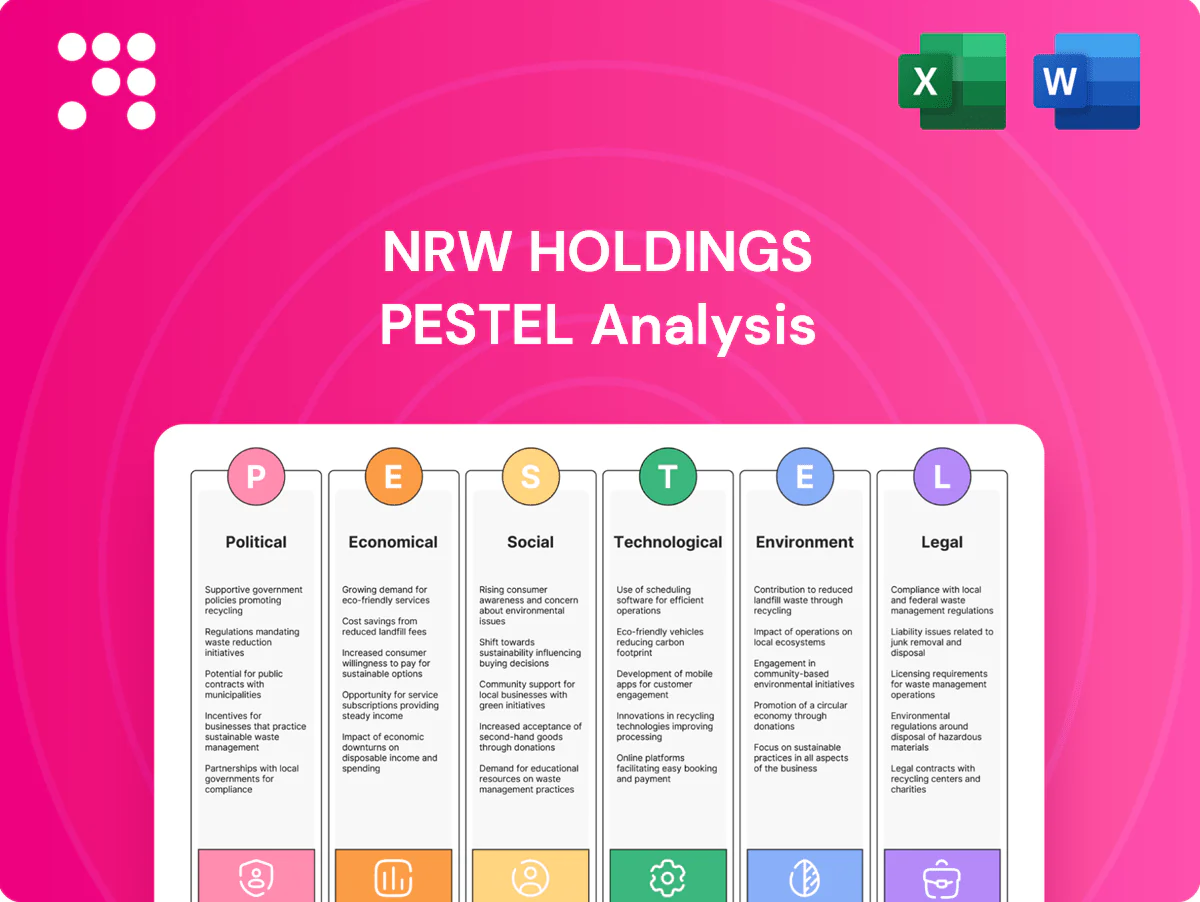
The preview shown here is the exact NRW Holdings PESTLE Analysis you’ll receive after purchase—fully formatted and ready to use. This is a real screenshot of the product you’re buying; the content, layout and structure are identical to the downloadable file. No placeholders or teasers—what you see is the final, professionally structured document available immediately after checkout.

Product Information
Product Information
Shipping & Returns
Shipping & Returns
Description
Skip the Research. Get the Strategy.
Discover how political shifts, economic cycles, and technological trends are shaping NRW Holdings’ prospects in our concise PESTLE snapshot. This targeted analysis highlights key risks and opportunities to sharpen your strategy. Purchase the full PESTLE for a detailed, actionable briefing you can use immediately.
Political factors
Infrastructure spend
Australian federal and state budgets directly set the civil and transport project pipelines NRW bids on, with shifts between stimulus and austerity materially altering backlog and margins. Priority programs such as Inland Rail (estimated cost A$14.5 billion) and major roads packages can accelerate awards and boost short-term tendering. Election outcomes routinely change the timing and geographic mix of funded projects, affecting cashflow predictability.
Mining policy
State royalties—WA iron ore 7.5% and Queensland coal ~7%—plus exploration incentives and 12–24 month mine approval timelines materially shape clients’ capex and contract timing; stricter conditions can delay mining awards while supportive regimes bring work forward. Policy stability in WA and QLD is pivotal, and shifts in federal/state critical minerals strategies are opening diversified contract opportunities.
Indigenous engagement
Government requirements for Indigenous participation, including the Australian Government Indigenous Procurement Policy and state targets such as Western Australia’s 3% Aboriginal procurement goal, shape NRW’s subcontracting and workforce models. Strong partnerships with Indigenous businesses can boost NRW’s competitiveness on public and resources contracts and support its FY24 revenue of about AUD1.3bn. Evolving procurement policy raises compliance complexity, while demonstrated employment and supply‑chain outcomes strengthen social licence and access to project pipelines.
IR and workforce policy
Commonwealth industrial relations reforms (Secure Jobs, Better Pay Act 2022) tighten bargaining, rostering and can elevate site labour costs. The migration planning level was 195,000 in 2023–24, influencing skilled labour availability for remote projects. FIFO community policies affect camp approvals and project design, while government VET subsidies help relieve skills bottlenecks.
- IR reforms: bargaining/rostering impact
- Migration: 195,000 planning level 2023–24
- FIFO policy: camp approvals/design
- Training subsidies: ease skills shortages
Trade and geopolitics
- China ~60% of AU iron ore exports (2023)
- Sanctions/tariffs shift commodity flows and investment timing
- Defence/Northern Australia programs enlarge civil‑works addressable market
- Tender bids now factor geopolitical risk premia
Federal budget shifts & election timing boost NRW tenders; Inland Rail A$14.5bn
Federal/state budget shifts (Inland Rail A$14.5bn) and election timing drive NRW tender pipelines; FY24 revenue ~AUD1.3bn. WA iron ore royalty 7.5% and QLD coal ~7% plus China ~60% of AU ore exports (2023) shape mining capex. IR reforms (Secure Jobs) and migration planning 195,000 (2023–24) affect labour costs and FIFO supply.
| Factor | Metric |
|---|---|
| FY24 revenue | AUD1.3bn |
| Inland Rail | A$14.5bn |
| Migration planning | 195,000 (23–24) |
What is included in the product
Detailed Word Document
Explores how macro-environmental factors uniquely affect NRW Holdings across Political, Economic, Social, Technological, Environmental and Legal dimensions, with each section backed by current data and regional industry trends. Designed for executives and investors, it highlights immediate risks and forward-looking opportunities to inform strategy, funding and scenario planning.
Customizable Excel Spreadsheet
A concise, visually segmented PESTLE summary for NRW Holdings that can be dropped into presentations, edited with notes for local context, and shared across teams to streamline discussions on external risks, regulatory impacts and market positioning.
Economic factors
Commodity cycle
Iron ore (≈US$110/t avg 2024), lithium carbonate ≈US$18,000/t, copper ≈US$9,300/t and gold ≈US$2,100/oz drive client mine starts and expansions; high prices expand tender volumes and improve NRW’s pricing power while downturns compress margins. NRW’s project and commodity diversification smooths but does not eliminate cyclicality. IEA projects critical‑mineral demand could rise about sixfold by 2040, supporting long‑term tailwinds for NRW.
Inflation and costs
Input costs for fuel (Brent ~USD85/bbl 2024 average), explosives, steel (HRC ~USD700/t 2024) and concrete materially pressure contract profitability for NRW Holdings.
Fixed-price civil contracts face margin squeeze where escalation clauses are absent; industry margins tightened in 2024 amid rising input prices.
Wage inflation in skilled trades remained persistent with Australian Wage Price Index near 4% y/y in 2024, increasing labour costs.
Supply agreements, long-term purchasing and hedging strategies have been used to mitigate volatility and protect margins.
Interest rates and credit
Higher rates (RBA cash rate 4.35%, 10‑yr Aussie bond ~4.2% mid‑2025) lift bonding, equipment financing and working capital costs, squeezing margins and bid pricing. Rising hurdle rates can defer client FIDs and slow contract awards. Conversely, rate cuts would likely reaccelerate infrastructure spend. Strong cash conversion and a conservative balance sheet underpin bid surety and tender competitiveness.
AUD and FX
A weaker AUD (averaging ~0.67 USD in 2024 and near 0.70 in early 2025) lifts Australian-dollar commodity receipts for NRW clients, supporting mining activity, but increases costs for imported equipment and OEM capex and parts priced in USD/EUR. FX volatility pressures pricing models—escalation clauses or FX pass-throughs are needed—and active hedging policies materially reduce earnings volatility for contract margins.
- FX range: AUD ~0.67–0.70 USD (2024–H1 2025)
- Impact: higher AUD revenues, higher imported capex
- Action: escalation/FX pass-through in contracts
- Mitigation: hedging limits earnings volatility
Construction cycle
Public infrastructure backlogs—Australia's pipeline exceeded AUD 150 billion in 2024 (Infrastructure Australia)—support NRW's civil divisions through downturns, while private non-residential and urban development continue to drive earthworks demand in major corridors. Sequencing constraints and contractor capacity materially affect NRW win rates and margins on multi-stage projects. Regional diversification across states mitigates the impact of state-specific slowdowns on revenue and utilisation.
- Pipeline: AUD 150bn+ (2024)
- Demand: private non-residential and urban earthworks growth
- Risk: sequencing & capacity → win rates/margins
- Mitigation: state diversification reduces concentration risk
Federal budget shifts & election timing boost NRW tenders; Inland Rail A$14.5bn
Commodity strength (iron ~US$110/t, lithium ~US$18,000/t, copper ~US$9,300/t, gold ~US$2,100/oz) boosts tenders and pricing power; input cost inflation (Brent ~US$85/bbl, HRC ~US$700/t) and wages (~4% WPI) squeeze margins. Higher rates (RBA 4.35%, 10y ~4.2%) raise financing/bonding costs; weak AUD (~0.67–0.70 USD) helps commodity receipts but raises imported capex. Strong public pipeline (AUD 150bn+) supports civil demand and diversification mitigates state risk.
| Metric | 2024–H1 2025 |
|---|---|
| Iron | ~US$110/t |
| Brent | ~US$85/bbl |
| RBA cash | 4.35% |
| AUD/USD | 0.67–0.70 |
| Pipeline | AUD 150bn+ |
Same Document Delivered
NRW Holdings PESTLE Analysis
The preview shown here is the exact NRW Holdings PESTLE Analysis you’ll receive after purchase—fully formatted and ready to use. This is a real screenshot of the product you’re buying; the content, layout and structure are identical to the downloadable file. No placeholders or teasers—what you see is the final, professionally structured document available immediately after checkout.