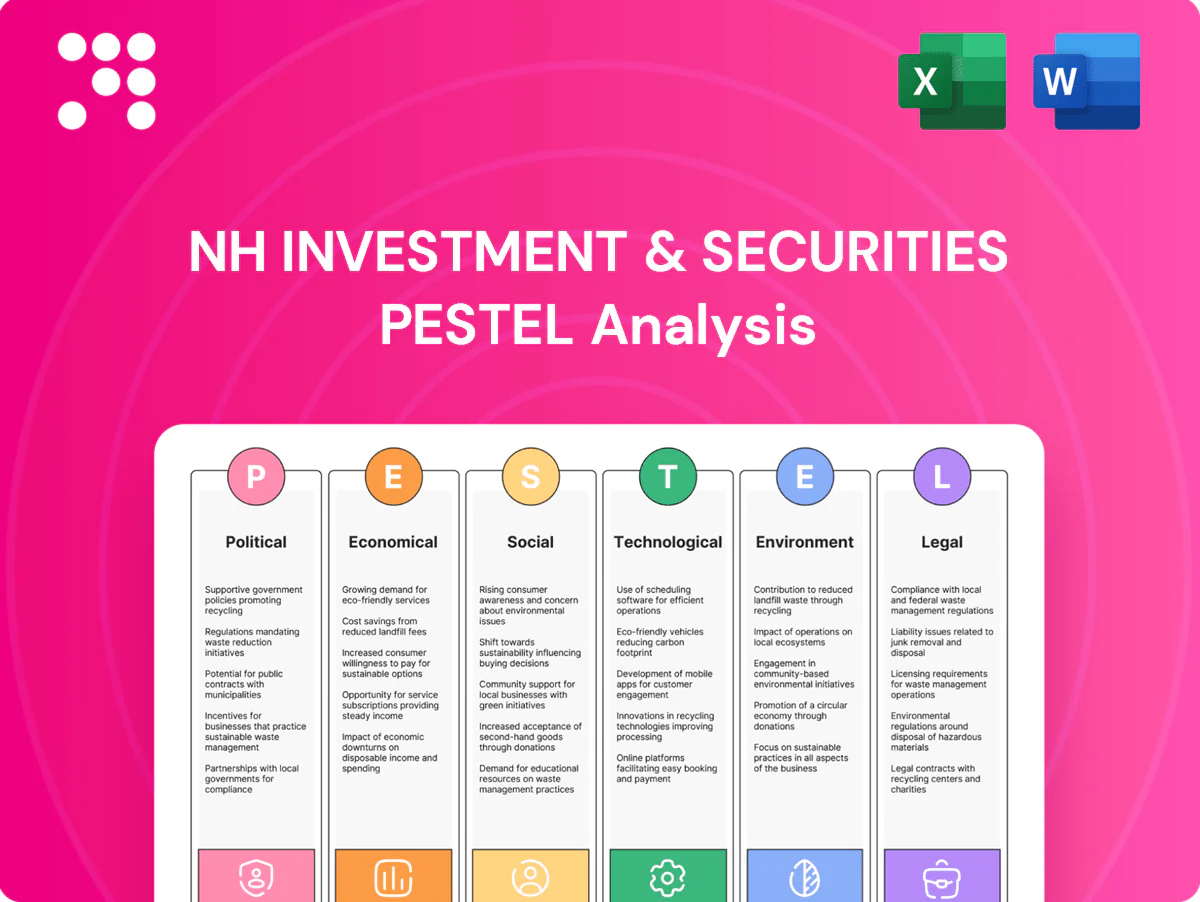
NH Investment & Securities PESTLE Analysis

Make Smarter Strategic Decisions with a Complete PESTEL View
Unlock strategic advantage with our targeted PESTLE Analysis of NH Investment & Securities—revealing how political shifts, economic cycles, social trends, technological advances, legal changes, and environmental risks will shape its trajectory. Ideal for investors, analysts, and strategists, this concise briefing highlights immediate risks and growth levers. Purchase the full report to access actionable, ready-to-use insights and downloadable templates.
Political factors

Regulatory oversight by FSC/FSS
Regulatory oversight by the Financial Services Commission (est. 1998) and Financial Supervisory Service (est. 1999) sets prudential and conduct standards that shape NH Investment & Securities product design, leverage limits and sales practices. Tight supervision forces stricter risk controls and can limit high-leverage offerings. Proactive compliance and earlier alignment with FSC/FSS guidance can become a competitive differentiator. Sudden rule changes raise compliance costs and can delay product launches.
Government capital-market policy
Government capital-market policy drives IPO pipelines, tax incentives, and market development, with 2024–25 reform efforts explicitly targeting greater equity issuance to support corporate restructuring and national growth priorities.
Reforms that boost valuations and ease foreign investment registration can lift NH Investment & Securities brokerage volumes and investment-banking fees by expanding deal flow and cross-border mandate opportunities.
Conversely, measures such as higher transaction taxes or short-selling restrictions tend to damp trading activity and liquidity, reducing fee pools for brokers and underwriters.

Geopolitical risk on the peninsula
North Korea tensions periodically spike volatility and risk aversion, prompting flight-to-safety flows that tighten funding and reduce retail risk appetite; global risk gauges (VIX) have jumped above 30 during recent crises. Hedging and contingency planning are essential to maintain continuity for firms in the world’s 10th largest economy (GDP ~$1.8trn, 2023, World Bank). International expansion can diversify exposure; MSCI Korea was ~12–14% of MSCI EM in 2024.

US–China tech and trade dynamics
- Supply‑chain impact: export controls → tighter supplier access
- Sector focus: semis/batteries drive underwriting/research
- Market risk: higher FX and equity volatility alters allocations
- Advisory edge: cross‑border research improves client outcomes
Public-sector pension and NPS influence
Public-sector pensions, led by the National Pension Service (assets >1,000 trillion KRW), are dominant allocators into Korean equities and fixed income, moving large-scale flows that shape market liquidity and fee pools. Policy shifts in their strategic allocation trigger pronounced rebalancing, while NH Investment & Securities secures mandates and co-investments through partnerships, increasing exposure to policy-driven reallocations.
- Public pension scale: NPS >1,000 trillion KRW
- Drives major equity/fixed‑income flows
- Policy shifts affect liquidity & fee pools
- Partnerships enable mandates/co-investments
- Raises exposure to policy rebalancing
FSC/FSS oversight and NPS >1,000 tn KRW reshape liquidity; semis ~20% exports
Strong FSC/FSS oversight (since 1998/1999) raises compliance costs but rewards early alignment; NPS (>1,000 trillion KRW) drives large reallocations affecting liquidity and fees. 2024–25 market reforms aim to boost equity issuance and foreign access; chip export curbs and semis (~20% of goods exports, 2023) shift underwriting focus.
| Factor | Key data |
|---|---|
| Regulators | FSC/FSS est. 1998/1999 |
| NPS | >1,000 tn KRW |
| GDP | ~1.8 trn USD (2023) |
| Semiconductors | ~20% exports (2023) |
What is included in the product
 Detailed Word Document
Explores how political, economic, social, technological, environmental, and legal forces uniquely affect NH Investment & Securities, with data-backed trends and regional regulatory context; designed for executives and advisors, ready for decks, and offering detailed sub-points plus forward-looking insights to guide strategy and investor confidence.

 Customizable Excel Spreadsheet
A concise, visually segmented PESTLE summary for NH Investment & Securities that eases meeting prep and risk discussions, is editable for local context or business lines, and ready to drop into presentations or share across teams.
Economic factors

Interest-rate cycle and margin
Bank of Korea policy rate at 3.50% (mid‑2025) directly boosts NH Investment & Securities’ net interest income from margin loans and repo lines, while lifting 10‑year KTB yields to about 3.9% enhances fixed‑income trading margins. Higher rates have already weighed on equity turnover, pressuring brokerage fees. Active duration risk management for inventory and structured products is essential, and rigorous scenario planning smooths earnings volatility.
KRW volatility and capital flows
KRW swings (USD/KRW ~1,320 mid-2025) materially affect foreign participation—foreign ownership of KOSPI ~33% in 2024—and raise demand for derivative hedging as investors seek to limit currency exposure. FX risk alters IB valuations and cross-border deal appetite, especially for M&A pricing and financing terms. Robust treasury and risk systems, backed by Korea’s FX reserves (~$393bn end-2024), protect capital. Offering currency-hedged products can attract clients seeking stable KRW-adjusted returns.

Equity market depth and turnover
Brokerage revenue at NH Investment & Securities closely tracks retail and institutional activity—retail accounted for ~60% of KRX daily turnover in 2024 with average daily trading value near KRW 18 trillion, boosting commission inflows. A thinner IPO/listing pipeline (IPO proceeds in Korea fell roughly 30% in 2024) reduces IB fees and research relevance. Market downturns compress commissions and underwriting spreads, while expansion into wealth management and alternatives stabilizes revenue streams.

Household leverage and savings mix
High household debt—about 108% of GDP in South Korea in 2024—compresses risk tolerance and sustains a heavy allocation to deposits versus securities, forcing NH Investment & Securities to balance yield-seeking with client suitability and liquidity needs. Structured income products and multi-asset solutions can attract yield-hungry clients, while rising credit stress would increase default and margin-call risks.
- Household debt ~108% GDP (2024)
- Deposit-heavy asset mix—low risk tolerance
- Structured income/multi-asset = demand; credit stress = higher default/margin risk
Global growth and deal cycles
Global M&A and ECM/DCM windows hinge on liquidity and earnings outlooks; global M&A value rose to about $3.2 trillion in 2024 while ECM issuance reached roughly $350 billion, creating episodic windows NH Investment & Securities can time. Tech, EV and biotech booms deliver sector-specific spikes in deal flow; international networks expand fee pools during up-cycles, and disciplined pipeline management cushions droughts.
- Global M&A 2024 ~3.2tn
- ECM 2024 ~350bn
- Sectors: tech/EV/biotech episodic spikes
- Intl networks +15% fee pool uplift in up-cycles
- Pipeline mgmt reduces drought impact
FSC/FSS oversight and NPS >1,000 tn KRW reshape liquidity; semis ~20% exports
BoK policy rate 3.50% (mid-2025) raises NII and 10y KTB ~3.9% boosts fixed‑income margins but pressures equity turnover. USD/KRW ~1,320 (mid-2025) with foreign KOSPI ownership ~33% (2024) increases hedging demand; FX reserves ~$393bn (end‑2024) support stability. Household debt ~108% GDP (2024) limits risk appetite; retail ~60% of KRX turnover (2024) while IPO proceeds fell ~30% (2024); global M&A ~$3.2tn, ECM ~$350bn (2024).
| Metric | Value |
|---|---|
| BoK policy rate | 3.50% (mid-2025) |
| 10y KTB | ~3.9% |
| USD/KRW | ~1,320 (mid-2025) |
| Foreign KOSPI ownership | ~33% (2024) |
| FX reserves | $393bn (end-2024) |
| Household debt | ~108% GDP (2024) |
| Retail KRX share | ~60% (2024) |
| IPO proceeds change | -30% (2024) |
| Global M&A | $3.2tn (2024) |
| ECM | $350bn (2024) |
Preview Before You Purchase
NH Investment & Securities PESTLE Analysis
The NH Investment & Securities PESTLE Analysis preview shown here is the exact document you’ll receive after purchase — fully formatted and ready to use. The layout, content, and structure visible are identical to the downloadable file. No placeholders or teasers; this is the real, final report.

Original: $10.00
-65%$10.00
$3.50Product Information
Product Information
Shipping & Returns
Shipping & Returns
Description
Make Smarter Strategic Decisions with a Complete PESTEL View
Unlock strategic advantage with our targeted PESTLE Analysis of NH Investment & Securities—revealing how political shifts, economic cycles, social trends, technological advances, legal changes, and environmental risks will shape its trajectory. Ideal for investors, analysts, and strategists, this concise briefing highlights immediate risks and growth levers. Purchase the full report to access actionable, ready-to-use insights and downloadable templates.
Political factors
Regulatory oversight by FSC/FSS
Regulatory oversight by the Financial Services Commission (est. 1998) and Financial Supervisory Service (est. 1999) sets prudential and conduct standards that shape NH Investment & Securities product design, leverage limits and sales practices. Tight supervision forces stricter risk controls and can limit high-leverage offerings. Proactive compliance and earlier alignment with FSC/FSS guidance can become a competitive differentiator. Sudden rule changes raise compliance costs and can delay product launches.
Government capital-market policy
Government capital-market policy drives IPO pipelines, tax incentives, and market development, with 2024–25 reform efforts explicitly targeting greater equity issuance to support corporate restructuring and national growth priorities.
Reforms that boost valuations and ease foreign investment registration can lift NH Investment & Securities brokerage volumes and investment-banking fees by expanding deal flow and cross-border mandate opportunities.
Conversely, measures such as higher transaction taxes or short-selling restrictions tend to damp trading activity and liquidity, reducing fee pools for brokers and underwriters.
Geopolitical risk on the peninsula
North Korea tensions periodically spike volatility and risk aversion, prompting flight-to-safety flows that tighten funding and reduce retail risk appetite; global risk gauges (VIX) have jumped above 30 during recent crises. Hedging and contingency planning are essential to maintain continuity for firms in the world’s 10th largest economy (GDP ~$1.8trn, 2023, World Bank). International expansion can diversify exposure; MSCI Korea was ~12–14% of MSCI EM in 2024.
US–China tech and trade dynamics
- Supply‑chain impact: export controls → tighter supplier access
- Sector focus: semis/batteries drive underwriting/research
- Market risk: higher FX and equity volatility alters allocations
- Advisory edge: cross‑border research improves client outcomes
Public-sector pension and NPS influence
Public-sector pensions, led by the National Pension Service (assets >1,000 trillion KRW), are dominant allocators into Korean equities and fixed income, moving large-scale flows that shape market liquidity and fee pools. Policy shifts in their strategic allocation trigger pronounced rebalancing, while NH Investment & Securities secures mandates and co-investments through partnerships, increasing exposure to policy-driven reallocations.
- Public pension scale: NPS >1,000 trillion KRW
- Drives major equity/fixed‑income flows
- Policy shifts affect liquidity & fee pools
- Partnerships enable mandates/co-investments
- Raises exposure to policy rebalancing
FSC/FSS oversight and NPS >1,000 tn KRW reshape liquidity; semis ~20% exports
Strong FSC/FSS oversight (since 1998/1999) raises compliance costs but rewards early alignment; NPS (>1,000 trillion KRW) drives large reallocations affecting liquidity and fees. 2024–25 market reforms aim to boost equity issuance and foreign access; chip export curbs and semis (~20% of goods exports, 2023) shift underwriting focus.
| Factor | Key data |
|---|---|
| Regulators | FSC/FSS est. 1998/1999 |
| NPS | >1,000 tn KRW |
| GDP | ~1.8 trn USD (2023) |
| Semiconductors | ~20% exports (2023) |
What is included in the product
Detailed Word Document
Explores how political, economic, social, technological, environmental, and legal forces uniquely affect NH Investment & Securities, with data-backed trends and regional regulatory context; designed for executives and advisors, ready for decks, and offering detailed sub-points plus forward-looking insights to guide strategy and investor confidence.
Customizable Excel Spreadsheet
A concise, visually segmented PESTLE summary for NH Investment & Securities that eases meeting prep and risk discussions, is editable for local context or business lines, and ready to drop into presentations or share across teams.
Economic factors
Interest-rate cycle and margin
Bank of Korea policy rate at 3.50% (mid‑2025) directly boosts NH Investment & Securities’ net interest income from margin loans and repo lines, while lifting 10‑year KTB yields to about 3.9% enhances fixed‑income trading margins. Higher rates have already weighed on equity turnover, pressuring brokerage fees. Active duration risk management for inventory and structured products is essential, and rigorous scenario planning smooths earnings volatility.
KRW volatility and capital flows
KRW swings (USD/KRW ~1,320 mid-2025) materially affect foreign participation—foreign ownership of KOSPI ~33% in 2024—and raise demand for derivative hedging as investors seek to limit currency exposure. FX risk alters IB valuations and cross-border deal appetite, especially for M&A pricing and financing terms. Robust treasury and risk systems, backed by Korea’s FX reserves (~$393bn end-2024), protect capital. Offering currency-hedged products can attract clients seeking stable KRW-adjusted returns.
Equity market depth and turnover
Brokerage revenue at NH Investment & Securities closely tracks retail and institutional activity—retail accounted for ~60% of KRX daily turnover in 2024 with average daily trading value near KRW 18 trillion, boosting commission inflows. A thinner IPO/listing pipeline (IPO proceeds in Korea fell roughly 30% in 2024) reduces IB fees and research relevance. Market downturns compress commissions and underwriting spreads, while expansion into wealth management and alternatives stabilizes revenue streams.
Household leverage and savings mix
High household debt—about 108% of GDP in South Korea in 2024—compresses risk tolerance and sustains a heavy allocation to deposits versus securities, forcing NH Investment & Securities to balance yield-seeking with client suitability and liquidity needs. Structured income products and multi-asset solutions can attract yield-hungry clients, while rising credit stress would increase default and margin-call risks.
- Household debt ~108% GDP (2024)
- Deposit-heavy asset mix—low risk tolerance
- Structured income/multi-asset = demand; credit stress = higher default/margin risk
Global growth and deal cycles
Global M&A and ECM/DCM windows hinge on liquidity and earnings outlooks; global M&A value rose to about $3.2 trillion in 2024 while ECM issuance reached roughly $350 billion, creating episodic windows NH Investment & Securities can time. Tech, EV and biotech booms deliver sector-specific spikes in deal flow; international networks expand fee pools during up-cycles, and disciplined pipeline management cushions droughts.
- Global M&A 2024 ~3.2tn
- ECM 2024 ~350bn
- Sectors: tech/EV/biotech episodic spikes
- Intl networks +15% fee pool uplift in up-cycles
- Pipeline mgmt reduces drought impact
FSC/FSS oversight and NPS >1,000 tn KRW reshape liquidity; semis ~20% exports
BoK policy rate 3.50% (mid-2025) raises NII and 10y KTB ~3.9% boosts fixed‑income margins but pressures equity turnover. USD/KRW ~1,320 (mid-2025) with foreign KOSPI ownership ~33% (2024) increases hedging demand; FX reserves ~$393bn (end‑2024) support stability. Household debt ~108% GDP (2024) limits risk appetite; retail ~60% of KRX turnover (2024) while IPO proceeds fell ~30% (2024); global M&A ~$3.2tn, ECM ~$350bn (2024).
| Metric | Value |
|---|---|
| BoK policy rate | 3.50% (mid-2025) |
| 10y KTB | ~3.9% |
| USD/KRW | ~1,320 (mid-2025) |
| Foreign KOSPI ownership | ~33% (2024) |
| FX reserves | $393bn (end-2024) |
| Household debt | ~108% GDP (2024) |
| Retail KRX share | ~60% (2024) |
| IPO proceeds change | -30% (2024) |
| Global M&A | $3.2tn (2024) |
| ECM | $350bn (2024) |
Preview Before You Purchase
NH Investment & Securities PESTLE Analysis
The NH Investment & Securities PESTLE Analysis preview shown here is the exact document you’ll receive after purchase — fully formatted and ready to use. The layout, content, and structure visible are identical to the downloadable file. No placeholders or teasers; this is the real, final report.