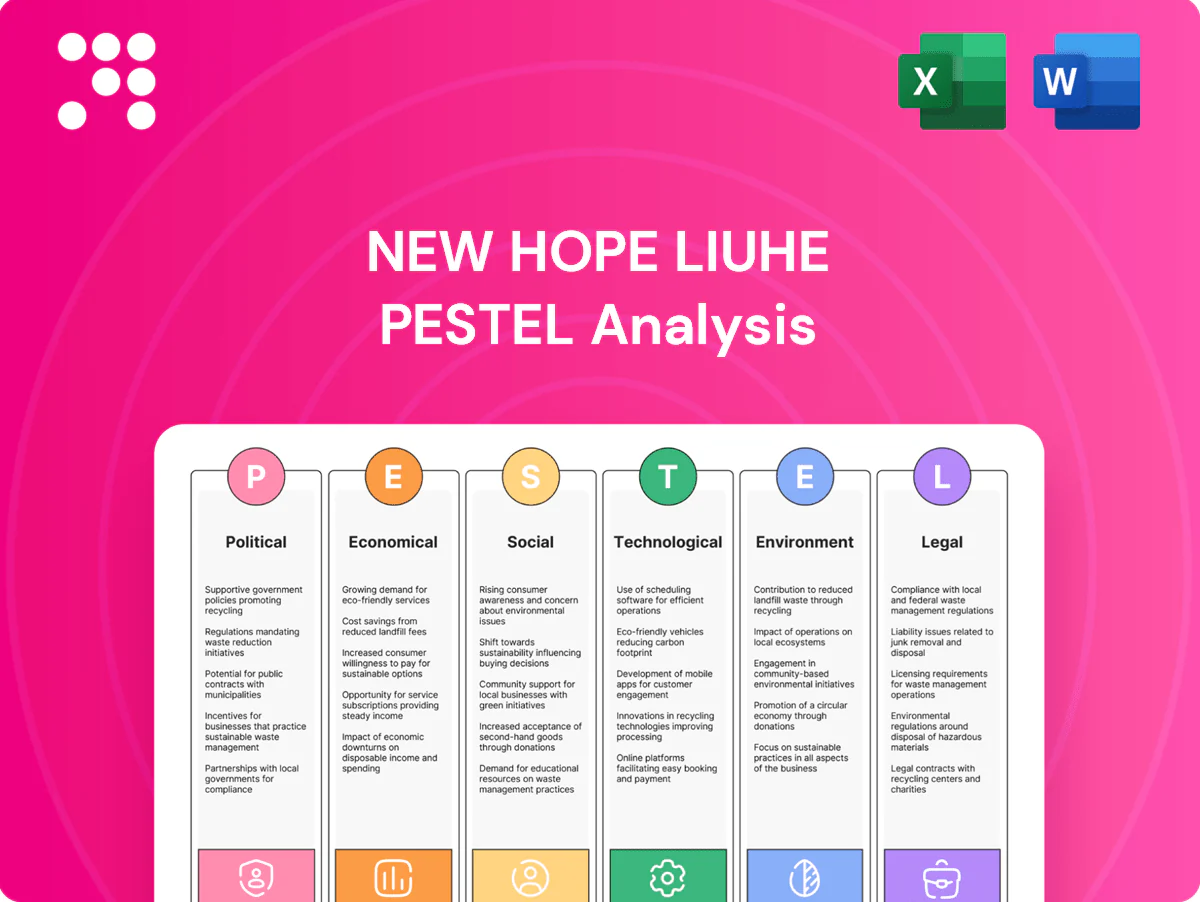
New Hope Liuhe PESTLE Analysis

Make Smarter Strategic Decisions with a Complete PESTEL View
Our PESTLE Analysis for New Hope Liuhe reveals how political shifts, supply-chain economics, and sustainability trends are reshaping its competitive edge; practical insights help you quantify risks and spot growth levers. Whether you’re an investor or strategist, this concise briefing accelerates decision-making. Purchase the full report to access the complete, editable analysis and actionable recommendations.
Political factors

Central agri-food policy alignment
China's agri-food policy centers on food security with a staple grain self-sufficiency target near 95% and pork output around 48 million tonnes in 2023, shaping subsidies, capacity targets and strict biosecurity since ASF. New Hope Liuhe gains from support for modern feed, hog and poultry operations, but policy pivots can redirect capital to state-led projects or alternative proteins. Continuous government engagement and rapid compliance agility are critical.
Trade relations and import dependencies
New Hope Liuhe’s feed chain depends on imported corn, soybeans and additives amid China’s roughly 100 million tonne soybean and ~25 million tonne corn import market (2023/24 USDA), exposing costs to tariff shifts and US–China or Brazil logistics tensions. Diversifying origins to Brazil, US and Argentina and using futures/options hedges reduces volatility from shipping and tariff risk. Regulatory approvals for GM crops and import quotas continue to constrain input flow and pricing stability.

Rural revitalization and regional incentives
Local governments under China’s rural revitalization push routinely offer land allocation, tax breaks and concessional financing to expand breeding and processing for firms like New Hope Liuhe, subject to performance, employment and environmental-compliance covenants. Site choice must weigh these incentives against infrastructure quality and animal-disease risk, while proactive collaboration with county authorities can materially shorten permit timelines and enable faster scaling.

Public health and food safety governance
Heightened oversight after high-profile food incidents has driven strict HACCP and full-chain traceability requirements, and political favor now leans toward large, standardized processors with robust QA/QC frameworks. New Hope Liuhe can leverage vertical integration—controlling feed, farming, processing and distribution—to meet intense audit regimes and reduce third-party risk. Non-compliance risks severe reputational damage, fines and punitive shutdowns.
- Regulatory focus: favors large, certified operators
- Competitive edge: vertical integration enables audit readiness
- Risk: non-compliance → reputational/operational penalties
Biosecurity crisis response capacity
Epidemics like African Swine Fever trigger mandatory culls, transport curbs and movement permits, and in China pork output fell roughly 21% in 2019 with wholesale prices spiking over 150% at peak, prompting authorities to favor firms with high biosecurity and vaccination-readiness where applicable. Political support tends to prioritize supply stabilization via major producers, and documented preparedness plans secure faster recovery and smoother government cooperation.
- Mandatory culls, movement permits, transport curbs
- China pork output down ~21% (2019); prices +150% peak
- Authorities favor biosecure, vaccination-ready firms
- Political backing often channels to major producers for supply stability
- Preparedness plans = faster recovery & govt coordination
China ~95% self-sufficiency; pork 48Mt, feed imports raise capex
China policy targets ~95% staple self-sufficiency and pork ~48Mt (2023), favoring large, biosecure processors like New Hope Liuhe. Feed reliance on ~100Mt soy and ~25Mt corn imports (2023/24) raises tariff and logistics risk. Local incentives and strict HACCP/traceability increase capex and compliance importance.
| Metric | 2023/24 |
|---|---|
| Pork output | 48 Mt |
| Soybean imports | ~100 Mt |
| Corn imports | ~25 Mt |
What is included in the product
 Detailed Word Document
Provides a concise PESTLE review of New Hope Liuhe across Political, Economic, Social, Technological, Environmental and Legal dimensions, combining data-driven trends and region-specific regulatory context to identify threats, opportunities and forward-looking scenarios for executives, investors and strategists.

 Customizable Excel Spreadsheet
A clean, visually segmented PESTLE summary of New Hope Liuhe that’s easily dropped into presentations, editable for region- or business-specific notes and ideal for quick alignment across teams during planning and risk discussions.
Economic factors

Commodity price volatility
Input costs for corn (CBOT ~5.5 USD/bu in 2024–25), soybean meal (~420 USD/ton) and energy (Brent ~85 USD/bbl) directly compress New Hope Liuhe feed margins and vitamin premix costs. Global weather shocks and freight volatility (Baltic Dry swings) shift landed costs and weaken pricing power. Dynamic formulation, procurement hedges and tight inventory discipline preserve spreads. Passing higher feed costs to downstream meat demands careful real-time demand sensing.
Consumer demand cycles
Rising disposable income—per China NBS, per capita disposable income rose about 5.0% in 2023—supports dining-out recovery, boosting poultry while pork faces substitution pressures as consumers trade down to cheaper proteins; catering revenue approached pre-COVID levels in 2023. Economic slowdowns push households toward value cuts and processed meats, while volume stability depends on retail, foodservice and growing e-commerce share; pricing strategies must cushion cyclical downswings.

Capacity rationalization and consolidation
Industry downturns prune weaker hog farms, raising feed-mill and slaughterhouse utilization for scaled operators like listed New Hope Liuhe (000876.SZ), which can expand share through contract farming and targeted M&A.
Economies of scale boost feed throughput and lower logistics unit costs, while timing capital deployment to China’s herd cycle enhances margin recovery and return on incremental capacity.

FX and financing conditions
Urbanization and cold-chain infrastructure
Rapid urbanization—China's urbanization rate reached about 67% by 2024—boosts demand for chilled, branded and ready-to-cook meats, favoring New Hope Liuhe’s premium SKUs. Ongoing cold-chain investment, with China’s cold-chain logistics market exceeding RMB 1 trillion by 2023, reduces spoilage and supports premiumization. Scaled, efficient distribution expands geographic reach, strengthens retail partnerships, lowers per-unit logistics costs, and raises service levels.
- Urbanization ~67% (2024)
- Cold-chain market > RMB 1 trillion (2023)
- Lower spoilage → higher margins
- Scale logistics → reduced unit costs, wider retail access
China ~95% self-sufficiency; pork 48Mt, feed imports raise capex
Imported corn/soy and energy (CBOT corn ~5.5 USD/bu, soybean meal ~420 USD/t, Brent ~85 USD/bbl) & USD/CNY ~7.25 compress feed margins; hedges and inventory discipline mitigate. Rising disposable income (+5.0% in 2023) and urbanization (~67% 2024) favor premium chilled meats. Credit costs (1yr LPR 3.45%, China 10yr ~2.8%) govern capex timing and M&A scale-up.
| Metric | Value |
|---|---|
| USD/CNY | ~7.25 (mid‑2025) |
| 1yr LPR | 3.45% |
| China 10yr | ~2.8% |
| Urbanization | ~67% (2024) |
| Cold-chain market | >RMB 1tn (2023) |
Same Document Delivered
New Hope Liuhe PESTLE Analysis
The preview shown here is the exact New Hope Liuhe PESTLE analysis you’ll receive after purchase—fully formatted and ready to use. It provides concise Political, Economic, Social, Technological, Legal and Environmental insights tailored to strategic and investment decisions. No placeholders or teasers—this is the final, downloadable file.

Product Information
Product Information
Shipping & Returns
Shipping & Returns
Description
Make Smarter Strategic Decisions with a Complete PESTEL View
Our PESTLE Analysis for New Hope Liuhe reveals how political shifts, supply-chain economics, and sustainability trends are reshaping its competitive edge; practical insights help you quantify risks and spot growth levers. Whether you’re an investor or strategist, this concise briefing accelerates decision-making. Purchase the full report to access the complete, editable analysis and actionable recommendations.
Political factors
Central agri-food policy alignment
China's agri-food policy centers on food security with a staple grain self-sufficiency target near 95% and pork output around 48 million tonnes in 2023, shaping subsidies, capacity targets and strict biosecurity since ASF. New Hope Liuhe gains from support for modern feed, hog and poultry operations, but policy pivots can redirect capital to state-led projects or alternative proteins. Continuous government engagement and rapid compliance agility are critical.
Trade relations and import dependencies
New Hope Liuhe’s feed chain depends on imported corn, soybeans and additives amid China’s roughly 100 million tonne soybean and ~25 million tonne corn import market (2023/24 USDA), exposing costs to tariff shifts and US–China or Brazil logistics tensions. Diversifying origins to Brazil, US and Argentina and using futures/options hedges reduces volatility from shipping and tariff risk. Regulatory approvals for GM crops and import quotas continue to constrain input flow and pricing stability.
Rural revitalization and regional incentives
Local governments under China’s rural revitalization push routinely offer land allocation, tax breaks and concessional financing to expand breeding and processing for firms like New Hope Liuhe, subject to performance, employment and environmental-compliance covenants. Site choice must weigh these incentives against infrastructure quality and animal-disease risk, while proactive collaboration with county authorities can materially shorten permit timelines and enable faster scaling.
Public health and food safety governance
Heightened oversight after high-profile food incidents has driven strict HACCP and full-chain traceability requirements, and political favor now leans toward large, standardized processors with robust QA/QC frameworks. New Hope Liuhe can leverage vertical integration—controlling feed, farming, processing and distribution—to meet intense audit regimes and reduce third-party risk. Non-compliance risks severe reputational damage, fines and punitive shutdowns.
- Regulatory focus: favors large, certified operators
- Competitive edge: vertical integration enables audit readiness
- Risk: non-compliance → reputational/operational penalties
Biosecurity crisis response capacity
Epidemics like African Swine Fever trigger mandatory culls, transport curbs and movement permits, and in China pork output fell roughly 21% in 2019 with wholesale prices spiking over 150% at peak, prompting authorities to favor firms with high biosecurity and vaccination-readiness where applicable. Political support tends to prioritize supply stabilization via major producers, and documented preparedness plans secure faster recovery and smoother government cooperation.
- Mandatory culls, movement permits, transport curbs
- China pork output down ~21% (2019); prices +150% peak
- Authorities favor biosecure, vaccination-ready firms
- Political backing often channels to major producers for supply stability
- Preparedness plans = faster recovery & govt coordination
China ~95% self-sufficiency; pork 48Mt, feed imports raise capex
China policy targets ~95% staple self-sufficiency and pork ~48Mt (2023), favoring large, biosecure processors like New Hope Liuhe. Feed reliance on ~100Mt soy and ~25Mt corn imports (2023/24) raises tariff and logistics risk. Local incentives and strict HACCP/traceability increase capex and compliance importance.
| Metric | 2023/24 |
|---|---|
| Pork output | 48 Mt |
| Soybean imports | ~100 Mt |
| Corn imports | ~25 Mt |
What is included in the product
Detailed Word Document
Provides a concise PESTLE review of New Hope Liuhe across Political, Economic, Social, Technological, Environmental and Legal dimensions, combining data-driven trends and region-specific regulatory context to identify threats, opportunities and forward-looking scenarios for executives, investors and strategists.
Customizable Excel Spreadsheet
A clean, visually segmented PESTLE summary of New Hope Liuhe that’s easily dropped into presentations, editable for region- or business-specific notes and ideal for quick alignment across teams during planning and risk discussions.
Economic factors
Commodity price volatility
Input costs for corn (CBOT ~5.5 USD/bu in 2024–25), soybean meal (~420 USD/ton) and energy (Brent ~85 USD/bbl) directly compress New Hope Liuhe feed margins and vitamin premix costs. Global weather shocks and freight volatility (Baltic Dry swings) shift landed costs and weaken pricing power. Dynamic formulation, procurement hedges and tight inventory discipline preserve spreads. Passing higher feed costs to downstream meat demands careful real-time demand sensing.
Consumer demand cycles
Rising disposable income—per China NBS, per capita disposable income rose about 5.0% in 2023—supports dining-out recovery, boosting poultry while pork faces substitution pressures as consumers trade down to cheaper proteins; catering revenue approached pre-COVID levels in 2023. Economic slowdowns push households toward value cuts and processed meats, while volume stability depends on retail, foodservice and growing e-commerce share; pricing strategies must cushion cyclical downswings.
Capacity rationalization and consolidation
Industry downturns prune weaker hog farms, raising feed-mill and slaughterhouse utilization for scaled operators like listed New Hope Liuhe (000876.SZ), which can expand share through contract farming and targeted M&A.
Economies of scale boost feed throughput and lower logistics unit costs, while timing capital deployment to China’s herd cycle enhances margin recovery and return on incremental capacity.
FX and financing conditions
Urbanization and cold-chain infrastructure
Rapid urbanization—China's urbanization rate reached about 67% by 2024—boosts demand for chilled, branded and ready-to-cook meats, favoring New Hope Liuhe’s premium SKUs. Ongoing cold-chain investment, with China’s cold-chain logistics market exceeding RMB 1 trillion by 2023, reduces spoilage and supports premiumization. Scaled, efficient distribution expands geographic reach, strengthens retail partnerships, lowers per-unit logistics costs, and raises service levels.
- Urbanization ~67% (2024)
- Cold-chain market > RMB 1 trillion (2023)
- Lower spoilage → higher margins
- Scale logistics → reduced unit costs, wider retail access
China ~95% self-sufficiency; pork 48Mt, feed imports raise capex
Imported corn/soy and energy (CBOT corn ~5.5 USD/bu, soybean meal ~420 USD/t, Brent ~85 USD/bbl) & USD/CNY ~7.25 compress feed margins; hedges and inventory discipline mitigate. Rising disposable income (+5.0% in 2023) and urbanization (~67% 2024) favor premium chilled meats. Credit costs (1yr LPR 3.45%, China 10yr ~2.8%) govern capex timing and M&A scale-up.
| Metric | Value |
|---|---|
| USD/CNY | ~7.25 (mid‑2025) |
| 1yr LPR | 3.45% |
| China 10yr | ~2.8% |
| Urbanization | ~67% (2024) |
| Cold-chain market | >RMB 1tn (2023) |
Same Document Delivered
New Hope Liuhe PESTLE Analysis
The preview shown here is the exact New Hope Liuhe PESTLE analysis you’ll receive after purchase—fully formatted and ready to use. It provides concise Political, Economic, Social, Technological, Legal and Environmental insights tailored to strategic and investment decisions. No placeholders or teasers—this is the final, downloadable file.











