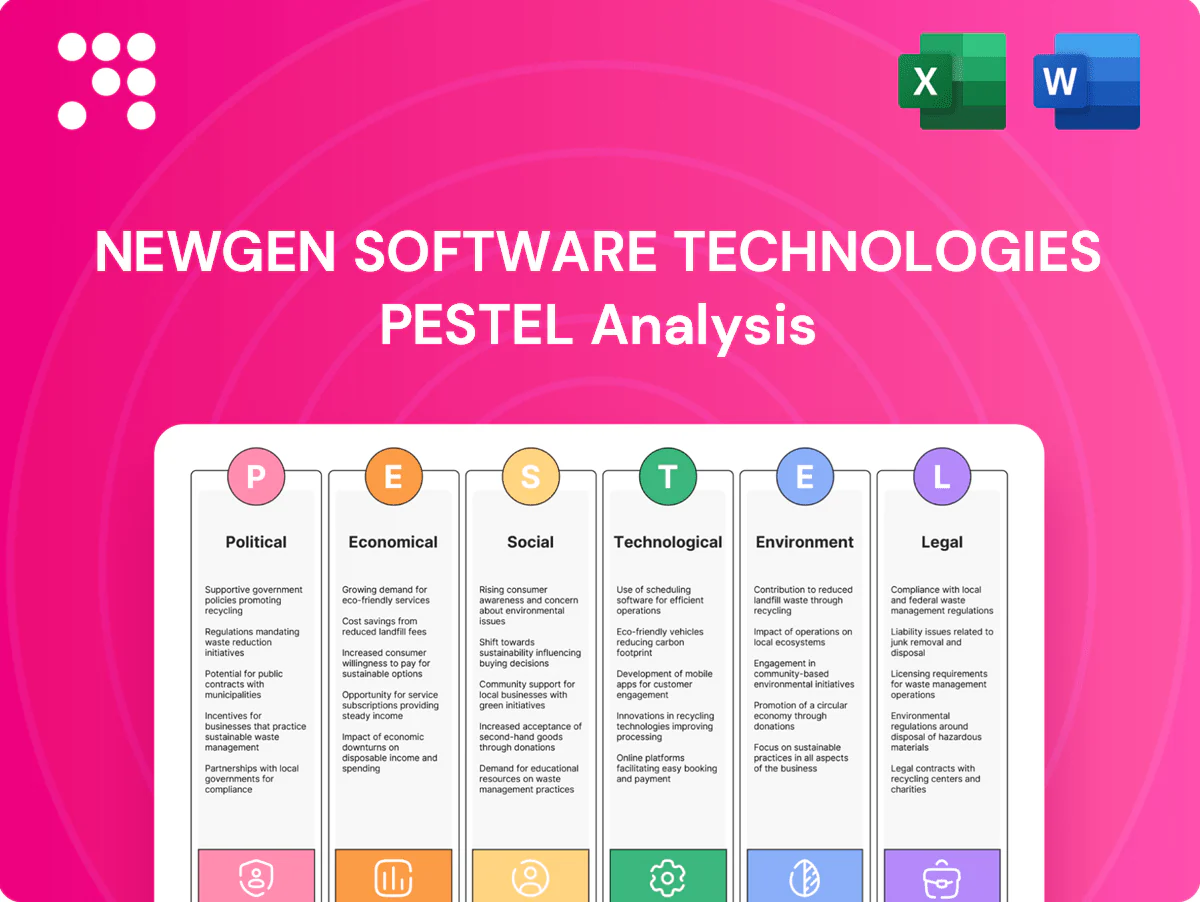
Newgen Software Technologies PESTLE Analysis

Plan Smarter. Present Sharper. Compete Stronger.
Unlock how regulatory shifts, economic trends, and emerging technologies are shaping Newgen Software Technologies with our concise PESTLE snapshot—ideal for investors and strategists. This expert analysis highlights risks and growth levers you can act on today. Purchase the full PESTLE for a complete, ready-to-use briefing and practical recommendations.
Political factors

Government digitalization agendas
Public-sector modernization—driven by India's DPI (Aadhaar ~1.4 billion IDs, UPI crossing 100 billion transactions in 2024)—boosts demand for process automation and content services relevant to Newgen. DPI-like programs across APAC, Middle East and Africa expand addressable markets. Budget cycles and policy continuity determine project timing and scale. Compliance with e-governance standards (MeitY guidelines, ISO/IEC 27001) improves procurement win rates.
Data sovereignty and localization
Rules mandating local storage/processing in banking and government shape cloud choices and deployment models, with RBI's 2018 payment-data localization directive and India's DPDP Act 2023 requiring configurable residency controls. Over 50 countries including GCC and ASEAN members have sectoral localization norms, favoring regional data centers and private clouds. Non-compliance can lead to disqualification from public tenders.

Geopolitical and trade dynamics
US-China tensions and US export controls announced Oct 7, 2022 on advanced semiconductors are fragmenting supply chains and reshaping hyperscaler footprints and vendor ecosystems. Global public cloud revenue reached about $591 billion in 2023 (Gartner), concentrating buyer power and forcing vendor re‑architecture. FX volatility from geopolitical shocks raises hedging and cross‑border contract risk, driving client demand for resilient, multi‑region delivery models.

Public procurement complexity
Government RFPs for enterprise software often run for months, subjecting bidders to L1 pricing pressure and strict performance guarantees that can compress margins and shift risk to vendors.
Eligibility requirements like past performance records and security clearances restrict new entrants, making local partners and systems integrator alliances essential; clear, auditable compliance documentation materially improves bid success rates.
- Lengthy RFPs: extend procurement timelines
- L1 pricing: drives margin compression
- Performance guarantees: increase vendor liability
- Eligibility barriers: past performance, clearances
- Local partnerships: critical for access
- Transparent compliance: boosts win probability
Incentives and taxation
STPI/SEZ tax benefits and R&D incentives plus cloud credits (AWS Activate up to 100,000 USD) lower Newgen’s innovation costs; GST at 18% on software/digital services shifts pricing dynamics and may compress margins; equalisation levy/TDS ~2% on cross-border SaaS complicates contracts; proactive tax planning preserves margins.
- STPI/SEZ tax relief
- R&D incentives
- Cloud credits ~100k USD
- GST 18%
- Equalisation levy/TDS ~2%
Public-sector scale fuels automation demand; localization, GST and levies force cloud strategy
Public-sector modernization (Aadhaar ~1.4B IDs; UPI >100B txns in 2024) expands demand for Newgen’s automation and content services. Data‑localization (RBI 2018; DPDP Act 2023) and >50 countries’ sectoral rules force regional/cloud choices. Long RFPs, L1 pricing and performance guarantees compress margins; GST 18% and ~2% equalisation levy affect pricing; STPI/SEZ relief and cloud credits (up to $100k) offset costs.
| Metric | Value |
|---|---|
| Aadhaar IDs | ~1.4B |
| UPI txns (2024) | >100B |
| Countries w/ localization | >50 |
| GST | 18% |
| Equalisation levy/TDS | ~2% |
| Cloud credits | up to $100k |
What is included in the product
 Detailed Word Document
Explores how Political, Economic, Social, Technological, Environmental and Legal forces uniquely affect Newgen Software Technologies, with data-backed, region- and industry-specific insights and multiple sub-points per category. Designed for executives and investors, it highlights threats, opportunities and forward-looking scenarios for strategic planning.

 Customizable Excel Spreadsheet
A concise, visually segmented PESTLE summary for Newgen Software Technologies that relieves planning pain points by highlighting external risks and opportunities at a glance, easily dropped into presentations or shared for quick team alignment.
Economic factors

IT spending cycles
Banking and healthcare capex/opex shifts are driving Newgen platform adoption as global IT spending reached about $5.6 trillion in 2024 (Gartner), pushing vendors toward subscription and cloud models. Tight credit cycles delay large core transformations but increase spend on efficiency-led automation. In upcycles, CX and omnichannel investments accelerate, and Newgen’s diversified vertical mix across banking, insurance, healthcare and government smooths revenue volatility.
Currency and pricing
Export revenue exposes Newgen to USD, EUR and GCC currency moves, with USD/INR around 83.5 and EUR/INR near 91.5 in mid‑2025, while most GCC currencies remain effectively pegged to the USD. INR volatility directly affects offshore cost advantages and operating margins. Multi‑year subscription contracts smooth revenue recognition and lower short‑term FX sensitivity versus one‑time licenses. Active hedging and localized pricing strategies help protect gross margins.

Inflation and wage pressures
Talent-intensive delivery faces salary inflation in engineering hubs, squeezing margins as India's CPI averaged about 5% in 2024 and IT compensation climbed. Client vendor consolidation intensifies price competition. Automation, reusable accelerators and partner-led implementations improve unit economics and lower delivery hours. Value-based pricing tied to outcomes can defend ARPU by shifting focus from time to value.

SaaS vs on-prem mix
Shift to SaaS improves revenue predictability and ARR conversion but requires upfront GTM and hosting investment; regulated customers often demand private cloud or on-prem deployments, delaying cash realization. Hybrid offerings allow compliance-sensitive clients to move to recurring models while preserving on-prem fees, with clear TCO articulation improving sales conversion.
- SaaS: predictable ARR, higher upfront GTM/hosting costs
- On-prem/private: preferred by regulated clients, uneven cash flows
- Hybrid: compliance + ARR growth
- TCO clarity: key to conversion
Emerging market growth
Emerging market growth drives demand for Newgen through expanding financial inclusion—1.4 billion adults remained unbanked in World Bank Findex 2021, fueling digitized public services and new banks that create workflow and compliance opportunities.
Mid-market wins offer shorter sales cycles that counterbalance long enterprise procurements, while local macro risks necessitate credit checks and staged deployments to protect revenue.
Robust regional channel ecosystems accelerate scale and localization, lowering go-to-market costs and improving adoption.
- Financial inclusion: 1.4 billion unbanked (World Bank Findex 2021)
- Sales dynamics: faster mid-market cycles vs enterprise procurement
- Risk management: mandatory credit checks, staged rollouts
- Scale enablers: regional channel ecosystems
Public-sector scale fuels automation demand; localization, GST and levies force cloud strategy
Global IT spend ~5.6T (Gartner 2024) and shifts to subscription/cloud boost Newgen adoption while tight credit cycles push efficiency-led automation. USD/INR ~83.5, EUR/INR ~91.5 (mid‑2025) and INR volatility affect margins; SaaS ARR improves predictability but needs upfront GTM spend. India CPI ~5% (2024) raises delivery costs; 1.4B unbanked (World Bank) expands addressable market.
| Metric | Value |
|---|---|
| Global IT Spend | 5.6T (2024) |
| USD/INR | 83.5 (mid‑2025) |
| India CPI | ~5% (2024) |
What You See Is What You Get
Newgen Software Technologies PESTLE Analysis
This Newgen Software Technologies PESTLE Analysis preview is the exact document you’ll receive after purchase—fully formatted and ready to use. The content, layout, and structure shown here are identical to the downloadable file. No placeholders, no surprises.

Product Information
Product Information
Shipping & Returns
Shipping & Returns
Description
Plan Smarter. Present Sharper. Compete Stronger.
Unlock how regulatory shifts, economic trends, and emerging technologies are shaping Newgen Software Technologies with our concise PESTLE snapshot—ideal for investors and strategists. This expert analysis highlights risks and growth levers you can act on today. Purchase the full PESTLE for a complete, ready-to-use briefing and practical recommendations.
Political factors
Government digitalization agendas
Public-sector modernization—driven by India's DPI (Aadhaar ~1.4 billion IDs, UPI crossing 100 billion transactions in 2024)—boosts demand for process automation and content services relevant to Newgen. DPI-like programs across APAC, Middle East and Africa expand addressable markets. Budget cycles and policy continuity determine project timing and scale. Compliance with e-governance standards (MeitY guidelines, ISO/IEC 27001) improves procurement win rates.
Data sovereignty and localization
Rules mandating local storage/processing in banking and government shape cloud choices and deployment models, with RBI's 2018 payment-data localization directive and India's DPDP Act 2023 requiring configurable residency controls. Over 50 countries including GCC and ASEAN members have sectoral localization norms, favoring regional data centers and private clouds. Non-compliance can lead to disqualification from public tenders.
Geopolitical and trade dynamics
US-China tensions and US export controls announced Oct 7, 2022 on advanced semiconductors are fragmenting supply chains and reshaping hyperscaler footprints and vendor ecosystems. Global public cloud revenue reached about $591 billion in 2023 (Gartner), concentrating buyer power and forcing vendor re‑architecture. FX volatility from geopolitical shocks raises hedging and cross‑border contract risk, driving client demand for resilient, multi‑region delivery models.
Public procurement complexity
Government RFPs for enterprise software often run for months, subjecting bidders to L1 pricing pressure and strict performance guarantees that can compress margins and shift risk to vendors.
Eligibility requirements like past performance records and security clearances restrict new entrants, making local partners and systems integrator alliances essential; clear, auditable compliance documentation materially improves bid success rates.
- Lengthy RFPs: extend procurement timelines
- L1 pricing: drives margin compression
- Performance guarantees: increase vendor liability
- Eligibility barriers: past performance, clearances
- Local partnerships: critical for access
- Transparent compliance: boosts win probability
Incentives and taxation
STPI/SEZ tax benefits and R&D incentives plus cloud credits (AWS Activate up to 100,000 USD) lower Newgen’s innovation costs; GST at 18% on software/digital services shifts pricing dynamics and may compress margins; equalisation levy/TDS ~2% on cross-border SaaS complicates contracts; proactive tax planning preserves margins.
- STPI/SEZ tax relief
- R&D incentives
- Cloud credits ~100k USD
- GST 18%
- Equalisation levy/TDS ~2%
Public-sector scale fuels automation demand; localization, GST and levies force cloud strategy
Public-sector modernization (Aadhaar ~1.4B IDs; UPI >100B txns in 2024) expands demand for Newgen’s automation and content services. Data‑localization (RBI 2018; DPDP Act 2023) and >50 countries’ sectoral rules force regional/cloud choices. Long RFPs, L1 pricing and performance guarantees compress margins; GST 18% and ~2% equalisation levy affect pricing; STPI/SEZ relief and cloud credits (up to $100k) offset costs.
| Metric | Value |
|---|---|
| Aadhaar IDs | ~1.4B |
| UPI txns (2024) | >100B |
| Countries w/ localization | >50 |
| GST | 18% |
| Equalisation levy/TDS | ~2% |
| Cloud credits | up to $100k |
What is included in the product
Detailed Word Document
Explores how Political, Economic, Social, Technological, Environmental and Legal forces uniquely affect Newgen Software Technologies, with data-backed, region- and industry-specific insights and multiple sub-points per category. Designed for executives and investors, it highlights threats, opportunities and forward-looking scenarios for strategic planning.
Customizable Excel Spreadsheet
A concise, visually segmented PESTLE summary for Newgen Software Technologies that relieves planning pain points by highlighting external risks and opportunities at a glance, easily dropped into presentations or shared for quick team alignment.
Economic factors
IT spending cycles
Banking and healthcare capex/opex shifts are driving Newgen platform adoption as global IT spending reached about $5.6 trillion in 2024 (Gartner), pushing vendors toward subscription and cloud models. Tight credit cycles delay large core transformations but increase spend on efficiency-led automation. In upcycles, CX and omnichannel investments accelerate, and Newgen’s diversified vertical mix across banking, insurance, healthcare and government smooths revenue volatility.
Currency and pricing
Export revenue exposes Newgen to USD, EUR and GCC currency moves, with USD/INR around 83.5 and EUR/INR near 91.5 in mid‑2025, while most GCC currencies remain effectively pegged to the USD. INR volatility directly affects offshore cost advantages and operating margins. Multi‑year subscription contracts smooth revenue recognition and lower short‑term FX sensitivity versus one‑time licenses. Active hedging and localized pricing strategies help protect gross margins.
Inflation and wage pressures
Talent-intensive delivery faces salary inflation in engineering hubs, squeezing margins as India's CPI averaged about 5% in 2024 and IT compensation climbed. Client vendor consolidation intensifies price competition. Automation, reusable accelerators and partner-led implementations improve unit economics and lower delivery hours. Value-based pricing tied to outcomes can defend ARPU by shifting focus from time to value.
SaaS vs on-prem mix
Shift to SaaS improves revenue predictability and ARR conversion but requires upfront GTM and hosting investment; regulated customers often demand private cloud or on-prem deployments, delaying cash realization. Hybrid offerings allow compliance-sensitive clients to move to recurring models while preserving on-prem fees, with clear TCO articulation improving sales conversion.
- SaaS: predictable ARR, higher upfront GTM/hosting costs
- On-prem/private: preferred by regulated clients, uneven cash flows
- Hybrid: compliance + ARR growth
- TCO clarity: key to conversion
Emerging market growth
Emerging market growth drives demand for Newgen through expanding financial inclusion—1.4 billion adults remained unbanked in World Bank Findex 2021, fueling digitized public services and new banks that create workflow and compliance opportunities.
Mid-market wins offer shorter sales cycles that counterbalance long enterprise procurements, while local macro risks necessitate credit checks and staged deployments to protect revenue.
Robust regional channel ecosystems accelerate scale and localization, lowering go-to-market costs and improving adoption.
- Financial inclusion: 1.4 billion unbanked (World Bank Findex 2021)
- Sales dynamics: faster mid-market cycles vs enterprise procurement
- Risk management: mandatory credit checks, staged rollouts
- Scale enablers: regional channel ecosystems
Public-sector scale fuels automation demand; localization, GST and levies force cloud strategy
Global IT spend ~5.6T (Gartner 2024) and shifts to subscription/cloud boost Newgen adoption while tight credit cycles push efficiency-led automation. USD/INR ~83.5, EUR/INR ~91.5 (mid‑2025) and INR volatility affect margins; SaaS ARR improves predictability but needs upfront GTM spend. India CPI ~5% (2024) raises delivery costs; 1.4B unbanked (World Bank) expands addressable market.
| Metric | Value |
|---|---|
| Global IT Spend | 5.6T (2024) |
| USD/INR | 83.5 (mid‑2025) |
| India CPI | ~5% (2024) |
What You See Is What You Get
Newgen Software Technologies PESTLE Analysis
This Newgen Software Technologies PESTLE Analysis preview is the exact document you’ll receive after purchase—fully formatted and ready to use. The content, layout, and structure shown here are identical to the downloadable file. No placeholders, no surprises.