nCino PESTLE Analysis

Your Competitive Advantage Starts with This Report
Discover how political, economic, social, technological, legal, and environmental forces shape nCino's trajectory—insights that clarify risks and reveal growth levers for investors and strategists. Purchase the full PESTLE Analysis to get the complete, actionable breakdown ready for immediate use.
Political factors

Regulatory priorities
Shifts in banking supervision and prudential policy — notably Basel III reform implementation phases running through 2023–2028 — increase demand for compliant, auditable workflows and reporting in dozens of jurisdictions. Pro-growth versus consumer-protection agendas reshape product roadmaps and audit features, driving firms to prioritize either speed or transparency. nCino must adapt rapidly to changing examination focus areas across regulators; alignment with supervisors can become either a sales catalyst or a market barrier.
Open banking push
Government-led open banking and open finance mandates (PSD2 in EU effective 2018; UK CMA9 from 2018) are forcing API-first architectures and reshape core banking integrations. Timelines and scope vary by country, with over 60 jurisdictions running formal open banking initiatives as of 2024, affecting rollout sequencing and partner roadmaps. Compliance readiness can materially differentiate vendor bids versus incumbents in RFPs. Political will determines the speed and breadth of data-sharing adoption.

Public cloud stance
National cloud sovereignty and critical infrastructure rules in regions such as the EU, India and China constrain deployment choices and push gov't workloads toward private or sovereign clouds. Global public cloud spending topped 600 billion USD in 2024 (Gartner), with AWS ~32% and Microsoft ~24% market share, so where governments endorse public cloud adoption accelerates. nCino must support multi-cloud and regional hosting to retain access as policy shifts can change TAM overnight.

Geopolitical risk
Sanctions and trade controls tightened by the US, EU and UK in 2023–2024 on semiconductors and AI hardware have reshaped bank operations and vendor footprints, forcing regional vendor splits and contract clauses. Data flows and support models now often require ring-fencing by region to meet GDPR (EU) and China PIPL (2021) requirements. nCino must maintain export-control compliance while serving global clients, increasing procurement due diligence.
- Sanctions: 2023–24 export controls (US/EU/UK)
- Data laws: GDPR, PIPL (2021)
- Operational impact: regional ring-fencing
- Procurement: elevated diligence and compliance
Public sector banking
Government-owned banks and development institutions often drive modernization waves; public banks account for about 20% of global banking assets (IMF) and procurement rules are policy-heavy, with local content and security mandates shaping deal terms. Public procurement averages roughly 12% of GDP (OECD, ~$3.5T), so winning public-sector deals can anchor regional credibility, but political cycles and 2024–25 elections strongly influence budget timing and program continuity.
- Public banks ~20% global banking assets (IMF)
- Public procurement ~12% GDP, ≈$3.5T (OECD)
- Political cycles (2024–25) affect budget timing
Regulatory, open-banking and cloud-sovereignty pressures reshape banking SaaS stacks
Regulatory shifts (Basel III 2023–28) and 60+ open-banking jurisdictions (2024) force nCino toward auditable, API-first stacks. Cloud sovereignty rules in EU/India/China and $600B global public cloud spend (2024) with AWS ~32%, MS ~24% shape hosting choices. Sanctions/export controls (US/EU/UK 2023–24) plus GDPR/PIPL increase regional ring-fencing and procurement diligence.
| Factor | Key stat |
|---|---|
| Open banking | 60+ jurisdictions (2024) |
| Public cloud spend | $600B (2024); AWS ~32%, MS ~24% |
| Public banks | ~20% global banking assets (IMF) |
What is included in the product
 Detailed Word Document
Explores how external macro-environmental factors uniquely affect nCino across Political, Economic, Social, Technological, Environmental and Legal dimensions, with data-backed, region-specific insights and forward-looking scenarios to help executives, investors and consultants identify risks, opportunities and strategic actions.

 Customizable Excel Spreadsheet
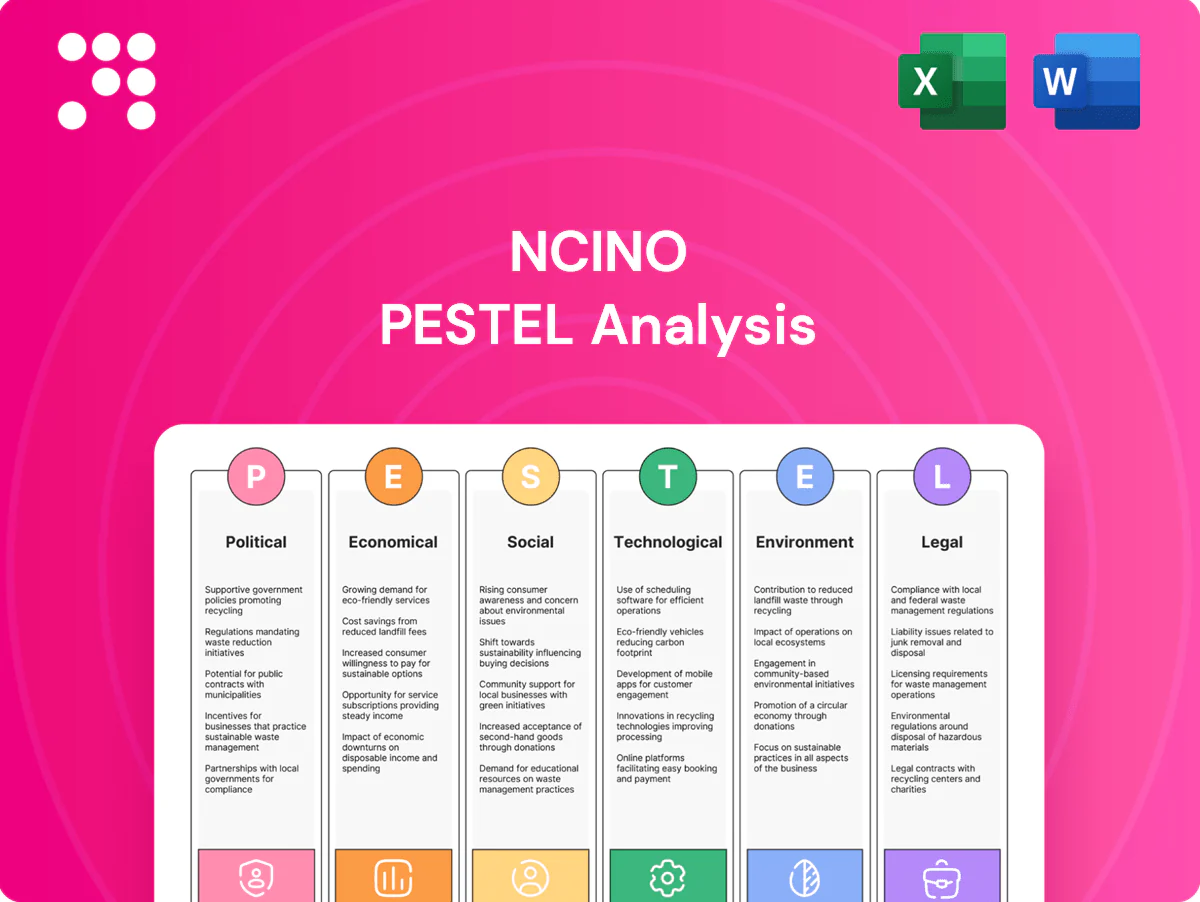
Summarized PESTLE analysis of nCino, visually segmented by category for quick interpretation and easily dropped into presentations, helps teams align on external risks and market positioning while allowing notes for regional or business-line context.
Economic factors

Rate cycles
Rate cycles reshape loan demand and margin priorities: with the fed funds rate near 5.25–5.50% in mid‑2025 banks emphasize efficiency and risk controls during tightening, while easing boosts volume and speed-to-yes importance; nCino must flex between origination‑volume and cost‑out use cases and align pricing and ROI messaging to macro moves and rate expectations to preserve deal economics.
IT spend trends
Banks expand IT budgets in profitable cycles and pull back in stress periods, forcing scrutiny of SaaS total cost versus legacy run costs. nCino wins when it demonstrates rapid payback and measurable reductions in operational expense, turning multi-year SaaS deals into defensible savings. Under cost-cutting mandates, procurement demands clear ROI timelines and contract flexibility to preserve value.

Credit cycle
Rising defaults in 2024 have driven banks to expand risk analytics and workflow controls as the 2024 SLOOS reported roughly 60% of banks tightened underwriting standards; tighter underwriting fuels demand for configurable policy-rule engines. nCino is positioned to upsell monitoring and portfolio-management modules, while downturns lengthen sales cycles but increase post-implementation stickiness and retention.

Consolidation
Bank mergers and acquisitions have accelerated platform standardization, with S&P Global noting elevated U.S. bank M&A activity across 2023–24 that drives demand for unified systems.
Post-merger rationalization typically prioritizes scalable operating platforms, making nCino’s multi-tenant architecture attractive for consolidations.
nCino must ensure smooth tenant consolidation and clear migration paths to capture large, enterprise-wide deals that can offset short-term procurement pauses.
- Procurement pauses vs enterprise wins
- Tenant consolidation + migration
- Scalable unified OS demand
- M&A-driven platform standardization
FX and expansion
Multi-currency pricing and local-currency support materially affect international margins for nCino, as currency conversion and local payment rails increase operational costs and pricing complexity. Currency volatility can compress subscription revenue when billed locally, while hedging strategies and localized contracts help stabilize cash flows and reduce translational risk. Regional economic disparities in banking modernization pace guide go-to-market focus toward higher-growth markets.
- FX pricing impact
- Volatility harms local billing
- Hedging/local contracts stabilize
- Regional GTM prioritization
Regulatory, open-banking and cloud-sovereignty pressures reshape banking SaaS stacks
Fed funds ~5.25–5.50% mid-2025 shifts bank focus between margin preservation and origination volume; nCino must toggle messaging and ROI timelines. The 2024 SLOOS showed ~60% of banks tightened underwriting, lifting demand for risk analytics and policy engines. M&A-driven platform consolidation increases enterprise deal size but lengthens procurement cycles.
| Metric | Value |
|---|---|
| Fed funds rate (mid‑2025) | 5.25–5.50% |
| Banks tightening underwriting (2024 SLOOS) | ~60% |
Same Document Delivered
nCino PESTLE Analysis
The preview shown here is the exact nCino PESTLE Analysis you’ll receive after purchase—fully formatted, professionally structured, and ready to use. No placeholders or teasers; this is the real, final file. After checkout you’ll instantly download this identical document.

Product Information
Product Information
Shipping & Returns
Shipping & Returns
Description
Your Competitive Advantage Starts with This Report
Discover how political, economic, social, technological, legal, and environmental forces shape nCino's trajectory—insights that clarify risks and reveal growth levers for investors and strategists. Purchase the full PESTLE Analysis to get the complete, actionable breakdown ready for immediate use.
Political factors
Regulatory priorities
Shifts in banking supervision and prudential policy — notably Basel III reform implementation phases running through 2023–2028 — increase demand for compliant, auditable workflows and reporting in dozens of jurisdictions. Pro-growth versus consumer-protection agendas reshape product roadmaps and audit features, driving firms to prioritize either speed or transparency. nCino must adapt rapidly to changing examination focus areas across regulators; alignment with supervisors can become either a sales catalyst or a market barrier.
Open banking push
Government-led open banking and open finance mandates (PSD2 in EU effective 2018; UK CMA9 from 2018) are forcing API-first architectures and reshape core banking integrations. Timelines and scope vary by country, with over 60 jurisdictions running formal open banking initiatives as of 2024, affecting rollout sequencing and partner roadmaps. Compliance readiness can materially differentiate vendor bids versus incumbents in RFPs. Political will determines the speed and breadth of data-sharing adoption.
Public cloud stance
National cloud sovereignty and critical infrastructure rules in regions such as the EU, India and China constrain deployment choices and push gov't workloads toward private or sovereign clouds. Global public cloud spending topped 600 billion USD in 2024 (Gartner), with AWS ~32% and Microsoft ~24% market share, so where governments endorse public cloud adoption accelerates. nCino must support multi-cloud and regional hosting to retain access as policy shifts can change TAM overnight.
Geopolitical risk
Sanctions and trade controls tightened by the US, EU and UK in 2023–2024 on semiconductors and AI hardware have reshaped bank operations and vendor footprints, forcing regional vendor splits and contract clauses. Data flows and support models now often require ring-fencing by region to meet GDPR (EU) and China PIPL (2021) requirements. nCino must maintain export-control compliance while serving global clients, increasing procurement due diligence.
- Sanctions: 2023–24 export controls (US/EU/UK)
- Data laws: GDPR, PIPL (2021)
- Operational impact: regional ring-fencing
- Procurement: elevated diligence and compliance
Public sector banking
Government-owned banks and development institutions often drive modernization waves; public banks account for about 20% of global banking assets (IMF) and procurement rules are policy-heavy, with local content and security mandates shaping deal terms. Public procurement averages roughly 12% of GDP (OECD, ~$3.5T), so winning public-sector deals can anchor regional credibility, but political cycles and 2024–25 elections strongly influence budget timing and program continuity.
- Public banks ~20% global banking assets (IMF)
- Public procurement ~12% GDP, ≈$3.5T (OECD)
- Political cycles (2024–25) affect budget timing
Regulatory, open-banking and cloud-sovereignty pressures reshape banking SaaS stacks
Regulatory shifts (Basel III 2023–28) and 60+ open-banking jurisdictions (2024) force nCino toward auditable, API-first stacks. Cloud sovereignty rules in EU/India/China and $600B global public cloud spend (2024) with AWS ~32%, MS ~24% shape hosting choices. Sanctions/export controls (US/EU/UK 2023–24) plus GDPR/PIPL increase regional ring-fencing and procurement diligence.
| Factor | Key stat |
|---|---|
| Open banking | 60+ jurisdictions (2024) |
| Public cloud spend | $600B (2024); AWS ~32%, MS ~24% |
| Public banks | ~20% global banking assets (IMF) |
What is included in the product
Detailed Word Document
Explores how external macro-environmental factors uniquely affect nCino across Political, Economic, Social, Technological, Environmental and Legal dimensions, with data-backed, region-specific insights and forward-looking scenarios to help executives, investors and consultants identify risks, opportunities and strategic actions.
Customizable Excel Spreadsheet
Summarized PESTLE analysis of nCino, visually segmented by category for quick interpretation and easily dropped into presentations, helps teams align on external risks and market positioning while allowing notes for regional or business-line context.
Economic factors
Rate cycles
Rate cycles reshape loan demand and margin priorities: with the fed funds rate near 5.25–5.50% in mid‑2025 banks emphasize efficiency and risk controls during tightening, while easing boosts volume and speed-to-yes importance; nCino must flex between origination‑volume and cost‑out use cases and align pricing and ROI messaging to macro moves and rate expectations to preserve deal economics.
IT spend trends
Banks expand IT budgets in profitable cycles and pull back in stress periods, forcing scrutiny of SaaS total cost versus legacy run costs. nCino wins when it demonstrates rapid payback and measurable reductions in operational expense, turning multi-year SaaS deals into defensible savings. Under cost-cutting mandates, procurement demands clear ROI timelines and contract flexibility to preserve value.
Credit cycle
Rising defaults in 2024 have driven banks to expand risk analytics and workflow controls as the 2024 SLOOS reported roughly 60% of banks tightened underwriting standards; tighter underwriting fuels demand for configurable policy-rule engines. nCino is positioned to upsell monitoring and portfolio-management modules, while downturns lengthen sales cycles but increase post-implementation stickiness and retention.
Consolidation
Bank mergers and acquisitions have accelerated platform standardization, with S&P Global noting elevated U.S. bank M&A activity across 2023–24 that drives demand for unified systems.
Post-merger rationalization typically prioritizes scalable operating platforms, making nCino’s multi-tenant architecture attractive for consolidations.
nCino must ensure smooth tenant consolidation and clear migration paths to capture large, enterprise-wide deals that can offset short-term procurement pauses.
- Procurement pauses vs enterprise wins
- Tenant consolidation + migration
- Scalable unified OS demand
- M&A-driven platform standardization
FX and expansion
Multi-currency pricing and local-currency support materially affect international margins for nCino, as currency conversion and local payment rails increase operational costs and pricing complexity. Currency volatility can compress subscription revenue when billed locally, while hedging strategies and localized contracts help stabilize cash flows and reduce translational risk. Regional economic disparities in banking modernization pace guide go-to-market focus toward higher-growth markets.
- FX pricing impact
- Volatility harms local billing
- Hedging/local contracts stabilize
- Regional GTM prioritization
Regulatory, open-banking and cloud-sovereignty pressures reshape banking SaaS stacks
Fed funds ~5.25–5.50% mid-2025 shifts bank focus between margin preservation and origination volume; nCino must toggle messaging and ROI timelines. The 2024 SLOOS showed ~60% of banks tightened underwriting, lifting demand for risk analytics and policy engines. M&A-driven platform consolidation increases enterprise deal size but lengthens procurement cycles.
| Metric | Value |
|---|---|
| Fed funds rate (mid‑2025) | 5.25–5.50% |
| Banks tightening underwriting (2024 SLOOS) | ~60% |
Same Document Delivered
nCino PESTLE Analysis
The preview shown here is the exact nCino PESTLE Analysis you’ll receive after purchase—fully formatted, professionally structured, and ready to use. No placeholders or teasers; this is the real, final file. After checkout you’ll instantly download this identical document.