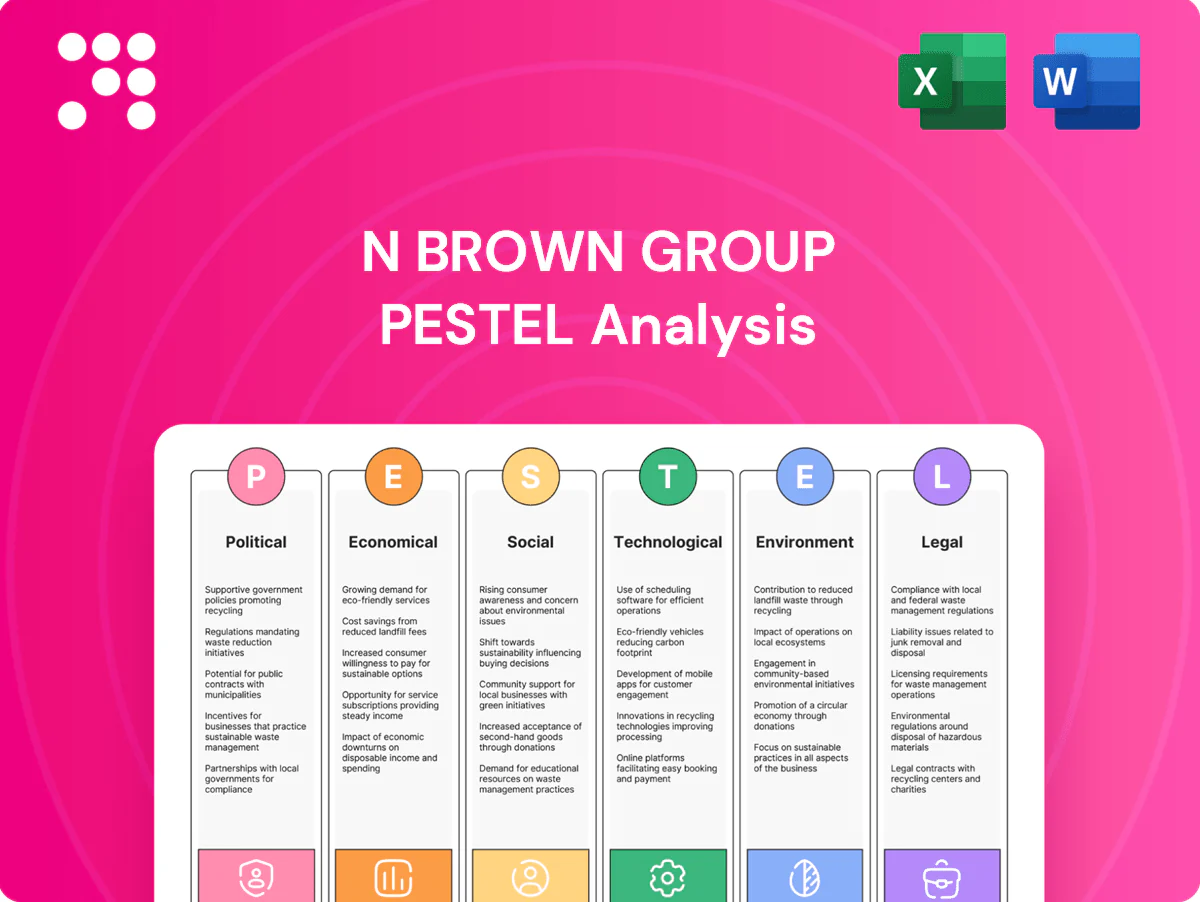
N Brown Group PESTLE Analysis

Your Competitive Advantage Starts with This Report
Unlock how political shifts, consumer trends, and regulatory pressures are reshaping N Brown Group’s competitive landscape in our concise PESTLE snapshot. Gain actionable insight into risks and opportunities that matter to investors and strategists. Purchase the full PESTLE to access the complete, editable analysis and make smarter, faster decisions.
Political factors

Post-Brexit trade rules
Post-Brexit customs declarations, new rules of origin requirements and changed VAT treatment on imports have raised landed costs and extended delivery lead times for cross‑channel shipments. N Brown must reoptimize sourcing and supplier routing to reduce tariff exposure and paperwork frictions. Ongoing policy shifts on GB‑NI movements and EU border checks continue to pose operational risks that can disrupt service levels.
Trade agreements & tariffs
UK accession to the CPTPP in 2023 and bilateral FTAs (eg UK–Australia, UK–New Zealand) can lower or raise duties on apparel and homeware, altering landed costs for N Brown. Sourcing strategy should align with tariff schedules and cumulation rules to preserve preferential margins. Active monitoring of preference utilization rates and certificate compliance can protect gross margin exposure.

Labor and wage policy
Rising National Living Wage (to £11.44/hr for 23+ from April 2024) and tighter immigration controls have increased N Brown’s warehouse/contact‑centre labour costs; UK vacancies remained high (~900,000 in 2024), pushing consideration of automation or nearshoring to control costs. Government training support and the Apprenticeship Levy (~£3bn pa) can partially offset upskilling and productivity investments.

Digital and tax policy
- VAT 20% impact on pricing
- DST 2% threshold >£500m
- OECD Pillar Two 15% increases compliance
- High-street policy may reweight e-commerce
Geopolitical supply shocks
Geopolitical supply shocks—conflicts and sanctions—can disrupt textile inputs and shipping lanes, raising lead times and costs for N Brown; over 30% of UK apparel imports originate in Asia (ONS 2023). Contingency sourcing and multi-route logistics lower exposure by enabling alternate suppliers and routes. Political risk insurance and diversified sourcing geographies improve financial resilience and continuity.
- 30%+ UK apparel imports from Asia (ONS 2023)
- Contingency sourcing reduces single-origin risk
- Political risk insurance preserves balance-sheet stability
Post‑Brexit costs, NLW £11.44, DST/OECD taxes drive nearshoring
Post‑Brexit rules, CPTPP/FTAs and VAT changes raise landed costs and compliance, forcing sourcing reroutes. NLW £11.44 Apr 2024 and ~900k vacancies in 2024 push automation/nearshoring. DST 2% >£500m and OECD Pillar Two 15% add tax complexity; 30%+ apparel imports from Asia (ONS 2023) heighten supply risk.
| Metric | Value |
|---|---|
| NLW | £11.44 |
| Vacancies 2024 | ~900k |
| DST | 2% >£500m |
| Asia imports | 30%+ |
What is included in the product
 Detailed Word Document
Concise PESTLE analysis of N Brown Group examining Political, Economic, Social, Technological, Environmental and Legal forces with data-backed trends and sector-specific examples; designed to identify strategic threats and opportunities and include forward-looking insights for scenario planning. Ready-formatted for inclusion in business plans, investor materials, or internal strategy reports.

 Customizable Excel Spreadsheet
A clean, summarized PESTLE of N Brown Group for quick reference in meetings, visually segmented by category for fast interpretation and easily dropped into presentations or shared across teams.
Economic factors

Consumer confidence & real incomes
Inflation remained elevated (~3–5% in 2024–25) and energy bills, though down from 2023 peaks, averaged roughly £1,900–2,200 pa in 2024, both squeezing real incomes and discretionary fashion spend. N Brown’s value-focused brands and promotions can defend volumes. Its core older demographic is more resilient in demand but highly price-sensitive, prioritising value over trend-led purchases.
Interest rates & credit
Higher rates raise financing costs and dampen BNPL demand; with the Bank of England base rate around 5.25% N Brown faces higher funding and lower discretionary spend. Credit underwriting requires tighter risk models, real‑time scorecards and stress testing to limit bad‑debt losses. Calibrated flexible payments—shorter terms, higher deposits and dynamic limits—help balance conversion and portfolio risk.

FX and import costs
Sterling volatility has materially affected USD-denominated fabric and freight costs for N Brown, with GBP/USD swinging roughly 8–12% year-on-year in 2023–24 and feeding directly into input prices. The group uses forward-hedging programs—typically covering around 70–90% of short-term USD exposure—to stabilise gross margin planning. Active supplier negotiations have increasingly shifted some currency risk through pricing clauses and shared-cost arrangements.

Freight and logistics inflation
Rising freight and last-mile inflation squeeze N Brown unit economics: global container rates fell from >10,000 USD/FEU in 2021 to ~1,500 USD/FEU in 2024 but remain volatile, while UK last-mile costs average ~£2.50–£3.50 per parcel, pressuring margins. Network optimisation and delivery-time segmentation can protect contribution by lowering premium delivery spend. Returns handling (~£8–£12 per fashion return) materially hits profitability.
- container-rates ~USD 1,500/FEU (2024)
- last-mile-costs £2.50–£3.50/parcel
- returns-cost £8–£12/return
Employment and wage trends
Wage growth (ONS reported regular pay growth ~6.3% in 2024) raises N Brown's operating costs but sustains consumer spending in its core UK markets; investment in fulfillment automation and robotics reduces per-unit labour inflation and improves margins; outsourcing decisions must compare total landed service cost including wage-driven uplifts, transport and quality risk.
- Wage growth: ONS ~6.3% (2024)
- Automation: lowers labour unit costs
- Outsourcing: evaluate total landed service cost
Post‑Brexit costs, NLW £11.44, DST/OECD taxes drive nearshoring
N Brown faces squeezed real incomes as UK inflation ~4% (2024) and BOE base rate ~5.25% reduce discretionary spend; value positioning and promotions protect volume. Sterling volatility (GBP/USD ±8–12% 2023–24) raises input costs despite 70–90% forward hedging. Freight volatility, last‑mile (~£2.50–£3.50/parcel) and returns (£8–£12) compress margins; wage growth ~6.3% raises operating costs.
| Metric | Value (2024) |
|---|---|
| Inflation | ~4% |
| BOE base rate | ~5.25% |
| GBP/USD volatility | ±8–12% |
| Hedging coverage | 70–90% |
| Container rates | ~USD 1,500/FEU |
| Last‑mile cost | £2.50–£3.50/parcel |
| Returns cost | £8–£12/return |
| Wage growth (ONS) | ~6.3% |
Same Document Delivered
N Brown Group PESTLE Analysis
The preview shown here is the exact N Brown Group PESTLE Analysis you’ll receive after purchase—fully formatted and ready to use. It comprehensively covers Political, Economic, Social, Technological, Legal and Environmental factors relevant to N Brown’s strategy and performance. No placeholders or teasers—this is the final file and will be available for immediate download upon checkout.

Original: $10.00
-65%$10.00
$3.50Product Information
Product Information
Shipping & Returns
Shipping & Returns
Description
Your Competitive Advantage Starts with This Report
Unlock how political shifts, consumer trends, and regulatory pressures are reshaping N Brown Group’s competitive landscape in our concise PESTLE snapshot. Gain actionable insight into risks and opportunities that matter to investors and strategists. Purchase the full PESTLE to access the complete, editable analysis and make smarter, faster decisions.
Political factors
Post-Brexit trade rules
Post-Brexit customs declarations, new rules of origin requirements and changed VAT treatment on imports have raised landed costs and extended delivery lead times for cross‑channel shipments. N Brown must reoptimize sourcing and supplier routing to reduce tariff exposure and paperwork frictions. Ongoing policy shifts on GB‑NI movements and EU border checks continue to pose operational risks that can disrupt service levels.
Trade agreements & tariffs
UK accession to the CPTPP in 2023 and bilateral FTAs (eg UK–Australia, UK–New Zealand) can lower or raise duties on apparel and homeware, altering landed costs for N Brown. Sourcing strategy should align with tariff schedules and cumulation rules to preserve preferential margins. Active monitoring of preference utilization rates and certificate compliance can protect gross margin exposure.
Labor and wage policy
Rising National Living Wage (to £11.44/hr for 23+ from April 2024) and tighter immigration controls have increased N Brown’s warehouse/contact‑centre labour costs; UK vacancies remained high (~900,000 in 2024), pushing consideration of automation or nearshoring to control costs. Government training support and the Apprenticeship Levy (~£3bn pa) can partially offset upskilling and productivity investments.
Digital and tax policy
- VAT 20% impact on pricing
- DST 2% threshold >£500m
- OECD Pillar Two 15% increases compliance
- High-street policy may reweight e-commerce
Geopolitical supply shocks
Geopolitical supply shocks—conflicts and sanctions—can disrupt textile inputs and shipping lanes, raising lead times and costs for N Brown; over 30% of UK apparel imports originate in Asia (ONS 2023). Contingency sourcing and multi-route logistics lower exposure by enabling alternate suppliers and routes. Political risk insurance and diversified sourcing geographies improve financial resilience and continuity.
- 30%+ UK apparel imports from Asia (ONS 2023)
- Contingency sourcing reduces single-origin risk
- Political risk insurance preserves balance-sheet stability
Post‑Brexit costs, NLW £11.44, DST/OECD taxes drive nearshoring
Post‑Brexit rules, CPTPP/FTAs and VAT changes raise landed costs and compliance, forcing sourcing reroutes. NLW £11.44 Apr 2024 and ~900k vacancies in 2024 push automation/nearshoring. DST 2% >£500m and OECD Pillar Two 15% add tax complexity; 30%+ apparel imports from Asia (ONS 2023) heighten supply risk.
| Metric | Value |
|---|---|
| NLW | £11.44 |
| Vacancies 2024 | ~900k |
| DST | 2% >£500m |
| Asia imports | 30%+ |
What is included in the product
Detailed Word Document
Concise PESTLE analysis of N Brown Group examining Political, Economic, Social, Technological, Environmental and Legal forces with data-backed trends and sector-specific examples; designed to identify strategic threats and opportunities and include forward-looking insights for scenario planning. Ready-formatted for inclusion in business plans, investor materials, or internal strategy reports.
Customizable Excel Spreadsheet
A clean, summarized PESTLE of N Brown Group for quick reference in meetings, visually segmented by category for fast interpretation and easily dropped into presentations or shared across teams.
Economic factors
Consumer confidence & real incomes
Inflation remained elevated (~3–5% in 2024–25) and energy bills, though down from 2023 peaks, averaged roughly £1,900–2,200 pa in 2024, both squeezing real incomes and discretionary fashion spend. N Brown’s value-focused brands and promotions can defend volumes. Its core older demographic is more resilient in demand but highly price-sensitive, prioritising value over trend-led purchases.
Interest rates & credit
Higher rates raise financing costs and dampen BNPL demand; with the Bank of England base rate around 5.25% N Brown faces higher funding and lower discretionary spend. Credit underwriting requires tighter risk models, real‑time scorecards and stress testing to limit bad‑debt losses. Calibrated flexible payments—shorter terms, higher deposits and dynamic limits—help balance conversion and portfolio risk.
FX and import costs
Sterling volatility has materially affected USD-denominated fabric and freight costs for N Brown, with GBP/USD swinging roughly 8–12% year-on-year in 2023–24 and feeding directly into input prices. The group uses forward-hedging programs—typically covering around 70–90% of short-term USD exposure—to stabilise gross margin planning. Active supplier negotiations have increasingly shifted some currency risk through pricing clauses and shared-cost arrangements.
Freight and logistics inflation
Rising freight and last-mile inflation squeeze N Brown unit economics: global container rates fell from >10,000 USD/FEU in 2021 to ~1,500 USD/FEU in 2024 but remain volatile, while UK last-mile costs average ~£2.50–£3.50 per parcel, pressuring margins. Network optimisation and delivery-time segmentation can protect contribution by lowering premium delivery spend. Returns handling (~£8–£12 per fashion return) materially hits profitability.
- container-rates ~USD 1,500/FEU (2024)
- last-mile-costs £2.50–£3.50/parcel
- returns-cost £8–£12/return
Employment and wage trends
Wage growth (ONS reported regular pay growth ~6.3% in 2024) raises N Brown's operating costs but sustains consumer spending in its core UK markets; investment in fulfillment automation and robotics reduces per-unit labour inflation and improves margins; outsourcing decisions must compare total landed service cost including wage-driven uplifts, transport and quality risk.
- Wage growth: ONS ~6.3% (2024)
- Automation: lowers labour unit costs
- Outsourcing: evaluate total landed service cost
Post‑Brexit costs, NLW £11.44, DST/OECD taxes drive nearshoring
N Brown faces squeezed real incomes as UK inflation ~4% (2024) and BOE base rate ~5.25% reduce discretionary spend; value positioning and promotions protect volume. Sterling volatility (GBP/USD ±8–12% 2023–24) raises input costs despite 70–90% forward hedging. Freight volatility, last‑mile (~£2.50–£3.50/parcel) and returns (£8–£12) compress margins; wage growth ~6.3% raises operating costs.
| Metric | Value (2024) |
|---|---|
| Inflation | ~4% |
| BOE base rate | ~5.25% |
| GBP/USD volatility | ±8–12% |
| Hedging coverage | 70–90% |
| Container rates | ~USD 1,500/FEU |
| Last‑mile cost | £2.50–£3.50/parcel |
| Returns cost | £8–£12/return |
| Wage growth (ONS) | ~6.3% |
Same Document Delivered
N Brown Group PESTLE Analysis
The preview shown here is the exact N Brown Group PESTLE Analysis you’ll receive after purchase—fully formatted and ready to use. It comprehensively covers Political, Economic, Social, Technological, Legal and Environmental factors relevant to N Brown’s strategy and performance. No placeholders or teasers—this is the final file and will be available for immediate download upon checkout.