Nautilus PESTLE Analysis

Your Competitive Advantage Starts with This Report
Gain strategic clarity with our Nautilus PESTLE analysis—three to five key external forces distilled into actionable insights that reveal political, economic, social, technological, legal, and environmental impacts on performance. Ideal for investors and strategists, it highlights risks and growth levers. Purchase the full report to access the complete, ready-to-use breakdown instantly.
Political factors

Tariffs and trade policy
Import duties on fitness equipment, especially from Asia, lift bill-of-materials and retail prices; U.S. Section 301 tariffs enacted 2018–19 included rates up to 25%, materially altering sourcing economics and margins. Shifts in U.S.-China relations and tariff lists change cost forecasts, while diversifying suppliers or nearshoring reduces exposure but requires significant time and capital. Monitoring USMCA, EU trade talks and tariff schedules is critical for cross-border sales.
Health and wellness policy
Government preventive health drives can lift home-fitness adoption as only about 23% of US adults meet aerobic and muscle-strengthening guidelines (CDC), while employer wellness programs—offered by roughly 55% of employers—and HSAs (2024 limits: $4,150 individual/$8,300 family) or FSA eligibility boost equipment/subscription affordability. Public campaigns shape seasonality and purchase timing; cuts or shifting budgets would reduce these policy tailwinds.

Fiscal and stimulus effects
Consumer durable demand, including Nautilus equipment, proved sensitive to stimulus: CARES Act payments of $1,200 (2020) and $1,400 checks (2021) and high pandemic-era savings (personal saving rate peaked 33.8% Apr 2020, fell to ~3.8% by 2023–24) lifted home fitness; withdrawal tightened discretionary spend. Targeted wellness rebates could re-energize purchases, while policy uncertainty complicates inventory and pricing planning.

Regulatory stability and market access
Political stability in Nautilus key markets supports consistent distribution and service operations, though import/export documentation and customs delays frequently extend lead times and disrupt inventory flow. Localization requirements for digital services add compliance overhead, and government procurement or partnerships represent a viable channel for institutional sales if certification and tender rules are met.
- Political stability: supports operations
- Customs/documentation: increases lead times
- Localization: higher compliance costs
- Government procurement: institutional access opportunity
Geopolitical supply chain risk
Conflicts, sanctions and port disruptions (eg Red Sea diversions) have added 5–12 days to voyages and pushed spot Asia–Europe box rates up to 30% on impacted routes in 2023–24, elevating freight costs and cycle times. Political risk has tightened supply of electronics, steel and plastics, with semiconductor lead times reaching 20–30 weeks in 2024. Firms must adopt contingency logistics and multi-region tooling; insurance and hedging in volatile corridors saw war-risk premiums spike over 200% on some routes in 2023.
- Freight impact: +5–12 days, spot rates up to +30%
- Component lead times: semiconductors 20–30 weeks (2024)
- Insurance: war-risk premiums >200% on some corridors (2023)
- Action: contingency logistics, multi-region tooling, hedging/insurance
Tariffs, Red Sea diversions and semiconductor shortages lift costs, delays and compliance burdens
Tariffs, sanctions and port disruptions raise Nautilus costs: Section 301 tariffs reached 25% (2018–19); Red Sea diversions added 5–12 days and pushed spot rates up to 30% (2023–24); semiconductor lead times 20–30 weeks (2024). Public health drives and ~55% employer wellness adoption plus HSAs (2024 limits $4,150/$8,300) support demand; localization and procurement add compliance burdens.
| Risk | Impact | 2023–24 metric |
|---|---|---|
| Tariffs | Higher COGS | Up to 25% |
| Shipping | Delay/cost | +5–12 days, +30% rates |
| Components | Capacity risk | 20–30 wk lead |
What is included in the product
 Detailed Word Document
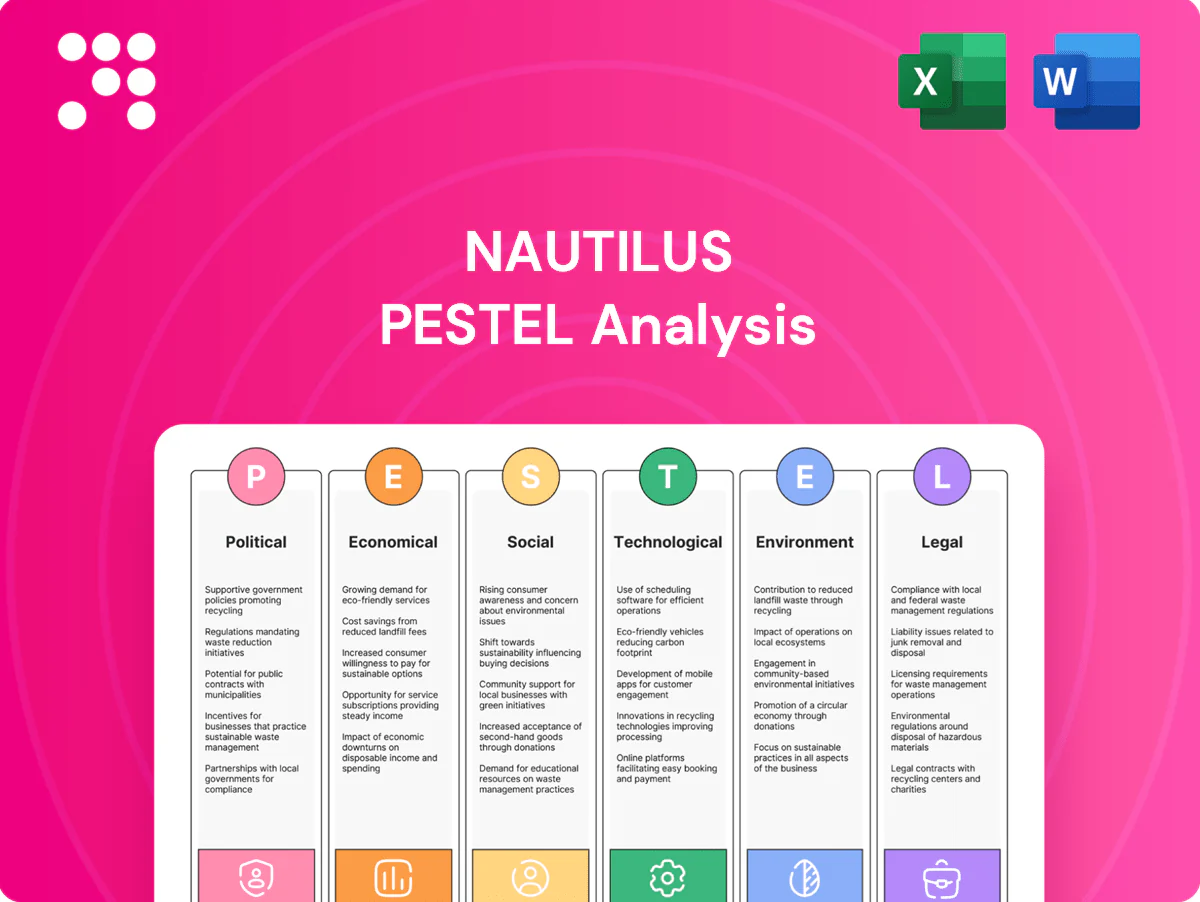
Explores how external macro-environmental factors uniquely affect Nautilus across Political, Economic, Social, Technological, Environmental, and Legal dimensions, with data-backed insights and trend analysis. Designed for executives and investors, the forward-looking PESTLE identifies risks, opportunities, and actionable implications ready for inclusion in plans and presentations.

 Customizable Excel Spreadsheet
Visually segmented by PESTLE categories for instant clarity, the Nautilus PESTLE summary condenses external risk and opportunity insights into a concise, editable format. Easily dropped into presentations or shared across teams, it speeds alignment and supports planning discussions with clear, accessible language.
Economic factors

Consumer spending and inflation
Elevated inflation (US CPI +3.4% in 2024, BLS) tightened household budgets and delayed big-ticket equipment purchases, increasing price sensitivity. High price elasticity forces heavier reliance on promotions and 0%-financing to close sales. Input-cost inflation has compressed gross margins unless offset by favorable product mix and disciplined pricing. Strong subscription attach rates stabilize recurring revenue and dampen hardware cyclicality.
Interest rates and financing
Higher policy rates (Fed funds ~5.25–5.50% in 2024) raise consumer financing costs, reducing point-of-sale loan approvals and shrinking impulse purchases; BNPL APRs often exceeded 20–30% in 2024. Corporate borrowing costs rise, constraining Nautilus inventory and R&D spend. Rate cuts typically revive demand for discretionary durables. Flexible payment plans smooth conversion across cycles.

Freight and logistics costs
Ocean and last-mile costs materially compress bulky-equipment unit economics, with last-mile often representing over 50% of final logistics spend and ocean/container volatility showing swings in excess of 50% since 2021, disrupting pricing. Building regional warehouses and better demand forecasting can cut expedites and returns roughly 25–30%, while packaging optimization can lower dimensional-weight fees by up to 40%.

Currency fluctuations
USD strength raises imported component costs and reduces translated overseas revenue; the DXY averaged about 103 in 2024 with the dollar ~4% stronger vs the euro in 2024, increasing COGS for euro-priced parts. Hedging programs can blunt volatility but add premiums, collateral and operational complexity. Pricing localization across EU, UK and Canada is required to stay competitive, and FX swings can distort quarter-to-quarter margins.
- FX index: DXY ~103 (2024)
- USD vs EUR ~+4% (2024)
- Hedging reduces volatility but adds cost
- Localization needed to protect sales and margins
Macroeconomic cycles
Recessions cut premium equipment demand and push buyers to value tiers; IMF projected global growth at about 3.2% for 2024, underscoring soft macro momentum. Recovery phases and higher housing turnover (existing-home sales dropped roughly 18% in 2023 per NAR) tend to spur replacements and upgrades. Fitness is semi-discretionary, so tight marketing ROI and inventory discipline matter; subscriptions can add counter-cyclical resilience if churn is controlled.
- IMF 2024 global growth ~3.2%
- NAR: existing-home sales down ~18% in 2023
- Shift to value tiers in downturns
- Subscriptions reduce volatility if churn
Tariffs, Red Sea diversions and semiconductor shortages lift costs, delays and compliance burdens
Elevated US inflation (CPI +3.4% in 2024) tightened consumer budgets, raising price sensitivity and reliance on promotions and 0%-financing.
Fed funds ~5.25–5.50% (2024) increased consumer financing costs and corporate borrowing, constraining inventory and R&D spend.
USD strength (DXY ~103 in 2024) lifted imported COGS; IMF global growth ~3.2% (2024) keeps demand soft while subscriptions stabilize revenue.
| Metric | 2024 value |
|---|---|
| US CPI | +3.4% |
| Fed funds | 5.25–5.50% |
| DXY | ~103 |
| IMF global growth | ~3.2% |
| Ocean volatility | >50% swings |
| Existing-home sales | −~18% (2023) |
Full Version Awaits
Nautilus PESTLE Analysis
The Nautilus PESTLE Analysis preview shown here is the exact document you’ll receive after purchase—fully formatted, professionally structured, and ready to use. No placeholders or teasers; the content and layout visible now are the final file. After checkout you’ll instantly download this same finished report.

Original: $10.00
-65%$10.00
$3.50Product Information
Product Information
Shipping & Returns
Shipping & Returns
Description
Your Competitive Advantage Starts with This Report
Gain strategic clarity with our Nautilus PESTLE analysis—three to five key external forces distilled into actionable insights that reveal political, economic, social, technological, legal, and environmental impacts on performance. Ideal for investors and strategists, it highlights risks and growth levers. Purchase the full report to access the complete, ready-to-use breakdown instantly.
Political factors
Tariffs and trade policy
Import duties on fitness equipment, especially from Asia, lift bill-of-materials and retail prices; U.S. Section 301 tariffs enacted 2018–19 included rates up to 25%, materially altering sourcing economics and margins. Shifts in U.S.-China relations and tariff lists change cost forecasts, while diversifying suppliers or nearshoring reduces exposure but requires significant time and capital. Monitoring USMCA, EU trade talks and tariff schedules is critical for cross-border sales.
Health and wellness policy
Government preventive health drives can lift home-fitness adoption as only about 23% of US adults meet aerobic and muscle-strengthening guidelines (CDC), while employer wellness programs—offered by roughly 55% of employers—and HSAs (2024 limits: $4,150 individual/$8,300 family) or FSA eligibility boost equipment/subscription affordability. Public campaigns shape seasonality and purchase timing; cuts or shifting budgets would reduce these policy tailwinds.
Fiscal and stimulus effects
Consumer durable demand, including Nautilus equipment, proved sensitive to stimulus: CARES Act payments of $1,200 (2020) and $1,400 checks (2021) and high pandemic-era savings (personal saving rate peaked 33.8% Apr 2020, fell to ~3.8% by 2023–24) lifted home fitness; withdrawal tightened discretionary spend. Targeted wellness rebates could re-energize purchases, while policy uncertainty complicates inventory and pricing planning.
Regulatory stability and market access
Political stability in Nautilus key markets supports consistent distribution and service operations, though import/export documentation and customs delays frequently extend lead times and disrupt inventory flow. Localization requirements for digital services add compliance overhead, and government procurement or partnerships represent a viable channel for institutional sales if certification and tender rules are met.
- Political stability: supports operations
- Customs/documentation: increases lead times
- Localization: higher compliance costs
- Government procurement: institutional access opportunity
Geopolitical supply chain risk
Conflicts, sanctions and port disruptions (eg Red Sea diversions) have added 5–12 days to voyages and pushed spot Asia–Europe box rates up to 30% on impacted routes in 2023–24, elevating freight costs and cycle times. Political risk has tightened supply of electronics, steel and plastics, with semiconductor lead times reaching 20–30 weeks in 2024. Firms must adopt contingency logistics and multi-region tooling; insurance and hedging in volatile corridors saw war-risk premiums spike over 200% on some routes in 2023.
- Freight impact: +5–12 days, spot rates up to +30%
- Component lead times: semiconductors 20–30 weeks (2024)
- Insurance: war-risk premiums >200% on some corridors (2023)
- Action: contingency logistics, multi-region tooling, hedging/insurance
Tariffs, Red Sea diversions and semiconductor shortages lift costs, delays and compliance burdens
Tariffs, sanctions and port disruptions raise Nautilus costs: Section 301 tariffs reached 25% (2018–19); Red Sea diversions added 5–12 days and pushed spot rates up to 30% (2023–24); semiconductor lead times 20–30 weeks (2024). Public health drives and ~55% employer wellness adoption plus HSAs (2024 limits $4,150/$8,300) support demand; localization and procurement add compliance burdens.
| Risk | Impact | 2023–24 metric |
|---|---|---|
| Tariffs | Higher COGS | Up to 25% |
| Shipping | Delay/cost | +5–12 days, +30% rates |
| Components | Capacity risk | 20–30 wk lead |
What is included in the product
Detailed Word Document
Explores how external macro-environmental factors uniquely affect Nautilus across Political, Economic, Social, Technological, Environmental, and Legal dimensions, with data-backed insights and trend analysis. Designed for executives and investors, the forward-looking PESTLE identifies risks, opportunities, and actionable implications ready for inclusion in plans and presentations.
Customizable Excel Spreadsheet
Visually segmented by PESTLE categories for instant clarity, the Nautilus PESTLE summary condenses external risk and opportunity insights into a concise, editable format. Easily dropped into presentations or shared across teams, it speeds alignment and supports planning discussions with clear, accessible language.
Economic factors
Consumer spending and inflation
Elevated inflation (US CPI +3.4% in 2024, BLS) tightened household budgets and delayed big-ticket equipment purchases, increasing price sensitivity. High price elasticity forces heavier reliance on promotions and 0%-financing to close sales. Input-cost inflation has compressed gross margins unless offset by favorable product mix and disciplined pricing. Strong subscription attach rates stabilize recurring revenue and dampen hardware cyclicality.
Interest rates and financing
Higher policy rates (Fed funds ~5.25–5.50% in 2024) raise consumer financing costs, reducing point-of-sale loan approvals and shrinking impulse purchases; BNPL APRs often exceeded 20–30% in 2024. Corporate borrowing costs rise, constraining Nautilus inventory and R&D spend. Rate cuts typically revive demand for discretionary durables. Flexible payment plans smooth conversion across cycles.
Freight and logistics costs
Ocean and last-mile costs materially compress bulky-equipment unit economics, with last-mile often representing over 50% of final logistics spend and ocean/container volatility showing swings in excess of 50% since 2021, disrupting pricing. Building regional warehouses and better demand forecasting can cut expedites and returns roughly 25–30%, while packaging optimization can lower dimensional-weight fees by up to 40%.
Currency fluctuations
USD strength raises imported component costs and reduces translated overseas revenue; the DXY averaged about 103 in 2024 with the dollar ~4% stronger vs the euro in 2024, increasing COGS for euro-priced parts. Hedging programs can blunt volatility but add premiums, collateral and operational complexity. Pricing localization across EU, UK and Canada is required to stay competitive, and FX swings can distort quarter-to-quarter margins.
- FX index: DXY ~103 (2024)
- USD vs EUR ~+4% (2024)
- Hedging reduces volatility but adds cost
- Localization needed to protect sales and margins
Macroeconomic cycles
Recessions cut premium equipment demand and push buyers to value tiers; IMF projected global growth at about 3.2% for 2024, underscoring soft macro momentum. Recovery phases and higher housing turnover (existing-home sales dropped roughly 18% in 2023 per NAR) tend to spur replacements and upgrades. Fitness is semi-discretionary, so tight marketing ROI and inventory discipline matter; subscriptions can add counter-cyclical resilience if churn is controlled.
- IMF 2024 global growth ~3.2%
- NAR: existing-home sales down ~18% in 2023
- Shift to value tiers in downturns
- Subscriptions reduce volatility if churn
Tariffs, Red Sea diversions and semiconductor shortages lift costs, delays and compliance burdens
Elevated US inflation (CPI +3.4% in 2024) tightened consumer budgets, raising price sensitivity and reliance on promotions and 0%-financing.
Fed funds ~5.25–5.50% (2024) increased consumer financing costs and corporate borrowing, constraining inventory and R&D spend.
USD strength (DXY ~103 in 2024) lifted imported COGS; IMF global growth ~3.2% (2024) keeps demand soft while subscriptions stabilize revenue.
| Metric | 2024 value |
|---|---|
| US CPI | +3.4% |
| Fed funds | 5.25–5.50% |
| DXY | ~103 |
| IMF global growth | ~3.2% |
| Ocean volatility | >50% swings |
| Existing-home sales | −~18% (2023) |
Full Version Awaits
Nautilus PESTLE Analysis
The Nautilus PESTLE Analysis preview shown here is the exact document you’ll receive after purchase—fully formatted, professionally structured, and ready to use. No placeholders or teasers; the content and layout visible now are the final file. After checkout you’ll instantly download this same finished report.