Mountaire PESTLE Analysis

Your Shortcut to Market Insight Starts Here
Get actionable insight with our Mountaire PESTLE Analysis—three to five expert-level perspectives on political, economic, social, technological, legal, and environmental forces shaping the company. Perfect for investors and strategists, it highlights risks and growth levers. Purchase the full, editable report to access the complete deep-dive and immediate decision-ready intelligence.
Political factors

USDA and farm policy direction
USDA and state agriculture policies determine processing standards, inspection intensity, and grower program dynamics; USDA funding in FY2024 (~$25–30B for farm/food programs) directly affects inspection resources. Farm bill shifts alter crop insurance and feed incentives—crop insurance covered roughly 350 million acres in 2023. Changes in rural development funding (billions annually) influence plant siting and infrastructure, and policy stability lowers compliance risk and capex uncertainty.
Trade tariffs and export access
Chicken exports hinge on tariff levels, quotas and sanitary barriers in key markets, affecting access for dark meat and byproducts and forcing rapid logistical shifts. Diplomatic moves can instantly open or close channels, while retaliatory tariffs compress margins and redirect product to the domestic market. Trade promotion programs such as USDA MAP, funded at about $200 million annually, help finance market diversification.

Labor and immigration stance
Processing plants like Mountaire depend on stable labor availability, and DOL reports over 330,000 H-2A agricultural labor certifications in 2023, underscoring reliance on guestworker programs.
Changes in immigration enforcement intensity and H-2A/H-2B access directly affect staffing levels and overtime exposures.
Political pressure to raise wage floors (federal minimum wage still $7.25) creates structural cost risks for processing margins.
Targeted workforce development grants can partially offset training and recruitment expenses.

State-local incentives and zoning
State and local tax abatements, infrastructure grants, and permitting timelines materially shape Mountaire’s facility expansion: zoning rules dictate siting of hatcheries, mills and processing plants, while local political support often depends on job creation commitments and environmental mitigation guarantees; permitting delays raise project carrying costs and can close critical demand windows.
- Tax abatements: affect capex payback
- Infrastructure grants: reduce upfront costs
- Permitting timelines: drive carrying costs
- Zoning: limits site options for mills/hatcheries
- Local support: tied to jobs and env assurances
Animal health and disease response
Government biosecurity protocols and indemnity programs shape Mountaire’s outbreak resilience; coordinated responses to avian influenza dictate culling scale, movement controls and restart timing—USDA reported over 58 million commercial poultry affected in the 2022–23 HPAI outbreak, pressuring supply and margins. Interstate transport rules can create bottlenecks; effective public-private coordination lowers systemic shock risk.
- Biosecurity protocols: reduce outbreak risk
- Indemnity programs: aid recovery capacity
- Culling & movement controls: affect throughput
- Interstate rules: potential supply chokepoints
- Public-private coordination: mitigates systemic impact
Farm policy, $25-30B USDA support, $200M exports; H-2A ~330k, HPAI 58M
Federal farm policy, USDA funding (~$25–30B FY2024), and trade rules drive inspection, input costs and export access; MAP export support ~$200M aids market diversification. Reliance on guestworker programs (H-2A ~330k certifications in 2023) and biosecurity (58M poultry lost 2022–23) create staffing and disease-risk exposures.
| Metric | 2023–2024 |
|---|---|
| USDA farm/food funding | $25–30B |
| MAP export support | $200M |
| H-2A certs | ~330,000 |
| HPAI impact | ~58M birds |
What is included in the product
 Detailed Word Document
Explores how Political, Economic, Social, Technological, Environmental and Legal forces uniquely affect Mountaire, with data‑backed trends and forward‑looking insights designed for executives, consultants and investors and formatted for direct inclusion in plans, decks or reports.

 Customizable Excel Spreadsheet
Condenses Mountaire's full PESTLE into a clean, shareable brief that highlights regulatory, supply-chain and market risks for quick meeting reference and easy insertion into presentations.
Economic factors

Feed grain price volatility
Corn and soybean meal are the primary drivers of unit feed costs across Mountaire’s integrated system; CME corn futures traded roughly between 4 and 7 USD/bu in 2023–24 while soybean meal ranged near 300–450 USD/ton in 2024.
Consumer demand and pricing
Protein demand tracks income, menu trends and retail promotions, with US per‑capita broiler disappearance at 100.9 lbs in 2023 (USDA), driving sensitivity to price swings. Shifts from value cuts to further‑processed SKUs change mix and margins as processed products carry higher yields and price premiums. Elasticity is higher in foodservice than retail, while growing private‑label penetration constrains price realization.

Logistics and fuel costs
On-highway diesel averaged about $3.95/gal in mid‑2025 and DAT national linehaul ran near $2.10/mile, directly lifting live‑haul, inbound grain and outbound distribution costs. Network optimization programs have cut empty miles ~15–20% and dwell times up to 25%, while rail shortages in some corridors have caused feed‑mill delays up to 48 hours. Fuel surcharges (commonly 6–12%) and fixed fuel contracts covering ~70% of miles help stabilize expense volatility.

Industry capacity and competition
Industry capacity and competition shape commodity chicken pricing cycles as utilization swings; U.S. broiler production reached about 46.5 billion pounds in 2024 (USDA), so regional plant expansions or closures quickly reallocate supply and pressure prices, while scale drives procurement and processing cost advantages and consolidation tightens grower and labor markets.
- Utilization impacts price cycles
- 2024 US broiler output ~46.5B lbs
- Expansion/closures reallocate regional supply
- Scale = procurement/processing efficiency
- Consolidation tightens grower and labor markets
Exchange rates and export mix
Stronger USD in 2024–25 has dampened export competitiveness for leg quarters and paws, squeezing margins on international shipments and shifting some volumes back to domestic channels. Currency swings alter the relative profitability of domestic versus foreign sales, prompting adjustments in pricing and order allocation. Mountaires hedging policies for committed volumes mitigate short-term FX risk while diversified market exposure smooths demand cycles across regions.
- FX pressure on export margins
- Hedging limits spot volatility
- Domestic sales gain relative margin
- Diversified markets reduce volatility
Farm policy, $25-30B USDA support, $200M exports; H-2A ~330k, HPAI 58M
Corn $4–7/bu (2023–24), soybean meal $300–450/ton (2024) drive feed cost; US broiler output ~46.5B lbs (2024) makes utilization key. Diesel ~$3.95/gal mid‑2025, DAT linehaul ~$2.10/mi raise transport; fuel contracts cover ~70% miles. Stronger USD in 2024–25 weakened export margins; hedging cushions FX.
| Metric | Value |
|---|---|
| Corn | $4–7/bu |
| Soymeal | $300–450/ton |
| Broiler output | 46.5B lbs (2024) |
| Diesel | $3.95/gal |
Same Document Delivered
Mountaire PESTLE Analysis
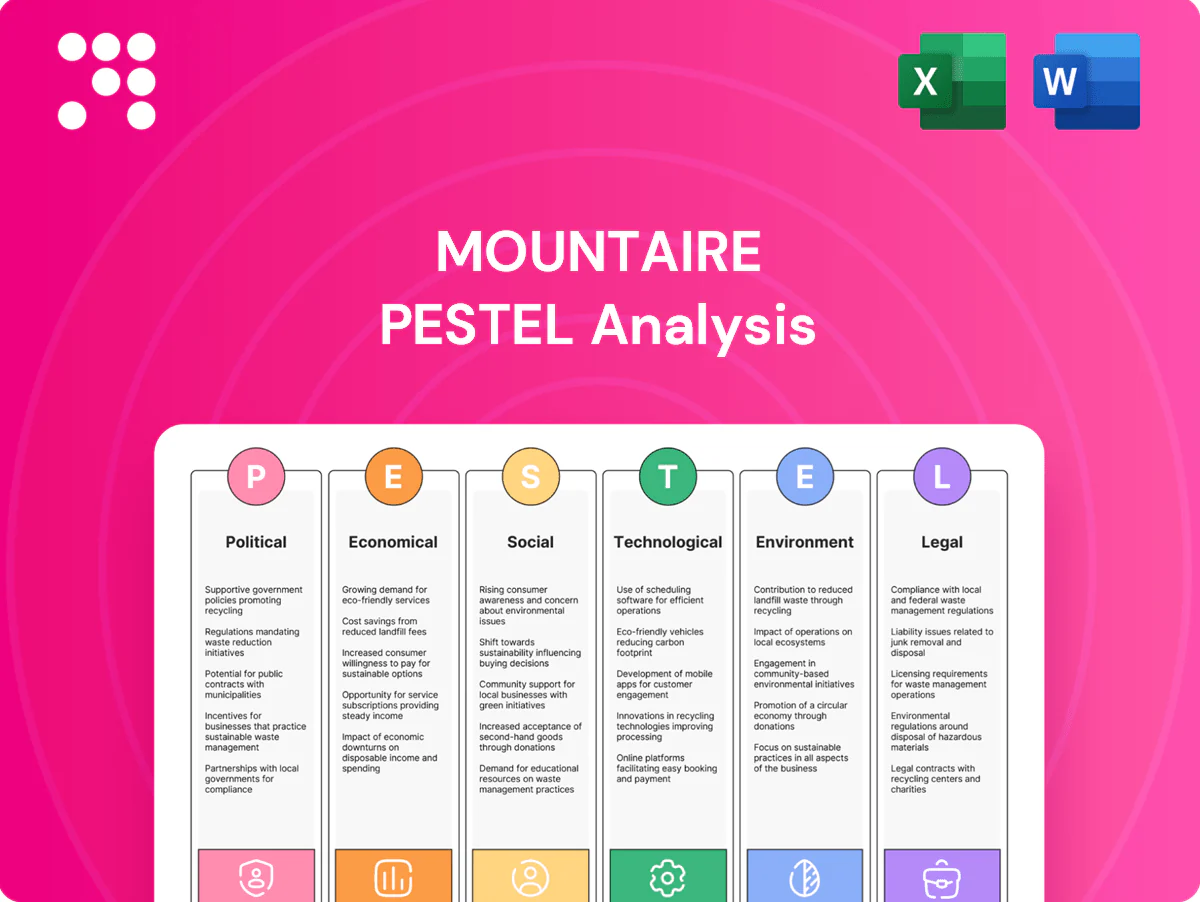
The preview shown here is the exact Mountaire PESTLE Analysis you’ll receive after purchase—fully formatted and ready to use. This screenshot reflects the real, final file with complete content and professional structure. No placeholders or teasers—download the identical document immediately after checkout.

Original: $10.00
-65%$10.00
$3.50Product Information
Product Information
Shipping & Returns
Shipping & Returns
Description
Your Shortcut to Market Insight Starts Here
Get actionable insight with our Mountaire PESTLE Analysis—three to five expert-level perspectives on political, economic, social, technological, legal, and environmental forces shaping the company. Perfect for investors and strategists, it highlights risks and growth levers. Purchase the full, editable report to access the complete deep-dive and immediate decision-ready intelligence.
Political factors
USDA and farm policy direction
USDA and state agriculture policies determine processing standards, inspection intensity, and grower program dynamics; USDA funding in FY2024 (~$25–30B for farm/food programs) directly affects inspection resources. Farm bill shifts alter crop insurance and feed incentives—crop insurance covered roughly 350 million acres in 2023. Changes in rural development funding (billions annually) influence plant siting and infrastructure, and policy stability lowers compliance risk and capex uncertainty.
Trade tariffs and export access
Chicken exports hinge on tariff levels, quotas and sanitary barriers in key markets, affecting access for dark meat and byproducts and forcing rapid logistical shifts. Diplomatic moves can instantly open or close channels, while retaliatory tariffs compress margins and redirect product to the domestic market. Trade promotion programs such as USDA MAP, funded at about $200 million annually, help finance market diversification.
Labor and immigration stance
Processing plants like Mountaire depend on stable labor availability, and DOL reports over 330,000 H-2A agricultural labor certifications in 2023, underscoring reliance on guestworker programs.
Changes in immigration enforcement intensity and H-2A/H-2B access directly affect staffing levels and overtime exposures.
Political pressure to raise wage floors (federal minimum wage still $7.25) creates structural cost risks for processing margins.
Targeted workforce development grants can partially offset training and recruitment expenses.
State-local incentives and zoning
State and local tax abatements, infrastructure grants, and permitting timelines materially shape Mountaire’s facility expansion: zoning rules dictate siting of hatcheries, mills and processing plants, while local political support often depends on job creation commitments and environmental mitigation guarantees; permitting delays raise project carrying costs and can close critical demand windows.
- Tax abatements: affect capex payback
- Infrastructure grants: reduce upfront costs
- Permitting timelines: drive carrying costs
- Zoning: limits site options for mills/hatcheries
- Local support: tied to jobs and env assurances
Animal health and disease response
Government biosecurity protocols and indemnity programs shape Mountaire’s outbreak resilience; coordinated responses to avian influenza dictate culling scale, movement controls and restart timing—USDA reported over 58 million commercial poultry affected in the 2022–23 HPAI outbreak, pressuring supply and margins. Interstate transport rules can create bottlenecks; effective public-private coordination lowers systemic shock risk.
- Biosecurity protocols: reduce outbreak risk
- Indemnity programs: aid recovery capacity
- Culling & movement controls: affect throughput
- Interstate rules: potential supply chokepoints
- Public-private coordination: mitigates systemic impact
Farm policy, $25-30B USDA support, $200M exports; H-2A ~330k, HPAI 58M
Federal farm policy, USDA funding (~$25–30B FY2024), and trade rules drive inspection, input costs and export access; MAP export support ~$200M aids market diversification. Reliance on guestworker programs (H-2A ~330k certifications in 2023) and biosecurity (58M poultry lost 2022–23) create staffing and disease-risk exposures.
| Metric | 2023–2024 |
|---|---|
| USDA farm/food funding | $25–30B |
| MAP export support | $200M |
| H-2A certs | ~330,000 |
| HPAI impact | ~58M birds |
What is included in the product
Detailed Word Document
Explores how Political, Economic, Social, Technological, Environmental and Legal forces uniquely affect Mountaire, with data‑backed trends and forward‑looking insights designed for executives, consultants and investors and formatted for direct inclusion in plans, decks or reports.
Customizable Excel Spreadsheet
Condenses Mountaire's full PESTLE into a clean, shareable brief that highlights regulatory, supply-chain and market risks for quick meeting reference and easy insertion into presentations.
Economic factors
Feed grain price volatility
Corn and soybean meal are the primary drivers of unit feed costs across Mountaire’s integrated system; CME corn futures traded roughly between 4 and 7 USD/bu in 2023–24 while soybean meal ranged near 300–450 USD/ton in 2024.
Consumer demand and pricing
Protein demand tracks income, menu trends and retail promotions, with US per‑capita broiler disappearance at 100.9 lbs in 2023 (USDA), driving sensitivity to price swings. Shifts from value cuts to further‑processed SKUs change mix and margins as processed products carry higher yields and price premiums. Elasticity is higher in foodservice than retail, while growing private‑label penetration constrains price realization.
Logistics and fuel costs
On-highway diesel averaged about $3.95/gal in mid‑2025 and DAT national linehaul ran near $2.10/mile, directly lifting live‑haul, inbound grain and outbound distribution costs. Network optimization programs have cut empty miles ~15–20% and dwell times up to 25%, while rail shortages in some corridors have caused feed‑mill delays up to 48 hours. Fuel surcharges (commonly 6–12%) and fixed fuel contracts covering ~70% of miles help stabilize expense volatility.
Industry capacity and competition
Industry capacity and competition shape commodity chicken pricing cycles as utilization swings; U.S. broiler production reached about 46.5 billion pounds in 2024 (USDA), so regional plant expansions or closures quickly reallocate supply and pressure prices, while scale drives procurement and processing cost advantages and consolidation tightens grower and labor markets.
- Utilization impacts price cycles
- 2024 US broiler output ~46.5B lbs
- Expansion/closures reallocate regional supply
- Scale = procurement/processing efficiency
- Consolidation tightens grower and labor markets
Exchange rates and export mix
Stronger USD in 2024–25 has dampened export competitiveness for leg quarters and paws, squeezing margins on international shipments and shifting some volumes back to domestic channels. Currency swings alter the relative profitability of domestic versus foreign sales, prompting adjustments in pricing and order allocation. Mountaires hedging policies for committed volumes mitigate short-term FX risk while diversified market exposure smooths demand cycles across regions.
- FX pressure on export margins
- Hedging limits spot volatility
- Domestic sales gain relative margin
- Diversified markets reduce volatility
Farm policy, $25-30B USDA support, $200M exports; H-2A ~330k, HPAI 58M
Corn $4–7/bu (2023–24), soybean meal $300–450/ton (2024) drive feed cost; US broiler output ~46.5B lbs (2024) makes utilization key. Diesel ~$3.95/gal mid‑2025, DAT linehaul ~$2.10/mi raise transport; fuel contracts cover ~70% miles. Stronger USD in 2024–25 weakened export margins; hedging cushions FX.
| Metric | Value |
|---|---|
| Corn | $4–7/bu |
| Soymeal | $300–450/ton |
| Broiler output | 46.5B lbs (2024) |
| Diesel | $3.95/gal |
Same Document Delivered
Mountaire PESTLE Analysis
The preview shown here is the exact Mountaire PESTLE Analysis you’ll receive after purchase—fully formatted and ready to use. This screenshot reflects the real, final file with complete content and professional structure. No placeholders or teasers—download the identical document immediately after checkout.