Momentum Metropolitan Holdings PESTLE Analysis

Your Competitive Advantage Starts with This Report
Our PESTLE Analysis of Momentum Metropolitan Holdings reveals how political shifts, economic pressures, and technological change are reshaping its risk and growth profile. Packed with actionable insights for investors and strategists, it highlights regulatory and ESG risks plus market opportunities. Purchase the full, downloadable analysis to get the complete, editable report now.
Political factors

Regulatory oversight and policy direction
The Prudential Authority (established 2018) and FSCA drive capital, conduct and consumer-protection rules that directly shape Momentum Metropolitan product design and pricing. National Treasury’s Financial Sector Masterplan (2019) and ongoing inclusion/stability priorities require alignment on distribution and reserve treatment. Changes to solvency rules or reserve requirements can materially affect capital needs, especially within SARB’s macro framework (inflation target band 3–6%).
B-BBEE and transformation imperatives
B-BBEE targets shape Momentum Metropolitan’s ownership, procurement, skills development and socio-economic initiatives through the formal scorecard elements of ownership, management control, skills development, enterprise and supplier development. Strong B-BBEE scores directly influence access to public-sector contracts, strategic partnerships and brand equity. Momentum Metropolitan must show measurable, auditable progress to retain competitiveness and regulatory legitimacy. Non-compliance risks lost access to roughly R1 trillion in South African public procurement and reputational drag.

National Health Insurance trajectory
The NHI trajectory could materially reshape private health funding demand and risk pools, threatening premiums from South Africa’s c.8.8 million private medical scheme members (CMS 2023). Health risk management and employee-benefits lines may need product redesign or pivots toward complementary cover as public provision expands. Policy clarity and rollout pace will determine timing and magnitude of impact, so scenario planning is essential to manage revenue-mix risk.

Political stability and governance quality
Domestic governance and weakened service delivery, with public debt near 73% of GDP and unemployment around 32% in 2024, raise investor caution and elevate operating costs for Momentum Metropolitan; fiscal pressures squeeze margins and capital costs. Policy continuity supports insurance penetration under 10% of GDP and steady asset-management inflows, while protests can disrupt branches, claims processing and collections; regional operations add country-specific political-risk complexity.
- Domestic governance — higher fiscal strain (debt ~73% GDP, 2024)
- Service delivery risk — operational disruptions, claims/collections
- Policy continuity — supports long-term penetration & AUM flows
- Regional exposure — diversification but added political complexity
Public infrastructure and state capacity
Public infrastructure and state capacity—energy reliability, crime prevention and public health—directly affect Momentum Metropolitan’s claims, expenses and field operations. Persistent load-shedding and logistics bottlenecks raise operational risk and business-interruption needs, driving contingency and resilience investments. South Africa records a murder rate of 36.4/100k (Stats SA 2022) and health spending ≈8.5% of GDP (World Bank 2022).
- Energy: increased BI exposure from load-shedding
- Security: higher claims from crime-related losses
- Health: system capacity affects medical claim frequency
- Strategy: invest in resilience and advocate infrastructure reform
Capital pressure: 3–6% inflation shifts, ~R1tn procurement access and NHI risk to 8.8m members
Momentum Metropolitan must align with Prudential Authority/FSCA rules and the Financial Sector Masterplan; solvency/reserve changes within SARB’s 3–6% inflation band can materially alter capital needs. B-BBEE and access to ~R1tn public procurement plus NHI risk to 8.8m private scheme members drive product/distribution shifts. Fiscal strain (debt ~73% GDP, unemployment ~32% in 2024) and load-shedding raise operating and claims costs.
| Indicator | Value | Implication |
|---|---|---|
| Public debt | ~73% GDP (2024) | Higher capital cost |
| Unemployment | ~32% (2024) | Lower premium affordability |
| Private schemes | 8.8m members (CMS 2023) | NHI exposure |
| Public procurement | ~R1tn | B-BBEE access critical |
What is included in the product
 Detailed Word Document
Explores how external macro-environmental factors across Political, Economic, Social, Technological, Environmental and Legal dimensions uniquely shape Momentum Metropolitan Holdings, with data-backed trends and forward-looking insights to help executives and investors identify risks, opportunities and strategic responses aligned to regional market and regulatory dynamics.

 Customizable Excel Spreadsheet
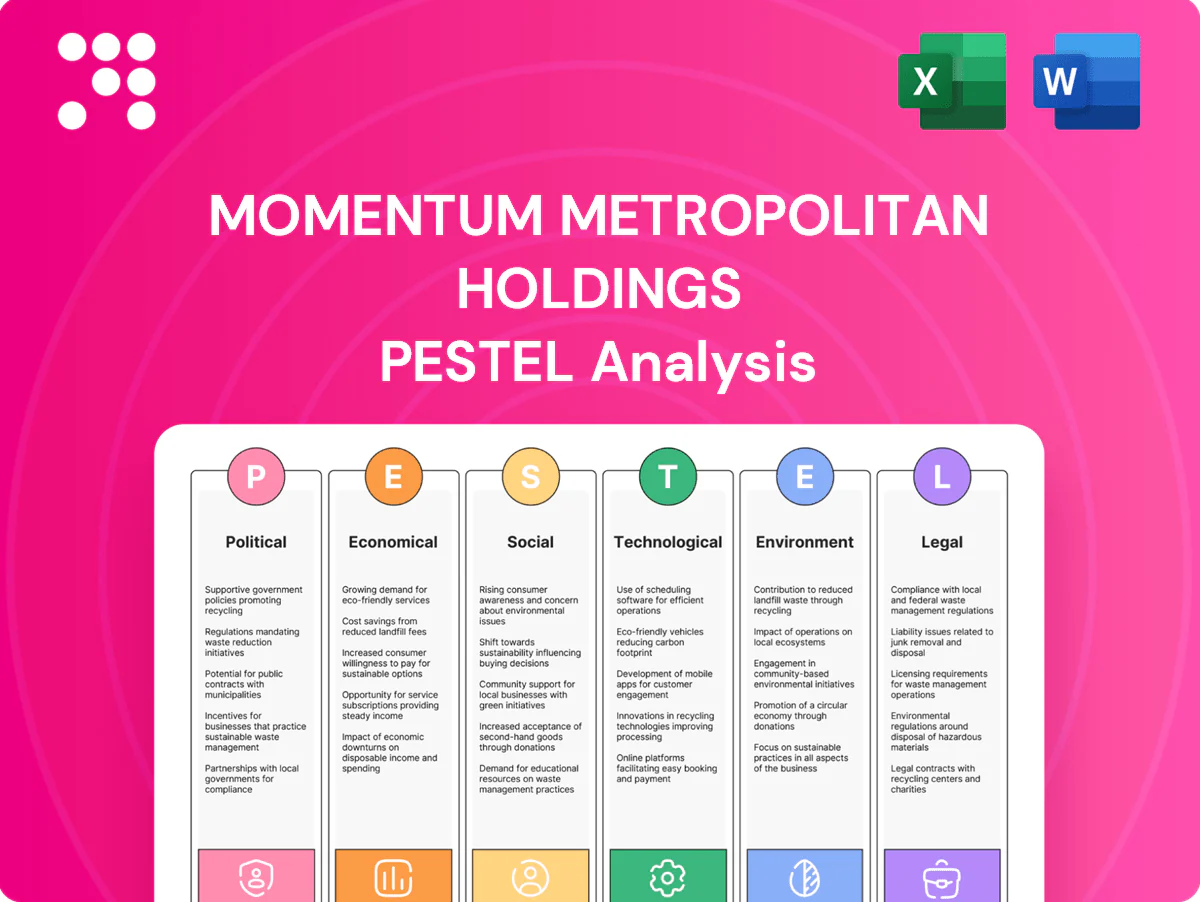
A concise, visually segmented PESTLE summary of Momentum Metropolitan Holdings that can be dropped into presentations, edited with notes by region or business line, and easily shared across teams to streamline planning, risk discussions, and client reports.
Economic factors

GDP growth and employment dynamics
South Africa's sluggish GDP growth—around 0.6% in 2024 per IMF estimates—and very high unemployment (32.9% Q4 2024, Stats SA) constrain disposable income and premium affordability. Corporate benefits and retirement contribution flows track business-cycle swings and payroll growth, which remained muted in 2024. Momentum Metropolitan’s top-line is sensitive to formal-sector payrolls and public/private employment expansion. Diversification and product tiering can smooth cycle exposure.
Interest rates and yield curve
Higher interest rates and a steeper yield curve (South African 10-year yield ~10.5% and SARB policy rate 8.25% at end-2024) lift Momentum Metropolitan’s net investment income but raise discount rates used in liability valuations, compressing some embedded values. Elevated rates can pressure lapse and loan affordability, so asset-liability matching is critical to control duration and reinvestment risk. Product guarantees and bonuses must be repriced to reflect curve shifts and higher discount rates.

Inflation and cost-of-living pressure
Rising inflation erodes real incomes—South Africa's CPI averaged about 5.5% in 2024—pushing policy lapses and downgrades as households cut cover. Claims costs, notably healthcare (private medical inflation ~7.5% in 2024) and motor parts, escalate with CPI, pressuring loss ratios. Momentum Metropolitan preserves margins via disciplined pricing, benefits management and indexation features. Tight expense control and targeted product adjustments sustain profitability.

Currency volatility and offshore exposure
Rand volatility affects imported medical inputs and offshore asset values; USD/ZAR traded near 18.6 in mid-2025, amplifying cost pressures and reducing rand-denominated asset returns. FX swings create earnings translation volatility for Momentum Metropolitan's international operations, while hedging policies trade off premium costs versus protection of solvency ratios. Client demand for hard-currency solutions typically rises during weak-rand periods.
- USD/ZAR ~18.6 (mid-2025)
- Imported medical-cost exposure increases with rand weakness
- Hedging balances cost vs solvency protection
- Higher demand for hard-currency products in weak rand
Savings rate and insurance penetration
Low household savings (around 2.5% of disposable income in 2023) and insurance penetration near 6% of GDP (Swiss Re 2024) indicate long-run growth headroom for Momentum Metropolitan, while financial inclusion gains can expand the addressable market.
- Focus: simpler, low-premium digital products to capture mass market
- Distribution: financial inclusion initiatives widen reach
- Retention: education and advisor support boost persistency and cross-sell
Capital pressure: 3–6% inflation shifts, ~R1tn procurement access and NHI risk to 8.8m members
Weak GDP (0.6% 2024) and high unemployment (32.9% Q4 2024) constrain premiums and benefits uptake. Higher rates (SARB 8.25% end-2024; 10y ~10.5%) boost investment income but raise valuation discounting and affordability pressure. Inflation (~5.5% 2024) and USD/ZAR ~18.6 (mid-2025) increase claims and imported costs; low savings (2.5% 2023) and 6% insurance penetration signal long-run growth room.
| Metric | Value |
|---|---|
| GDP 2024 | 0.6% |
| Unemployment | 32.9% Q4 2024 |
| SARB / 10y | 8.25% / 10.5% |
| CPI / Med inflation | 5.5% / 7.5% |
| USD/ZAR | ~18.6 (mid-2025) |
| Savings / Penetration | 2.5% / 6% |
What You See Is What You Get
Momentum Metropolitan Holdings PESTLE Analysis
This Momentum Metropolitan Holdings PESTLE Analysis preview is the exact document you’ll receive after purchase—fully formatted and ready to use. It contains complete political, economic, social, technological, legal and environmental assessments with actionable insights. No placeholders, no surprises.

Product Information
Product Information
Shipping & Returns
Shipping & Returns
Description
Your Competitive Advantage Starts with This Report
Our PESTLE Analysis of Momentum Metropolitan Holdings reveals how political shifts, economic pressures, and technological change are reshaping its risk and growth profile. Packed with actionable insights for investors and strategists, it highlights regulatory and ESG risks plus market opportunities. Purchase the full, downloadable analysis to get the complete, editable report now.
Political factors
Regulatory oversight and policy direction
The Prudential Authority (established 2018) and FSCA drive capital, conduct and consumer-protection rules that directly shape Momentum Metropolitan product design and pricing. National Treasury’s Financial Sector Masterplan (2019) and ongoing inclusion/stability priorities require alignment on distribution and reserve treatment. Changes to solvency rules or reserve requirements can materially affect capital needs, especially within SARB’s macro framework (inflation target band 3–6%).
B-BBEE and transformation imperatives
B-BBEE targets shape Momentum Metropolitan’s ownership, procurement, skills development and socio-economic initiatives through the formal scorecard elements of ownership, management control, skills development, enterprise and supplier development. Strong B-BBEE scores directly influence access to public-sector contracts, strategic partnerships and brand equity. Momentum Metropolitan must show measurable, auditable progress to retain competitiveness and regulatory legitimacy. Non-compliance risks lost access to roughly R1 trillion in South African public procurement and reputational drag.
National Health Insurance trajectory
The NHI trajectory could materially reshape private health funding demand and risk pools, threatening premiums from South Africa’s c.8.8 million private medical scheme members (CMS 2023). Health risk management and employee-benefits lines may need product redesign or pivots toward complementary cover as public provision expands. Policy clarity and rollout pace will determine timing and magnitude of impact, so scenario planning is essential to manage revenue-mix risk.
Political stability and governance quality
Domestic governance and weakened service delivery, with public debt near 73% of GDP and unemployment around 32% in 2024, raise investor caution and elevate operating costs for Momentum Metropolitan; fiscal pressures squeeze margins and capital costs. Policy continuity supports insurance penetration under 10% of GDP and steady asset-management inflows, while protests can disrupt branches, claims processing and collections; regional operations add country-specific political-risk complexity.
- Domestic governance — higher fiscal strain (debt ~73% GDP, 2024)
- Service delivery risk — operational disruptions, claims/collections
- Policy continuity — supports long-term penetration & AUM flows
- Regional exposure — diversification but added political complexity
Public infrastructure and state capacity
Public infrastructure and state capacity—energy reliability, crime prevention and public health—directly affect Momentum Metropolitan’s claims, expenses and field operations. Persistent load-shedding and logistics bottlenecks raise operational risk and business-interruption needs, driving contingency and resilience investments. South Africa records a murder rate of 36.4/100k (Stats SA 2022) and health spending ≈8.5% of GDP (World Bank 2022).
- Energy: increased BI exposure from load-shedding
- Security: higher claims from crime-related losses
- Health: system capacity affects medical claim frequency
- Strategy: invest in resilience and advocate infrastructure reform
Capital pressure: 3–6% inflation shifts, ~R1tn procurement access and NHI risk to 8.8m members
Momentum Metropolitan must align with Prudential Authority/FSCA rules and the Financial Sector Masterplan; solvency/reserve changes within SARB’s 3–6% inflation band can materially alter capital needs. B-BBEE and access to ~R1tn public procurement plus NHI risk to 8.8m private scheme members drive product/distribution shifts. Fiscal strain (debt ~73% GDP, unemployment ~32% in 2024) and load-shedding raise operating and claims costs.
| Indicator | Value | Implication |
|---|---|---|
| Public debt | ~73% GDP (2024) | Higher capital cost |
| Unemployment | ~32% (2024) | Lower premium affordability |
| Private schemes | 8.8m members (CMS 2023) | NHI exposure |
| Public procurement | ~R1tn | B-BBEE access critical |
What is included in the product
Detailed Word Document
Explores how external macro-environmental factors across Political, Economic, Social, Technological, Environmental and Legal dimensions uniquely shape Momentum Metropolitan Holdings, with data-backed trends and forward-looking insights to help executives and investors identify risks, opportunities and strategic responses aligned to regional market and regulatory dynamics.
Customizable Excel Spreadsheet
A concise, visually segmented PESTLE summary of Momentum Metropolitan Holdings that can be dropped into presentations, edited with notes by region or business line, and easily shared across teams to streamline planning, risk discussions, and client reports.
Economic factors
GDP growth and employment dynamics
South Africa's sluggish GDP growth—around 0.6% in 2024 per IMF estimates—and very high unemployment (32.9% Q4 2024, Stats SA) constrain disposable income and premium affordability. Corporate benefits and retirement contribution flows track business-cycle swings and payroll growth, which remained muted in 2024. Momentum Metropolitan’s top-line is sensitive to formal-sector payrolls and public/private employment expansion. Diversification and product tiering can smooth cycle exposure.
Interest rates and yield curve
Higher interest rates and a steeper yield curve (South African 10-year yield ~10.5% and SARB policy rate 8.25% at end-2024) lift Momentum Metropolitan’s net investment income but raise discount rates used in liability valuations, compressing some embedded values. Elevated rates can pressure lapse and loan affordability, so asset-liability matching is critical to control duration and reinvestment risk. Product guarantees and bonuses must be repriced to reflect curve shifts and higher discount rates.
Inflation and cost-of-living pressure
Rising inflation erodes real incomes—South Africa's CPI averaged about 5.5% in 2024—pushing policy lapses and downgrades as households cut cover. Claims costs, notably healthcare (private medical inflation ~7.5% in 2024) and motor parts, escalate with CPI, pressuring loss ratios. Momentum Metropolitan preserves margins via disciplined pricing, benefits management and indexation features. Tight expense control and targeted product adjustments sustain profitability.
Currency volatility and offshore exposure
Rand volatility affects imported medical inputs and offshore asset values; USD/ZAR traded near 18.6 in mid-2025, amplifying cost pressures and reducing rand-denominated asset returns. FX swings create earnings translation volatility for Momentum Metropolitan's international operations, while hedging policies trade off premium costs versus protection of solvency ratios. Client demand for hard-currency solutions typically rises during weak-rand periods.
- USD/ZAR ~18.6 (mid-2025)
- Imported medical-cost exposure increases with rand weakness
- Hedging balances cost vs solvency protection
- Higher demand for hard-currency products in weak rand
Savings rate and insurance penetration
Low household savings (around 2.5% of disposable income in 2023) and insurance penetration near 6% of GDP (Swiss Re 2024) indicate long-run growth headroom for Momentum Metropolitan, while financial inclusion gains can expand the addressable market.
- Focus: simpler, low-premium digital products to capture mass market
- Distribution: financial inclusion initiatives widen reach
- Retention: education and advisor support boost persistency and cross-sell
Capital pressure: 3–6% inflation shifts, ~R1tn procurement access and NHI risk to 8.8m members
Weak GDP (0.6% 2024) and high unemployment (32.9% Q4 2024) constrain premiums and benefits uptake. Higher rates (SARB 8.25% end-2024; 10y ~10.5%) boost investment income but raise valuation discounting and affordability pressure. Inflation (~5.5% 2024) and USD/ZAR ~18.6 (mid-2025) increase claims and imported costs; low savings (2.5% 2023) and 6% insurance penetration signal long-run growth room.
| Metric | Value |
|---|---|
| GDP 2024 | 0.6% |
| Unemployment | 32.9% Q4 2024 |
| SARB / 10y | 8.25% / 10.5% |
| CPI / Med inflation | 5.5% / 7.5% |
| USD/ZAR | ~18.6 (mid-2025) |
| Savings / Penetration | 2.5% / 6% |
What You See Is What You Get
Momentum Metropolitan Holdings PESTLE Analysis
This Momentum Metropolitan Holdings PESTLE Analysis preview is the exact document you’ll receive after purchase—fully formatted and ready to use. It contains complete political, economic, social, technological, legal and environmental assessments with actionable insights. No placeholders, no surprises.