Modine Manufacturing Co. PESTLE Analysis

Your Competitive Advantage Starts with This Report
Unlock strategic clarity with our concise PESTLE Analysis of Modine Manufacturing Co.; see how political, economic and environmental forces are reshaping its HVAC and thermal solutions business. Ideal for investors and strategists, the full report delivers actionable insights and ready-to-use slides—purchase now to download the complete analysis.
Political factors

Trade policy volatility
Shifts in tariffs such as the US Section 232 levies—25% on steel and 10% on aluminum—directly raise Modine’s input costs and complicate cross-border sourcing of coils and cores. Regional agreements like USMCA (effective July 1, 2020) encourage nearshoring of assemblies to North America, reducing logistics and tariff exposure. Export incentives or penalties and 2022–2024 US export controls and sanctions (notably vs Russia and tightened tech exports to China) reshape pricing and limit sales to sanctioned markets.
Industrial policy and subsidies
Industrial policy and subsidies—EV, heat pump and data center incentives—steer demand toward high-efficiency thermal systems, reinforced by the Inflation Reduction Act's roughly $369 billion clean-energy investment.
Government-backed manufacturing and infrastructure credits are catalyzing plant investments and reshoring, increasing capital intensity for Modine.
Public funding such as the $122 billion K‑12 relief pool enables HVAC upgrades and program-driven orders, while policy reversals could disrupt multi-year planning and capacity utilization.

Geopolitical supply risks
Instability in copper hubs like Chile (≈28% of global copper output) and Peru and China’s dominance of primary aluminum capacity (≈55%) can disrupt Modine’s metals and specialty component flows. Diversifying suppliers and regional assembly lowers exposure. Maritime chokepoints (Suez ~12% of seaborne trade) and energy shocks raise logistics costs and lead times. Governments increasingly favor domestic producers via subsidies and procurement rules.

Public procurement dynamics
Buy American and local-content rules (Build America, Buy America) restrict eligibility for federal and federally funded HVAC and infrastructure contracts, while U.S. federal procurement exceeded roughly 800 billion USD in FY2024, concentrating opportunity but raising compliance costs. Tender processes demand certifications, documented domestic content and aggressive pricing; public project award cycles commonly span 6–18 months, which enlarges backlog visibility risks. Political cycles and appropriations shifts, including the 1.2 trillion USD Bipartisan Infrastructure Law (2021–26), can rapidly reallocate budgets across sectors, affecting demand timing for Modine's products.
- Compliance: Build America, Buy America impacts eligibility
- Procurement size: ~800B USD federal procurement FY2024
- Approval lag: 6–18 months typical award cycles
- Budget risk: $1.2T Infrastructure Law reallocates sector spend
Energy security agendas
IRA-driven heat-pump surge meets tariffs and metal supply risks
Tariffs (US Sec.232: steel 25%, aluminum 10%) and export controls raise input costs and limit market access. Buy America/procurement (US federal ~$800B FY2024) and longer award cycles (6–18 months) shift demand and add compliance costs. Clean-energy policy (IRA ≈ $369B) and electrification boost heat-pump demand; metal supply risks (Chile ~28% copper, China ~55% aluminum capacity) threaten lead times.
| Factor | Impact | 2024/25 Data |
|---|---|---|
| Tariffs | Higher input costs | Steel 25%, Al 10% |
| Procurement | Market access/compliance | Federal ~$800B FY2024 |
| Policy | Demand shift to efficient tech | IRA ≈ $369B |
| Supplies | Disruption risk | Chile 28% Cu, China 55% Al |
What is included in the product
 Detailed Word Document
Explores how macro-environmental factors uniquely affect Modine Manufacturing Co. across Political, Economic, Social, Technological, Environmental and Legal dimensions, with data-backed trends and region/industry-specific examples. Designed for executives and investors, it provides forward-looking insights to identify strategic risks and opportunities.

 Customizable Excel Spreadsheet
A concise, visually segmented PESTLE summary for Modine Manufacturing Co. that streamlines external risk assessment and market positioning, ready to drop into presentations or share across teams for faster decision-making.
Economic factors

Industrial cycle exposure
Cyclical swings in construction, automotive and industrial manufacturing directly drive Modine’s volume and product mix, compressing margins in downturns and creating capacity strain during booms. Pricing comes under pressure in recessions while backlog quality and end-market diversification—HVAC, transport, and heat-transfer solutions—help buffer volatility. Rigorous inventory management and capacity-flex plans are critical through cycles.
Commodity price swings
Volatility in aluminum, copper and steel prices drives margin risk for Modine, with LME aluminum and copper and US HRC steel showing swings of up to ~30–40% across 2023–24 that eroded input-cost visibility. Metal surcharges and hedging mitigate but lagging passthroughs compressed gross margins in recent quarters. Continued design optimization to cut material intensity and strategic supplier partnerships support availability and price stability.

Capex waves in data centers
AI-driven hyperscale buildouts by the four major hyperscalers (Amazon, Microsoft, Google, Meta) are boosting demand for liquid cooling and advanced air systems, directly expanding addressable markets for Modine. Procurement concentration with these large customers increases buyer pricing power and contract leverage. Project-tied lead times—often exceeding 26 weeks—drive working-capital needs and cash-conversion timing. Regional capex shifts across US, EMEA and APAC change plant loading and logistics costs.

Interest rates and financing
Higher rates (Fed funds ~5.25–5.50% in 2024–25) raise Modine’s WACC, increasing hurdle rates and prompting deferral of plant, tooling and R&D investments. Customer financing constraints, tighter commercial HVAC loans and municipal budget pressure, can delay retrofits and fleet upgrades, stretching project timelines to 12–24 months. Working capital needs rise as receivables and inventory tie up cash; rate cuts could unlock deferred demand and accelerate order flow.
FX and global footprint
Modine’s multi-currency revenues and costs drive both translation and transaction risks; in fiscal 2024 the company reported roughly $2.3 billion in revenue with about 55% generated outside the US, amplifying FX sensitivity. Localizing production in key markets has reduced tariff exposure and shortened FX pass-through, while hedging programs smooth quarterly earnings but increase treasury complexity and counterparty risk. Currency swings in 2024 (USD strength ~6% on the DXY) shifted regional competitiveness across Europe and APAC.
- FX exposure: ~55% international sales
- Revenue (FY2024): $2.3B
- DXY 2024 move: ~+6%
- Mitigants: localized production, hedging programs
IRA-driven heat-pump surge meets tariffs and metal supply risks
Cyclical swings in construction, automotive and industrial manufacturing drive Modine’s volume and margins, compressing profitability in downturns. Metal input volatility (aluminum/copper/steel ~30–40% swings in 2023–24) and FX moves eroded gross margins and competitiveness. Higher rates (Fed funds ~5.25–5.50% in 2024–25) raised WACC and working-capital needs; FY2024 revenue $2.3B with ~55% international sales.
| Metric | Value |
|---|---|
| FY2024 revenue | $2.3B |
| Intl sales | ~55% |
| Metal volatility (2023–24) | ~30–40% |
| Fed funds (2024–25) | ~5.25–5.50% |
| DXY 2024 | +6% |
What You See Is What You Get
Modine Manufacturing Co. PESTLE Analysis
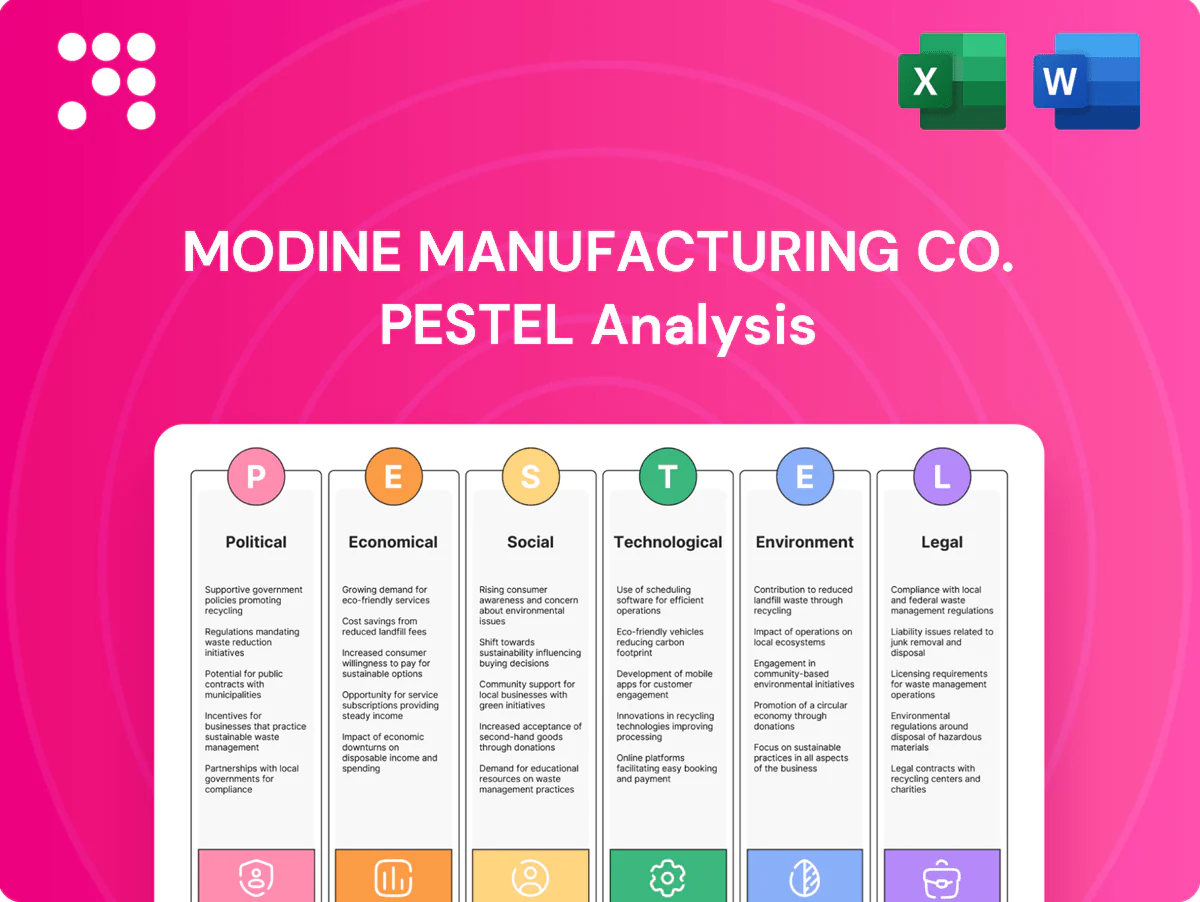
The preview shown here is the exact document you’ll receive after purchase—fully formatted and ready to use. This Modine Manufacturing Co. PESTLE Analysis outlines key political, economic, social, technological, legal, and environmental factors affecting the company. It highlights risks, opportunities, and strategic implications for stakeholders. No placeholders—this is the final, downloadable file.

Product Information
Product Information
Shipping & Returns
Shipping & Returns
Description
Your Competitive Advantage Starts with This Report
Unlock strategic clarity with our concise PESTLE Analysis of Modine Manufacturing Co.; see how political, economic and environmental forces are reshaping its HVAC and thermal solutions business. Ideal for investors and strategists, the full report delivers actionable insights and ready-to-use slides—purchase now to download the complete analysis.
Political factors
Trade policy volatility
Shifts in tariffs such as the US Section 232 levies—25% on steel and 10% on aluminum—directly raise Modine’s input costs and complicate cross-border sourcing of coils and cores. Regional agreements like USMCA (effective July 1, 2020) encourage nearshoring of assemblies to North America, reducing logistics and tariff exposure. Export incentives or penalties and 2022–2024 US export controls and sanctions (notably vs Russia and tightened tech exports to China) reshape pricing and limit sales to sanctioned markets.
Industrial policy and subsidies
Industrial policy and subsidies—EV, heat pump and data center incentives—steer demand toward high-efficiency thermal systems, reinforced by the Inflation Reduction Act's roughly $369 billion clean-energy investment.
Government-backed manufacturing and infrastructure credits are catalyzing plant investments and reshoring, increasing capital intensity for Modine.
Public funding such as the $122 billion K‑12 relief pool enables HVAC upgrades and program-driven orders, while policy reversals could disrupt multi-year planning and capacity utilization.
Geopolitical supply risks
Instability in copper hubs like Chile (≈28% of global copper output) and Peru and China’s dominance of primary aluminum capacity (≈55%) can disrupt Modine’s metals and specialty component flows. Diversifying suppliers and regional assembly lowers exposure. Maritime chokepoints (Suez ~12% of seaborne trade) and energy shocks raise logistics costs and lead times. Governments increasingly favor domestic producers via subsidies and procurement rules.
Public procurement dynamics
Buy American and local-content rules (Build America, Buy America) restrict eligibility for federal and federally funded HVAC and infrastructure contracts, while U.S. federal procurement exceeded roughly 800 billion USD in FY2024, concentrating opportunity but raising compliance costs. Tender processes demand certifications, documented domestic content and aggressive pricing; public project award cycles commonly span 6–18 months, which enlarges backlog visibility risks. Political cycles and appropriations shifts, including the 1.2 trillion USD Bipartisan Infrastructure Law (2021–26), can rapidly reallocate budgets across sectors, affecting demand timing for Modine's products.
- Compliance: Build America, Buy America impacts eligibility
- Procurement size: ~800B USD federal procurement FY2024
- Approval lag: 6–18 months typical award cycles
- Budget risk: $1.2T Infrastructure Law reallocates sector spend
Energy security agendas
IRA-driven heat-pump surge meets tariffs and metal supply risks
Tariffs (US Sec.232: steel 25%, aluminum 10%) and export controls raise input costs and limit market access. Buy America/procurement (US federal ~$800B FY2024) and longer award cycles (6–18 months) shift demand and add compliance costs. Clean-energy policy (IRA ≈ $369B) and electrification boost heat-pump demand; metal supply risks (Chile ~28% copper, China ~55% aluminum capacity) threaten lead times.
| Factor | Impact | 2024/25 Data |
|---|---|---|
| Tariffs | Higher input costs | Steel 25%, Al 10% |
| Procurement | Market access/compliance | Federal ~$800B FY2024 |
| Policy | Demand shift to efficient tech | IRA ≈ $369B |
| Supplies | Disruption risk | Chile 28% Cu, China 55% Al |
What is included in the product
Detailed Word Document
Explores how macro-environmental factors uniquely affect Modine Manufacturing Co. across Political, Economic, Social, Technological, Environmental and Legal dimensions, with data-backed trends and region/industry-specific examples. Designed for executives and investors, it provides forward-looking insights to identify strategic risks and opportunities.
Customizable Excel Spreadsheet
A concise, visually segmented PESTLE summary for Modine Manufacturing Co. that streamlines external risk assessment and market positioning, ready to drop into presentations or share across teams for faster decision-making.
Economic factors
Industrial cycle exposure
Cyclical swings in construction, automotive and industrial manufacturing directly drive Modine’s volume and product mix, compressing margins in downturns and creating capacity strain during booms. Pricing comes under pressure in recessions while backlog quality and end-market diversification—HVAC, transport, and heat-transfer solutions—help buffer volatility. Rigorous inventory management and capacity-flex plans are critical through cycles.
Commodity price swings
Volatility in aluminum, copper and steel prices drives margin risk for Modine, with LME aluminum and copper and US HRC steel showing swings of up to ~30–40% across 2023–24 that eroded input-cost visibility. Metal surcharges and hedging mitigate but lagging passthroughs compressed gross margins in recent quarters. Continued design optimization to cut material intensity and strategic supplier partnerships support availability and price stability.
Capex waves in data centers
AI-driven hyperscale buildouts by the four major hyperscalers (Amazon, Microsoft, Google, Meta) are boosting demand for liquid cooling and advanced air systems, directly expanding addressable markets for Modine. Procurement concentration with these large customers increases buyer pricing power and contract leverage. Project-tied lead times—often exceeding 26 weeks—drive working-capital needs and cash-conversion timing. Regional capex shifts across US, EMEA and APAC change plant loading and logistics costs.
Interest rates and financing
Higher rates (Fed funds ~5.25–5.50% in 2024–25) raise Modine’s WACC, increasing hurdle rates and prompting deferral of plant, tooling and R&D investments. Customer financing constraints, tighter commercial HVAC loans and municipal budget pressure, can delay retrofits and fleet upgrades, stretching project timelines to 12–24 months. Working capital needs rise as receivables and inventory tie up cash; rate cuts could unlock deferred demand and accelerate order flow.
FX and global footprint
Modine’s multi-currency revenues and costs drive both translation and transaction risks; in fiscal 2024 the company reported roughly $2.3 billion in revenue with about 55% generated outside the US, amplifying FX sensitivity. Localizing production in key markets has reduced tariff exposure and shortened FX pass-through, while hedging programs smooth quarterly earnings but increase treasury complexity and counterparty risk. Currency swings in 2024 (USD strength ~6% on the DXY) shifted regional competitiveness across Europe and APAC.
- FX exposure: ~55% international sales
- Revenue (FY2024): $2.3B
- DXY 2024 move: ~+6%
- Mitigants: localized production, hedging programs
IRA-driven heat-pump surge meets tariffs and metal supply risks
Cyclical swings in construction, automotive and industrial manufacturing drive Modine’s volume and margins, compressing profitability in downturns. Metal input volatility (aluminum/copper/steel ~30–40% swings in 2023–24) and FX moves eroded gross margins and competitiveness. Higher rates (Fed funds ~5.25–5.50% in 2024–25) raised WACC and working-capital needs; FY2024 revenue $2.3B with ~55% international sales.
| Metric | Value |
|---|---|
| FY2024 revenue | $2.3B |
| Intl sales | ~55% |
| Metal volatility (2023–24) | ~30–40% |
| Fed funds (2024–25) | ~5.25–5.50% |
| DXY 2024 | +6% |
What You See Is What You Get
Modine Manufacturing Co. PESTLE Analysis
The preview shown here is the exact document you’ll receive after purchase—fully formatted and ready to use. This Modine Manufacturing Co. PESTLE Analysis outlines key political, economic, social, technological, legal, and environmental factors affecting the company. It highlights risks, opportunities, and strategic implications for stakeholders. No placeholders—this is the final, downloadable file.