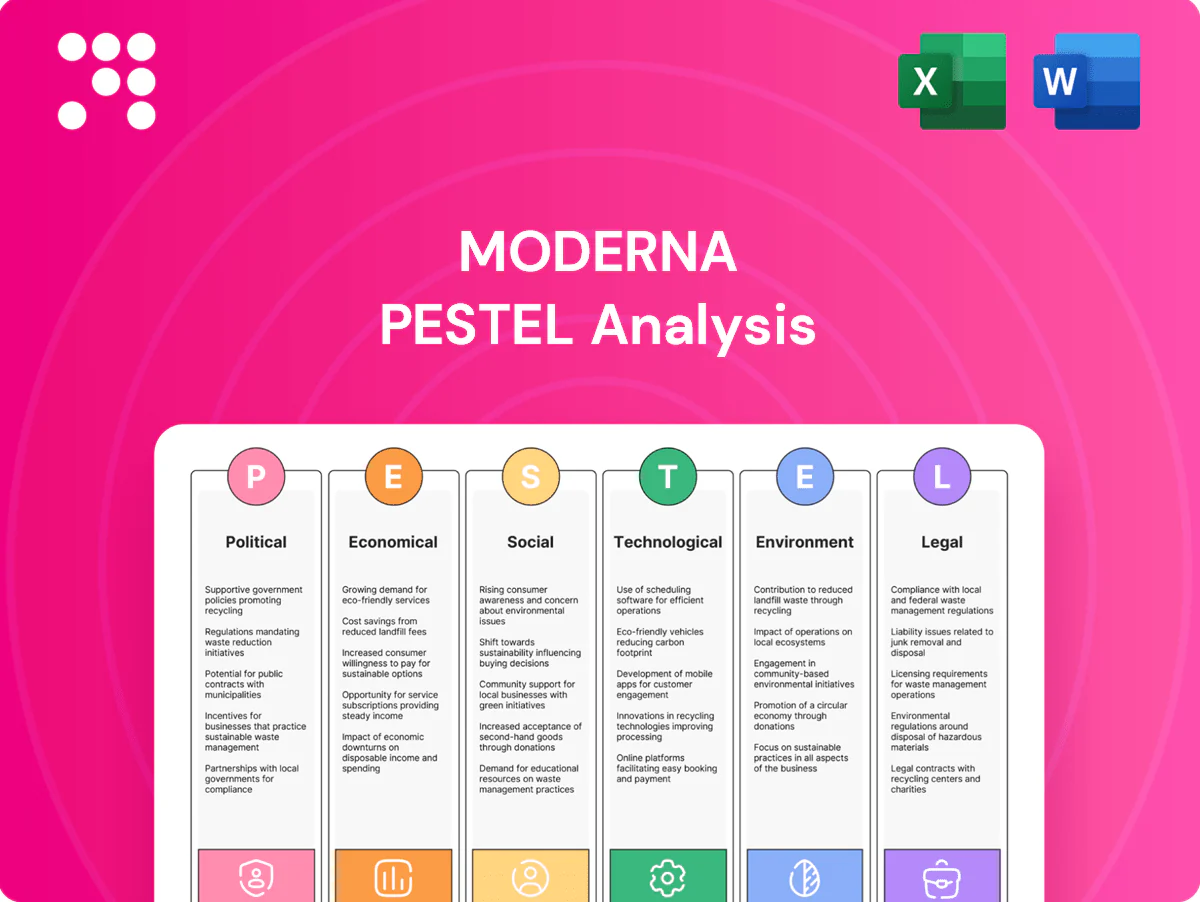
Moderna PESTLE Analysis

Your Shortcut to Market Insight Starts Here
Unlock how political pressures, regulatory shifts, economic trends, social attitudes, technological advances, and environmental forces converge on Moderna’s strategy in our concise PESTLE snapshot—ideal for investors and strategists. This expert-ready analysis highlights key risks and opportunities to inform decisions quickly. Purchase the full PESTLE to access the complete, actionable breakdown and downloadable files now.
Political factors

Vaccine nationalism and public health policy
Vaccine nationalism—high‑income countries securing >60% of early COVID-19 doses—shapes Moderna’s allocation, pricing and negotiation leverage, forcing prioritization of domestic contracts. National immunization plans determine booster and new mRNA demand, with EU and US adult booster recommendations driving fiscal 2024–25 procurement. Shifts in pandemic preparedness budgets alter procurement timelines and political scrutiny of responses can influence contract awards and reputational risk.
Geopolitical tensions and supply chain security
Export controls on raw materials, lipids, and single-use bioreactor components—seen during COVID-19—can constrain Moderna’s mRNA output and delay batches. Diversifying manufacturing across friendly jurisdictions with partners like Lonza and Catalent mitigates geopolitical risk but raises capex and operating costs. Sanctions regimes limit collaborations and market entry in targeted countries, while government incentives to localize biotech manufacturing are shifting investment and siting decisions for Moderna.

Funding and incentives for biodefense
Public agencies funding pan‑pathogen platforms and rapid response capabilities provide Moderna with non‑dilutive revenue streams; Moderna received about $1.5 billion in U.S. government support during COVID‑19 vaccine development, illustrating scale. Multi‑year BARDA/CEPI‑type contracts (often spanning several years) can stabilize cash flows and de‑risk R&D. Policy emphasis on pandemic readiness drives stockpiling and flexible manufacturing investments. Political shifts, however, may reprioritize funding away from infectious disease to other health needs.

Health diplomacy and global access initiatives
Participation in COVAX and tiered pricing has reduced per-dose margins but bolstered diplomatic ties and market access; COVAX had shipped roughly 1.8 billion doses by mid-2022 and remains a key channel. Multilateral pressure fuels technology-transfer debates and vaccine equity scrutiny, while alignment with global health goals can unlock grants and expedited reviews; WHO ended the COVID-19 PHE in May 2023.
- Margins vs access: tiered pricing lowers unit margins
- Diplomacy: COVAX distribution ~1.8B doses (mid-2022)
- Policy risk: tech-transfer pressure from multilateral bodies
- Incentives: grants/expedited reviews when aligned
- Downside: criticism/access restrictions if misaligned
Trade, tax, and industrial policy
Patent boxes and R&D tax credits (US federal credit ~14% alternative simplified credit) plus CHIPS ($52bn) and IRA (~$369bn climate/energy incentives) skew Moderna’s site selection and capex toward US/EU hubs; tariffs on lab equipment (often mid-single-digit rates) raise COGS and pressure margins. Regulatory harmonization lowers launch friction, while political backlash on drug pricing risks windfall taxes or mandated contributions.
- Patent boxes: affect effective tax rate
- R&D credit ~14%: boosts after‑tax return
- CHIPS $52bn / IRA $369bn: direct incentives
- Tariffs mid‑single digits: increase COGS
- Pricing backlash: potential windfall taxes
Vaccine nationalism, boosters and US incentives reshape global vaccine supply chains
Vaccine nationalism (>60% of early COVID doses to high‑income countries) and national booster policies shape Moderna’s allocation, pricing and negotiations. US support (~$1.5bn) and multilateral channels (COVAX ~1.8bn doses mid‑2022) influence volumes and margins; WHO ended the COVID PHE in May 2023. Incentives (CHIPS $52bn; IRA $369bn) and export controls drive siting and supply‑chain diversification.
| Metric | Value |
|---|---|
| Early dose concentration | >60% |
| US support | $1.5bn |
| COVAX shipments | ~1.8bn (mid‑2022) |
| CHIPS | $52bn |
| IRA | $369bn |
| WHO PHE end | May 2023 |
What is included in the product
 Detailed Word Document
Explores how external macro-environmental factors uniquely affect Moderna across six dimensions: Political, Economic, Social, Technological, Environmental, and Legal. Every section is data-backed, forward-looking and formatted for executives, investors and strategists to identify risks, opportunities and support decks, plans, and scenario planning.

 Customizable Excel Spreadsheet
A concise, visually segmented Moderna PESTLE summary that clarifies external risk and market positioning for planning sessions, easily droppable into presentations, shareable across teams, and editable for regional or business-line notes.
Economic factors

Post‑pandemic demand normalization
Revenue volatility follows waning COVID-19 primary series demand—Moderna revenue fell from $18.5B in 2022 to $8.2B in 2023—while booster uptake remains uncertain. Transitioning to endemic management requires accurate volume forecasting to avoid overproduction. Inventory write-downs and capacity underutilization pressure margins. Portfolio diversification into RSV, seasonal flu and combo vaccines (mRNA RSV, mRNA flu programs) aims to smooth cyclicality.
Capital intensity and scale economics
Moderna's mRNA platform leverages shared R&D and facility infrastructure but still requires upfront capex typically in the hundreds of millions to low billions for clinical‑scale and commercial manufacturing. Single‑use systems shorten build times and lower fixed investment yet can raise per‑unit costs by roughly 10–30% depending on scale. Filling multiple programs into the same lines improves absorption and utilization. Cost discipline is essential as reimbursement compresses in mature markets.

Pricing and payer dynamics
Private and public payers are increasingly scrutinizing vaccine and oncology prices, heightening downward pressure and formulary barriers. Health technology assessments shape reimbursement — INAHTA lists 51 member HTA agencies and EU HTA regulation took effect Jan 2025, tightening access rules. Payer interest in value‑based contracts linking payments to real‑world outcomes and tiered pricing for lower‑income markets is rising to preserve developed‑market economics.

FX and international market exposure
Global sales expose Moderna to currency swings that can materially alter reported revenues; the company uses hedging programs which reduce quarter-to-quarter volatility but add treasury complexity and costs. Growth in emerging markets increases volumes at lower price points, while global macro slowdowns have historically delayed vaccine and oncology uptake, affecting near-term cash flows.
- FX exposure: impacts reported revs
- Hedging: lowers volatility, increases complexity
- Emerging markets: volume up, price down
- Macro risk: delayed adoption of therapies
R&D productivity and portfolio optionality
Pipeline success rates drive valuation more than near‑term sales: industry Phase I→approval success ~9.6% (BIO 2011–2020) and Moderna carried 20+ clinical programs in 2024; platform reuse cuts timelines and marginal cost—mRNA‑1273 moved from sequence to first human dose in 63 days (2020); strategic partnerships spread risk and broaden indications, while pivotal failures can materially erode cash runway and investor confidence.
- Fact: Phase I→approval ≈9.6%
- Fact: Moderna 20+ clinical programs (2024)
- Fact: 63 days from sequence to first human dose for mRNA‑1273
Vaccine nationalism, boosters and US incentives reshape global vaccine supply chains
Revenue fell from $18.5B (2022) to $8.2B (2023), raising forecast uncertainty as COVID demand wanes. Heavy upfront capex (hundreds of millions–low billions) and single‑use tradeoffs pressure margins. Payer scrutiny, HTA expansion (EU HTA Jan 2025) and FX/EM pricing compress returns.
| Metric | 2022 | 2023 | Note |
|---|---|---|---|
| Revenue | $18.5B | $8.2B | COVID decline |
| Clinical programs | — | 20+ | 2024 |
| Phase I→Approval | — | 9.6% | BIO 2011–2020 |
Same Document Delivered
Moderna PESTLE Analysis
The preview shown here is the exact Moderna PESTLE analysis you’ll receive after purchase—fully formatted and ready to use. It includes the complete political, economic, social, technological, legal, and environmental assessment with no placeholders or edits needed. After checkout you’ll instantly download this same finished document, structured for immediate application.

Original: $10.00
-65%$10.00
$3.50Product Information
Product Information
Shipping & Returns
Shipping & Returns
Description
Your Shortcut to Market Insight Starts Here
Unlock how political pressures, regulatory shifts, economic trends, social attitudes, technological advances, and environmental forces converge on Moderna’s strategy in our concise PESTLE snapshot—ideal for investors and strategists. This expert-ready analysis highlights key risks and opportunities to inform decisions quickly. Purchase the full PESTLE to access the complete, actionable breakdown and downloadable files now.
Political factors
Vaccine nationalism and public health policy
Vaccine nationalism—high‑income countries securing >60% of early COVID-19 doses—shapes Moderna’s allocation, pricing and negotiation leverage, forcing prioritization of domestic contracts. National immunization plans determine booster and new mRNA demand, with EU and US adult booster recommendations driving fiscal 2024–25 procurement. Shifts in pandemic preparedness budgets alter procurement timelines and political scrutiny of responses can influence contract awards and reputational risk.
Geopolitical tensions and supply chain security
Export controls on raw materials, lipids, and single-use bioreactor components—seen during COVID-19—can constrain Moderna’s mRNA output and delay batches. Diversifying manufacturing across friendly jurisdictions with partners like Lonza and Catalent mitigates geopolitical risk but raises capex and operating costs. Sanctions regimes limit collaborations and market entry in targeted countries, while government incentives to localize biotech manufacturing are shifting investment and siting decisions for Moderna.
Funding and incentives for biodefense
Public agencies funding pan‑pathogen platforms and rapid response capabilities provide Moderna with non‑dilutive revenue streams; Moderna received about $1.5 billion in U.S. government support during COVID‑19 vaccine development, illustrating scale. Multi‑year BARDA/CEPI‑type contracts (often spanning several years) can stabilize cash flows and de‑risk R&D. Policy emphasis on pandemic readiness drives stockpiling and flexible manufacturing investments. Political shifts, however, may reprioritize funding away from infectious disease to other health needs.
Health diplomacy and global access initiatives
Participation in COVAX and tiered pricing has reduced per-dose margins but bolstered diplomatic ties and market access; COVAX had shipped roughly 1.8 billion doses by mid-2022 and remains a key channel. Multilateral pressure fuels technology-transfer debates and vaccine equity scrutiny, while alignment with global health goals can unlock grants and expedited reviews; WHO ended the COVID-19 PHE in May 2023.
- Margins vs access: tiered pricing lowers unit margins
- Diplomacy: COVAX distribution ~1.8B doses (mid-2022)
- Policy risk: tech-transfer pressure from multilateral bodies
- Incentives: grants/expedited reviews when aligned
- Downside: criticism/access restrictions if misaligned
Trade, tax, and industrial policy
Patent boxes and R&D tax credits (US federal credit ~14% alternative simplified credit) plus CHIPS ($52bn) and IRA (~$369bn climate/energy incentives) skew Moderna’s site selection and capex toward US/EU hubs; tariffs on lab equipment (often mid-single-digit rates) raise COGS and pressure margins. Regulatory harmonization lowers launch friction, while political backlash on drug pricing risks windfall taxes or mandated contributions.
- Patent boxes: affect effective tax rate
- R&D credit ~14%: boosts after‑tax return
- CHIPS $52bn / IRA $369bn: direct incentives
- Tariffs mid‑single digits: increase COGS
- Pricing backlash: potential windfall taxes
Vaccine nationalism, boosters and US incentives reshape global vaccine supply chains
Vaccine nationalism (>60% of early COVID doses to high‑income countries) and national booster policies shape Moderna’s allocation, pricing and negotiations. US support (~$1.5bn) and multilateral channels (COVAX ~1.8bn doses mid‑2022) influence volumes and margins; WHO ended the COVID PHE in May 2023. Incentives (CHIPS $52bn; IRA $369bn) and export controls drive siting and supply‑chain diversification.
| Metric | Value |
|---|---|
| Early dose concentration | >60% |
| US support | $1.5bn |
| COVAX shipments | ~1.8bn (mid‑2022) |
| CHIPS | $52bn |
| IRA | $369bn |
| WHO PHE end | May 2023 |
What is included in the product
Detailed Word Document
Explores how external macro-environmental factors uniquely affect Moderna across six dimensions: Political, Economic, Social, Technological, Environmental, and Legal. Every section is data-backed, forward-looking and formatted for executives, investors and strategists to identify risks, opportunities and support decks, plans, and scenario planning.
Customizable Excel Spreadsheet
A concise, visually segmented Moderna PESTLE summary that clarifies external risk and market positioning for planning sessions, easily droppable into presentations, shareable across teams, and editable for regional or business-line notes.
Economic factors
Post‑pandemic demand normalization
Revenue volatility follows waning COVID-19 primary series demand—Moderna revenue fell from $18.5B in 2022 to $8.2B in 2023—while booster uptake remains uncertain. Transitioning to endemic management requires accurate volume forecasting to avoid overproduction. Inventory write-downs and capacity underutilization pressure margins. Portfolio diversification into RSV, seasonal flu and combo vaccines (mRNA RSV, mRNA flu programs) aims to smooth cyclicality.
Capital intensity and scale economics
Moderna's mRNA platform leverages shared R&D and facility infrastructure but still requires upfront capex typically in the hundreds of millions to low billions for clinical‑scale and commercial manufacturing. Single‑use systems shorten build times and lower fixed investment yet can raise per‑unit costs by roughly 10–30% depending on scale. Filling multiple programs into the same lines improves absorption and utilization. Cost discipline is essential as reimbursement compresses in mature markets.
Pricing and payer dynamics
Private and public payers are increasingly scrutinizing vaccine and oncology prices, heightening downward pressure and formulary barriers. Health technology assessments shape reimbursement — INAHTA lists 51 member HTA agencies and EU HTA regulation took effect Jan 2025, tightening access rules. Payer interest in value‑based contracts linking payments to real‑world outcomes and tiered pricing for lower‑income markets is rising to preserve developed‑market economics.
FX and international market exposure
Global sales expose Moderna to currency swings that can materially alter reported revenues; the company uses hedging programs which reduce quarter-to-quarter volatility but add treasury complexity and costs. Growth in emerging markets increases volumes at lower price points, while global macro slowdowns have historically delayed vaccine and oncology uptake, affecting near-term cash flows.
- FX exposure: impacts reported revs
- Hedging: lowers volatility, increases complexity
- Emerging markets: volume up, price down
- Macro risk: delayed adoption of therapies
R&D productivity and portfolio optionality
Pipeline success rates drive valuation more than near‑term sales: industry Phase I→approval success ~9.6% (BIO 2011–2020) and Moderna carried 20+ clinical programs in 2024; platform reuse cuts timelines and marginal cost—mRNA‑1273 moved from sequence to first human dose in 63 days (2020); strategic partnerships spread risk and broaden indications, while pivotal failures can materially erode cash runway and investor confidence.
- Fact: Phase I→approval ≈9.6%
- Fact: Moderna 20+ clinical programs (2024)
- Fact: 63 days from sequence to first human dose for mRNA‑1273
Vaccine nationalism, boosters and US incentives reshape global vaccine supply chains
Revenue fell from $18.5B (2022) to $8.2B (2023), raising forecast uncertainty as COVID demand wanes. Heavy upfront capex (hundreds of millions–low billions) and single‑use tradeoffs pressure margins. Payer scrutiny, HTA expansion (EU HTA Jan 2025) and FX/EM pricing compress returns.
| Metric | 2022 | 2023 | Note |
|---|---|---|---|
| Revenue | $18.5B | $8.2B | COVID decline |
| Clinical programs | — | 20+ | 2024 |
| Phase I→Approval | — | 9.6% | BIO 2011–2020 |
Same Document Delivered
Moderna PESTLE Analysis
The preview shown here is the exact Moderna PESTLE analysis you’ll receive after purchase—fully formatted and ready to use. It includes the complete political, economic, social, technological, legal, and environmental assessment with no placeholders or edits needed. After checkout you’ll instantly download this same finished document, structured for immediate application.