Martin Midstream Partners SWOT Analysis

Elevate Your Analysis with the Complete SWOT Report
Martin Midstream Partners shows stable cash flows from diversified energy logistics assets but faces commodity-price exposure and capital intensity that pressure margins. Strategic pipeline and storage positioning create growth and tariff leverage, though regulatory and market shifts add execution risk. Purchase the full SWOT for a detailed, editable Word+Excel report to guide investment or strategic decisions.
Strengths

Diversified midstream portfolio
Martin Midstream maintains a diversified midstream portfolio across five segments — terminalling, storage, transportation, sulfur, and natural gas — spreading revenue sources and lowering reliance on any single commodity or service line. This structure enables cross-selling and operational synergies and helps cushion cyclical downturns in one segment.
Strategic energy infrastructure
Martin Midstream’s strategically located terminals and pipelines anchor critical petroleum supply chains, enabling movement and storage of refined products and by-products close to Gulf Coast producers and inland markets. Proximity to producers and end markets supports steady utilization and stable throughput, with essential midstream infrastructure typically exhibiting durable demand across cycles. Contracted volumes and fee-based agreements provide revenue visibility and downside protection for cash flows.

Logistics expertise and integration
Martin Midstream Partners' end-to-end capabilities from processing through transportation streamline customer operations by consolidating scheduling, custody transfer and billing. Integrated services lower client costs and improve reliability through coordinated asset deployment and reduced transload delays. These bundled offerings create switching costs and stickier relationships while optimizing asset throughput across terminals and pipeline networks.

By-product handling specialization
By-product handling specialization, including sulfur services, requires niche technical and regulatory know-how that few competitors possess, creating meaningful barriers to entry; customers prioritize safe, compliant management of complex streams and often accept premium pricing for proven capabilities.
- Specialized know-how
- Barrier to entry
- Customer willingness to pay
- Premium margins
Stable fee-based revenue potential
Martin Midstream Partners benefits from a fee-based, take-or-pay midstream model that shifts revenue exposure away from commodity price swings common to upstream peers.
Such contracts create more predictable cash flows that historically support easier access to capital and debt markets.
This fee-centric structure enhances resilience through commodity cycles and operational downturns.
- reduces commodity price exposure
- predictable cash flows aid capital access
- take-or-pay contracts stabilize revenue
- improves cyclical resilience
5-segment midstream platform diversifies revenue with Gulf Coast fee-based throughput
Martin Midstream’s five-segment portfolio (terminalling, storage, transportation, sulfur, natural gas) diversifies revenue and enables cross-selling, reducing single-commodity risk. Gulf Coast-proximate terminals and pipelines sustain steady throughput and contracted fee-based cash flow that limits commodity exposure. Niche sulfur and by-product capabilities create technical barriers, sticky customers, and premium margins.
| Metric | Strength |
|---|---|
| Segments | 5 |
| Revenue model | Fee-based / take-or-pay |
| Specialization | Sulfur/by-product handling |
What is included in the product
 Detailed Word Document
Provides a clear SWOT framework for analyzing Martin Midstream Partners’s strategic position, highlighting internal strengths and weaknesses and external opportunities and threats that shape its growth prospects and risk exposure.

 Customizable Excel Spreadsheet
Provides a concise, Martin Midstream Partners–specific SWOT matrix for rapid strategy alignment and stakeholder briefings. Editable format eases updates as market or pipeline dynamics change, relieving analysis bottlenecks.
Weaknesses

Commodity and volume sensitivity
Despite fee-based contracts cushioning revenue, volumes remain tied to upstream and downstream activity, so prolonged commodity downturns can materially reduce throughput and revenue. Certain service lines include price-linked components that pass commodity volatility into margins. This combination amplifies quarter-to-quarter earnings variability and challenges forecasting and cash‑flow stability.
Capital intensity and leverage
Martin Midstream faces high capital intensity as midstream infrastructure needs sizable maintenance and growth capex; management reported net capital expenditures of about $120m in 2024. The partnership carries elevated leverage, with net debt/EBITDA near 4.0x in 2024, limiting financial flexibility. Rising interest rates have increased financing costs, compressing free cash flow. This dynamic may constrain distributions and new investments.

Customer concentration risk
Customer concentration is a weakness for Martin Midstream; its 2023 Form 10-K highlights that a small group of large energy producers and refiners account for a material portion of revenues, making contract rollovers with key counterparties pivotal. Renegotiations at renewal could pressure pricing or terms, while counterparty credit health in cyclical downturns raises collection and volume risk.

Environmental and operational liabilities
Terminals, storage, and transport expose Martin Midstream to spill, emission, and safety risks that can trigger multi-million-dollar remediation and EPA fines; large hydrocarbon incident cleanups often exceed $1 million and can halt operations. Compliance and monitoring costs are substantial and recurring, pressuring margins. Insurance coverage may exclude certain pollution liabilities, leaving residual financial and reputational exposure.
- Spill/emission risk: operations prone to costly incidents
- Compliance: recurring substantial expenses
- Fines/remediation: can exceed $1M per major incident
- Insurance gaps: potential uncovered liabilities
Limited scale versus larger peers
Smaller asset base reduces bargaining power with shippers and suppliers, leading to higher per-unit operating and financing costs and fewer greenfield or bolt-on project options. Competition from larger midstream firms can compress margins and limit fee-based contract wins. Limited scale also constrains geographic diversification, concentrating exposure to regional demand and commodity cycles.
- Lower bargaining power
- Higher capital costs
- Fewer project options
- Compressed margins vs larger peers
- Limited geographic diversification
Volume sensitive; capex $120m, leverage 4.0x
Martin Midstream remains volume‑sensitive despite fee contracts, so prolonged commodity downturns can cut throughput and revenue. High capital intensity and net capex ~$120m in 2024, with net debt/EBITDA ~4.0x in 2024, limit financial flexibility and distributions. Customer concentration (2023 10‑K) and spill/environmental liabilities (major incidents >$1m) elevate counterparty and operational risk.
| Weakness | 2024/2023 metric |
|---|---|
| Net capex | $120m (2024) |
| Leverage | Net debt/EBITDA ~4.0x (2024) |
| Customer concentration | Material portion (2023 10‑K) |
| Incident costs | Major cleanup >$1m |
Preview the Actual Deliverable
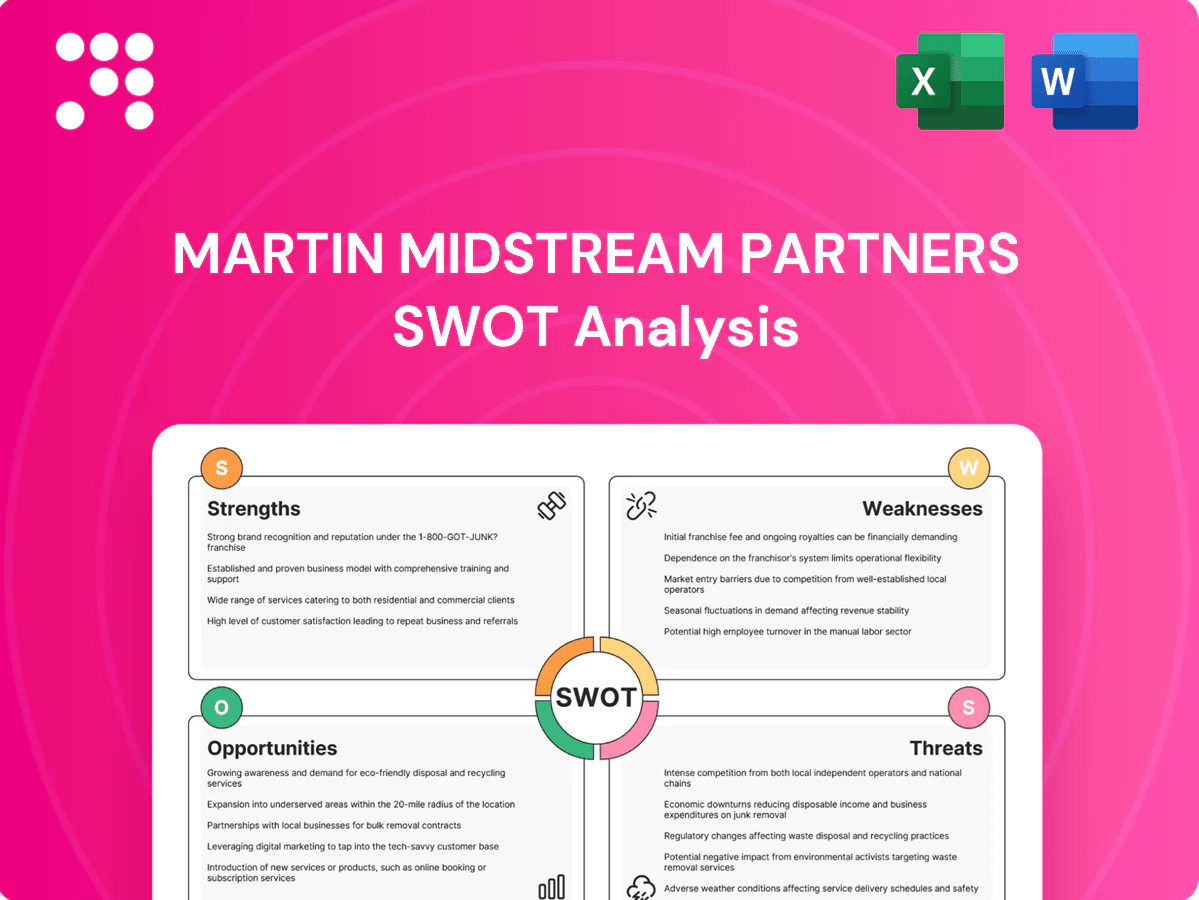
Martin Midstream Partners SWOT Analysis
This is the actual SWOT analysis document you’ll receive upon purchase—no surprises, just professional quality. The preview below is taken directly from the full SWOT report you'll get, and the complete, editable version becomes available after checkout. Purchase unlocks the entire in-depth file, structured and ready to use.

Product Information
Product Information
Shipping & Returns
Shipping & Returns
Description
Elevate Your Analysis with the Complete SWOT Report
Martin Midstream Partners shows stable cash flows from diversified energy logistics assets but faces commodity-price exposure and capital intensity that pressure margins. Strategic pipeline and storage positioning create growth and tariff leverage, though regulatory and market shifts add execution risk. Purchase the full SWOT for a detailed, editable Word+Excel report to guide investment or strategic decisions.
Strengths
Diversified midstream portfolio
Martin Midstream maintains a diversified midstream portfolio across five segments — terminalling, storage, transportation, sulfur, and natural gas — spreading revenue sources and lowering reliance on any single commodity or service line. This structure enables cross-selling and operational synergies and helps cushion cyclical downturns in one segment.
Strategic energy infrastructure
Martin Midstream’s strategically located terminals and pipelines anchor critical petroleum supply chains, enabling movement and storage of refined products and by-products close to Gulf Coast producers and inland markets. Proximity to producers and end markets supports steady utilization and stable throughput, with essential midstream infrastructure typically exhibiting durable demand across cycles. Contracted volumes and fee-based agreements provide revenue visibility and downside protection for cash flows.
Logistics expertise and integration
Martin Midstream Partners' end-to-end capabilities from processing through transportation streamline customer operations by consolidating scheduling, custody transfer and billing. Integrated services lower client costs and improve reliability through coordinated asset deployment and reduced transload delays. These bundled offerings create switching costs and stickier relationships while optimizing asset throughput across terminals and pipeline networks.
By-product handling specialization
By-product handling specialization, including sulfur services, requires niche technical and regulatory know-how that few competitors possess, creating meaningful barriers to entry; customers prioritize safe, compliant management of complex streams and often accept premium pricing for proven capabilities.
- Specialized know-how
- Barrier to entry
- Customer willingness to pay
- Premium margins
Stable fee-based revenue potential
Martin Midstream Partners benefits from a fee-based, take-or-pay midstream model that shifts revenue exposure away from commodity price swings common to upstream peers.
Such contracts create more predictable cash flows that historically support easier access to capital and debt markets.
This fee-centric structure enhances resilience through commodity cycles and operational downturns.
- reduces commodity price exposure
- predictable cash flows aid capital access
- take-or-pay contracts stabilize revenue
- improves cyclical resilience
5-segment midstream platform diversifies revenue with Gulf Coast fee-based throughput
Martin Midstream’s five-segment portfolio (terminalling, storage, transportation, sulfur, natural gas) diversifies revenue and enables cross-selling, reducing single-commodity risk. Gulf Coast-proximate terminals and pipelines sustain steady throughput and contracted fee-based cash flow that limits commodity exposure. Niche sulfur and by-product capabilities create technical barriers, sticky customers, and premium margins.
| Metric | Strength |
|---|---|
| Segments | 5 |
| Revenue model | Fee-based / take-or-pay |
| Specialization | Sulfur/by-product handling |
What is included in the product
Detailed Word Document
Provides a clear SWOT framework for analyzing Martin Midstream Partners’s strategic position, highlighting internal strengths and weaknesses and external opportunities and threats that shape its growth prospects and risk exposure.
Customizable Excel Spreadsheet
Provides a concise, Martin Midstream Partners–specific SWOT matrix for rapid strategy alignment and stakeholder briefings. Editable format eases updates as market or pipeline dynamics change, relieving analysis bottlenecks.
Weaknesses
Commodity and volume sensitivity
Despite fee-based contracts cushioning revenue, volumes remain tied to upstream and downstream activity, so prolonged commodity downturns can materially reduce throughput and revenue. Certain service lines include price-linked components that pass commodity volatility into margins. This combination amplifies quarter-to-quarter earnings variability and challenges forecasting and cash‑flow stability.
Capital intensity and leverage
Martin Midstream faces high capital intensity as midstream infrastructure needs sizable maintenance and growth capex; management reported net capital expenditures of about $120m in 2024. The partnership carries elevated leverage, with net debt/EBITDA near 4.0x in 2024, limiting financial flexibility. Rising interest rates have increased financing costs, compressing free cash flow. This dynamic may constrain distributions and new investments.
Customer concentration risk
Customer concentration is a weakness for Martin Midstream; its 2023 Form 10-K highlights that a small group of large energy producers and refiners account for a material portion of revenues, making contract rollovers with key counterparties pivotal. Renegotiations at renewal could pressure pricing or terms, while counterparty credit health in cyclical downturns raises collection and volume risk.
Environmental and operational liabilities
Terminals, storage, and transport expose Martin Midstream to spill, emission, and safety risks that can trigger multi-million-dollar remediation and EPA fines; large hydrocarbon incident cleanups often exceed $1 million and can halt operations. Compliance and monitoring costs are substantial and recurring, pressuring margins. Insurance coverage may exclude certain pollution liabilities, leaving residual financial and reputational exposure.
- Spill/emission risk: operations prone to costly incidents
- Compliance: recurring substantial expenses
- Fines/remediation: can exceed $1M per major incident
- Insurance gaps: potential uncovered liabilities
Limited scale versus larger peers
Smaller asset base reduces bargaining power with shippers and suppliers, leading to higher per-unit operating and financing costs and fewer greenfield or bolt-on project options. Competition from larger midstream firms can compress margins and limit fee-based contract wins. Limited scale also constrains geographic diversification, concentrating exposure to regional demand and commodity cycles.
- Lower bargaining power
- Higher capital costs
- Fewer project options
- Compressed margins vs larger peers
- Limited geographic diversification
Volume sensitive; capex $120m, leverage 4.0x
Martin Midstream remains volume‑sensitive despite fee contracts, so prolonged commodity downturns can cut throughput and revenue. High capital intensity and net capex ~$120m in 2024, with net debt/EBITDA ~4.0x in 2024, limit financial flexibility and distributions. Customer concentration (2023 10‑K) and spill/environmental liabilities (major incidents >$1m) elevate counterparty and operational risk.
| Weakness | 2024/2023 metric |
|---|---|
| Net capex | $120m (2024) |
| Leverage | Net debt/EBITDA ~4.0x (2024) |
| Customer concentration | Material portion (2023 10‑K) |
| Incident costs | Major cleanup >$1m |
Preview the Actual Deliverable
Martin Midstream Partners SWOT Analysis
This is the actual SWOT analysis document you’ll receive upon purchase—no surprises, just professional quality. The preview below is taken directly from the full SWOT report you'll get, and the complete, editable version becomes available after checkout. Purchase unlocks the entire in-depth file, structured and ready to use.