MKS Instruments PESTLE Analysis

Plan Smarter. Present Sharper. Compete Stronger.
Our PESTLE Analysis of MKS Instruments reveals how political regulations, macroeconomic cycles, and rapid tech innovation shape its competitive edge. We unpack environmental and legal risks alongside social trends affecting demand. Purchase the full report for the complete, actionable breakdown and ready-to-use strategic insight.
Political factors

US-China export controls
Tightening US export controls since 2022 on advanced process control tools, photonics and specialty chemicals targeting China have increased license scrutiny and expanded entity lists, creating order delays and market limits. MKS must engineer compliant variants and diversify end-market demand to offset constrained shipments and substitution risk. Ongoing rule changes raise planning complexity and inventory risk across its supply chain.
Industrial policy incentives
CHIPS Act and allied-country subsidies totaling roughly $52 billion in the US and an EU Chips mobilization around €43 billion are spurring new fabs and advanced packaging plants, creating pull-through for MKS Instruments process and vacuum solutions. Grant timing and local-content rules often determine siting and supplier eligibility, favoring regionally partnered bids. Aligning with local partners raises bid win rates and places MKS closer to clustered, policy-driven capex cycles.

Geopolitical supply risk
Tensions in the Taiwan Strait, Red Sea and Eastern Europe threaten logistics, extend lead times and push up insurance and war-risk surcharges; Taiwan hosts key foundries (TSMC holds over 50% of global foundry revenue), concentrating upstream risk for MKS's semiconductor-related products.
Dual-sourcing and regionalized manufacturing can reduce disruption risk but increase unit costs and capex; governments are shifting toward domestic resilience over pure global efficiency, making supply-chain localization more likely.
Scenario planning for critical components and specialty gases is essential to preserve fab uptime and manage price and delivery volatility.

Trade tariffs and localization
Tariffs on components and finished systems materially compress MKS Instruments margins and force price pass-through; US-China tariffs imposed since 2018 remain a key input to pricing and supply-chain decisions. Local manufacturing footprints in Asia and Europe reduce duties and can unlock local investment incentives. Rules-of-origin and procurement preferences alter bid competitiveness, so continuous cost engineering is required to neutralize tariff volatility.
- Tariff impact: increases input costs, pressures margins
- Localization: reduces duties, enables incentives
- Rules-of-origin: affects eligibility for contracts
- Cost engineering: ongoing to offset tariff swings
Government R&D and defense
Government R&D and defense funding materially supports photonics, vacuum science and advanced materials for MKS; US defense spending stood near $858B (FY2024) and DARPA funding was about $4.8B, with global military R&D driving procurement of precision instrumentation. Public-sector projects bring 12–36 month sales cycles and heavy compliance overhead, while reference deployments in defense labs often seed faster commercial adoption. Budget reassignments and election outcomes create demand volatility for multi-year contracts.
- Defense budget: ~$858B (US FY2024)
- DARPA funding: ~$4.8B (FY2024)
- Sales cycles: 12–36 months
- Impact: reference wins → commercial uptake
- Risk: budget shifts/elections → demand uncertainty
Export controls, subsidies and geopolitics squeeze semiconductor supply chains
US export controls since 2022 and expanded entity lists constrain shipments to China, raising compliance costs and delivery delays. CHIPS Act ($52B US) and EU mobilization (€43B) drive fab builds and demand but favor local suppliers. Geopolitical hotspots (Taiwan, Red Sea, Ukraine) and tariffs since 2018 increase lead times, insurance and margin pressure. US defense R&D (~$858B FY2024; DARPA ~$4.8B) supports specialty demand but adds long sales cycles.
| Factor | Impact | Key data |
|---|---|---|
| Export controls | Shipment limits, compliance | Since 2022, expanded lists |
| Subsidies | Fab demand, localization | US $52B; EU €43B |
| Geopolitics | Logistics risk | TSMC >50% foundry rev |
| Defense funding | Specialty sales, long cycles | US ~$858B; DARPA ~$4.8B |
| Tariffs | Margin pressure | US-China tariffs since 2018 |
What is included in the product
 Detailed Word Document
Explores how Political, Economic, Social, Technological, Environmental, and Legal forces uniquely affect MKS Instruments across its semiconductor, industrial and scientific markets, with region- and industry-specific context. Each section is data-backed, forward-looking and tailored for executives, investors and strategists to spot risks and opportunities.

 Customizable Excel Spreadsheet
A concise, visually segmented PESTLE summary for MKS Instruments that’s easily dropped into presentations, editable for regional or business-line context, and shareable for quick cross-team alignment during planning and risk discussions.
Economic factors

Semiconductor capex cyclicality
Wafer fab and packaging investments drive MKS order intake but remain highly cyclical; TSMC guided 2024 capex at $32–36 billion, illustrating OEM-driven swings that affect MKS bookings. Shifts in memory versus logic mix change tool demand and attach rates, altering revenue composition. Backlog management and variable cost structures have cushioned recent downturns. Portfolios tied to node transitions see outsized gains in upcycles.
FX and global revenue mix
Multi-currency exposure materially affects MKS Instruments reported revenue and gross margins, with international markets comprising a majority of sales and 2024 revenue near $2.6 billion. Hedging programs reduced short-term volatility but could not fully eliminate translation effects on quarterly results. Pricing power varies by region and product differentiation, supporting margin resilience in higher-value segments. Supply contracts with indexation and adjustment clauses helped preserve profitability during 2024 currency swings.

Interest rates and liquidity
Higher interest rates (U.S. fed funds ~5.25–5.50% mid-2025) raise borrowing costs and customer WACC, which can defer semiconductor and industrial capex and pressure order timing for MKS Instruments. Strong balance-sheet flexibility enables sustained R&D and opportunistic M&A through cycles, while vendor financing or extended terms can secure strategic deals but increase credit exposure. Cash discipline and liquidity management are critical in downcycles to protect margins and execution.

Industrial diversification
Industrial tech, life sciences and specialty chemicals give MKS counter-cyclical buffers; semiconductors remained the largest end-market while diversified businesses represented about 40% of FY2024 revenue, smoothing cyclicality.
Distinct demand drivers and multi-quarter qualification timelines across end-markets reduce correlated drops; cross-selling integrated subsystems boosts wallet share and recurring service revenue.
- Diversification: ~40% of FY2024 revenue from non-semiconductor markets
- Qualification timelines: multi-quarter to multi-year varies by end-market
- Cross-sell: integrated subsystems raise average deal size and service attach
- Operational smoothing: portfolio mix evens factory utilization and field service demand
Input costs and supply constraints
Input costs for MKS are pressured as specialty metals, electronics and process gases saw availability swings and price volatility—industry reports showed localized gas price moves up to 20% in 2023–24—impacting margins even as MKS posted roughly $2.9B revenue in FY2024. Strategic inventory buffers, supplier partnerships and design-to-cost/value-engineering reduced inflation exposure, while long-term agreements stabilized key component supply and pricing.
- specialty metals volatility
- process gases ±20% (2023–24)
- design-to-cost/value-engineering
- long-term supplier agreements
Export controls, subsidies and geopolitics squeeze semiconductor supply chains
Macro cycles drive order volatility—TSMC 2024 capex $32–36B; semis still dominant but FY2024 revenue ~$2.9B with ~40% non-semiconductor diversification. FX and input-cost swings (process gases ±20% 2023–24) pressure margins; Fed funds ~5.25–5.50% mid‑2025 raises WACC and can delay capex.
| Metric | Value |
|---|---|
| FY2024 revenue | $2.9B |
| Non‑semiconductor share | ~40% |
| TSMC 2024 capex | $32–36B |
| Fed funds mid‑2025 | 5.25–5.50% |
Full Version Awaits
MKS Instruments PESTLE Analysis
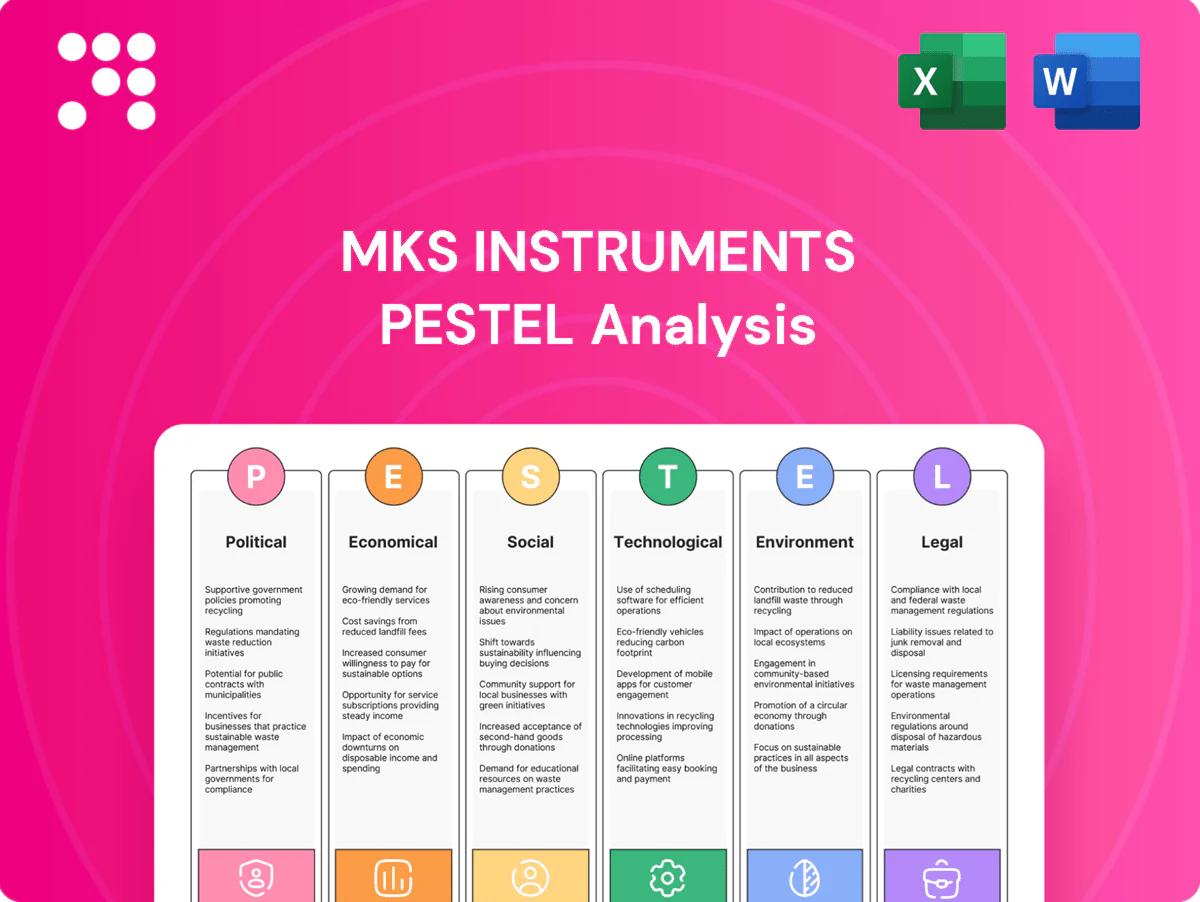
The MKS Instruments PESTLE Analysis shown here is the exact document you’ll receive after purchase, fully formatted and ready to use. It covers political, economic, social, technological, legal, and environmental factors specific to MKS Instruments. No placeholders or teasers—this preview is the final file, downloadable instantly upon payment.

Original: $10.00
-65%$10.00
$3.50Product Information
Product Information
Shipping & Returns
Shipping & Returns
Description
Plan Smarter. Present Sharper. Compete Stronger.
Our PESTLE Analysis of MKS Instruments reveals how political regulations, macroeconomic cycles, and rapid tech innovation shape its competitive edge. We unpack environmental and legal risks alongside social trends affecting demand. Purchase the full report for the complete, actionable breakdown and ready-to-use strategic insight.
Political factors
US-China export controls
Tightening US export controls since 2022 on advanced process control tools, photonics and specialty chemicals targeting China have increased license scrutiny and expanded entity lists, creating order delays and market limits. MKS must engineer compliant variants and diversify end-market demand to offset constrained shipments and substitution risk. Ongoing rule changes raise planning complexity and inventory risk across its supply chain.
Industrial policy incentives
CHIPS Act and allied-country subsidies totaling roughly $52 billion in the US and an EU Chips mobilization around €43 billion are spurring new fabs and advanced packaging plants, creating pull-through for MKS Instruments process and vacuum solutions. Grant timing and local-content rules often determine siting and supplier eligibility, favoring regionally partnered bids. Aligning with local partners raises bid win rates and places MKS closer to clustered, policy-driven capex cycles.
Geopolitical supply risk
Tensions in the Taiwan Strait, Red Sea and Eastern Europe threaten logistics, extend lead times and push up insurance and war-risk surcharges; Taiwan hosts key foundries (TSMC holds over 50% of global foundry revenue), concentrating upstream risk for MKS's semiconductor-related products.
Dual-sourcing and regionalized manufacturing can reduce disruption risk but increase unit costs and capex; governments are shifting toward domestic resilience over pure global efficiency, making supply-chain localization more likely.
Scenario planning for critical components and specialty gases is essential to preserve fab uptime and manage price and delivery volatility.
Trade tariffs and localization
Tariffs on components and finished systems materially compress MKS Instruments margins and force price pass-through; US-China tariffs imposed since 2018 remain a key input to pricing and supply-chain decisions. Local manufacturing footprints in Asia and Europe reduce duties and can unlock local investment incentives. Rules-of-origin and procurement preferences alter bid competitiveness, so continuous cost engineering is required to neutralize tariff volatility.
- Tariff impact: increases input costs, pressures margins
- Localization: reduces duties, enables incentives
- Rules-of-origin: affects eligibility for contracts
- Cost engineering: ongoing to offset tariff swings
Government R&D and defense
Government R&D and defense funding materially supports photonics, vacuum science and advanced materials for MKS; US defense spending stood near $858B (FY2024) and DARPA funding was about $4.8B, with global military R&D driving procurement of precision instrumentation. Public-sector projects bring 12–36 month sales cycles and heavy compliance overhead, while reference deployments in defense labs often seed faster commercial adoption. Budget reassignments and election outcomes create demand volatility for multi-year contracts.
- Defense budget: ~$858B (US FY2024)
- DARPA funding: ~$4.8B (FY2024)
- Sales cycles: 12–36 months
- Impact: reference wins → commercial uptake
- Risk: budget shifts/elections → demand uncertainty
Export controls, subsidies and geopolitics squeeze semiconductor supply chains
US export controls since 2022 and expanded entity lists constrain shipments to China, raising compliance costs and delivery delays. CHIPS Act ($52B US) and EU mobilization (€43B) drive fab builds and demand but favor local suppliers. Geopolitical hotspots (Taiwan, Red Sea, Ukraine) and tariffs since 2018 increase lead times, insurance and margin pressure. US defense R&D (~$858B FY2024; DARPA ~$4.8B) supports specialty demand but adds long sales cycles.
| Factor | Impact | Key data |
|---|---|---|
| Export controls | Shipment limits, compliance | Since 2022, expanded lists |
| Subsidies | Fab demand, localization | US $52B; EU €43B |
| Geopolitics | Logistics risk | TSMC >50% foundry rev |
| Defense funding | Specialty sales, long cycles | US ~$858B; DARPA ~$4.8B |
| Tariffs | Margin pressure | US-China tariffs since 2018 |
What is included in the product
Detailed Word Document
Explores how Political, Economic, Social, Technological, Environmental, and Legal forces uniquely affect MKS Instruments across its semiconductor, industrial and scientific markets, with region- and industry-specific context. Each section is data-backed, forward-looking and tailored for executives, investors and strategists to spot risks and opportunities.
Customizable Excel Spreadsheet
A concise, visually segmented PESTLE summary for MKS Instruments that’s easily dropped into presentations, editable for regional or business-line context, and shareable for quick cross-team alignment during planning and risk discussions.
Economic factors
Semiconductor capex cyclicality
Wafer fab and packaging investments drive MKS order intake but remain highly cyclical; TSMC guided 2024 capex at $32–36 billion, illustrating OEM-driven swings that affect MKS bookings. Shifts in memory versus logic mix change tool demand and attach rates, altering revenue composition. Backlog management and variable cost structures have cushioned recent downturns. Portfolios tied to node transitions see outsized gains in upcycles.
FX and global revenue mix
Multi-currency exposure materially affects MKS Instruments reported revenue and gross margins, with international markets comprising a majority of sales and 2024 revenue near $2.6 billion. Hedging programs reduced short-term volatility but could not fully eliminate translation effects on quarterly results. Pricing power varies by region and product differentiation, supporting margin resilience in higher-value segments. Supply contracts with indexation and adjustment clauses helped preserve profitability during 2024 currency swings.
Interest rates and liquidity
Higher interest rates (U.S. fed funds ~5.25–5.50% mid-2025) raise borrowing costs and customer WACC, which can defer semiconductor and industrial capex and pressure order timing for MKS Instruments. Strong balance-sheet flexibility enables sustained R&D and opportunistic M&A through cycles, while vendor financing or extended terms can secure strategic deals but increase credit exposure. Cash discipline and liquidity management are critical in downcycles to protect margins and execution.
Industrial diversification
Industrial tech, life sciences and specialty chemicals give MKS counter-cyclical buffers; semiconductors remained the largest end-market while diversified businesses represented about 40% of FY2024 revenue, smoothing cyclicality.
Distinct demand drivers and multi-quarter qualification timelines across end-markets reduce correlated drops; cross-selling integrated subsystems boosts wallet share and recurring service revenue.
- Diversification: ~40% of FY2024 revenue from non-semiconductor markets
- Qualification timelines: multi-quarter to multi-year varies by end-market
- Cross-sell: integrated subsystems raise average deal size and service attach
- Operational smoothing: portfolio mix evens factory utilization and field service demand
Input costs and supply constraints
Input costs for MKS are pressured as specialty metals, electronics and process gases saw availability swings and price volatility—industry reports showed localized gas price moves up to 20% in 2023–24—impacting margins even as MKS posted roughly $2.9B revenue in FY2024. Strategic inventory buffers, supplier partnerships and design-to-cost/value-engineering reduced inflation exposure, while long-term agreements stabilized key component supply and pricing.
- specialty metals volatility
- process gases ±20% (2023–24)
- design-to-cost/value-engineering
- long-term supplier agreements
Export controls, subsidies and geopolitics squeeze semiconductor supply chains
Macro cycles drive order volatility—TSMC 2024 capex $32–36B; semis still dominant but FY2024 revenue ~$2.9B with ~40% non-semiconductor diversification. FX and input-cost swings (process gases ±20% 2023–24) pressure margins; Fed funds ~5.25–5.50% mid‑2025 raises WACC and can delay capex.
| Metric | Value |
|---|---|
| FY2024 revenue | $2.9B |
| Non‑semiconductor share | ~40% |
| TSMC 2024 capex | $32–36B |
| Fed funds mid‑2025 | 5.25–5.50% |
Full Version Awaits
MKS Instruments PESTLE Analysis
The MKS Instruments PESTLE Analysis shown here is the exact document you’ll receive after purchase, fully formatted and ready to use. It covers political, economic, social, technological, legal, and environmental factors specific to MKS Instruments. No placeholders or teasers—this preview is the final file, downloadable instantly upon payment.