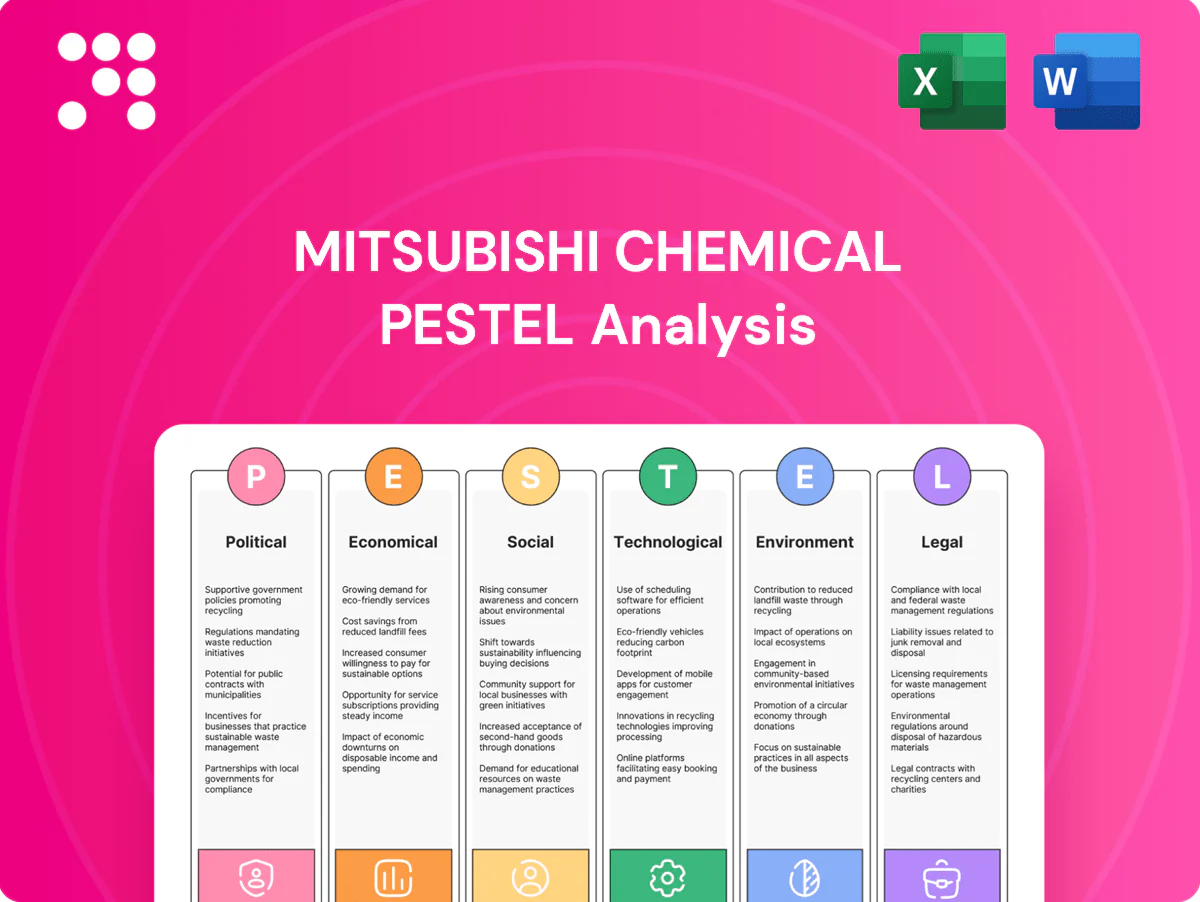
Mitsubishi Chemical PESTLE Analysis

Your Competitive Advantage Starts with This Report
Uncover how political shifts, economic cycles, social trends, technological innovation, regulatory changes, and environmental pressures shape Mitsubishi Chemical’s strategic outlook in our concise PESTLE snapshot. Ideal for investors and strategists, the full analysis delivers detailed, actionable insights—purchase now to access the complete, ready-to-use report.
Political factors

Trade policy and tariffs
Shifts in US-China-Japan trade policies reshape cross-border flows of chemicals, electronics inputs and industrial gases, affecting Mitsubishi Chemical exposure across major supply chains. US-China tariffs introduced since 2018 of up to 25% raise relative costs and force sourcing and pricing adjustments. Preferential pacts like CPTPP (11 members) and RCEP (15 members, ~30% global GDP) lower barriers and can unlock demand. Persistent trade frictions increase planning complexity and inventory buffers.
Industrial policy and subsidies
Government incentives such as the US CHIPS Act ($52.7B) and the Inflation Reduction Act (~$369B) steer demand for semiconductors, EVs, batteries and green materials, boosting end-market growth for Mitsubishi Chemical's high-performance polymers and specialty films. Access to national subsidies has enabled faster capacity expansions, influencing plant siting as countries prioritize local sourcing. Divergent subsidy regimes heighten global competition and pressure sector margins.

Regulatory alignment across regions
Divergent chemical regulations across the EU, US and Asia—REACH with ~22,000 substance registrations versus TSCA's post-2016 prioritization—complicate Mitsubishi Chemical product registration and compliance. Ongoing harmonization efforts (e.g., OECD frameworks) ease trade but remain incomplete for advanced materials. Localization in healthcare and food packaging demands tailored formulations, raising per-substance compliance costs often between $0.5–3M and 12–36 month approval timelines, slowing speed-to-market and squeezing lifecycle profitability.

Geopolitical supply chain stability
Geopolitical tensions in key shipping lanes — for example, routes through the Suez and Strait of Hormuz (about 12% of global trade transits the Suez) — threaten uninterrupted feedstock and rare material flows to Mitsubishi Chemical, while sanctions regimes restrict sales and sourcing from targeted entities. Political risk has driven the company toward multi-sourcing, higher inventory buffers and nearshoring, raising working capital needs. Insurance and logistics costs rise during instability, squeezing margins and increasing unit costs.
- 12% transit exposure: Suez Canal
- Higher working capital from multi-sourcing/nearshoring
- Elevated insurance/logistics costs pressuring margins
Public procurement and healthcare policy
Public procurement and reimbursement frameworks directly shape demand for medical-grade polymers; cost-containment moves in 2024–25 have compressed pricing and margins for commodity healthcare grades. The global in vitro diagnostics and bioprocessing market is ~USD 100B by 2025, supporting specialty polymer sales. Localization mandates in EU/US/Asia force regional capex and supply-chain shifts.
- procurement: public buyers drive volume and specs
- pricing: 2024–25 cost containment compresses margins
- growth: diagnostics/bioprocessing ≈ USD 100B (2025)
- localization: requires regional manufacturing footprints
Tariffs up to 25%, CHIPS boost and CPTPP/RCEP reroute supply chains
Shifts in US-China-Japan trade policy and 25% tariffs alter supply-costs; CPTPP (11 members) and RCEP (15 members, ~30% global GDP) open preferential routes. US CHIPS $52.7B and IRA ~$369B boost demand for polymers/battery materials; diagnostic market ≈ USD100B (2025). REACH (~22,000 registrations) vs TSCA raise compliance costs; Suez transit ~12% exposure drives nearshoring, higher working capital.
| Indicator | Value | Impact |
|---|---|---|
| Tariffs | up to 25% | raises sourcing costs |
| CHIPS/IRA | $52.7B / ~$369B | stimulates demand |
| REACH | ~22,000 | higher compliance cost |
| Suez transit | ~12% | supply risk |
What is included in the product
 Detailed Word Document
Explores how macro-environmental factors uniquely affect Mitsubishi Chemical across Political, Economic, Social, Technological, Environmental and Legal dimensions, each backed by current data and sector trends. Designed for executives and investors, it highlights actionable risks, strategic opportunities and forward-looking scenarios tailored to the company’s markets and regulatory landscape.

 Customizable Excel Spreadsheet
Condenses Mitsubishi Chemical's PESTLE into a clear, shareable summary that eases stakeholder alignment and supports quick decision-making during strategy sessions.
Economic factors

Global GDP and industrial cycles
Global GDP grew about 3.0% in 2024 with the IMF projecting ~3.1% for 2025, directly driving volumes in automotive, electronics and construction—global vehicle production reached ~80 million units in 2024 and the global electronics market was roughly $1.8 trillion. Downturns cut utilization and squeeze operating leverage; recoveries favor higher‑margin specialties versus commodities. Mitsubishi Chemical’s diversification across sectors smooths cyclical volatility.
Feedstock and energy price volatility
Brent crude averaged about $85/bbl in 2024 and naphtha, closely linked to crude, traded near $700–900/tonne, while Henry Hub natural gas averaged roughly $3/MMBtu, meaning oil, naphtha and gas swings materially move Mitsubishi Chemical’s feedstock costs.
Energy-intensive units see margins shift with electricity and LNG spot moves—European TTF and Asian LNG remained volatile despite declines from 2022 peaks—hedging lowers but does not remove exposure.
Long-term supply contracts and upstream integration into feedstock or captive power improved cost predictability and reduced realized volatility for the group.

Currency fluctuations (JPY, USD, EUR)
Exchange rate moves (USD/JPY ~155, EUR/JPY ~165 in July 2025) materially affect Mitsubishi Chemical’s reported earnings and export competitiveness, with a roughly 8% yen depreciation year-on-year boosting translated overseas revenue. A weaker yen aids top-line translation but raises import costs for raw materials and energy, pressuring margins. Natural hedges from local production/sourcing and treasury strategies that align debt currency mix with operating cash flows reduce volatility.

Capital expenditure and financing conditions
Higher global interest rates (US fed funds ~5.25% in 2024) lift hurdle rates for new plants and R&D scale-up, making long-cycle chemical investments less attractive; tighter credit since 2022 has slowed expansion and M&A activity in the chemicals sector. Government-backed green finance in Japan and internationally—often offering lower spreads—can reduce Mitsubishi Chemical’s cost of capital for sustainability projects, while phased investments de-risk capacity additions amid uneven demand.
- Interest-rate pressure: raises required returns
- Credit tightening: slows capex and M&A
- Green finance: lowers financing costs for decarbonization
- Phased investments: reduce demand risk
Customer sector mix and pricing power
Specialty products for electronics, healthcare and food give Mitsubishi Chemical stronger pricing resilience; global semiconductor sales were 614.5 billion USD in 2023 (SIA), supporting higher-margin specialty demand. Commodity segments face intense competition and faster price pass-through cycles. Product differentiation, application support and index-linked contracts increase stickiness and help stabilize margins.
- Specialty = higher resilience
- Commodities = faster pass-through
- Differentiation = stickiness
- Indexation = margin stability
Tariffs up to 25%, CHIPS boost and CPTPP/RCEP reroute supply chains
Global GDP ~3.1% (2025 IMF) drives demand in auto/electronics; specialties show stronger pricing vs commodities. Brent ~$85/bbl and naphtha ~$800/t in 2024; feedstock swings hit margins. USD/JPY ~155 (Jul 2025) boosts translated sales but raises import costs. Fed funds ~5.25% raises hurdle rates; green finance lowers capex cost for decarbonization.
| Metric | Value |
|---|---|
| Global GDP (2025) | ~3.1% |
| Brent (2024 avg) | $85/bbl |
| Naphtha | ~$800/t |
| USD/JPY (Jul 2025) | ~155 |
| Fed funds | ~5.25% |
What You See Is What You Get
Mitsubishi Chemical PESTLE Analysis
The Mitsubishi Chemical PESTLE Analysis shown here is the exact document you’ll receive after purchase—fully formatted and ready to use. The layout, content, and structure visible in this preview are identical to the file available for immediate download after checkout. No placeholders or teasers—this is the final, professionally structured report you will own.

Original: $10.00
-65%$10.00
$3.50Product Information
Product Information
Shipping & Returns
Shipping & Returns
Description
Your Competitive Advantage Starts with This Report
Uncover how political shifts, economic cycles, social trends, technological innovation, regulatory changes, and environmental pressures shape Mitsubishi Chemical’s strategic outlook in our concise PESTLE snapshot. Ideal for investors and strategists, the full analysis delivers detailed, actionable insights—purchase now to access the complete, ready-to-use report.
Political factors
Trade policy and tariffs
Shifts in US-China-Japan trade policies reshape cross-border flows of chemicals, electronics inputs and industrial gases, affecting Mitsubishi Chemical exposure across major supply chains. US-China tariffs introduced since 2018 of up to 25% raise relative costs and force sourcing and pricing adjustments. Preferential pacts like CPTPP (11 members) and RCEP (15 members, ~30% global GDP) lower barriers and can unlock demand. Persistent trade frictions increase planning complexity and inventory buffers.
Industrial policy and subsidies
Government incentives such as the US CHIPS Act ($52.7B) and the Inflation Reduction Act (~$369B) steer demand for semiconductors, EVs, batteries and green materials, boosting end-market growth for Mitsubishi Chemical's high-performance polymers and specialty films. Access to national subsidies has enabled faster capacity expansions, influencing plant siting as countries prioritize local sourcing. Divergent subsidy regimes heighten global competition and pressure sector margins.
Regulatory alignment across regions
Divergent chemical regulations across the EU, US and Asia—REACH with ~22,000 substance registrations versus TSCA's post-2016 prioritization—complicate Mitsubishi Chemical product registration and compliance. Ongoing harmonization efforts (e.g., OECD frameworks) ease trade but remain incomplete for advanced materials. Localization in healthcare and food packaging demands tailored formulations, raising per-substance compliance costs often between $0.5–3M and 12–36 month approval timelines, slowing speed-to-market and squeezing lifecycle profitability.
Geopolitical supply chain stability
Geopolitical tensions in key shipping lanes — for example, routes through the Suez and Strait of Hormuz (about 12% of global trade transits the Suez) — threaten uninterrupted feedstock and rare material flows to Mitsubishi Chemical, while sanctions regimes restrict sales and sourcing from targeted entities. Political risk has driven the company toward multi-sourcing, higher inventory buffers and nearshoring, raising working capital needs. Insurance and logistics costs rise during instability, squeezing margins and increasing unit costs.
- 12% transit exposure: Suez Canal
- Higher working capital from multi-sourcing/nearshoring
- Elevated insurance/logistics costs pressuring margins
Public procurement and healthcare policy
Public procurement and reimbursement frameworks directly shape demand for medical-grade polymers; cost-containment moves in 2024–25 have compressed pricing and margins for commodity healthcare grades. The global in vitro diagnostics and bioprocessing market is ~USD 100B by 2025, supporting specialty polymer sales. Localization mandates in EU/US/Asia force regional capex and supply-chain shifts.
- procurement: public buyers drive volume and specs
- pricing: 2024–25 cost containment compresses margins
- growth: diagnostics/bioprocessing ≈ USD 100B (2025)
- localization: requires regional manufacturing footprints
Tariffs up to 25%, CHIPS boost and CPTPP/RCEP reroute supply chains
Shifts in US-China-Japan trade policy and 25% tariffs alter supply-costs; CPTPP (11 members) and RCEP (15 members, ~30% global GDP) open preferential routes. US CHIPS $52.7B and IRA ~$369B boost demand for polymers/battery materials; diagnostic market ≈ USD100B (2025). REACH (~22,000 registrations) vs TSCA raise compliance costs; Suez transit ~12% exposure drives nearshoring, higher working capital.
| Indicator | Value | Impact |
|---|---|---|
| Tariffs | up to 25% | raises sourcing costs |
| CHIPS/IRA | $52.7B / ~$369B | stimulates demand |
| REACH | ~22,000 | higher compliance cost |
| Suez transit | ~12% | supply risk |
What is included in the product
Detailed Word Document
Explores how macro-environmental factors uniquely affect Mitsubishi Chemical across Political, Economic, Social, Technological, Environmental and Legal dimensions, each backed by current data and sector trends. Designed for executives and investors, it highlights actionable risks, strategic opportunities and forward-looking scenarios tailored to the company’s markets and regulatory landscape.
Customizable Excel Spreadsheet
Condenses Mitsubishi Chemical's PESTLE into a clear, shareable summary that eases stakeholder alignment and supports quick decision-making during strategy sessions.
Economic factors
Global GDP and industrial cycles
Global GDP grew about 3.0% in 2024 with the IMF projecting ~3.1% for 2025, directly driving volumes in automotive, electronics and construction—global vehicle production reached ~80 million units in 2024 and the global electronics market was roughly $1.8 trillion. Downturns cut utilization and squeeze operating leverage; recoveries favor higher‑margin specialties versus commodities. Mitsubishi Chemical’s diversification across sectors smooths cyclical volatility.
Feedstock and energy price volatility
Brent crude averaged about $85/bbl in 2024 and naphtha, closely linked to crude, traded near $700–900/tonne, while Henry Hub natural gas averaged roughly $3/MMBtu, meaning oil, naphtha and gas swings materially move Mitsubishi Chemical’s feedstock costs.
Energy-intensive units see margins shift with electricity and LNG spot moves—European TTF and Asian LNG remained volatile despite declines from 2022 peaks—hedging lowers but does not remove exposure.
Long-term supply contracts and upstream integration into feedstock or captive power improved cost predictability and reduced realized volatility for the group.
Currency fluctuations (JPY, USD, EUR)
Exchange rate moves (USD/JPY ~155, EUR/JPY ~165 in July 2025) materially affect Mitsubishi Chemical’s reported earnings and export competitiveness, with a roughly 8% yen depreciation year-on-year boosting translated overseas revenue. A weaker yen aids top-line translation but raises import costs for raw materials and energy, pressuring margins. Natural hedges from local production/sourcing and treasury strategies that align debt currency mix with operating cash flows reduce volatility.
Capital expenditure and financing conditions
Higher global interest rates (US fed funds ~5.25% in 2024) lift hurdle rates for new plants and R&D scale-up, making long-cycle chemical investments less attractive; tighter credit since 2022 has slowed expansion and M&A activity in the chemicals sector. Government-backed green finance in Japan and internationally—often offering lower spreads—can reduce Mitsubishi Chemical’s cost of capital for sustainability projects, while phased investments de-risk capacity additions amid uneven demand.
- Interest-rate pressure: raises required returns
- Credit tightening: slows capex and M&A
- Green finance: lowers financing costs for decarbonization
- Phased investments: reduce demand risk
Customer sector mix and pricing power
Specialty products for electronics, healthcare and food give Mitsubishi Chemical stronger pricing resilience; global semiconductor sales were 614.5 billion USD in 2023 (SIA), supporting higher-margin specialty demand. Commodity segments face intense competition and faster price pass-through cycles. Product differentiation, application support and index-linked contracts increase stickiness and help stabilize margins.
- Specialty = higher resilience
- Commodities = faster pass-through
- Differentiation = stickiness
- Indexation = margin stability
Tariffs up to 25%, CHIPS boost and CPTPP/RCEP reroute supply chains
Global GDP ~3.1% (2025 IMF) drives demand in auto/electronics; specialties show stronger pricing vs commodities. Brent ~$85/bbl and naphtha ~$800/t in 2024; feedstock swings hit margins. USD/JPY ~155 (Jul 2025) boosts translated sales but raises import costs. Fed funds ~5.25% raises hurdle rates; green finance lowers capex cost for decarbonization.
| Metric | Value |
|---|---|
| Global GDP (2025) | ~3.1% |
| Brent (2024 avg) | $85/bbl |
| Naphtha | ~$800/t |
| USD/JPY (Jul 2025) | ~155 |
| Fed funds | ~5.25% |
What You See Is What You Get
Mitsubishi Chemical PESTLE Analysis
The Mitsubishi Chemical PESTLE Analysis shown here is the exact document you’ll receive after purchase—fully formatted and ready to use. The layout, content, and structure visible in this preview are identical to the file available for immediate download after checkout. No placeholders or teasers—this is the final, professionally structured report you will own.