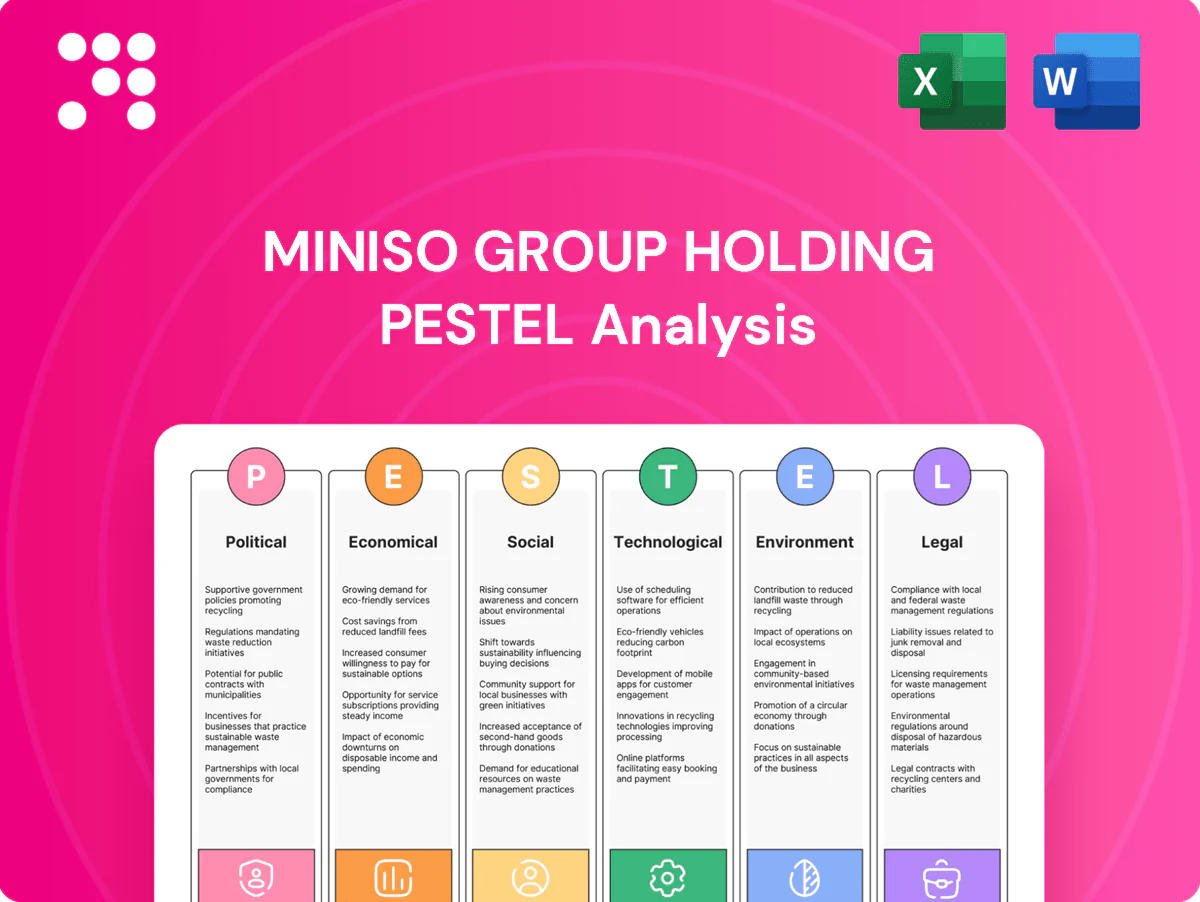
Miniso Group Holding PESTLE Analysis

Your Competitive Advantage Starts with This Report
Gain a competitive edge with our PESTLE Analysis of Miniso Group Holding—spot regulatory, economic, social, and technological forces shaping growth and risk. Ideal for investors and strategists; buy the full, editable report to unlock actionable insights now.
Political factors

Trade policies and tariffs
As a China-origin brand, Miniso is exposed to tariff swings between China and key markets, notably the US tariffs covering about $370 billion of Chinese imports introduced since 2018 with rates up to 25%. Higher import duties can compress already-thin retail margins or force price hikes that erode Miniso’s value proposition. Diversifying sourcing and nearshoring to ASEAN or Mexico can buffer tariff risk. Active customs planning and HS code optimization are critical to minimize duty leakage.
Geopolitical tensions
US‑China and regional tensions can trigger regulatory scrutiny, store permit delays, or consumer boycotts, raising compliance costs and slowing store openings. Sudden policy shifts may disrupt cross‑border logistics and inventory allocation, forcing expedited freight and higher working capital. Scenario planning enables rapid rebalancing of inventory across safer hubs and ports to preserve service levels. Local brand building and localized sourcing reduce country‑of‑origin sensitivity.

Foreign market entry rules
FDI caps, joint‑venture rules and local‑content mandates differ sharply—China allows 100% foreign ownership in retail, India restricts multi‑brand retail FDI to 51% under conditions—while UNCTAD reported global FDI at about $1.52 trillion in 2023. Miniso’s partner/agency model must map to host retail laws; strict compliance unlocks incentives (e.g., tax breaks, grants) and proactive engagement with investment promotion agencies reduces setup friction.

Public health and emergency policies
Pandemic-era rules after WHO declared COVID-19 a pandemic on 11 March 2020 showed store closures and capacity limits slashed footfall—global retail foot traffic fell over 50% at peak—hitting Miniso’s brick-and-mortar revenues and cash flow. Supply chains suffered port shutdowns and testing mandates, with chokepoints like the 2021 Suez Canal incident affecting about 12% of global trade and adding volatility to inventory replenishment. Expanding e-commerce, mobile channels and curbside pickup has reduced policy-induced sales swings and improved omnichannel resilience; business continuity plans must align with local emergency standards and testing/quarantine requirements to maintain operations.
- store-impact: footfall down >50% at peak
- supply-risk: Suez/ports ≈12% global trade
Tax regimes and incentives
Shifts in VAT/GST and new retail levies reshape Miniso’s pricing power, while OECD Pillar Two’s 15% global minimum tax (effective 2024 for MNEs >€750m) changes after‑tax margins for large cross‑border groups. Free trade zones and bonded warehouses (eg Shanghai FTZ, Hainan) help defer duties and improve cash flow; Hainan offers 15% CIT for qualifying firms. Transfer pricing scrutiny and BEPS tools increase audit risk as multinational footprints expand. Optimized entity structures are used to balance tax efficiency with heightened governance and compliance expectations.
- 15% Pillar Two minimum tax (2024) impacts large MNEs
- Hainan/FTZs: duty deferral, possible 15% CIT for encouraged sectors
- Higher transfer pricing audits under BEPS initiatives
- Entity structuring balances tax savings vs governance/compliance
Tariff, FDI & 15% tax risk: $370bn tariffs ≤25%, India 51% — nearshore, FTZs
Miniso faces tariff risk (US tariffs on about $370bn of Chinese imports since 2018, rates up to 25%), geopolitical/FDI scrutiny (India multi‑brand retail FDI 51%), and tax shifts (OECD Pillar Two 15% effective 2024); mitigations include ASEAN/Mexico nearshoring, FTZs (Hainan 15% CIT incentives) and e‑commerce expansion.
| Risk | Metric | Mitigation |
|---|---|---|
| Tariffs | $370bn; ≤25% | Nearshoring |
| FDI rules | India 51% | Partner models |
| Tax | Pillar Two 15% | FTZs |
What is included in the product
 Detailed Word Document
Provides a concise PESTLE evaluation of Miniso Group Holding, examining Political, Economic, Social, Technological, Environmental and Legal drivers with data-backed trends and region-specific examples; designed to help executives, investors and strategists identify risks, opportunities and forward-looking scenarios for informed planning.

 Customizable Excel Spreadsheet
Concise, visually segmented PESTLE summary of Miniso Group Holding that distills external risks and opportunities for quick insertion into presentations or strategy sessions, easily shareable and annotatable for region- or product-specific planning.
Economic factors

Consumer spending cycles
Affordable, impulse-driven goods at Miniso (MNSO) track disposable income and confidence indices; with 5,000+ stores in 100+ countries, value positioning often outperforms premium peers in soft markets. Sharp recessions reduce discretionary add-ons despite strong footfall. Dynamic SKU mixes and rapid merchandising shifts allow tilt toward essentials when sentiment weakens.
FX and cost volatility
Miniso’s revenues and costs span multiple currencies across 100+ markets and over 4,200 stores, creating translation and transaction risk between USD, RMB and local currencies. A stronger USD can squeeze non-dollar consumers’ purchasing power while lowering USD-priced input costs for the chain. The company uses hedging and currency-matched sourcing to reduce volatility, and tiered price ladders absorb small FX moves without damaging brand perception.

Inflation and input costs
Rising labor, resin, paper and freight costs in 2024 continue to squeeze Miniso Group Holding gross margins as inflation remained elevated across many markets in 2024. Shrinkflation and package downsizing have been used to preserve price points without overtly raising shelf prices. Private-label control gives Miniso rapid cost-engineering flexibility to reformulate SKUs and sourcing. Vendor diversification reduces exposure to any single input corridor and shipping route.

Store economics and footprint
Store economics for Miniso hinge on rent escalations and mall-traffic trends: commercial rents rose roughly 3–5% in major markets in 2024 (CBRE), pressuring unit margins, while mall footfall recovery remains uneven; Miniso operated about 5,000 stores worldwide by 2024, favoring smaller, high-turn formats that cut capex and shorten breakeven to months rather than years. Omni-channel integration lifts store productivity via click-and-collect and cross-sell, and flexible short-term leases enable rapid exit from underperforming sites.
- Rent escalation tag: 3–5% (2024 CBRE)
- Store count tag: ≈5,000 stores (2024 company data)
- Format tag: small, high-turn stores lower capex and breakeven
- Omni-channel tag: raises in-store productivity
- Lease flexibility tag: enables rapid site exits
Emerging market growth
- Market size: Asia ~66% global middle class
- Risk: FX volatility, trade barriers
- Strategy: local assortments, price tiers
- Execution: phased rollouts, test markets
Tariff, FDI & 15% tax risk: $370bn tariffs ≤25%, India 51% — nearshore, FTZs
Miniso’s value model cushions demand swings; ~5,000 stores (2024) and private-label sourcing allow quick SKU shifts as inflation and consumer confidence move. Cross-border FX, multi-currency exposure and hedging are material risks; 2024 saw 3–5% rent rises (CBRE) and elevated input cost inflation, while Asia accounts for ~66% of the global middle class, expanding TAM.
| Metric | 2024 value | Note |
|---|---|---|
| Store count | ≈5,000 | Company data |
| Rent escalation | 3–5% | CBRE 2024 |
| Asia middle class | ≈66% | Brookings/World Bank 2024 |
| Input inflation | Elevated | 2024 supply-chain pressures |
Same Document Delivered
Miniso Group Holding PESTLE Analysis
The preview shown here is the exact Miniso Group Holding PESTLE Analysis you’ll receive after purchase—fully formatted and ready to use. This is the real document, delivered exactly as shown with no placeholders or teasers. The layout, content, and structure visible here are exactly what you’ll download immediately after buying.

Product Information
Product Information
Shipping & Returns
Shipping & Returns
Description
Your Competitive Advantage Starts with This Report
Gain a competitive edge with our PESTLE Analysis of Miniso Group Holding—spot regulatory, economic, social, and technological forces shaping growth and risk. Ideal for investors and strategists; buy the full, editable report to unlock actionable insights now.
Political factors
Trade policies and tariffs
As a China-origin brand, Miniso is exposed to tariff swings between China and key markets, notably the US tariffs covering about $370 billion of Chinese imports introduced since 2018 with rates up to 25%. Higher import duties can compress already-thin retail margins or force price hikes that erode Miniso’s value proposition. Diversifying sourcing and nearshoring to ASEAN or Mexico can buffer tariff risk. Active customs planning and HS code optimization are critical to minimize duty leakage.
Geopolitical tensions
US‑China and regional tensions can trigger regulatory scrutiny, store permit delays, or consumer boycotts, raising compliance costs and slowing store openings. Sudden policy shifts may disrupt cross‑border logistics and inventory allocation, forcing expedited freight and higher working capital. Scenario planning enables rapid rebalancing of inventory across safer hubs and ports to preserve service levels. Local brand building and localized sourcing reduce country‑of‑origin sensitivity.
Foreign market entry rules
FDI caps, joint‑venture rules and local‑content mandates differ sharply—China allows 100% foreign ownership in retail, India restricts multi‑brand retail FDI to 51% under conditions—while UNCTAD reported global FDI at about $1.52 trillion in 2023. Miniso’s partner/agency model must map to host retail laws; strict compliance unlocks incentives (e.g., tax breaks, grants) and proactive engagement with investment promotion agencies reduces setup friction.
Public health and emergency policies
Pandemic-era rules after WHO declared COVID-19 a pandemic on 11 March 2020 showed store closures and capacity limits slashed footfall—global retail foot traffic fell over 50% at peak—hitting Miniso’s brick-and-mortar revenues and cash flow. Supply chains suffered port shutdowns and testing mandates, with chokepoints like the 2021 Suez Canal incident affecting about 12% of global trade and adding volatility to inventory replenishment. Expanding e-commerce, mobile channels and curbside pickup has reduced policy-induced sales swings and improved omnichannel resilience; business continuity plans must align with local emergency standards and testing/quarantine requirements to maintain operations.
- store-impact: footfall down >50% at peak
- supply-risk: Suez/ports ≈12% global trade
Tax regimes and incentives
Shifts in VAT/GST and new retail levies reshape Miniso’s pricing power, while OECD Pillar Two’s 15% global minimum tax (effective 2024 for MNEs >€750m) changes after‑tax margins for large cross‑border groups. Free trade zones and bonded warehouses (eg Shanghai FTZ, Hainan) help defer duties and improve cash flow; Hainan offers 15% CIT for qualifying firms. Transfer pricing scrutiny and BEPS tools increase audit risk as multinational footprints expand. Optimized entity structures are used to balance tax efficiency with heightened governance and compliance expectations.
- 15% Pillar Two minimum tax (2024) impacts large MNEs
- Hainan/FTZs: duty deferral, possible 15% CIT for encouraged sectors
- Higher transfer pricing audits under BEPS initiatives
- Entity structuring balances tax savings vs governance/compliance
Tariff, FDI & 15% tax risk: $370bn tariffs ≤25%, India 51% — nearshore, FTZs
Miniso faces tariff risk (US tariffs on about $370bn of Chinese imports since 2018, rates up to 25%), geopolitical/FDI scrutiny (India multi‑brand retail FDI 51%), and tax shifts (OECD Pillar Two 15% effective 2024); mitigations include ASEAN/Mexico nearshoring, FTZs (Hainan 15% CIT incentives) and e‑commerce expansion.
| Risk | Metric | Mitigation |
|---|---|---|
| Tariffs | $370bn; ≤25% | Nearshoring |
| FDI rules | India 51% | Partner models |
| Tax | Pillar Two 15% | FTZs |
What is included in the product
Detailed Word Document
Provides a concise PESTLE evaluation of Miniso Group Holding, examining Political, Economic, Social, Technological, Environmental and Legal drivers with data-backed trends and region-specific examples; designed to help executives, investors and strategists identify risks, opportunities and forward-looking scenarios for informed planning.
Customizable Excel Spreadsheet
Concise, visually segmented PESTLE summary of Miniso Group Holding that distills external risks and opportunities for quick insertion into presentations or strategy sessions, easily shareable and annotatable for region- or product-specific planning.
Economic factors
Consumer spending cycles
Affordable, impulse-driven goods at Miniso (MNSO) track disposable income and confidence indices; with 5,000+ stores in 100+ countries, value positioning often outperforms premium peers in soft markets. Sharp recessions reduce discretionary add-ons despite strong footfall. Dynamic SKU mixes and rapid merchandising shifts allow tilt toward essentials when sentiment weakens.
FX and cost volatility
Miniso’s revenues and costs span multiple currencies across 100+ markets and over 4,200 stores, creating translation and transaction risk between USD, RMB and local currencies. A stronger USD can squeeze non-dollar consumers’ purchasing power while lowering USD-priced input costs for the chain. The company uses hedging and currency-matched sourcing to reduce volatility, and tiered price ladders absorb small FX moves without damaging brand perception.
Inflation and input costs
Rising labor, resin, paper and freight costs in 2024 continue to squeeze Miniso Group Holding gross margins as inflation remained elevated across many markets in 2024. Shrinkflation and package downsizing have been used to preserve price points without overtly raising shelf prices. Private-label control gives Miniso rapid cost-engineering flexibility to reformulate SKUs and sourcing. Vendor diversification reduces exposure to any single input corridor and shipping route.
Store economics and footprint
Store economics for Miniso hinge on rent escalations and mall-traffic trends: commercial rents rose roughly 3–5% in major markets in 2024 (CBRE), pressuring unit margins, while mall footfall recovery remains uneven; Miniso operated about 5,000 stores worldwide by 2024, favoring smaller, high-turn formats that cut capex and shorten breakeven to months rather than years. Omni-channel integration lifts store productivity via click-and-collect and cross-sell, and flexible short-term leases enable rapid exit from underperforming sites.
- Rent escalation tag: 3–5% (2024 CBRE)
- Store count tag: ≈5,000 stores (2024 company data)
- Format tag: small, high-turn stores lower capex and breakeven
- Omni-channel tag: raises in-store productivity
- Lease flexibility tag: enables rapid site exits
Emerging market growth
- Market size: Asia ~66% global middle class
- Risk: FX volatility, trade barriers
- Strategy: local assortments, price tiers
- Execution: phased rollouts, test markets
Tariff, FDI & 15% tax risk: $370bn tariffs ≤25%, India 51% — nearshore, FTZs
Miniso’s value model cushions demand swings; ~5,000 stores (2024) and private-label sourcing allow quick SKU shifts as inflation and consumer confidence move. Cross-border FX, multi-currency exposure and hedging are material risks; 2024 saw 3–5% rent rises (CBRE) and elevated input cost inflation, while Asia accounts for ~66% of the global middle class, expanding TAM.
| Metric | 2024 value | Note |
|---|---|---|
| Store count | ≈5,000 | Company data |
| Rent escalation | 3–5% | CBRE 2024 |
| Asia middle class | ≈66% | Brookings/World Bank 2024 |
| Input inflation | Elevated | 2024 supply-chain pressures |
Same Document Delivered
Miniso Group Holding PESTLE Analysis
The preview shown here is the exact Miniso Group Holding PESTLE Analysis you’ll receive after purchase—fully formatted and ready to use. This is the real document, delivered exactly as shown with no placeholders or teasers. The layout, content, and structure visible here are exactly what you’ll download immediately after buying.