Metro Mining PESTLE Analysis

Skip the Research. Get the Strategy.
Unpack how political shifts, commodity cycles, and environmental regulations are shaping Metro Mining’s strategic outlook in our concise PESTLE snapshot; ideal for investors and strategists seeking actionable clarity. Buy the full PESTLE analysis to access deep-dive insights, ready-to-use data, and practical recommendations.
Political factors

Federal–state mining policy alignment
Australia’s federal settings (including EPBC Act reforms) and Queensland’s mining policies directly shape approvals, royalties and operational certainty for Metro Mining (ASX:MMI) at Bauxite Hills near Weipa. Stable policy underpins multi‑year mine plans and continued use of Weipa port infrastructure. Shifts in royalty rates or exploration incentives can materially alter project cash flows and NPV. Monitor Queensland’s annual budget cycle (delivered in June) and periodic resource policy reviews for risks.
Indigenous relations and native title
Engagement with Traditional Owners and registered Indigenous Land Use Agreements underpin Metro Mining’s access to its Bauxite Hills operations in Cape York and secure benefit-sharing and social licence. Policy shifts tightening cultural heritage protections can increase compliance obligations and shorten approval timelines. Genuine partnerships, employment pathways and transparent benefit sharing lower political risk; disputes can trigger delays or permit variations. Indigenous Australians were 3.8% of the population (2021 census).

Northern Australia development agenda
Federal Northern Australia agenda, backed by the NAIF which was established with up to A$5 billion in concessional finance, enables infrastructure support for roads, ports and airstrips that would benefit Cape York access for Metro Mining. Priority designation can accelerate upgrades near Cape York, but shifts in government priorities risk reallocating funding. Active advocacy is needed to secure inclusion in regional plans.

Trade relations with key buyers
Metro Mining's bauxite export exposure to Asia makes Australia–China and Australia–India relations critical; tariffs, informal barriers or diplomatic tensions can quickly affect shipment volumes and realised prices. Diversifying offtake across buyers and building multi‑market ties reduces single‑market shock risk. Engagement with Austrade and industry bodies supports market access; Austrade operates 70+ international offices.
- Key risk: China/India dependency
- Mitigation: diversify offtake
- Support: Austrade 70+ offices
Energy transition industrial policy
Energy transition industrial policy—policies supporting low‑carbon aluminum, green power and critical minerals are lifting bauxite demand as decarbonisation shifts raw‑material sourcing; the EU Carbon Border Adjustment Mechanism moved from a transitional phase in 2023 toward full application in 2026, favoring lower‑emission supply chains and opening premium contract opportunities for compliant miners.
- CBAM: transitional 2023 → full 2026
- Incentives: domestic refining shifts value chains
- Market: lower‑emission bauxite attracts pricing premiums
Policy, Indigenous consent and CBAM threaten project NPV; NAIF A$5bn
Federal and Queensland mining policy (monitor June budget) drives approvals, royalties and port access for Bauxite Hills; changes can shift NPV. Indigenous Land Use Agreements underpin access; Indigenous Australians 3.8% (2021) — tighter heritage laws raise compliance risk. Export reliance on China/India and CBAM (full 2026) mean market/diversification and NAIF A$5bn infrastructure funding are material.
| Factor | Metric | Implication |
|---|---|---|
| Policy | Queensland budget (June) | Royalty/approval risk |
| Indigenous | 3.8% (2021) | Access/compliance |
| Markets | Austrade 70+ offices; CBAM 2026; NAIF A$5bn | Market access; premium demand; infra support |
What is included in the product
 Detailed Word Document
Explores how macro-environmental factors uniquely affect Metro Mining across Political, Economic, Social, Technological, Environmental, and Legal dimensions, with data-backed trends and region-specific regulatory context; designed for executives and investors to identify risks, opportunities and support scenario-based strategic planning.

 Customizable Excel Spreadsheet
A clean, summarized Metro Mining PESTLE for easy referencing in meetings, visually segmented by PESTLE categories and easily shareable to align teams and support external risk discussions during planning sessions.
Economic factors

Bauxite price and aluminum cycle
Metro’s revenue closely follows seaborne bauxite indices and the alumina/aluminum cycle, with LME aluminium averaging about US$2,300/t in mid‑2025, directly influencing alumina demand and bauxite prices.
Smelter and refinery throughput drives Metro’s volumes and pricing power, while periods of refinery curtailment or global oversupply compress margins and lower realized prices.
Long‑term offtake contracts smooth spot volatility and protect cashflow but limit upside when cycle prices rally above contracted levels.
FX exposure (AUD/USD)
Metro Mining invoices bauxite in USD while most operating costs (labor, services) and diesel are AUD‑linked, so AUD depreciation (AUD/USD ~0.66 in July 2025) materially boosts margins while appreciation compresses them. The company uses hedging policies and natural hedges from USD‑linked contract expenses to stabilise cashflow, with sensitivity analysis guiding treasury hedging size and tenor.

Freight, fuel, and logistics costs
Handysize rates (~USD 6,000–9,000/day) and Supramax (~USD 8,000–12,000/day) plus VLSFO bunker prices (≈USD 500–700/t in 2024) materially raise delivered cost to Asia. Remote operations add haulage, port and maintenance uplifts (roughly USD 3–7/t). Cyclone season disrupts windows and can lift insurance premiums 10–20%. Contracting and seasonal planning are used to reduce this variance.

Capital intensity and scalability
Shallow bauxite at Bauxite Hills supports modular expansions with moderate capex, allowing Metro Mining to add capacity in stages. Phased pit development and mobile fleet deployment reduce unit costs as throughput scales. Reliable working capital is essential to cover wet‑season shutdowns and maintain operations. Tight discipline on sustaining capex preserves free cash flow and balance‑sheet resilience.
- Modular expansions — lower upfront capex
- Phased pits + mobile equipment — improving unit economics
- Working capital — crucial for wet‑season downtime
- Sustaining capex discipline — protects free cash flow
Customer concentration and credit
Small buyer base heightens counterparty and renegotiation risk for Metro Mining; reliance on a handful of offtakers concentrates revenue exposure. Prepayments and offtake agreements fund expansions but create delivery and performance obligations. Rigorous credit checks and staggered tenors have reduced default exposure. By 2024 Metro expanded sales into India and Southeast Asia to lower single-market dependence.
- Counterparty risk: concentrated buyers
- Offtake/prepayments: funds growth, adds obligations
- Risk mitigation: credit checks, diversified tenor
- Market diversification: India & Southeast Asia growth in 2024
Policy, Indigenous consent and CBAM threaten project NPV; NAIF A$5bn
Metro’s revenue tracks seaborne bauxite and alumina cycles; LME aluminium ~US$2,300/t (mid‑2025) and alumina demand set bauxite prices. USD invoicing vs AUD costs (AUD/USD ~0.66 July 2025) creates FX-driven margin swings; hedging and natural USD costs mitigate risk. Shipping (Handysize US$6–9k/day; Supramax US$8–12k/day) plus VLSFO ~US$600/t and remote logistics add ~US$3–7/t to delivered cost.
| Metric | Value |
|---|---|
| LME Aluminium | ~US$2,300/t (mid‑2025) |
| AUD/USD | ~0.66 (Jul 2025) |
| Handy/Supramax rates | US$6–9k / US$8–12k per day |
| VLSFO | ~US$600/t (2024–25) |
Preview Before You Purchase
Metro Mining PESTLE Analysis
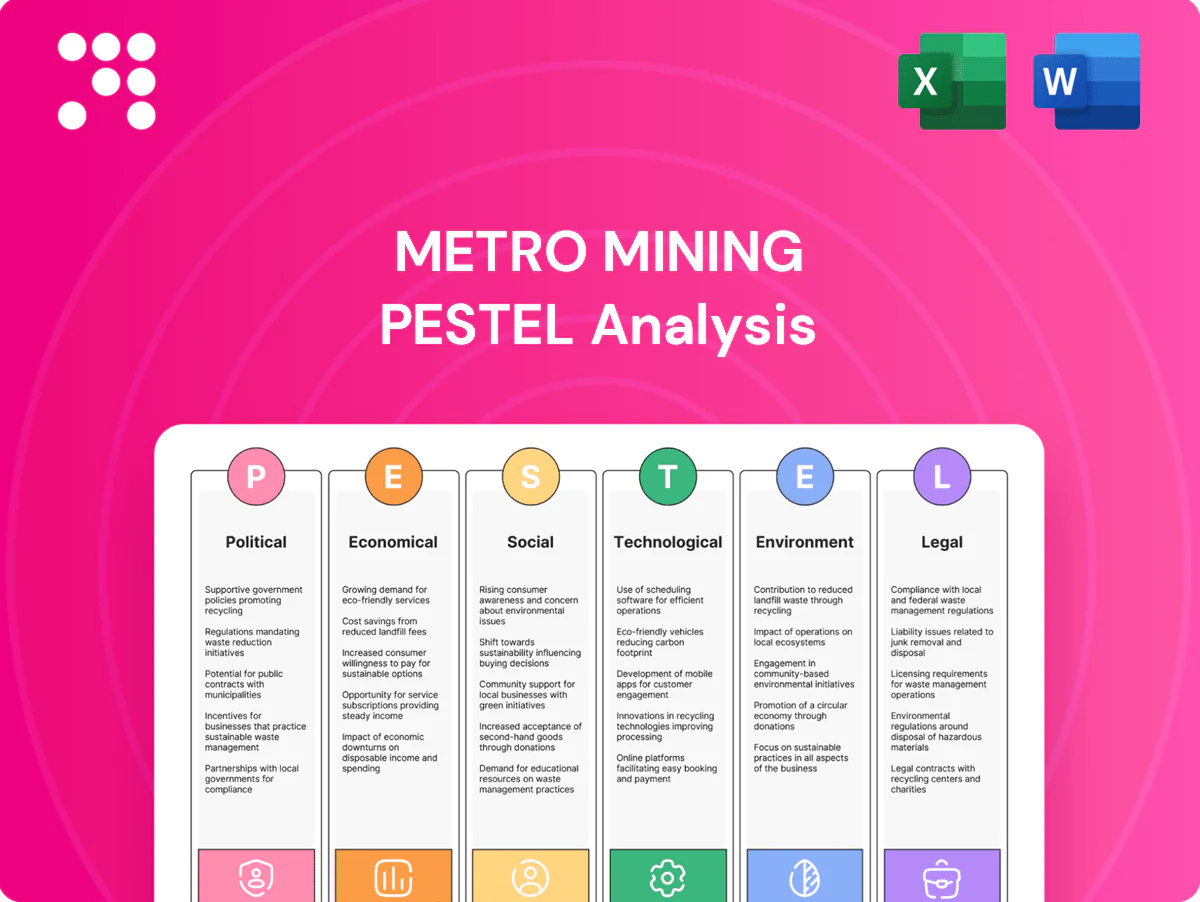
The preview shown here is the exact Metro Mining PESTLE Analysis document you’ll receive after purchase—fully formatted and ready to use. It contains the full political, economic, social, technological, legal and environmental assessment as displayed. No placeholders or teasers—this is the finished file ready for immediate download.

Product Information
Product Information
Shipping & Returns
Shipping & Returns
Description
Skip the Research. Get the Strategy.
Unpack how political shifts, commodity cycles, and environmental regulations are shaping Metro Mining’s strategic outlook in our concise PESTLE snapshot; ideal for investors and strategists seeking actionable clarity. Buy the full PESTLE analysis to access deep-dive insights, ready-to-use data, and practical recommendations.
Political factors
Federal–state mining policy alignment
Australia’s federal settings (including EPBC Act reforms) and Queensland’s mining policies directly shape approvals, royalties and operational certainty for Metro Mining (ASX:MMI) at Bauxite Hills near Weipa. Stable policy underpins multi‑year mine plans and continued use of Weipa port infrastructure. Shifts in royalty rates or exploration incentives can materially alter project cash flows and NPV. Monitor Queensland’s annual budget cycle (delivered in June) and periodic resource policy reviews for risks.
Indigenous relations and native title
Engagement with Traditional Owners and registered Indigenous Land Use Agreements underpin Metro Mining’s access to its Bauxite Hills operations in Cape York and secure benefit-sharing and social licence. Policy shifts tightening cultural heritage protections can increase compliance obligations and shorten approval timelines. Genuine partnerships, employment pathways and transparent benefit sharing lower political risk; disputes can trigger delays or permit variations. Indigenous Australians were 3.8% of the population (2021 census).
Northern Australia development agenda
Federal Northern Australia agenda, backed by the NAIF which was established with up to A$5 billion in concessional finance, enables infrastructure support for roads, ports and airstrips that would benefit Cape York access for Metro Mining. Priority designation can accelerate upgrades near Cape York, but shifts in government priorities risk reallocating funding. Active advocacy is needed to secure inclusion in regional plans.
Trade relations with key buyers
Metro Mining's bauxite export exposure to Asia makes Australia–China and Australia–India relations critical; tariffs, informal barriers or diplomatic tensions can quickly affect shipment volumes and realised prices. Diversifying offtake across buyers and building multi‑market ties reduces single‑market shock risk. Engagement with Austrade and industry bodies supports market access; Austrade operates 70+ international offices.
- Key risk: China/India dependency
- Mitigation: diversify offtake
- Support: Austrade 70+ offices
Energy transition industrial policy
Energy transition industrial policy—policies supporting low‑carbon aluminum, green power and critical minerals are lifting bauxite demand as decarbonisation shifts raw‑material sourcing; the EU Carbon Border Adjustment Mechanism moved from a transitional phase in 2023 toward full application in 2026, favoring lower‑emission supply chains and opening premium contract opportunities for compliant miners.
- CBAM: transitional 2023 → full 2026
- Incentives: domestic refining shifts value chains
- Market: lower‑emission bauxite attracts pricing premiums
Policy, Indigenous consent and CBAM threaten project NPV; NAIF A$5bn
Federal and Queensland mining policy (monitor June budget) drives approvals, royalties and port access for Bauxite Hills; changes can shift NPV. Indigenous Land Use Agreements underpin access; Indigenous Australians 3.8% (2021) — tighter heritage laws raise compliance risk. Export reliance on China/India and CBAM (full 2026) mean market/diversification and NAIF A$5bn infrastructure funding are material.
| Factor | Metric | Implication |
|---|---|---|
| Policy | Queensland budget (June) | Royalty/approval risk |
| Indigenous | 3.8% (2021) | Access/compliance |
| Markets | Austrade 70+ offices; CBAM 2026; NAIF A$5bn | Market access; premium demand; infra support |
What is included in the product
Detailed Word Document
Explores how macro-environmental factors uniquely affect Metro Mining across Political, Economic, Social, Technological, Environmental, and Legal dimensions, with data-backed trends and region-specific regulatory context; designed for executives and investors to identify risks, opportunities and support scenario-based strategic planning.
Customizable Excel Spreadsheet
A clean, summarized Metro Mining PESTLE for easy referencing in meetings, visually segmented by PESTLE categories and easily shareable to align teams and support external risk discussions during planning sessions.
Economic factors
Bauxite price and aluminum cycle
Metro’s revenue closely follows seaborne bauxite indices and the alumina/aluminum cycle, with LME aluminium averaging about US$2,300/t in mid‑2025, directly influencing alumina demand and bauxite prices.
Smelter and refinery throughput drives Metro’s volumes and pricing power, while periods of refinery curtailment or global oversupply compress margins and lower realized prices.
Long‑term offtake contracts smooth spot volatility and protect cashflow but limit upside when cycle prices rally above contracted levels.
FX exposure (AUD/USD)
Metro Mining invoices bauxite in USD while most operating costs (labor, services) and diesel are AUD‑linked, so AUD depreciation (AUD/USD ~0.66 in July 2025) materially boosts margins while appreciation compresses them. The company uses hedging policies and natural hedges from USD‑linked contract expenses to stabilise cashflow, with sensitivity analysis guiding treasury hedging size and tenor.
Freight, fuel, and logistics costs
Handysize rates (~USD 6,000–9,000/day) and Supramax (~USD 8,000–12,000/day) plus VLSFO bunker prices (≈USD 500–700/t in 2024) materially raise delivered cost to Asia. Remote operations add haulage, port and maintenance uplifts (roughly USD 3–7/t). Cyclone season disrupts windows and can lift insurance premiums 10–20%. Contracting and seasonal planning are used to reduce this variance.
Capital intensity and scalability
Shallow bauxite at Bauxite Hills supports modular expansions with moderate capex, allowing Metro Mining to add capacity in stages. Phased pit development and mobile fleet deployment reduce unit costs as throughput scales. Reliable working capital is essential to cover wet‑season shutdowns and maintain operations. Tight discipline on sustaining capex preserves free cash flow and balance‑sheet resilience.
- Modular expansions — lower upfront capex
- Phased pits + mobile equipment — improving unit economics
- Working capital — crucial for wet‑season downtime
- Sustaining capex discipline — protects free cash flow
Customer concentration and credit
Small buyer base heightens counterparty and renegotiation risk for Metro Mining; reliance on a handful of offtakers concentrates revenue exposure. Prepayments and offtake agreements fund expansions but create delivery and performance obligations. Rigorous credit checks and staggered tenors have reduced default exposure. By 2024 Metro expanded sales into India and Southeast Asia to lower single-market dependence.
- Counterparty risk: concentrated buyers
- Offtake/prepayments: funds growth, adds obligations
- Risk mitigation: credit checks, diversified tenor
- Market diversification: India & Southeast Asia growth in 2024
Policy, Indigenous consent and CBAM threaten project NPV; NAIF A$5bn
Metro’s revenue tracks seaborne bauxite and alumina cycles; LME aluminium ~US$2,300/t (mid‑2025) and alumina demand set bauxite prices. USD invoicing vs AUD costs (AUD/USD ~0.66 July 2025) creates FX-driven margin swings; hedging and natural USD costs mitigate risk. Shipping (Handysize US$6–9k/day; Supramax US$8–12k/day) plus VLSFO ~US$600/t and remote logistics add ~US$3–7/t to delivered cost.
| Metric | Value |
|---|---|
| LME Aluminium | ~US$2,300/t (mid‑2025) |
| AUD/USD | ~0.66 (Jul 2025) |
| Handy/Supramax rates | US$6–9k / US$8–12k per day |
| VLSFO | ~US$600/t (2024–25) |
Preview Before You Purchase
Metro Mining PESTLE Analysis
The preview shown here is the exact Metro Mining PESTLE Analysis document you’ll receive after purchase—fully formatted and ready to use. It contains the full political, economic, social, technological, legal and environmental assessment as displayed. No placeholders or teasers—this is the finished file ready for immediate download.