Mengniu PESTLE Analysis

Your Shortcut to Market Insight Starts Here
Our PESTLE analysis reveals how political, economic and technological shifts are reshaping Mengniu's market position, from regulatory pressures to sustainability trends. Use these insights to anticipate risks and spot growth opportunities. Purchase the full, ready-to-use report for the complete breakdown and immediate download.
Political factors

National food security priorities
China treats dairy as core to nutrition and food security, with state guidance—reflected in 2024 policies promoting domestic milk and upstream integration—shaping subsidies and safety standards; national milk output (~36 million tonnes in 2023) and rising raw-milk prices have tightened supply. Policy shifts affect raw-milk pricing and approvals for investments, while Mengniu’s alignment with state nutrition goals bolsters market access and branding.
Regulatory oversight intensity
Central and provincial authorities tightly supervise dairy processing and cold-chain logistics, with post-2008 and post-2016 reforms raising inspection frequency and compliance costs; Mengniu reported RMB 89.5 billion revenue in FY2024 and increased QA spend accordingly. Heightened inspections after past safety incidents push routine audits and recall readiness across plants. Predictable enforcement boosts consumer confidence but forces Mengniu to maintain best-in-class traceability (>90% SKU coverage) to avoid disruptive shutdowns.

Rural revitalization and farming support
China’s 14th Five-Year Plan (2021–25) and rural revitalization policies promote modern dairy farming, improved herd genetics, and cooperative models; targeted subsidies and easier farm credit aim to expand domestic raw milk capacity, reducing import dependence while potentially compressing processor margins. Mengniu’s partnerships with government-backed model farms align it with policy and help stabilize supply.

Trade relations and tariff dynamics
Import tariffs and bilateral relations directly affect Mengniu’s input costs for milk powder, whey and equipment, with tariff rates across dairy inputs varying by origin (commonly 0–25%) and subject to trade negotiations; disruptions raise COGS and margin pressure for listed Mengniu (2319.HK).
Geopolitical tensions periodically disrupt feed and nutrient imports from key suppliers, but Mengniu’s diversified sourcing network and scale enable procurement and currency hedging across origins to smooth supply shocks.
- Tariff exposure: 0–25% range
- Public listing: 2319.HK
- Mitigation: diversified sourcing and hedging
Public health campaigns
Government nutrition guidelines such as China’s Dietary Guidelines recommend about 300 grams of dairy daily, reinforcing protein and calcium messaging and supporting demand for milk products; school milk programs and sports initiatives have expanded consumption among students and youth. WHO sugar targets of less than 10% (conditional <5%) of energy are driving policy toward sugar reduction, prompting Mengniu to reformulate SKUs and reposition portfolios to stay compliant and preferred.
- Guideline: 300 g dairy/day
- WHO sugar: <10% energy (conditional <5%)
- Action: reformulation & portfolio adaptation
China policy boosts milk; compliant processors benefit as tighter QA, tariffs and WHO sugar caps
State nutrition policy and Five-Year Plan support domestic milk growth (China raw milk ~36 Mt in 2023) and favour processors aligned with national goals; Mengniu (2319.HK) reported RMB 89.5bn revenue in FY2024 and benefits from policy-aligned branding. Tightened inspections and QA raise compliance costs; Mengniu >90% SKU traceability. Tariff exposure (0–25%) and WHO sugar targets (<10% energy) force reformulation and hedging.
| Metric | Value |
|---|---|
| China raw milk (2023) | 36 Mt |
| Mengniu FY2024 rev | RMB 89.5bn |
| SKU traceability | >90% |
| Tariff range | 0–25% |
What is included in the product
 Detailed Word Document
Explores how Political, Economic, Social, Technological, Environmental and Legal forces uniquely affect Mengniu, with data-backed trends and region-specific examples to identify risks and opportunities; designed for executives, consultants and investors, the analysis is formatted for business plans and includes forward-looking insights to support scenario planning and strategic decisions.

 Customizable Excel Spreadsheet
A concise, visually segmented PESTLE summary of Mengniu that can be dropped into presentations, edited with region- or product-specific notes, and easily shared for quick alignment across teams—supporting external risk discussions and strategic planning.
Economic factors

Consumer income and demand elasticity
Rising urban incomes (China urbanization 66.8% in 2023) underpin demand for Mengniu’s premium and functional dairy, while household income pressure during slowdowns shifts purchases to value brands and family packs; Mengniu reported ~RMB 99.1bn revenue in 2024, with tiered SKUs helping buffer cycles. During downcycles price architecture and targeted promotions become critical to defend volume and margins.
Raw milk and feed cost volatility
Feed (corn, soymeal) typically makes up about 60% of farm-gate milk cost, so corn and soymeal price swings strongly drive raw milk inflation. Corn futures traded roughly 4–6 USD/bu and soymeal 380–520 USD/ton in 2024–25, with weather and global supply shocks pushing input inflation. Cost pass-through to consumers is constrained by intense retail competition. Long-term supplier contracts and efficiency gains have helped protect Mengniu margins.

RMB exchange rate movements
Currency swings affect Mengniu via imported ingredients, equipment and packaging; USD/CNY near 7.2 in mid-2025 increases import costs when RMB weakens. A weaker RMB raises COGS while a stronger RMB lowers capex import costs, and Mengniu's documented hedging programmes help reduce FX-driven earnings volatility. Revenue from overseas and domestic sales mix provides partial natural hedges.

Channel mix and retail consolidation
Modern trade, e-commerce and O2O gained share in 2024, with e-commerce/O2O accounting for about 25% of dairy sales in China, increasing channel concentration and promotional pressure. Large retailers and platforms exert strong pricing and slotting power, compressing margins for suppliers. Efficient route-to-market and D2C uplift gross margins; Mengniu’s reported national distribution depth (reach into >2.2 million retail points) is a key competitive lever.
- Channel shift: e-commerce/O2O ≈25% (2024)
- Retailer power: stronger slotting/pricing pressure
- Margin drivers: route-to-market + D2C
- Mengniu leverage: >2.2M retail outlets coverage
Competitive intensity and pricing power
Mengniu faces intense competition from domestic peers like Yili and multinationals such as Nestlé across milk, yogurt and ice cream.
Promotional intensity and trade spend have pressured margins; Mengniu reported a gross margin around 20% in 2023.
Innovation and strong brand equity (≈20% share of China liquid milk) underpin pricing power, while category management and SKU rationalization boost SKU productivity and profitability.
- Market share: ≈20% China liquid milk (2023)
- Gross margin: ≈20% (2023)
- Key pressures: high promo & trade spend
- Levers: innovation, brand, SKU optimization
China policy boosts milk; compliant processors benefit as tighter QA, tariffs and WHO sugar caps
Rising urban incomes (urbanization 66.8% in 2023) support premium/functonal sales while slowdowns shift buyers to value SKUs; Mengniu revenue ~RMB 99.1bn (2024) and SKU tiering buffer cycles. Feed cost volatility (corn ~4–6 USD/bu, soymeal 380–520 USD/t in 2024–25) and USD/CNY ~7.2 (mid‑2025) drive input inflation; channel shift (e‑commerce ≈25% 2024) raises promo pressure and retailer bargaining, pressuring margins (~20% 2023).
| Metric | Value | Year |
|---|---|---|
| Urbanization | 66.8% | 2023 |
| Revenue | RMB 99.1bn | 2024 |
| E‑commerce share | ≈25% | 2024 |
| Market share (liquid milk) | ≈20% | 2023 |
| Gross margin | ≈20% | 2023 |
| USD/CNY | ≈7.2 | mid‑2025 |
Preview the Actual Deliverable
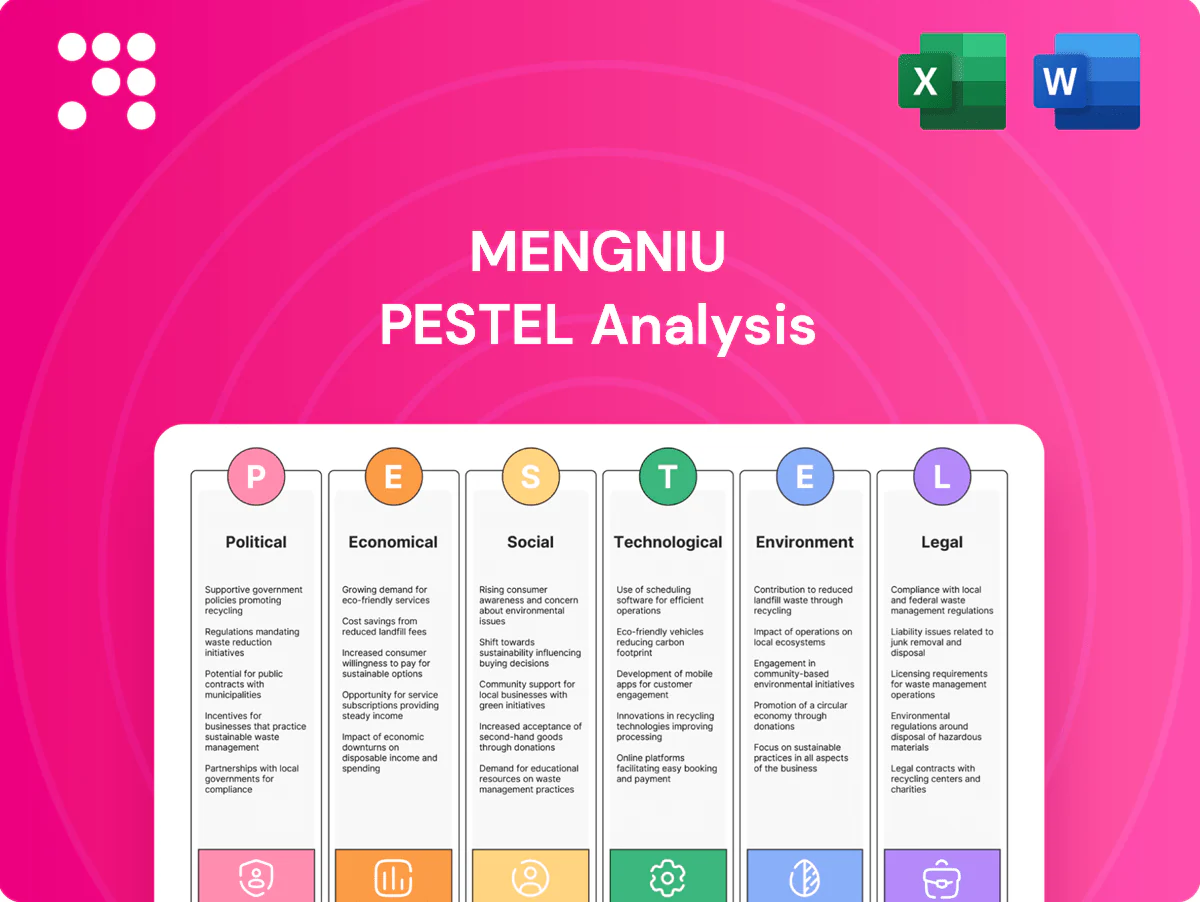
Mengniu PESTLE Analysis
The preview shown here is the exact Mengniu PESTLE Analysis you’ll receive after purchase—fully formatted and ready to use. The file you’re seeing now is the final version, with no placeholders or surprises. The layout, content, and structure visible here are exactly what you’ll download immediately after buying.

Product Information
Product Information
Shipping & Returns
Shipping & Returns
Description
Your Shortcut to Market Insight Starts Here
Our PESTLE analysis reveals how political, economic and technological shifts are reshaping Mengniu's market position, from regulatory pressures to sustainability trends. Use these insights to anticipate risks and spot growth opportunities. Purchase the full, ready-to-use report for the complete breakdown and immediate download.
Political factors
National food security priorities
China treats dairy as core to nutrition and food security, with state guidance—reflected in 2024 policies promoting domestic milk and upstream integration—shaping subsidies and safety standards; national milk output (~36 million tonnes in 2023) and rising raw-milk prices have tightened supply. Policy shifts affect raw-milk pricing and approvals for investments, while Mengniu’s alignment with state nutrition goals bolsters market access and branding.
Regulatory oversight intensity
Central and provincial authorities tightly supervise dairy processing and cold-chain logistics, with post-2008 and post-2016 reforms raising inspection frequency and compliance costs; Mengniu reported RMB 89.5 billion revenue in FY2024 and increased QA spend accordingly. Heightened inspections after past safety incidents push routine audits and recall readiness across plants. Predictable enforcement boosts consumer confidence but forces Mengniu to maintain best-in-class traceability (>90% SKU coverage) to avoid disruptive shutdowns.
Rural revitalization and farming support
China’s 14th Five-Year Plan (2021–25) and rural revitalization policies promote modern dairy farming, improved herd genetics, and cooperative models; targeted subsidies and easier farm credit aim to expand domestic raw milk capacity, reducing import dependence while potentially compressing processor margins. Mengniu’s partnerships with government-backed model farms align it with policy and help stabilize supply.
Trade relations and tariff dynamics
Import tariffs and bilateral relations directly affect Mengniu’s input costs for milk powder, whey and equipment, with tariff rates across dairy inputs varying by origin (commonly 0–25%) and subject to trade negotiations; disruptions raise COGS and margin pressure for listed Mengniu (2319.HK).
Geopolitical tensions periodically disrupt feed and nutrient imports from key suppliers, but Mengniu’s diversified sourcing network and scale enable procurement and currency hedging across origins to smooth supply shocks.
- Tariff exposure: 0–25% range
- Public listing: 2319.HK
- Mitigation: diversified sourcing and hedging
Public health campaigns
Government nutrition guidelines such as China’s Dietary Guidelines recommend about 300 grams of dairy daily, reinforcing protein and calcium messaging and supporting demand for milk products; school milk programs and sports initiatives have expanded consumption among students and youth. WHO sugar targets of less than 10% (conditional <5%) of energy are driving policy toward sugar reduction, prompting Mengniu to reformulate SKUs and reposition portfolios to stay compliant and preferred.
- Guideline: 300 g dairy/day
- WHO sugar: <10% energy (conditional <5%)
- Action: reformulation & portfolio adaptation
China policy boosts milk; compliant processors benefit as tighter QA, tariffs and WHO sugar caps
State nutrition policy and Five-Year Plan support domestic milk growth (China raw milk ~36 Mt in 2023) and favour processors aligned with national goals; Mengniu (2319.HK) reported RMB 89.5bn revenue in FY2024 and benefits from policy-aligned branding. Tightened inspections and QA raise compliance costs; Mengniu >90% SKU traceability. Tariff exposure (0–25%) and WHO sugar targets (<10% energy) force reformulation and hedging.
| Metric | Value |
|---|---|
| China raw milk (2023) | 36 Mt |
| Mengniu FY2024 rev | RMB 89.5bn |
| SKU traceability | >90% |
| Tariff range | 0–25% |
What is included in the product
Detailed Word Document
Explores how Political, Economic, Social, Technological, Environmental and Legal forces uniquely affect Mengniu, with data-backed trends and region-specific examples to identify risks and opportunities; designed for executives, consultants and investors, the analysis is formatted for business plans and includes forward-looking insights to support scenario planning and strategic decisions.
Customizable Excel Spreadsheet
A concise, visually segmented PESTLE summary of Mengniu that can be dropped into presentations, edited with region- or product-specific notes, and easily shared for quick alignment across teams—supporting external risk discussions and strategic planning.
Economic factors
Consumer income and demand elasticity
Rising urban incomes (China urbanization 66.8% in 2023) underpin demand for Mengniu’s premium and functional dairy, while household income pressure during slowdowns shifts purchases to value brands and family packs; Mengniu reported ~RMB 99.1bn revenue in 2024, with tiered SKUs helping buffer cycles. During downcycles price architecture and targeted promotions become critical to defend volume and margins.
Raw milk and feed cost volatility
Feed (corn, soymeal) typically makes up about 60% of farm-gate milk cost, so corn and soymeal price swings strongly drive raw milk inflation. Corn futures traded roughly 4–6 USD/bu and soymeal 380–520 USD/ton in 2024–25, with weather and global supply shocks pushing input inflation. Cost pass-through to consumers is constrained by intense retail competition. Long-term supplier contracts and efficiency gains have helped protect Mengniu margins.
RMB exchange rate movements
Currency swings affect Mengniu via imported ingredients, equipment and packaging; USD/CNY near 7.2 in mid-2025 increases import costs when RMB weakens. A weaker RMB raises COGS while a stronger RMB lowers capex import costs, and Mengniu's documented hedging programmes help reduce FX-driven earnings volatility. Revenue from overseas and domestic sales mix provides partial natural hedges.
Channel mix and retail consolidation
Modern trade, e-commerce and O2O gained share in 2024, with e-commerce/O2O accounting for about 25% of dairy sales in China, increasing channel concentration and promotional pressure. Large retailers and platforms exert strong pricing and slotting power, compressing margins for suppliers. Efficient route-to-market and D2C uplift gross margins; Mengniu’s reported national distribution depth (reach into >2.2 million retail points) is a key competitive lever.
- Channel shift: e-commerce/O2O ≈25% (2024)
- Retailer power: stronger slotting/pricing pressure
- Margin drivers: route-to-market + D2C
- Mengniu leverage: >2.2M retail outlets coverage
Competitive intensity and pricing power
Mengniu faces intense competition from domestic peers like Yili and multinationals such as Nestlé across milk, yogurt and ice cream.
Promotional intensity and trade spend have pressured margins; Mengniu reported a gross margin around 20% in 2023.
Innovation and strong brand equity (≈20% share of China liquid milk) underpin pricing power, while category management and SKU rationalization boost SKU productivity and profitability.
- Market share: ≈20% China liquid milk (2023)
- Gross margin: ≈20% (2023)
- Key pressures: high promo & trade spend
- Levers: innovation, brand, SKU optimization
China policy boosts milk; compliant processors benefit as tighter QA, tariffs and WHO sugar caps
Rising urban incomes (urbanization 66.8% in 2023) support premium/functonal sales while slowdowns shift buyers to value SKUs; Mengniu revenue ~RMB 99.1bn (2024) and SKU tiering buffer cycles. Feed cost volatility (corn ~4–6 USD/bu, soymeal 380–520 USD/t in 2024–25) and USD/CNY ~7.2 (mid‑2025) drive input inflation; channel shift (e‑commerce ≈25% 2024) raises promo pressure and retailer bargaining, pressuring margins (~20% 2023).
| Metric | Value | Year |
|---|---|---|
| Urbanization | 66.8% | 2023 |
| Revenue | RMB 99.1bn | 2024 |
| E‑commerce share | ≈25% | 2024 |
| Market share (liquid milk) | ≈20% | 2023 |
| Gross margin | ≈20% | 2023 |
| USD/CNY | ≈7.2 | mid‑2025 |
Preview the Actual Deliverable
Mengniu PESTLE Analysis
The preview shown here is the exact Mengniu PESTLE Analysis you’ll receive after purchase—fully formatted and ready to use. The file you’re seeing now is the final version, with no placeholders or surprises. The layout, content, and structure visible here are exactly what you’ll download immediately after buying.