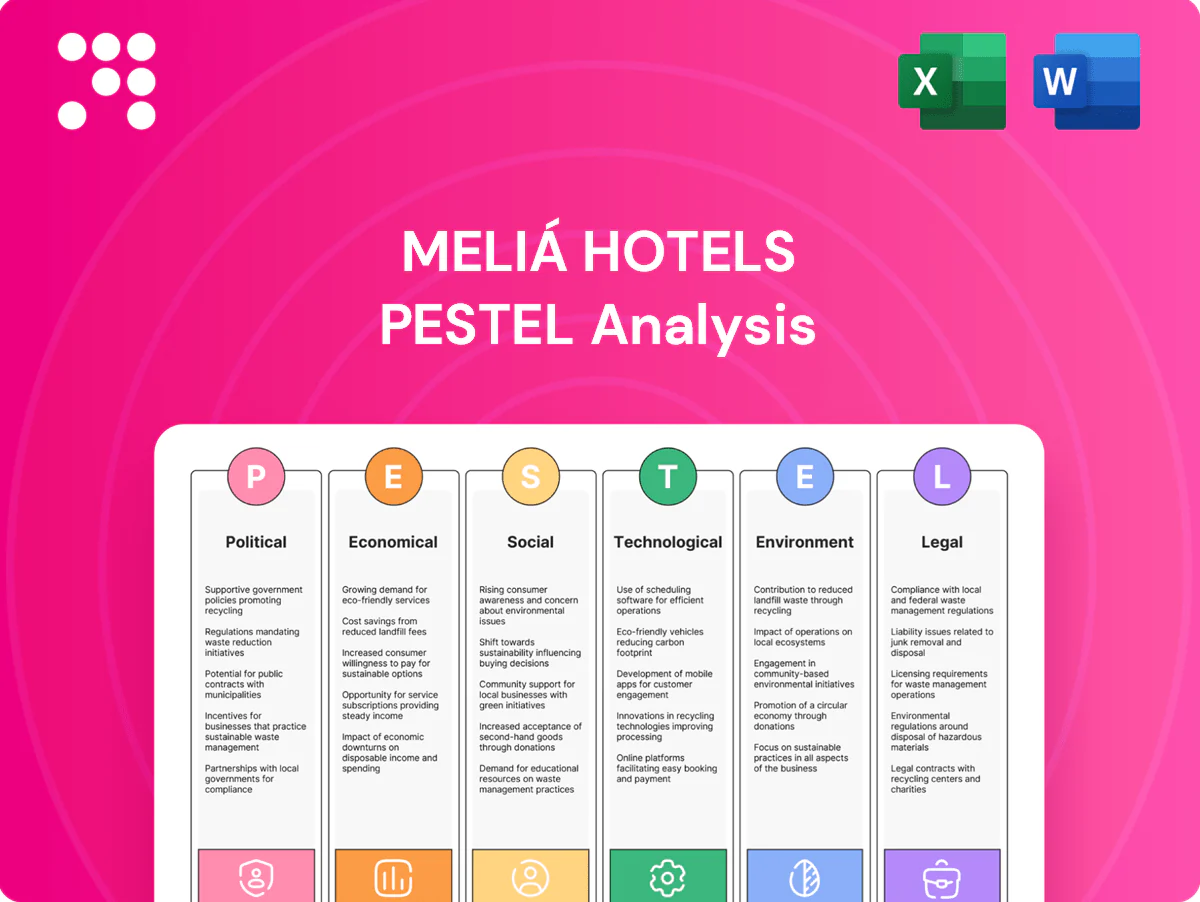
Meliá Hotels PESTLE Analysis

Skip the Research. Get the Strategy.
Discover how political shifts, economic cycles, social trends, technological disruption, legal changes and environmental pressures shape Meliá Hotels' strategy. Our PESTLE pinpoints risks and opportunities across markets. Ideal for investors and planners seeking actionable intelligence. Buy the full analysis to get the complete, editable report instantly.
Political factors

Geopolitical stability
Operations across regions with varying stability expose Meliá (listed MLE) to demand swings and higher insurance costs; global international arrivals were ~1.4 billion in 2023 (UNWTO), so travel disruptions materially affect revenue. Political unrest can close travel corridors and interrupt resort supply chains. Diversifying country exposure and flexible staffing, plus monitoring election cycles and tourism policy changes, mitigate localized shocks.
Tourism incentives
Many governments offer tax breaks, subsidies or co-funded marketing to boost arrivals, supporting hotel demand; UNWTO reports 2023 international arrivals recovered to about 88% of 2019 levels. Accessing incentive schemes measurably improves project IRRs and refurbishment economics for groups like Meliá. Policy reversals or budget cuts can abruptly curtail these benefits. Active government relations are essential to secure continuity.

Visa and entry rules
Stricter visa regimes suppress long-haul demand, while wider e-visa rollout has supported recovery in arrivals; UNWTO reported 2023 international tourist arrivals recovered to roughly 85% of 2019 levels, highlighting sensitivity to entry rules. Rapid changes in health entry requirements shift booking patterns overnight, forcing Meliá to reprice and reallocate distribution by source-market friction, and airline partnerships (codeshares, joint promotions) help cushion policy shocks.

Public infrastructure
Airport capacity and urban transit shape Meliá accessibility—global air traffic recovered to about 94% of 2019 levels in 2024 (IATA), boosting resort and city demand; Madrid and Barcelona expansions added capacity in 2023–24, unlocking MICE potential. Government investments (EU recovery funds >€700bn regionally) can open new destinations, while infrastructure delays commonly postpone managed-property ramp-up by 6–18 months; proactive advocacy aligns openings with transport access.
- Airport capacity: +94% of 2019 global traffic (2024)
- Project delays: typical ramp-up hit 6–18 months
- Public funding: NextGenerationEU scale >€700bn regionally
- Action: destination planning advocacy
Trade and taxation
Import tariffs and VAT at import (Spain standard VAT 21%) raise FF&E landed costs during renovations, pressuring refurbishment budgets and margins.
Changes in VAT or tourism levies directly affect ADR and net RevPAR, cross-border repatriation hinges on double-taxation treaties, and optimized corporate structuring is used to manage tax drag across jurisdictions; Spain corporate tax rate 25% is a key benchmark.
- Import VAT: 21% (Spain)
- Corporate tax benchmark: 25% (Spain)
- Profit flows depend on double-tax treaties
- Structuring reduces multi-jurisdictional tax drag
Hotel operator exposed to demand swings as 2023 intl arrivals ~1.4bn; 2024 air traffic ~94% of 2019
Meliá faces revenue swings from regional instability as 2023 international arrivals were ~1.4bn (UNWTO) and 2024 air traffic reached ~94% of 2019 (IATA); election cycles, unrest and visa rules rapidly shift demand. Government incentives (NextGenerationEU >€700bn) and tax regimes (Spain VAT 21%, corporate tax 25%) materially affect refurbishment economics and net RevPAR; strong government relations reduce policy risk.
| Indicator | Value |
|---|---|
| Intl arrivals 2023 | ~1.4bn |
| Air traffic 2024 | ~94% of 2019 |
| Spain VAT | 21% |
| Spain corp tax | 25% |
What is included in the product
 Detailed Word Document
Explores how Political, Economic, Social, Technological, Environmental and Legal forces uniquely impact Meliá Hotels, with data-backed trends and region-specific examples. Designed for executives and investors, it highlights threats, opportunities and forward-looking scenarios to inform strategy, funding and operational planning.

 Customizable Excel Spreadsheet
A clean, summarized PESTLE of Meliá Hotels that’s visually segmented for quick interpretation, editable for region- or business-specific notes, and ready to drop into presentations or share across teams to streamline risk discussions and planning.
Economic factors

Global travel cycle
Hotel demand closely follows global GDP (IMF projects ~3.0% growth in 2025), consumer confidence and airline capacity (IATA reported passenger demand near pre‑pandemic levels by 2024). Leisure segments recovered faster than corporate after downturns, with resort occupancy outpacing urban business hotels by double‑digit percentage points in 2023–24. Sensitivity varies across resorts, city and MICE hotels, while dynamic pricing and RevPAR management (STR data showed global RevPAR above 2019 in 2024) align with macro momentum.
FX volatility
Meliá reports in euros while earning revenues in multiple currencies across Europe, Latin America and the Caribbean, so FX swings directly affect room pricing competitiveness for key source markets. Active hedging programs and natural currency offsets from geographically diversified operations moderate reported earnings volatility. Shifting contract mix toward local-currency revenue-linked cost structures further mitigates translation risk.

Inflation and wages
Staffing, typically 30–40% of hotel revenue, is a major cost for Meliá and wage inflation in 2024 (euro area inflation ~2.4%) squeezes margins; negotiated pay rises have lifted payroll pressure. Energy and food price volatility (Brent ~USD82/bbl avg 2024) raises F&B and utilities costs. Investment in productivity tools and menu engineering supports GOP protection, while contractual rate escalators help recover rising input costs.

Interest rates
Higher interest rates (ECB deposit ~4% and US fed funds ~5.25% mid‑2025) increase Meliá’s refinancing and refurbishment costs, push hotel transaction cap rates up c.100–150bps to ~5–6% in 2024–25, and tilt valuation math toward asset‑light models; lease liabilities become more expensive to service, so phased capex is used to preserve liquidity through cycles.
- Higher borrowing costs: increases financing/refurb costs
- Cap rates ~5–6%: favors asset‑light
- Lease liabilities rise: higher service cost
- Phased capex: preserves liquidity
Segment mix
Segment mix at Meliá balances leisure, MICE and corporate demand with macro shifts; premium resorts sustain rate via experiential offerings while flexible group pace visibility supports staffing and inventory planning. Diversified footprint of around 380 hotels across 40 countries buffers local shocks; UNWTO reported international arrivals at about 88% of 2019 in 2023, aiding leisure recovery.
- Leisure-driven RevPAR resilience
- Group pace improves staffing efficiency
- Premium resorts maintain ADR
- ~380 hotels in 40 countries smooth shocks
Hotel operator exposed to demand swings as 2023 intl arrivals ~1.4bn; 2024 air traffic ~94% of 2019
Global GDP ~3.0% (IMF 2025), RevPAR >2019 (STR 2024) driving leisure recovery; Meliá ~380 hotels in 40 countries cushions local shocks. ECB deposit ~4% and US Fed ~5.25% mid‑2025 lift borrowing/refurb costs; cap rates ~5–6% favor asset‑light. Wage inflation ~2.4% (euro area 2024) and Brent ~USD82/bbl raise operating costs; hedging and phased capex mitigate risks.
| Metric | Value |
|---|---|
| Hotels | ~380/40 countries |
| ECB deposit | ~4% (mid‑2025) |
| Fed funds | ~5.25% (mid‑2025) |
| Brent | ~USD82/bbl (2024 avg) |
| Euro area inflation | ~2.4% (2024) |
Full Version Awaits
Meliá Hotels PESTLE Analysis
The preview shown here is the exact Meliá Hotels PESTLE Analysis you’ll receive after purchase—fully formatted and ready to use. This sample reflects the full content, structure and insights on political, economic, social, technological, legal and environmental factors. No placeholders or teasers—download the final file instantly after checkout.

Original: $10.00
-65%$10.00
$3.50Product Information
Product Information
Shipping & Returns
Shipping & Returns
Description
Skip the Research. Get the Strategy.
Discover how political shifts, economic cycles, social trends, technological disruption, legal changes and environmental pressures shape Meliá Hotels' strategy. Our PESTLE pinpoints risks and opportunities across markets. Ideal for investors and planners seeking actionable intelligence. Buy the full analysis to get the complete, editable report instantly.
Political factors
Geopolitical stability
Operations across regions with varying stability expose Meliá (listed MLE) to demand swings and higher insurance costs; global international arrivals were ~1.4 billion in 2023 (UNWTO), so travel disruptions materially affect revenue. Political unrest can close travel corridors and interrupt resort supply chains. Diversifying country exposure and flexible staffing, plus monitoring election cycles and tourism policy changes, mitigate localized shocks.
Tourism incentives
Many governments offer tax breaks, subsidies or co-funded marketing to boost arrivals, supporting hotel demand; UNWTO reports 2023 international arrivals recovered to about 88% of 2019 levels. Accessing incentive schemes measurably improves project IRRs and refurbishment economics for groups like Meliá. Policy reversals or budget cuts can abruptly curtail these benefits. Active government relations are essential to secure continuity.
Visa and entry rules
Stricter visa regimes suppress long-haul demand, while wider e-visa rollout has supported recovery in arrivals; UNWTO reported 2023 international tourist arrivals recovered to roughly 85% of 2019 levels, highlighting sensitivity to entry rules. Rapid changes in health entry requirements shift booking patterns overnight, forcing Meliá to reprice and reallocate distribution by source-market friction, and airline partnerships (codeshares, joint promotions) help cushion policy shocks.
Public infrastructure
Airport capacity and urban transit shape Meliá accessibility—global air traffic recovered to about 94% of 2019 levels in 2024 (IATA), boosting resort and city demand; Madrid and Barcelona expansions added capacity in 2023–24, unlocking MICE potential. Government investments (EU recovery funds >€700bn regionally) can open new destinations, while infrastructure delays commonly postpone managed-property ramp-up by 6–18 months; proactive advocacy aligns openings with transport access.
- Airport capacity: +94% of 2019 global traffic (2024)
- Project delays: typical ramp-up hit 6–18 months
- Public funding: NextGenerationEU scale >€700bn regionally
- Action: destination planning advocacy
Trade and taxation
Import tariffs and VAT at import (Spain standard VAT 21%) raise FF&E landed costs during renovations, pressuring refurbishment budgets and margins.
Changes in VAT or tourism levies directly affect ADR and net RevPAR, cross-border repatriation hinges on double-taxation treaties, and optimized corporate structuring is used to manage tax drag across jurisdictions; Spain corporate tax rate 25% is a key benchmark.
- Import VAT: 21% (Spain)
- Corporate tax benchmark: 25% (Spain)
- Profit flows depend on double-tax treaties
- Structuring reduces multi-jurisdictional tax drag
Hotel operator exposed to demand swings as 2023 intl arrivals ~1.4bn; 2024 air traffic ~94% of 2019
Meliá faces revenue swings from regional instability as 2023 international arrivals were ~1.4bn (UNWTO) and 2024 air traffic reached ~94% of 2019 (IATA); election cycles, unrest and visa rules rapidly shift demand. Government incentives (NextGenerationEU >€700bn) and tax regimes (Spain VAT 21%, corporate tax 25%) materially affect refurbishment economics and net RevPAR; strong government relations reduce policy risk.
| Indicator | Value |
|---|---|
| Intl arrivals 2023 | ~1.4bn |
| Air traffic 2024 | ~94% of 2019 |
| Spain VAT | 21% |
| Spain corp tax | 25% |
What is included in the product
Detailed Word Document
Explores how Political, Economic, Social, Technological, Environmental and Legal forces uniquely impact Meliá Hotels, with data-backed trends and region-specific examples. Designed for executives and investors, it highlights threats, opportunities and forward-looking scenarios to inform strategy, funding and operational planning.
Customizable Excel Spreadsheet
A clean, summarized PESTLE of Meliá Hotels that’s visually segmented for quick interpretation, editable for region- or business-specific notes, and ready to drop into presentations or share across teams to streamline risk discussions and planning.
Economic factors
Global travel cycle
Hotel demand closely follows global GDP (IMF projects ~3.0% growth in 2025), consumer confidence and airline capacity (IATA reported passenger demand near pre‑pandemic levels by 2024). Leisure segments recovered faster than corporate after downturns, with resort occupancy outpacing urban business hotels by double‑digit percentage points in 2023–24. Sensitivity varies across resorts, city and MICE hotels, while dynamic pricing and RevPAR management (STR data showed global RevPAR above 2019 in 2024) align with macro momentum.
FX volatility
Meliá reports in euros while earning revenues in multiple currencies across Europe, Latin America and the Caribbean, so FX swings directly affect room pricing competitiveness for key source markets. Active hedging programs and natural currency offsets from geographically diversified operations moderate reported earnings volatility. Shifting contract mix toward local-currency revenue-linked cost structures further mitigates translation risk.
Inflation and wages
Staffing, typically 30–40% of hotel revenue, is a major cost for Meliá and wage inflation in 2024 (euro area inflation ~2.4%) squeezes margins; negotiated pay rises have lifted payroll pressure. Energy and food price volatility (Brent ~USD82/bbl avg 2024) raises F&B and utilities costs. Investment in productivity tools and menu engineering supports GOP protection, while contractual rate escalators help recover rising input costs.
Interest rates
Higher interest rates (ECB deposit ~4% and US fed funds ~5.25% mid‑2025) increase Meliá’s refinancing and refurbishment costs, push hotel transaction cap rates up c.100–150bps to ~5–6% in 2024–25, and tilt valuation math toward asset‑light models; lease liabilities become more expensive to service, so phased capex is used to preserve liquidity through cycles.
- Higher borrowing costs: increases financing/refurb costs
- Cap rates ~5–6%: favors asset‑light
- Lease liabilities rise: higher service cost
- Phased capex: preserves liquidity
Segment mix
Segment mix at Meliá balances leisure, MICE and corporate demand with macro shifts; premium resorts sustain rate via experiential offerings while flexible group pace visibility supports staffing and inventory planning. Diversified footprint of around 380 hotels across 40 countries buffers local shocks; UNWTO reported international arrivals at about 88% of 2019 in 2023, aiding leisure recovery.
- Leisure-driven RevPAR resilience
- Group pace improves staffing efficiency
- Premium resorts maintain ADR
- ~380 hotels in 40 countries smooth shocks
Hotel operator exposed to demand swings as 2023 intl arrivals ~1.4bn; 2024 air traffic ~94% of 2019
Global GDP ~3.0% (IMF 2025), RevPAR >2019 (STR 2024) driving leisure recovery; Meliá ~380 hotels in 40 countries cushions local shocks. ECB deposit ~4% and US Fed ~5.25% mid‑2025 lift borrowing/refurb costs; cap rates ~5–6% favor asset‑light. Wage inflation ~2.4% (euro area 2024) and Brent ~USD82/bbl raise operating costs; hedging and phased capex mitigate risks.
| Metric | Value |
|---|---|
| Hotels | ~380/40 countries |
| ECB deposit | ~4% (mid‑2025) |
| Fed funds | ~5.25% (mid‑2025) |
| Brent | ~USD82/bbl (2024 avg) |
| Euro area inflation | ~2.4% (2024) |
Full Version Awaits
Meliá Hotels PESTLE Analysis
The preview shown here is the exact Meliá Hotels PESTLE Analysis you’ll receive after purchase—fully formatted and ready to use. This sample reflects the full content, structure and insights on political, economic, social, technological, legal and environmental factors. No placeholders or teasers—download the final file instantly after checkout.