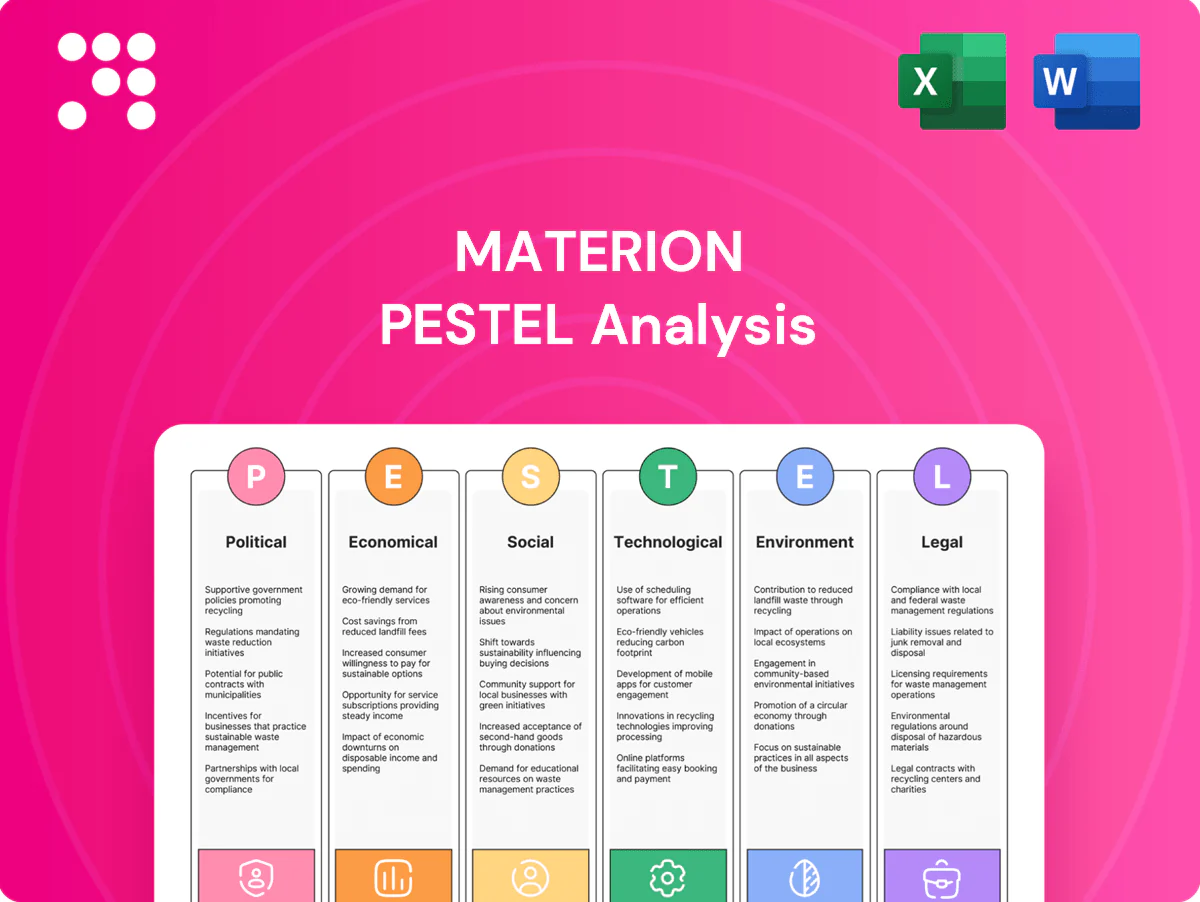
Materion PESTLE Analysis

Skip the Research. Get the Strategy.
Gain a competitive edge with our Materion PESTLE Analysis. Explore political, economic, social, technological, legal and environmental forces shaping Materion's strategy and risks. Ready-to-use and fully sourced, it's ideal for investors and strategists. Buy the full report to access actionable, downloadable insights now.
Political factors

Export controls and defense policy
Materials for aerospace and defense are tightly regulated by ITAR/EAR, with licensing, end-use screening and country restrictions adding weeks to months to lead times and shaping pipelines; U.S. defense spending was about $858 billion in 2024, so shifts in budgets directly affect demand for high-performance alloys. Policy stability improves backlog visibility, while geopolitical events can abruptly re-route orders.
Trade tariffs and localization
Tariffs on specialty metals (US Section 232: 25% for steel, 10% for aluminum) alter Materion input costs and pricing power. Buy-American and local-content rules (Build America, Buy America often use a 55% domestic content threshold) influence footprint and partnerships. Cross-border VAT (EU avg ~21%) and customs procedures affect delivery reliability; policy harmonization reduces scale costs while fragmentation raises complexity and lead times.

Critical minerals strategy
Governments classify beryllium as a critical mineral (US DOE 2022); USGS reports global beryllium production near 200 tonnes/year (2023), concentrating strategic importance for Materion as the primary US supplier. Incentives and strategic stockpiles support domestic refining/processing and resilience. Export restrictions by producer nations can quickly tighten this sub-200 t global market. Public-private IIJA/IRA programs have directed hundreds of millions toward critical-mineral capacity, testing, and resilience projects.

Industrial policy tailwinds
CHIPS- and EV-focused industrial policy bolsters semiconductor and automotive value chains relevant to Materion; the CHIPS Act includes roughly 52 billion USD for domestic semiconductor incentives and the Inflation Reduction Act allocates about 369 billion USD in clean-energy tax incentives, which can de-risk capex for advanced materials. Offset agreements can unlock new international accounts, while sunsets or budget caps could reduce momentum.
- CHIPS funding ~52B USD
- IRA clean-energy tax incentives ~369B USD
- Grants/tax credits lower capex risk
- Offsets expand international sales; sunsets cap upside
Geopolitical risk and sanctions
Geopolitical risk and sanctions can rapidly reconfigure Materion’s customer eligibility and supplier options, prompting route diversification as shipping chokepoints like the Strait of Hormuz and South China Sea amplify logistics risk; in 2024 global seaborne trade value remained a core conduit for specialty metals demand. Currency and commodity hedging strategies must be aligned with political scenarios, and scenario planning helps mitigate sudden market closures.
- Sanctions reshuffle suppliers/customers
- Route diversification essential
- Hedging intersects political risk
- Scenario planning to avoid closures
ITAR/EAR, tariffs and Buy-American boost aero demand; defense spend $858B
ITAR/EAR controls and defense procurement volatility (US defense spend ~$858B in 2024) directly drive Materion aerospace/defense demand and lead times. Tariffs (US Sec232: steel 25%, aluminum 10%) and Buy-American rules affect input costs and sourcing. Beryllium strategic importance (global production ~200 t/yr, US primary supplier) and CHIPS/IRA funding (CHIPS ~$52B; IRA ~$369B) shape investment and supply resilience.
| Metric | Value (latest) |
|---|---|
| US defense spend 2024 | $858B |
| CHIPS funding | $52B |
| IRA incentives | $369B |
| Global beryllium prod. | ~200 t/yr |
What is included in the product
 Detailed Word Document
Explores how Political, Economic, Social, Technological, Environmental and Legal forces uniquely affect Materion, combining data-driven trends and region-specific regulatory context to identify risks, opportunities and strategic implications for executives, investors and advisors; presented in ready-to-use, forward-looking format for planning and funding discussions.

 Customizable Excel Spreadsheet
A compact, visually segmented Materion PESTLE summary that clarifies regulatory, supply‑chain and market risks for quick integration into meetings or presentations, and that can be annotated for region‑ or business‑line specific action planning.
Economic factors

End-market cyclicality
End-market cyclicality drives Materion order volatility as aerospace, electronics and automotive cycles swing demand; semiconductor inventory corrections in 2023–24 compressed near-term revenue and backlog visibility. Medical and defense remain partially counter-cyclical, smoothing order flow during commercial downturns. Mix shifts toward higher or lower value-added content materially affect margins and profitability.
Commodity and energy costs
Price swings in LME copper (~$8,800/t 2024), nickel (~$22,000/t 2024), precious metals (gold ≈ $2,100/oz 2024) and energy (Brent ≈ $85/bbl 2024) directly raise Materion’s COGS; surcharges and hedging programs aim to stabilize margins, while long‑term supply contracts with strategic customers share input risk; persistent volatility drives shifts in product mix and sourcing to favor lower‑cost alloys and regional suppliers.

FX exposure and global sales
Multi-currency revenues and inputs expose Materion to translation and transaction risk; FY2024 net sales were about $1.06 billion, with roughly 40% derived from international markets, amplifying FX impact on reported results. A strong dollar pressures exports and can reduce reported revenue and margins. Natural hedges from geographically matched costs and sales mitigate but do not eliminate exposure. Pricing discipline and regional supply chain shifts help manage short-term swings.

Capital intensity and rates
Materion's advanced processing and R&D demand sustained capex while the US federal funds rate sat at 5.25–5.50% in late 2024, lifting financing costs and hurdle rates; customers often delay capital programs when access to funding tightens, pressuring order timing. Productivity gains and automation can partially offset higher cost of capital by lowering unit labor and cycle costs.
- Capex intensity: sustained R&D/capex needs
- Rates: Fed funds 5.25–5.50% (late 2024)
- Demand risk: customer program delays
- Mitigation: automation/productivity gains
Supply chain resilience
Lead times for critical metals and engineered ceramics can extend sharply in tight markets, with Materion noting supply constraints that contributed to longer fulfillment cycles in FY2024 when net sales were $1.43 billion.
Dual-sourcing and inventory buffers have been deployed to protect delivery performance and service levels, while logistics disruptions press on-time, in-full metrics and cash conversion days.
Strategic supplier alliances secure priority allocations for semiconductor and defense customers and reduce interruption risk.
- Lead-time risk: elevated in 2024
- Mitigation: dual-sourcing, buffers
- Impact: OTIF and cash conversion
- Defense: supplier alliances for priority
ITAR/EAR, tariffs and Buy-American boost aero demand; defense spend $858B
End‑market cyclicality (aerospace, auto, semiconductors) and semiconductor inventory corrections compressed revenue visibility in 2023–24; medical and defense partially offset downturns. Input-price volatility (copper ~$8,800/t, nickel ~$22,000/t, gold ~$2,100/oz, Brent ~$85/bbl in 2024) raises COGS; surcharges/hedges mitigate. FY2024 net sales ~$1.06B, ~40% international; Fed funds 5.25–5.50% raised financing costs.
| Metric | Value (2024) |
|---|---|
| Net sales | $1.06B |
| Intl share | ~40% |
| Fed funds | 5.25–5.50% |
| Copper | $8,800/t |
| Brent | $85/bbl |
Preview the Actual Deliverable
Materion PESTLE Analysis
The preview shown here is the exact Materion PESTLE Analysis document you’ll receive after purchase—fully formatted and ready to use. The layout, content, and structure visible are identical to the downloadable file with no placeholders or surprises. After payment you’ll instantly get this final, professionally structured report.

Original: $10.00
-65%$10.00
$3.50Product Information
Product Information
Shipping & Returns
Shipping & Returns
Description
Skip the Research. Get the Strategy.
Gain a competitive edge with our Materion PESTLE Analysis. Explore political, economic, social, technological, legal and environmental forces shaping Materion's strategy and risks. Ready-to-use and fully sourced, it's ideal for investors and strategists. Buy the full report to access actionable, downloadable insights now.
Political factors
Export controls and defense policy
Materials for aerospace and defense are tightly regulated by ITAR/EAR, with licensing, end-use screening and country restrictions adding weeks to months to lead times and shaping pipelines; U.S. defense spending was about $858 billion in 2024, so shifts in budgets directly affect demand for high-performance alloys. Policy stability improves backlog visibility, while geopolitical events can abruptly re-route orders.
Trade tariffs and localization
Tariffs on specialty metals (US Section 232: 25% for steel, 10% for aluminum) alter Materion input costs and pricing power. Buy-American and local-content rules (Build America, Buy America often use a 55% domestic content threshold) influence footprint and partnerships. Cross-border VAT (EU avg ~21%) and customs procedures affect delivery reliability; policy harmonization reduces scale costs while fragmentation raises complexity and lead times.
Critical minerals strategy
Governments classify beryllium as a critical mineral (US DOE 2022); USGS reports global beryllium production near 200 tonnes/year (2023), concentrating strategic importance for Materion as the primary US supplier. Incentives and strategic stockpiles support domestic refining/processing and resilience. Export restrictions by producer nations can quickly tighten this sub-200 t global market. Public-private IIJA/IRA programs have directed hundreds of millions toward critical-mineral capacity, testing, and resilience projects.
Industrial policy tailwinds
CHIPS- and EV-focused industrial policy bolsters semiconductor and automotive value chains relevant to Materion; the CHIPS Act includes roughly 52 billion USD for domestic semiconductor incentives and the Inflation Reduction Act allocates about 369 billion USD in clean-energy tax incentives, which can de-risk capex for advanced materials. Offset agreements can unlock new international accounts, while sunsets or budget caps could reduce momentum.
- CHIPS funding ~52B USD
- IRA clean-energy tax incentives ~369B USD
- Grants/tax credits lower capex risk
- Offsets expand international sales; sunsets cap upside
Geopolitical risk and sanctions
Geopolitical risk and sanctions can rapidly reconfigure Materion’s customer eligibility and supplier options, prompting route diversification as shipping chokepoints like the Strait of Hormuz and South China Sea amplify logistics risk; in 2024 global seaborne trade value remained a core conduit for specialty metals demand. Currency and commodity hedging strategies must be aligned with political scenarios, and scenario planning helps mitigate sudden market closures.
- Sanctions reshuffle suppliers/customers
- Route diversification essential
- Hedging intersects political risk
- Scenario planning to avoid closures
ITAR/EAR, tariffs and Buy-American boost aero demand; defense spend $858B
ITAR/EAR controls and defense procurement volatility (US defense spend ~$858B in 2024) directly drive Materion aerospace/defense demand and lead times. Tariffs (US Sec232: steel 25%, aluminum 10%) and Buy-American rules affect input costs and sourcing. Beryllium strategic importance (global production ~200 t/yr, US primary supplier) and CHIPS/IRA funding (CHIPS ~$52B; IRA ~$369B) shape investment and supply resilience.
| Metric | Value (latest) |
|---|---|
| US defense spend 2024 | $858B |
| CHIPS funding | $52B |
| IRA incentives | $369B |
| Global beryllium prod. | ~200 t/yr |
What is included in the product
Detailed Word Document
Explores how Political, Economic, Social, Technological, Environmental and Legal forces uniquely affect Materion, combining data-driven trends and region-specific regulatory context to identify risks, opportunities and strategic implications for executives, investors and advisors; presented in ready-to-use, forward-looking format for planning and funding discussions.
Customizable Excel Spreadsheet
A compact, visually segmented Materion PESTLE summary that clarifies regulatory, supply‑chain and market risks for quick integration into meetings or presentations, and that can be annotated for region‑ or business‑line specific action planning.
Economic factors
End-market cyclicality
End-market cyclicality drives Materion order volatility as aerospace, electronics and automotive cycles swing demand; semiconductor inventory corrections in 2023–24 compressed near-term revenue and backlog visibility. Medical and defense remain partially counter-cyclical, smoothing order flow during commercial downturns. Mix shifts toward higher or lower value-added content materially affect margins and profitability.
Commodity and energy costs
Price swings in LME copper (~$8,800/t 2024), nickel (~$22,000/t 2024), precious metals (gold ≈ $2,100/oz 2024) and energy (Brent ≈ $85/bbl 2024) directly raise Materion’s COGS; surcharges and hedging programs aim to stabilize margins, while long‑term supply contracts with strategic customers share input risk; persistent volatility drives shifts in product mix and sourcing to favor lower‑cost alloys and regional suppliers.
FX exposure and global sales
Multi-currency revenues and inputs expose Materion to translation and transaction risk; FY2024 net sales were about $1.06 billion, with roughly 40% derived from international markets, amplifying FX impact on reported results. A strong dollar pressures exports and can reduce reported revenue and margins. Natural hedges from geographically matched costs and sales mitigate but do not eliminate exposure. Pricing discipline and regional supply chain shifts help manage short-term swings.
Capital intensity and rates
Materion's advanced processing and R&D demand sustained capex while the US federal funds rate sat at 5.25–5.50% in late 2024, lifting financing costs and hurdle rates; customers often delay capital programs when access to funding tightens, pressuring order timing. Productivity gains and automation can partially offset higher cost of capital by lowering unit labor and cycle costs.
- Capex intensity: sustained R&D/capex needs
- Rates: Fed funds 5.25–5.50% (late 2024)
- Demand risk: customer program delays
- Mitigation: automation/productivity gains
Supply chain resilience
Lead times for critical metals and engineered ceramics can extend sharply in tight markets, with Materion noting supply constraints that contributed to longer fulfillment cycles in FY2024 when net sales were $1.43 billion.
Dual-sourcing and inventory buffers have been deployed to protect delivery performance and service levels, while logistics disruptions press on-time, in-full metrics and cash conversion days.
Strategic supplier alliances secure priority allocations for semiconductor and defense customers and reduce interruption risk.
- Lead-time risk: elevated in 2024
- Mitigation: dual-sourcing, buffers
- Impact: OTIF and cash conversion
- Defense: supplier alliances for priority
ITAR/EAR, tariffs and Buy-American boost aero demand; defense spend $858B
End‑market cyclicality (aerospace, auto, semiconductors) and semiconductor inventory corrections compressed revenue visibility in 2023–24; medical and defense partially offset downturns. Input-price volatility (copper ~$8,800/t, nickel ~$22,000/t, gold ~$2,100/oz, Brent ~$85/bbl in 2024) raises COGS; surcharges/hedges mitigate. FY2024 net sales ~$1.06B, ~40% international; Fed funds 5.25–5.50% raised financing costs.
| Metric | Value (2024) |
|---|---|
| Net sales | $1.06B |
| Intl share | ~40% |
| Fed funds | 5.25–5.50% |
| Copper | $8,800/t |
| Brent | $85/bbl |
Preview the Actual Deliverable
Materion PESTLE Analysis
The preview shown here is the exact Materion PESTLE Analysis document you’ll receive after purchase—fully formatted and ready to use. The layout, content, and structure visible are identical to the downloadable file with no placeholders or surprises. After payment you’ll instantly get this final, professionally structured report.